
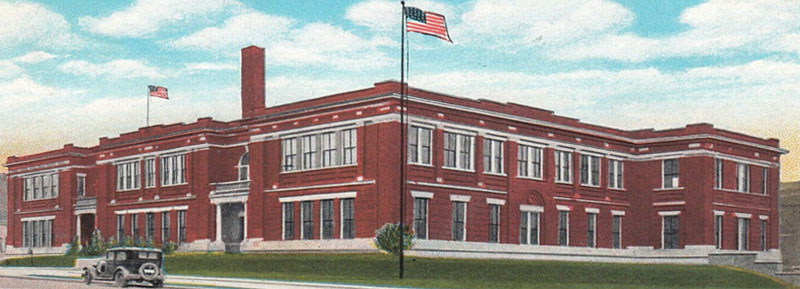
Leavenworth High School, Kansas, 1930s.
In 1855, the Territory of Kansas adopted the school law of the State of Missouri, by which each district was to be controlled by an inspector and three trustees. That year, a small building was erected near the levee for a tin shop. In May, they purchased it for educational and religious purposes. Reverend J.B. McAfee, the Lutheran minister, moved the building to the Southeast corner of Shawnee and Fifth Streets. This small building gave way to a two-story frame structure built for the church, but the city later purchased it for school use. This was the first public school.
The history of the Leavenworth County schools began with the organization of the school board on July 3, 1858, with Nelson McCracken as president. The board rented N.Z. Strong’s house for ten weeks and hired George Wetherill as a teacher. Soon afterward, Miss J. Howard was employed. In August, the school needed more space, and J. Robertson was induced to teach in his own house for $55 per month and $16 rent. George E. Budington was elected the first County Superintendent on December 14, 1858. Before the year’s end, the board divided the city into three districts and opened a school in each.
During the Winter, a bill was passed in the Legislature, creating the Board of Trustees as an independent body of the City Council and providing for a regular City Superintendent of Schools. At this time, the attendance of the three public schools was about 500.
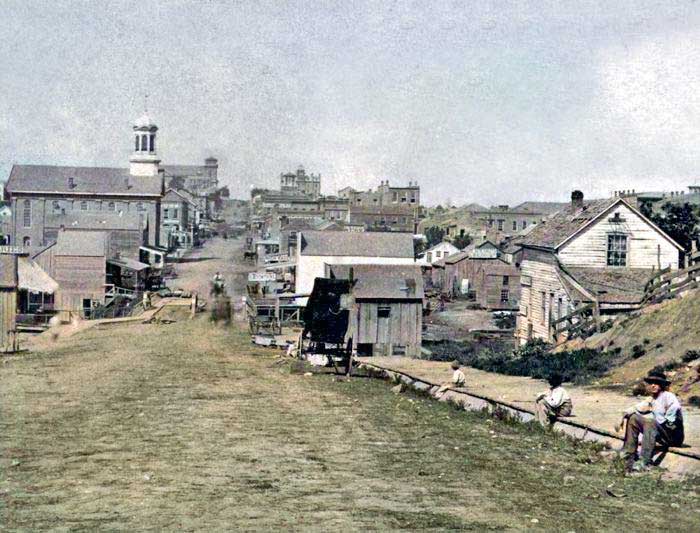
Fifth Street in Leavenworth, Kansas, by Alexander Gardner, 1867.
James Taylor was appointed Superintendent on March 4, 1859. That month, H.D. McCarty, who had been teaching at a private institution for over a year, assumed charge of the Second District School and proposed a graded system, which was adopted. Later, he was elected City Superintendent.
The German-English School Society was organized in 1859 with G.F. Smeltzer as president. The society purchased the Strong building, where it opened a public German school to benefit the city’s significant German element. The school, which taught German and English, was located between Fifth and Sixth Street on the South side of Seneca Street. A few years later, the school sold the property to raise enough money to build two comfortable brick buildings, which became the Third Avenue and Osage schools.
Though progress was being made, the city and county schools were very disorganized until the State system of public instruction was adopted in 1861.
In 1862, while Judge D.J. Brewer, County Superintendent, was in charge of the city schools, Governor Thomas Carney signed the act authorizing $25,000 to erect school buildings in Leavenworth. In pursuance of this act, the first regular public school building was erected—the Osage Street School for $12,000 on Osage Street, between Sixth and Seventh Streets.
In 1865, the board made very material additions to the school property. It leased a block known as the Public Square from the city for 50 years and purchased a two-room frame building thereon. The board purchased a brick church on the corner of Oak and Seventh Streets from the Westminster Society and remodeled it into a comfortable two-room building used for 9 years.
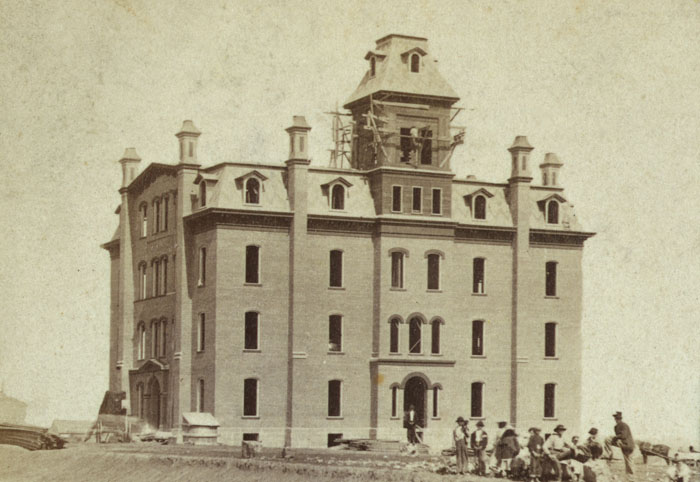
Leavenworth, Kansas School by Alexander Gardner, 1867.
In 1867, the first city school building for African American students was completed in South Leavenworth, on the corner of Fourth Avenue and Prospect Street. Colored schools had been temporarily established as early as 1863 in the Christian and Baptist churches, but the brick building erected in 1867 was the first permanent structure built by the city. In 1868-1869, the colored people of North Leavenworth were accommodated by erecting a second building on the corner of Cheyenne and Fifth Streets.
In July 1868, Dr. Malcolm McVicar became City Superintendent. He was formerly the Principal of the Brockport State Normal School in New York and an experienced educator. His coming signaled a new departure in Leavenworth’s public education system. The board was thoroughly reorganized, the magnificent three-story brick structure at the corner of Walnut and Seventh Streets, called the “Morris School,” was under construction, and everything seemed ready to be shaped into a regular system. McVicar commenced a systematic course of grading in September 1868.
The Morris school building, completed in the public square for $80,000 in early 1869, was in Leavenworth. However, the opposition to Mr. McVicar was so unpleasant that he resigned in March 1869 to take charge of the Potsdam State Normal School, New York. P.J. Williams succeeded him
In response to a general appeal for the founding of additional Normal Schools, the Legislature of 1870 provided for the Leavenworth Normal School. The city furnished the buildings, and the school was organized with John Wherrell as president. In 1874, the school had 100 students. The state provided appropriations for 4 years, totaling $26,900. State funds were discontinued in 1875, and the following year, the Kansas normal schools were consolidated into the Emporia Normal School, which later became Emporia State University. Afterward, the Normal School building became the high school.
The city also boasted the Osage Street School, the North and South Leavenworth Colored Schools, the wooden Shawnee Street School building, and the brick Third Avenue School.
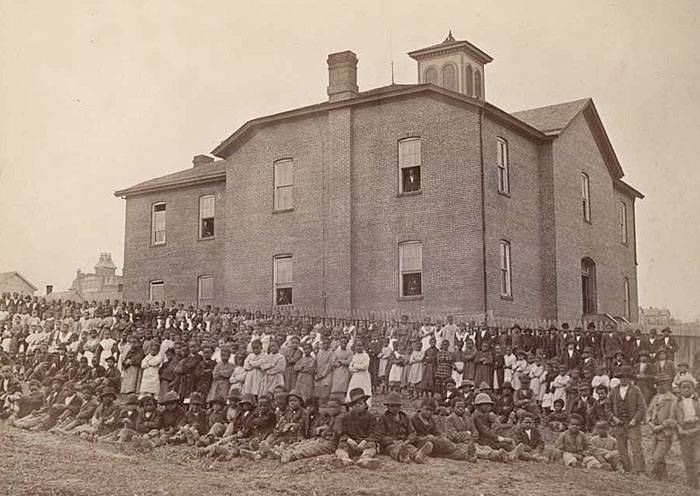
Colored School in Leavenworth, Kansas, 1875.
In 1874, the two-story school building at the corner of Oak and Seventh Streets was torn down, and the Oak Street School building was erected for $27,000 on the adjoining property purchased to enlarge the grounds.
The Kansas Conservatory of Music and Collegiate School, located at 206 Fifth Avenue in Leavenworth, was organized in 1877 under Reverend Robert Brown, Director, and a board of eleven trustees. The conservatory offered a three-year course in music and art with moderate tuition, and its annual list of graduates was quite extensive.
In 1878, the Grand Avenue school site was purchased for $1,000, and a $4,000 brick structure was built on it.
By the early 1880s, the system was divided into the High School, Grammar, and Primary departments. The Grammar Department is divided into three grades, and the Primary into four. During the eleven years that the High School has existed, about 1,200 students have been enrolled. Of the 6,796 children of school age in the city, 3,158 were enrolled in the public schools and 856 in private institutions – a total of 3,914, a little over 50%. School buildings, sites, furniture, and other assets were valued at $177,000. The educational system and public school buildings of 1882, compared with the condition of affairs in 1858, reflected Leavenworth’s growth.
By the early 1880s, Lyman Morgan, superintendent of public instruction, supervised Leavenworth County schools. At that time, there were 78 districts, 84 schools, and as many teachers as there were students. The estimated value of the school buildings was $228,000, most of which were wood, though some were brick and stone. The furniture and apparatus of the different schools were valued at $41,320, making the total valuation $270,000. The average monthly wages paid to male teachers were $46, and to female teachers were $40. The average daily attendance at the district schools outside Leavenworth was 5,000. Receipts for 1881-82 were $58,000, and expenditures were $56,700.
In 1885, the board secured an unfinished church and remodeled it into a new, spacious high school building. It contained a large auditorium, a laboratory, an office, halls, a recitation room, and cloakrooms.
The Leavenworth Business College was established in 1887.
In 1890, Leavenworth’s teaching force consisted of 55 teachers, and salaries totaled $38,637.
Before 1901, Fort Leavenworth’s educational facilities were limited. By an act of the Kansas State Legislature, all military reservations were organized into a school district called District No. 81. The Board of County Commissioners composed the school board, which fell under the jurisdiction of the Leavenworth County Superintendent. The revenue used to defray the school’s expenses was derived from corporate taxes, with the burden falling principally on the railroads and the Leavenworth Water Company. The valuation of all the taxable property was about $500,000. Taxing this amount, along with the State School Fund, provided ample funds for the school. The school had five teachers, including the principal. The government erected a well-equipped school building just East of Pope Hall on the incline overlooking the Missouri River.
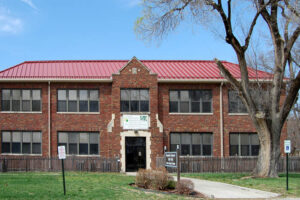
Basehor, Kansas School by Kathy Alexander.
Today, Leavenworth County, Kansas, is divided into six school districts, including:
Basehor-Linwood USD 458 – Located in southern Leavenworth County, the District covers 90 square miles and incorporates the cities of Basehor and Linwood. The District includes the Early Learning Center in Basehor, Basehor Elementary, Glenwood Ridge Elementary School in Basehor, Gray Hawk Elementary School in Basehor, Linwood Elementary School, Basehor Intermediate School, Basehor-Linwood Middle School in Basehor, Basehor-Linwood High School in Basehor, and Basehor-Linwood Virtual School in Basehor.
Easton USD 449 – The district is headquartered in Easton, Kansas, and operates Pleasant Ridge Elementary, Pleasant Ridge Middle School, and Pleasant Ridge High School there.
Fort Leavenworth USD 207 – This public unified school district is headquartered in Fort Leavenworth, Kansas. The district operates Bradley Elementary School (K-6), Eisenhower Elementary School (K-6), MacArthur Elementary School (K-6), and the Patton Jr. High School (7-9). High school students attend Leavenworth High School of Leavenworth USD 453.
Lansing USD 469 – This public unified school district is headquartered in Lansing, Kansas. The district includes the city of Lansing and a small southern section of Leavenworth. The school district operates the Lansing Early Childhood Center (PreK), Lansing Elementary School (K-3), Lansing Intermediate School (4-5), Lansing Middle School (6-8), and Lansing High School (9-12).
Leavenworth USD 453 – Headquartered in Leavenworth, Kansas, this district includes the central portion of Leavenworth city. It operates the Earl Lawson Early Education Center (preK-K), Anthony Elementary School (1-4), David Brewer Elementary School (1-4), Henry Leavenworth Elementary School (1-4), Leavenworth Intermediate School (part of the Warren campus (5-6), Richard W. Warren Middle School (7-8), Leavenworth High School (9-12), and the Nettie Hartnett Education Center (3rd Avenue School, Quest 18-21 Program, Virtual School).
Tonganoxie USD 464 – The district is headquartered in Tonganoxie, Kansas, and operates an elementary, middle, and high school there.
Historic Schools of Leavenworth County
| Name | District | Years of Operation | Location & Information | |
| Easton Grade School | ?? | Leavenworth | 1950 |
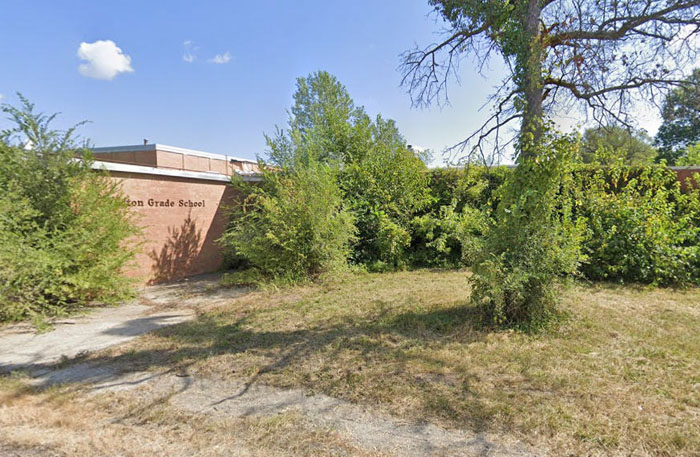 Easton Grade School The old Easton Grade School is a one-story pink brick building with metal trim and an overhang over the West façade. It has glass block windows on the West façade, a concrete addition on the South, and a wood addition on the North. The 1993 flood damaged the foundation, and the school closed. It is privately owned today. Located at 120 N. 1st Street, it is mainly obscured by trees. |
| Honey Valley | 56 | Leavenworth | 1916-?? | As one of four buildings on the Tonganoxie Historical Society site, the Honey Valley schoolhouse was organized on March 25, 1869. It was located about a mile South of Tonganoxie on the Gordon Harmon Farm near County Road 1 and U. S. Highway 24-40. The original building burned down in 1915. The district voted on bonds for $1,200.00 to erect a new school building on June 21, 1916. This building now sits at the Historical Site, where it was moved in 1991. At the one-room schoolhouse, one teacher taught all eight grades. |
| Howard Wilson Elementary | ?? | Leavenworth | 1942-2010 |
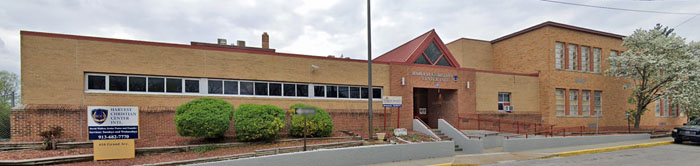 Howard Wilson School The North portion of the blonde-and-red-brick building is two stories, while the newer South portion and East façade are one story. The West addition was added in 1950, and the Northeast addition in 1967. It was named for Howard Wilson, who donated $70k to the school district when he died in 1939. The Kingdom Christian Academy now utilizes the building. It is located at 616 Grand Avenue, Leavenworth, Kansas. |
| Hund | ?? | Leavenworth | 1939-1965 |
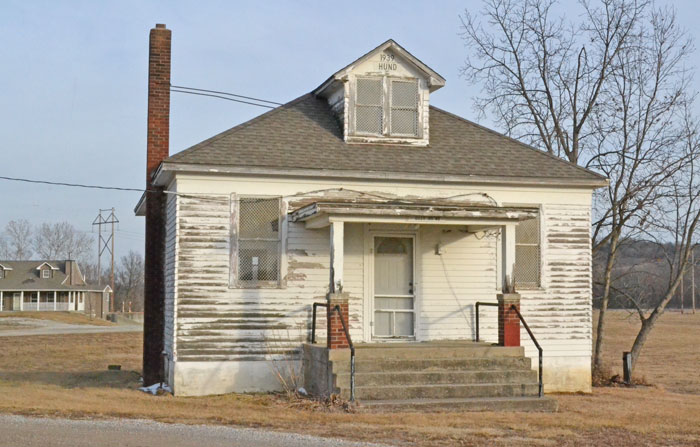 Hund School The Hund School is a historic one-room schoolhouse northwest of Leavenworth, Kansas. The school district built a wood bungalow in 1939 on land Wendelin and Josephine Hund donated to the district in 1882. It replaced a school building that was destroyed in a fire. The school building is typical of other rural schoolhouses built in Kansas. The building has a cloakroom, a classroom with built-in library shelves, and a basement. Outside the schoolhouse is a hand pump for water and an outhouse. The school operated from 1939 to 1965, serving children of German heritage primarily within walking distance. It was listed on the National Register of Historic Places in 2000. |
| Lansing | ?? | Leavenworth | 1919-?? |
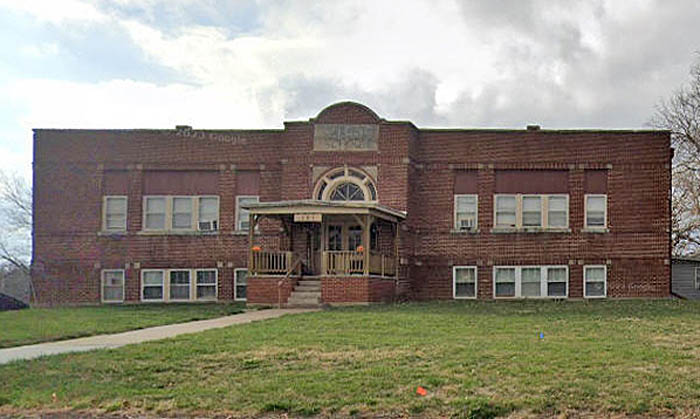 Lansing School This one-and-a-half-story red brick Mission-style building was built for grades one through eight, replacing a former school on this site. The building has been converted to 11 apartments. The front porch is a recent addition. The building measures approximately 80′ wide by 60′ deep. Lansing School is located at 101 North Main Street, Lansing, Kansas. |
| Mayginnes School | ?? | Leavenworth | 1869 |
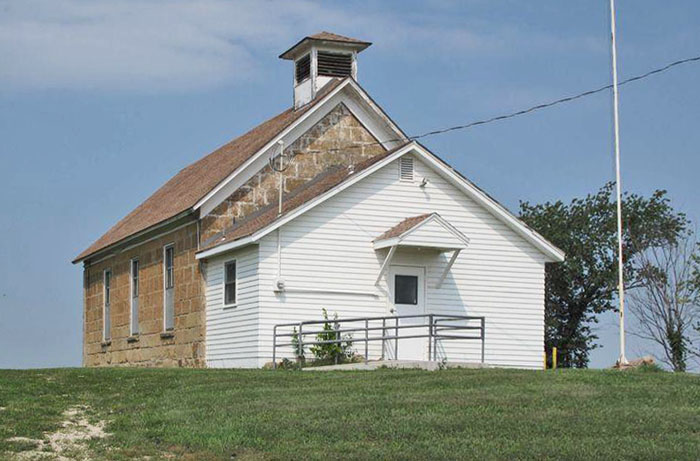 Old Mayginnes School The old Mayginnes School was named for William Mayginnes, who donated the land in 1867 for the school. The school was opened in 1869. Several families have attended for five generations. The one-story, rectangular, Commercial-style building sits on about an acre and was built of limestone and wood. Used as a community building today, it is located at 22017 189th Street, about 6 miles northeast of Tonganoxie, Kansas. |
| North Broadway | ?? | Leavenworth | 1923-1998 |
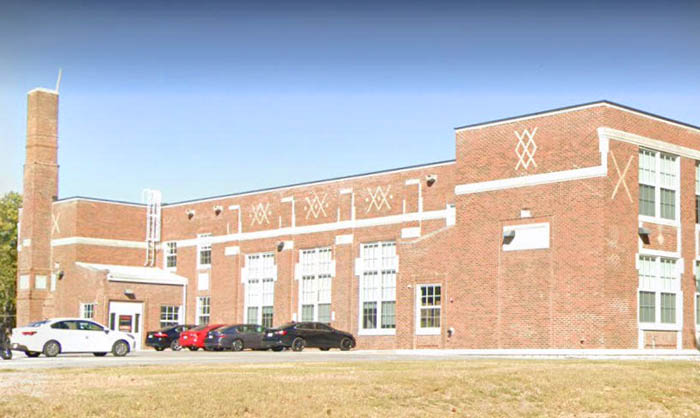 Old North Broadway School Built as an elementary school and closed in 1998. The first day of school at North Broadway School was September 17, 1923; 382 students attended. The school district relocated its elementary classes out of the building in 1999 and then operated several special programs, including an alternative high school, in the building until 2010. It was added to the National Register of Historic Places as part of the Historic Public Schools of Kansas nomination in October 2011. Today, this rectangular, two-story brick Tudor Revival-style building serves as Broadway Lofts. It is located at 801 N. Broadway Street. |
| Oak Street | ?? | Leavenworth | 1874-1924 |
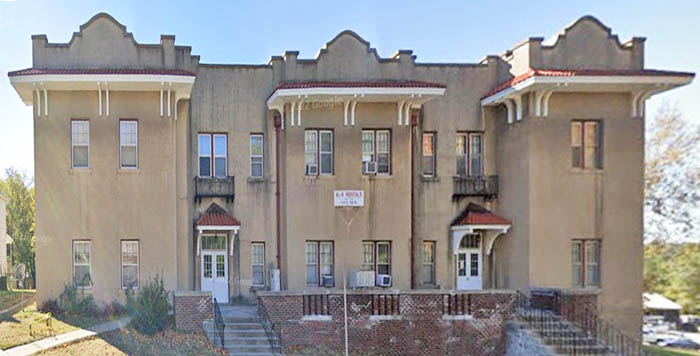 Old Oak Street School The old Oak Street School is a two-story Spanish Eclectic-style stucco building with red tile awnings over the East entrances and under curved parapets. The property was sold in 1927 and was likely converted into apartments then. Called A&K Rentals today; it is at 514 South 7th Street in Leavenworth, Kansas. |
| Schoolhouse #18 | 18 | Near Lawrence | 1879 |
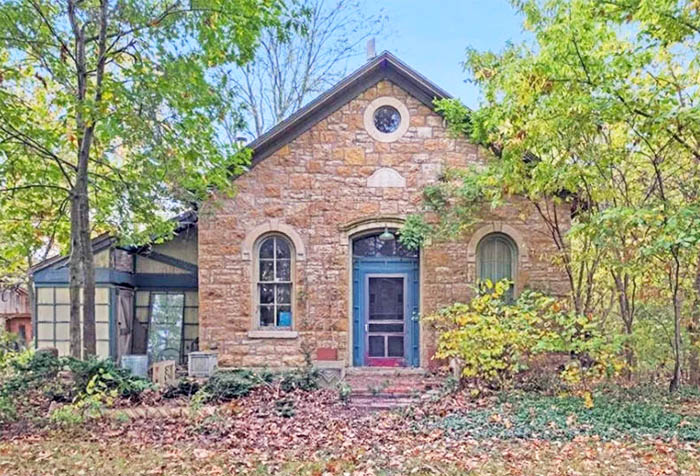 #18 School Built in 1879, this one-room limestone schoolhouse is in Leavenworth County, but has a Lawrence, Kansas mailing address. Today it is a residence. It is located at 25130 Chieftain Road, about four miles northeast of the Lawrence Regional Airport. |
| Sumner Elementary | Leavenworth | 1925-1969 |
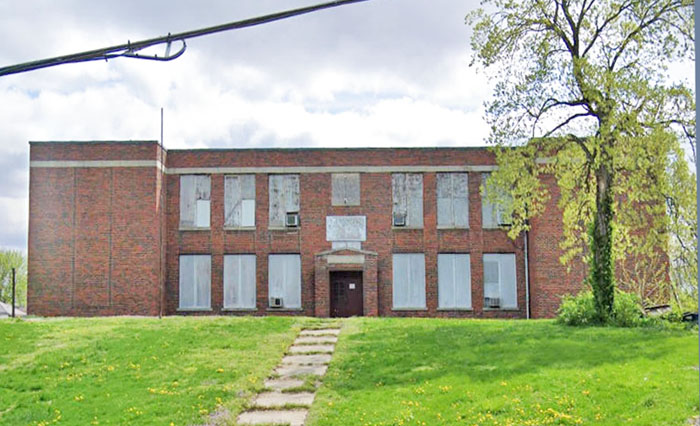 Old Sumner School Sumner School was one of two elementary schools built to serve Leavenworth’s African-American students in the 19th Century. Lincoln School served students living in North Leavenworth, and Sumner served students living in South Leavenworth. The first Sumner School was constructed in 1866 and remodeled in 1899. By 1915, however, the original building could not accommodate its 185 students. School principal Dr. Blanche Bruce oversaw the construction of the new building in 1924 and 1925. In spring 1960, the Abeles and Cleveland Schools closed and were consolidated into Sumner and Anthony Schools. At this time, Sumner housed the 3rd-6th grades. The school closed at the end of the 1968-1969 school year because a structural engineer’s report found it not feasible to improve the building for continued use as a school. During the 1969-1970 school year, the district converted this building into a maintenance facility. Today, it is an activity center for the Pentecostal Church of Apostolic Faith. This rectangular two-story commercial-style building has a flat roof with a parapet. It is located at 1501 5th Avenue in Leavenworth, Kansas. |

Chief Tablet
©Kathy Alexander/Legends of Kansas, updated September 2026.
Also See:
Sources:
Cutler, William G.; History of Kansas; A. T. Andreas, Chicago, IL, 1883.
Historic Public Schools of Kansas
Kansas Historic Resources Inventory
Kansas State Historical Society, The Columbian History of Education in Kansas, Hamilton Printing Company, Topeka, KS, 1893.