
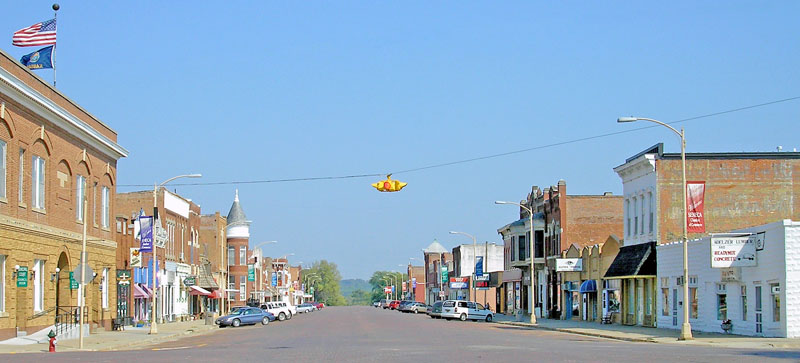
Seneca, Kansas business district, by Kathy Alexander.
Seneca, Kansas, on the Nemaha River, is a city and the county seat of Nemaha County. As of the 2020 census, the city’s population was 2,139, and it had a total area of 1.63 square miles, all land.
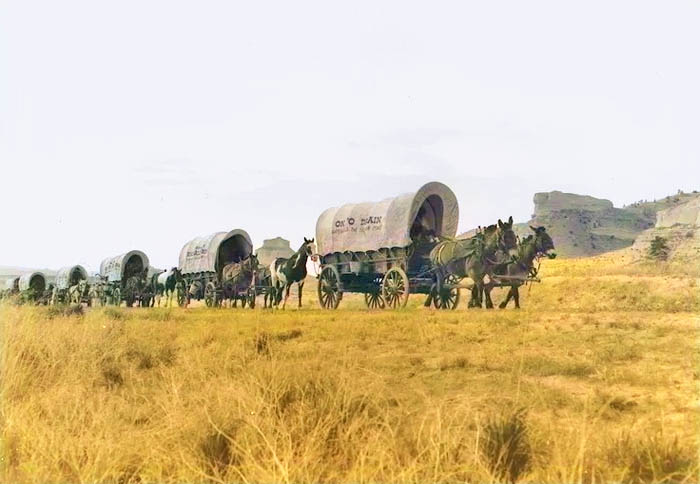
Oregon Trail Crossing Northeast Kansas.
Located along the wagon route from St. Joseph, Missouri, pioneers came through Seneca to connect with the Oregon Trail at Marysville, Kansas. A branch of the California Trail also passed through the area. The Fort Leavenworth-Fort Kearny Military Road took soldiers and supplies through the county as they traveled to Fort Kearney, Nebraska. The Overland Stage Route of the 1850s, Lane’s Trail, brought northerners into Kansas from the East into Nemaha County.
Seneca was founded in 1857 and was named after Seneca County, Ohio. The townsite was located by J.B. Ingersoll, who, in 1857, staked off a claim he called Rock Castle.
A town company was soon organized, with Samuel Lappin, Charles G. Scrafford, Royal U. Torry, and Finley Lappin as members, and the town was immediately platted and named Seneca. The first house, a double-log structure, was built in the fall of the same year by John S. Doyle for Finley Lappin, who started a hotel at one end and rented the other to Downing & Stewart for a grocery store. The hotel end was also used for an office by Samuel Lappin, the register of deeds. A blacksmith shop, consisting of four poles covered with brush and a few boards over the forge, was put up by Levi Hensel, a correspondent of the New York Tribune.
In the summer of 1858, John E. Smith built rooms over the Wilson House, calling it Smith’s Hotel. In 1860, he built it on Main Street and continued as landlord until the fall of 1879, when he leased it to J.Q.A. Jeffreys, who retained it for one year, after which the property was sold to P. Joseph Assemacher. In November 1880, T.B. Collins took possession, and in 1882, P. Joseph Assemacher built a fine brick addition for $3,000, leasing the entire building to Charles E. Wilson, who changed its name from the Collins House, under which it had been run for a time, to the Wilson House. The hotel had 18 rooms for guests.
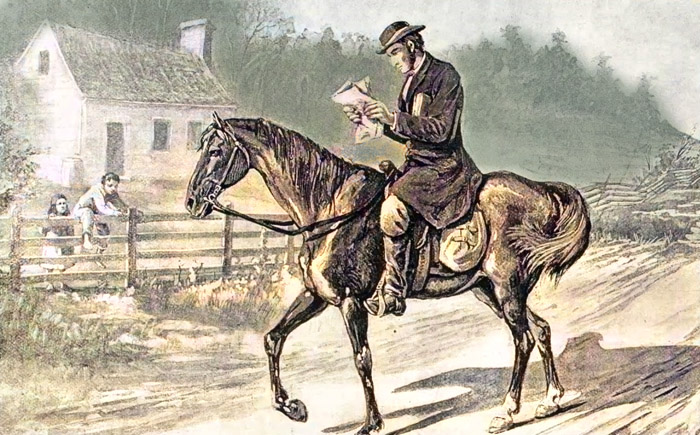
Circuit Preacher.
That year, Reverend Leonard Nichols was appointed to what was then known as the Kansas and Nebraska Circuit of the Methodist Church, with Seneca, or some point in the near vicinity, being one of the places he visited in the line of his regular duty. He served one year.
Seneca Mills, the first mill in the area, purchased its machinery in Massachusetts, brought to St. Louis, Missouri, by rail, from St. Louis to Atchison, Kansas, by river, and drawn by ox teams from Atchison to the site, just southeast of Seneca, in the spring of 1858. Its owner was John E. Smith, who continued to operate it for several years. It was finally sold to Bolivar Scofield, who moved the machinery to Marshall County and resold the mill site to Newton & Lanham.
The first courthouse was built by the Seneca Town Company in Seneca in 1858.
That year, John E. Smith built a hotel and erected a sawmill a mile West from town. An ox team hauled the mill’s machinery from Atchison, Kansas. A log cabin, measuring 10 feet by 12 feet, was erected in the immediate proximity. Miss Addie Smith taught the first school in Smith’s hotel in the fall of 1858.
The first post office in Seneca was established on November 5, 1858. It was kept in the rear part of the present Wilson House, a building which J.E. Smith had erected for hotel purposes in the spring of 1858.
The next building was of concrete, erected by Downing & Stewart. The fourth building of any consequence was a business block erected by the town company.
In 1859, the Methodist Church was also organized, with Reverend Asbury Clark becoming its pastor, in connection with other duties he performed in surrounding towns. For years, the organization used private residences and the schoolhouse for church purposes and, upon its completion in 1869, the Universalist building.
In the fall of 1859, the overland stages began stopping in Seneca and continued to do so for the next eight years. The immigration to the far West was at that time very great, there frequently being as many as 25 passengers at the hotel table, all of whom were charged $1 apiece.
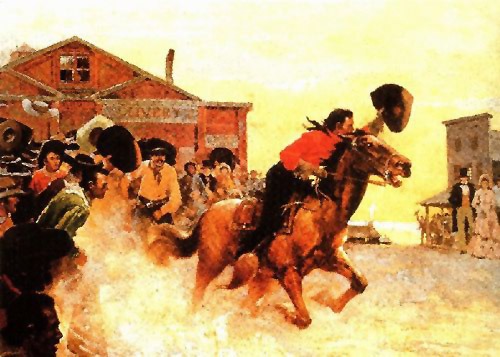
Pony Express.
Seneca was a Pony Express station from St. Joseph, Missouri to San Francisco, California when the service began in 1860. The station was located in the Smith Hotel, at the present-day location of Fourth and Main Streets.
It was also on the Overland Stage route, and remained so until the railroads were built.
The first report of school matters in Nemaha County was made that year by J.C. Hebbard, the County Superintendent, to Samuel W. Greer, the Territorial Superintendent of Public Instruction. It showed that, in Nemaha County at that time, there were 180 people between the ages of 5 and 21 years and six organized school districts, with the same number of schools.
The Union House, a frame building, was erected by Edward Ingram in 1860; a brick addition was added in 1862, and another at the end of the first in 1878. After the owner died in 1875, the Union House passed into the hands of John Shumway, who called it the Sherman House. Its next proprietor was C. R. Fairchild, after whom the house was named. James Martin, who succeeded Fairchild, named it the City Hotel, and no change in the appellation was made by Levi Petty, who was the next proprietor. In 1879, C.E. Wilson became a partner of Petty’s, subsequently buying the entire building, remaining landlord of the hotel until July 1882, when he leased the house to H.G. Stites; under Wilson’s management, it was called the Wilson House, resuming the name of City Hotel when Stites took possession. The house contained 13 rooms.
Another building erected on Main Street was also built by the Town Company and first occupied by James P. Brace. His stock of goods was afterward bought by C.G. Scrafford, who, subsequently taking Samuel Lappin as a partner, built the Central Store on Main Street in 1861.
That year, the county seat was moved to Seneca, and the courthouse burned in December. The second courthouse was a one-story frame structure at Main Street and Castle Street erected by the Seneca Town Company in 1861.
The first Presbyterian Church of Seneca was organized on June 14, 1863. Reverend Nash was sent out by the Board of Missions and ministered to the society for a few months. However, the church soon became disorganized, and its members united themselves with other denominations.
The first newspaper published in Seneca and Nemaha County was the Nemaha Courier, which appeared on November 14, 1863, with John P. Cone as editor and proprietor. It was a six-column folio, Republican in politics. It was published in Lappin & Scrafford’s building on Main Street.
As early as 1864, a teachers’ association was organized, with T.D. Shepherd, President; Abijah Wells, Secretary, and William Histed, Treasurer.
The School Board advertised on April 21, 1864, for proposals to build a one-story brick schoolhouse in Seneca, the contract being let early in May to L.J. McGowen and George Monroe. This building, measuring 24 by 50 feet, was erected for $1,700 and first occupied in the spring of 1865, under the charge of Abijah Wells and Miss Kate Webber.
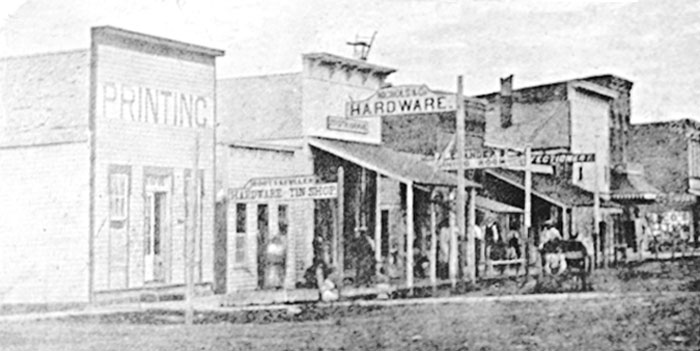
Early day Seneca, Kansas.
In 1864, Newton & Lanham moved a saw and gristmill they had been operating at Central City to Seneca, and in 1865, they installed wool carding machinery, which they operated until 1866. At that time, H.H. Lanham withdrew from the firm, and the property passed to H.M. Newton and J.C. Newton. In January 1867, the Newton Brothers sold the mill to D.A. Starkweather and L. Sheeley, and the machinery was moved away shortly thereafter.
In 1865, Seneca had three general stores, a hardware store, a jewelry store, a grist and saw mill, two hotels, a newspaper, and various other establishments, numbering 56 buildings, business houses, dwellings, a schoolhouse, and public buildings. At that time, it had a population of 301.
The Seneca Regular Baptist Church was organized on April 25, 1866, in the schoolhouse.
The Congregational Church was organized in Seneca on December 2, 1866.
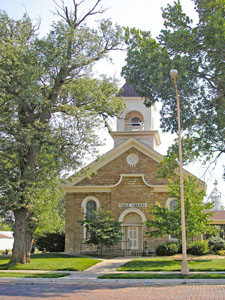
The old stone church in Seneca, Kansas, now holds the library. Photo by Kathy Alexander.
Before 1867, Seneca had no church buildings, and no combined or energetic effort had been made toward the erection of any. On April 30 of that year, a church meeting, in which all the denominations represented in the community took part, was held to consider building a church. A previous canvass had resulted in subscriptions for the purpose amounting to $2,050; it being understood that the building was to be known as the Presbyterian Church, but was to be used in common by all the denominations. At or immediately after this meeting, the Universalists offered to pledge $1,600 additional to the $2,000 already subscribed, if the previous subscription should be transferred to them, and consent given that the name ‘Universalist’ should be substituted for ‘Presbyterian,’ the church to be used by all, but to be the property of the former organization, when instituted. To this proposition, the Presbyterians and others freely consented, and a new subscription paper was drawn in accordance with the above conditions.
On May 2, the Universalists met and organized their society. During the same month, a contract was let for the erection of a church building, and a site was purchased on the south side of Main Street, in an excellent location. On October 20, 1867, the stone work was completed, and on January 1, 1868, the building was occupied for the first time by the Universalist pastor. Soon after, this work was temporarily suspended for lack of funds, the edifice not being altogether finished until nearly 18 months later.
Within a few years, the school building was found to be entirely inadequate to meet the increased demands of the school population. The board, foreseeing this, advertised in April 1868 for bids on a new and much larger building, the contract for which was let to C.G. Scrafford, and the building was completed the following year. The new building was of stone, measuring 45 by 56 feet, and had two stories, with a bell tower and a 66-foot pinnacle above the surface.
The old schoolhouse was sold to the Catholic Society for church purposes.
On March 25, 1869, the name of the Nemaha Courier was changed to that of the Nemaha Kansas Courier.
St. Peter and St. Paul Catholic Church society was instituted that year, principally through the efforts of Mathias Stein, who contributed largely toward the purchase of the district brick schoolhouse in Seneca that same year, costing $1,000 and used for church purposes. The first services in the church were held July 17, 1869, with Reverend G.W. Skinner, of Leavenworth. Afterward, it was also used by the Methodists, Baptists, and Congregationalists. The building was of stone, measuring 39 by 55 feet, 32 feet from foundation to gable, with a belfry 30 feet tall. It was lighted by large windows, and was a commodious and handsome edifice. Its cost was about $7,500.
The second newspaper issued in Seneca was the Mercury, established by the Mercury Printing Company, and first published on September 19, 1869. After a precarious few weeks, it suspended publication.
On November 16, 1869, a preliminary meeting to organize a literary society was held in the schoolhouse, and a week later, the question of whether it should be incorporated was debated and approved. Considerable interest manifested for some weeks, when the society ceased to exist.
The Independent Press was issued under the direction of the Nemaha County Printing Association, with George W. Collins as editor. The first issue appeared on January 1, 1870. Paul Conner assumed editorial control on June 18 of the same year, the paper suspending on December 25. On March 8, 1871, it was revived and published by L.A. Hoffman. In August, its proprietors were L.A. Hoffman & Co., and in January 1872, L.A. Hoffman again became the sole owner. On January 19 of the same year, W.D. Wood purchased the Press, and on March 14, 1873, changed its name to the Nonpareil. It ceased publication on February 6, 1874.
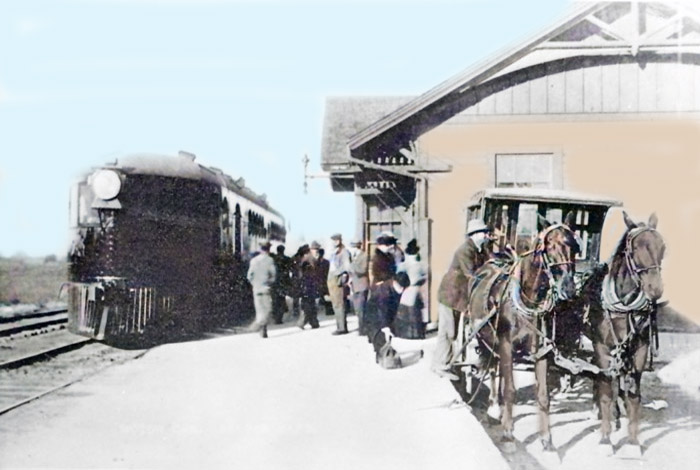
Railroad depot in Seneca, Kansas.
Seneca was incorporated as a third-class city in 1870, and the following trustees were appointed: James P. Taylor, Charles G. Scrafford, J.B. Meyers, Abijah Wells, and John F. McGowan.
Lappin & Scrafford’s private bank was established in 1870, and a substantial and handsome brick building was erected on the North side of Main Street.
The St. Joseph & Grand Island Railroad was being built through Seneca by June of 1870. The city had granted the railroad 100 feet of right-of-way across town and 10 acres of land. After it arrived with a telegraph, immigration flowed in.
The Congregationalist members decided to build a church on June 20, 1870. By Christmas Day, a $4,000 frame building measuring 32 feet by 50 feet had been dedicated in Seneca.
In August of 1870, the last of the city lots owned by the county had been sold, netting the courthouse fund $17,473.83.
In September of 1870, the public school had a primary, intermediate, and high school department. This same month, the Nemaha County Agricultural Society held its third annual exhibition, similar to a county fair, in Seneca.
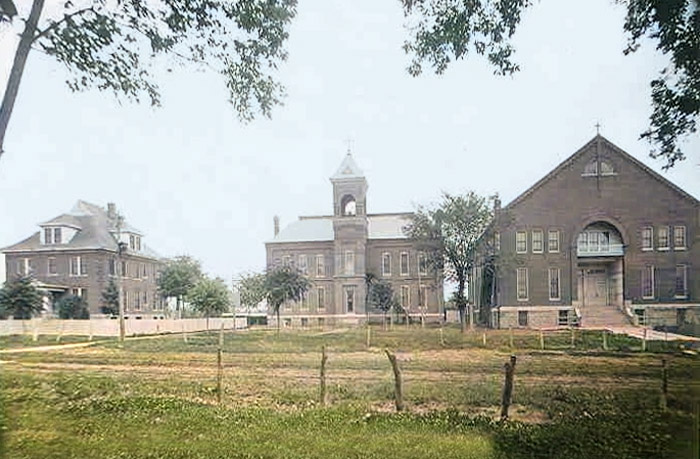
Catholic Convent, School, and auditorium.
By that time, the Catholics, with the help of some of the town’s Protestants, formed the St. Peter and Paul Parochial School, with Daniel Huhn as the first teacher. The school had an average attendance of 25 students in its first term.
The first election was held in 1871 and resulted in the following: W.G. Sargent, mayor; George Graham, J.H. Peckham, John H. Larew, Jacob Meisner, and Mathias Stein, councilmen. Abijah Wells was subsequently appointed probate judge.
Seneca Mills was established in 1871 by Knowles & Son of Galesburg, Illinois, who received substantial financial encouragement from the citizens, notably from the firm of Lappin & Scrafford. The 60-horsepower engine and the machinery were moved from Galesburg to Seneca, and several runs of burrs at once were put in. In the winter of 1881, improved machinery was purchased, and capacity increased to four sets of stones in use. The mill, under the superintendency of J.W. Bergen, did custom work and employed six men.
On February 10, 1871, Frank A. Root and West E. Wilkinson purchased the Nemaha, Kansas Courier, and renamed it the Seneca Courier.
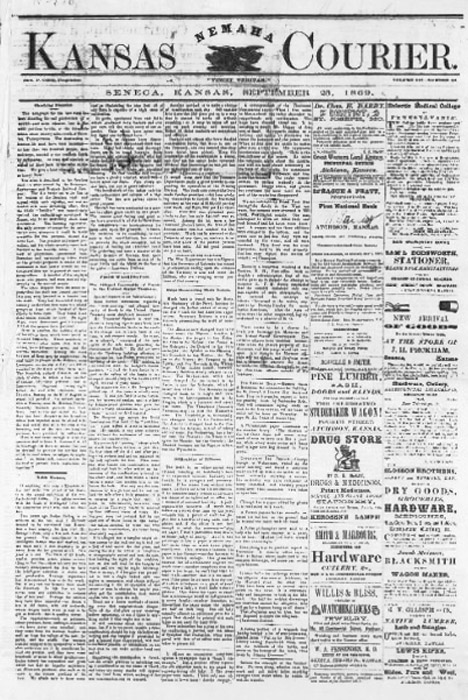
Nemaha Courier newspaper in Seneca, Kansas.
On March 29, 1872, Frank A. Root withdrew from the Nemaha, Kansas Courier, and West E. Wilkinson continued its publication as sole editor and proprietor. After various changes in form, the newspaper became an eight-column folio and was aggressively Republican.
The Seneca House was erected by John Kaune in 1871. It was a substantial frame building, containing 12 rooms.
The Seneca Literary and Library Association was organized on December 12, 1871, with A. Wells, President; W.G. Sargent, Secretary, and Joseph Sharpe, Treasurer. On December 19, a constitution and bylaws were adopted. This organization, and those in legitimate succession to it, lasted for several years; a library was established, consisting of $300 worth of books, along with several donations.
In 1872, the third courthouse, a brick structure, was erected for $29,173. The courthouse burned on March 4, 1876.
After several years of successful business, other capital became interested. In January 1875, the affairs of Lappin & Scrafford’s private bank were wound up, the concern being succeeded by the State Bank of Kansas.
The State Bank of Kansas, succeeding to the business and location of Lappin & Scrafford, was organized with a capital stock of $100,000, and Samuel Lappin, President; Edwin Knowles, Vice-President; and Willis Brown, Cashier. The bank began operations on January 25, 1875. In January 1876, Samuel Lappin and C.G. Scrafford withdrew, and Edwin Knowles was elected President and D.B. McKay, Vice-President.
In 1877, the Methodists erected a handsome edifice in a convenient location and with a seating capacity of 216, for $3,150. This church building was dedicated on June 10, 1877, the Reverend D.J. Holmes officiating.
That year, St. Ann’s school building, in connection with the St. Peter and St. Paul Catholic Church, was erected for $4,000. It was a preparatory school under the charge of the St. Benedictine Sisters. From three to five teachers were employed, and the average attendance was about 50.
The fourth courthouse was constructed by James A McGonagle, of Leavenworth, in 1877 for $20,138.
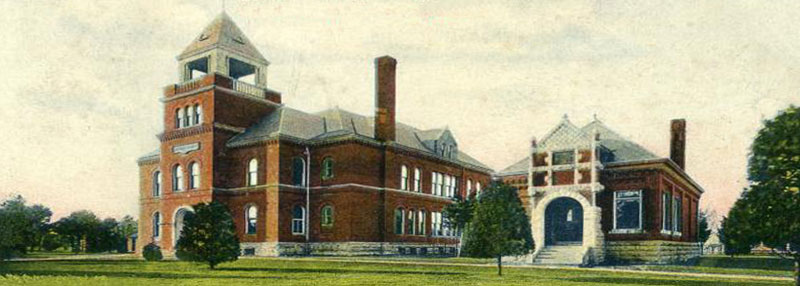
Old Nemaha County Courthouse in Seneca, Kansas.
The Seneca Elevator was established during the winter of 1877 and 1878 by W.W. Stewart, who erected a building adjacent to the railroad that measured 24 by 30 feet, with an attached engine room measuring 12 by 24 feet. All machinery, other than the engine, was in the basement. The elevator’s storage capacity was 6,400 bushels.
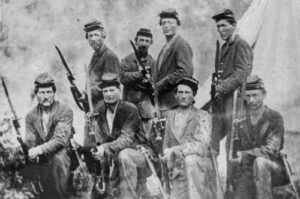
Kansas Militia.
Company D of the First State Kansas Militia was organized in 1878, with commissioned officers: Willis Brown, Captain; Lewis Sheeley, First Lieutenant; Edward Butt, Second Lieutenant. In September of the same year, the State issued arms to the Company, and the company went earnestly to work, adopted a suitable uniform, drilled regularly, and soon showed fine progress in the art of military maneuvers.
On September 28, 1878, a charter was secured for the Seneca Library Association. The library previously referred to was secured, and important additions made; and soon it had nearly 500 well-selected volumes, in all departments of literature.
Keystone Barb Wire Works was established in Seneca in 1879 by O.A. Marvin and W.R. Tyler, who erected a wood-frame building on Main Street and installed five barbing machines and two barb-manufacturing machines. The patent covered a four-pointed barb on a single wire. The establishment’s output was about 1,000 pounds per day.
The Seneca Tribune was started by George W. Wrenn and George W. Clawson on April 16, 1879, as a seven-column folio with Democratic proclivities. On October 2, 1879, the property was transferred to George & Adams, and the publication continued, with H.C. Adams becoming sole proprietor on December 18 of the same year. Under his management, an immigration edition was issued on January 1, 1880, giving a complete and accurate description of the various townships and villages in the county, with their several advantages. On January 8, 1880, Abijah Wells purchased an interest in the paper and became its editor, the firm name being Adams & Wells. Under the new management, the paper assumed a Republican tone. On June 1, 1881, Andrew J. Felt, formerly of Nashua, Iowa, purchased the concern and has since continued to operate it as its sole proprietor. The Tribune is now an eight-column quarto and a success.
The Nemaha County Journal, a monthly publication devoted principally to real estate matters, made its first appearance in August 1879. Its proprietor, J.P. Taylor, continued to issue it for a few months when its light went out.
In November 1879, the ladies of Seneca presented the First State Militia with a fine stand of colors. Willis Brown was promoted to colonel of the regiment, preceding his commission as General of the State Militia. Edward Butt was promoted to captain, and Lewis Sheeley was commissioned as First Lieutenant.
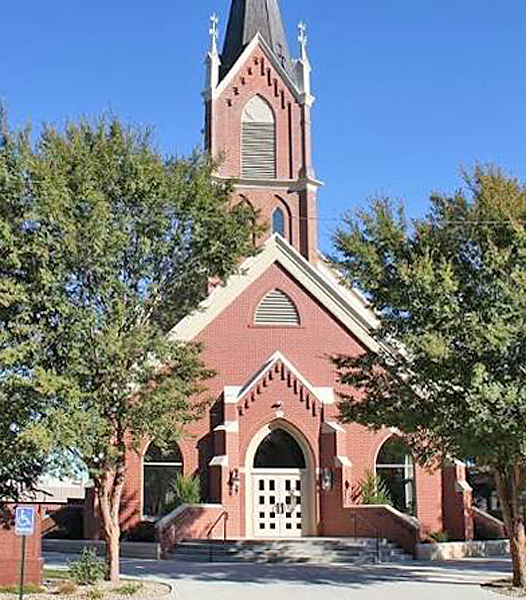
St. Peter and St. Paul Catholic Church in Seneca, Kansas.
In 1880, a large frame addition was built to the St. Peter and St. Paul Catholic Church, before which time a parsonage had been erected.
In 1880, the county had a school population of 4,473, with 86 organized districts and 90 schoolhouses. The schools employed 133 teachers. The total valuation of the school property at this time was $57,904. At that time, the city’s population was 1,203.
In the fall of 1880, a creamery was started on Main Street in Seneca by W.H. Fosmer, who continued as proprietor for some months, the establishment passing into the possession of John A. Gilchrist in the summer of 1881. A building was erected during the same season, about two miles North of the city, and fully fitted up, the creamery being managed according to the Davis & Fairlam system. It had a five-horsepower engine that operated the oscillating churn. Its capacity was 3,000 pounds of butter per day; its usual product was about 1,000 pounds. Its actual cash value was $3,600.
On December 14, 1880, a preliminary meeting to organize a fire department was held in Seneca. On January 11, 1881, this organization was completed, and on March 18, the Council decided to purchase hook-and-ladder trucks, with four Babcock extinguishers; six ladders aggregating 96 feet in length; 10 oak-tanned fire buckets; and other accessories. The fire company, numbering 22 members, was provided with neat and tasteful uniforms, and devoted much time to practice.
The Seneca Foundry was established in 1881, when W.M. Butler and W.F. Troughton entered into a copartnership under the name of Butler & Company. They erected a building on Main Street, measuring 30 by 60 feet, installed a 15-horsepower engine, and began work in November of that year. From five to ten men were employed in general contracting and job work.
The Seneca Light Artillery Company, both a civil and a military organization, was chartered under the laws of Kansas on July 4, 1881. The military company consisted of 20 men. In the fall of 1881, an armory was erected, a two-story frame building, measuring 30 by 50 feet in size, in which meetings were held, and where a six-pound brass cannon, the property of the State, was kept. The members of the company were each provided with two uniforms, fatigue and dress costumes, and as an organization, possessed a fine $50 flag, presented by the city.
In the summer of 1881, the First State Militia disbanded.
The Nemaha County Bank was organized in July 1881 and commenced business on March 1, 1882, with a capital of $50,000. E.J. Emery was President; J.A. Hatch, Vice President; and J.H. Johnston, Cashier.
In the 1880s, Kansas’s population grew, the economy boomed, and Seneca also prospered. In 1883, the town was described:
“Seneca, the county seat of Nemaha County, is favorably situated on high rolling prairie land, surrounded by well cultivated farms and pleasant groves… The city is well built. There are, in Seneca, very many handsome residences… while the business portion of the place is rapidly approaching the appearance of that which belongs to a city.”
By 1890, the town had a well-established central business district, churches, schools, and railroad connections. One observer commented, “the business portion is built up like a city four times its size.” Many businesses in the Main Street district had moved from early wood-frame buildings to more substantial brick ones by that time. One of the brick landmarks was the First National Bank, designed by John G. Haskell, architect of the Kansas capital building, in 1889. Several storefronts on Main Street had cast-iron thresholds and fronts that the Butler Foundry manufactured in Seneca. Most of the business buildings were constructed during this period, and more and more of them were constructed of brick. As an observer commented in 1895, “most of the business houses are large, elegant structures of modern design with plate glass fronts, heated by steam and lighted by electricity, and are built of pressed brick.
A violent F5 tornado struck Seneca, Kansas, on May 17, 1896. The catastrophic, nearly 100-mile-long twister reached up to 2.5 miles wide, leveled significant parts of Seneca, including the opera house, courthouse, and the new school, damaged 50 homes, and destroyed 20 others on the North side of Sabetha, and left several rural farms “as bare as the prairie”. Damage in Seneca alone was estimated at $250,000, with most homes, the fairgrounds, and other small structures sustaining at least heavy damage, if not destruction. It then continued, tearing through the towns of Oneida, Reserve, and Sabetha, Kansas, and into Nebraska, where four people died, and damage occurred on the south side of Falls City. At least 200 people were injured.
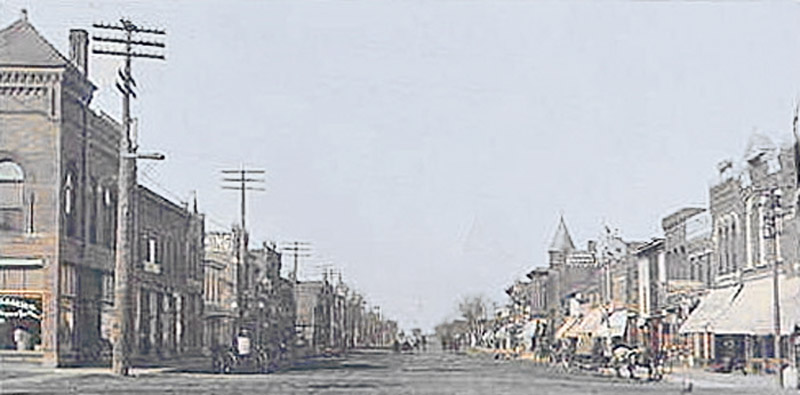
Seneca, Kansas Main Street in 1900.
In 1910, Seneca was on the St. Joseph & Grand Island and the Missouri Pacific Railroads. At that time, it had a brick plant, an iron foundry, a cement block plant, a creamery, four banks, two weekly newspapers called the Tribune and the Courier-Democrat, a high school, a city library, waterworks and electric light plant, express and telegraph offices, an international money order post office with five rural routes, and a population of 1,808.
By 1911, the town had a public waterworks and electric power plant. There was increasing demand for good roads. Cities and towns invested in infrastructure, especially street paving. Brick paving was most effective at curing the ever-present mud, dust, and ruts along Main Street. Easy to lay and long-lasting, vitrified brick streets were used in many Kansas towns as a solution for street paving.
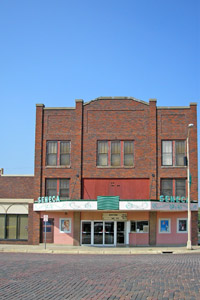
Liberty Theater, Seneca, Kansas by Kathy Alexander.
In 1922, the Williams Tractor Company was a dealer for Dodge Brothers automobiles and trucks. The Jerome Motor Company was a Ford dealer.
By 1924, Seneca had five miles of brick paving. The growth of automobile transportation was reflected in the construction of service buildings on Seneca’s Main Street as garages and auto dealers replaced livery stables.
The Liberty Theater was built in 1927 on the site of a former Opera House that was constructed in the 1890s. Moving pictures were shown at the Opera House as early as 1909. The Liberty Theatre was remodeled around 1951, and the name was changed to the Seneca Theatre. Located at 301 Main Street, it still shows movies today.
During the Great Depression of the 1930s, banks failed, individuals lost their savings and homes, and farmers lost their land. Between 1930 and 1938, scores of Nemaha County farms were sold at auction. To make matters worse, the drought from 1934 to 1937 and a grasshopper infestation brought hard times. Many federal programs were established to reduce unemployment and stimulate the economy. Federal financial aid assisted with the construction of a new Seneca Post Office built on Main Street in 1938-1939. It is listed on the National Register of Historic Places today.
Trends that affected Seneca Main Street after World War II included the shift in population from farms to cities, the development of the federal interstate highway system, and the decline of railroads. During this period, railroad passenger service to Seneca ended, and the passenger depot was demolished.
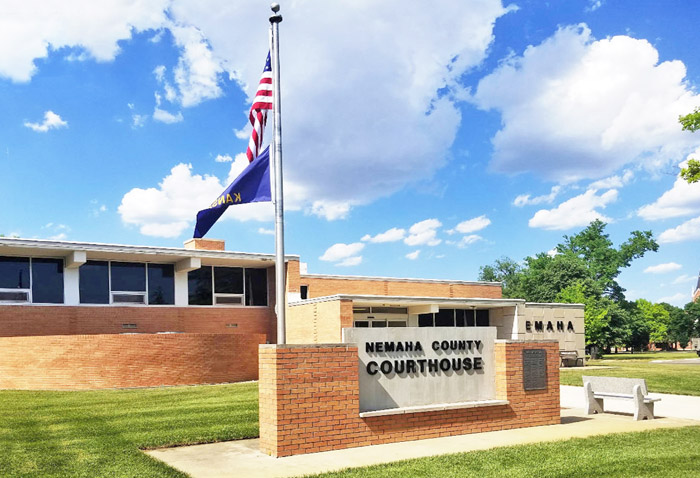
Nemaha County Courthouse in Seneca, Kansas, courtesy of Google Maps.
In the early 1950s, the courthouse was demolished. The fifth and present courthouse was constructed from 1954 to 1955. The Modern-style building was designed by Thomas, Harris, Calvin & Associates and built by the Edmonds Construction Company. The south-facing building is a one- and two-story light red-orange colored brick, glass, and concrete structure. Located on spacious landscaped grounds in the center of Seneca, the entrance is along the East end of the South side. On the East side is a stone-faced section, and behind it is a high brick section where the County District Court courtroom is located. On the West side, the building is two stories, and the roof overhangs. Inside is a high north-south lobby area with stairs ascending and descending on the West side and the large courtroom on the East side. The building houses the County District Court of the 22nd Judicial District, which also includes Brown County, Doniphan County, and Marshall County. To the southeast is the old red-colored brick Sheriff’s Residence and Jail, built in 1879. It is located at 607 Nemaha Street and North 5th Street.
Seneca’s population peaked in 1980 at 2,389.
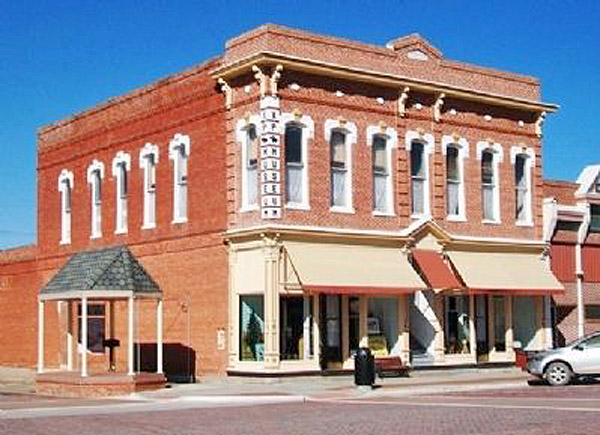
Pony Express Museum in Seneca, Kansas.
The Pony Express Museum was established in 1995. It is located at 4th and Main Street,
Seneca Main Street is still an active business district anchored by public services, including City Hall, the Post Office, the Library, the nearby Nemaha County Courthouse, and medical offices.
Seneca’s Main Street District provides walking tour graphic panels to lead visitors through 13 sites of historic relevance with stories of the Pony Express Riders, the beginnings of the newspaper and telephone company, an award-winning library, the original Nemaha County Jail, and others.
The community is served by the Nemaha Central USD 115 public school district, headquartered in Seneca.
Seneca is located northwest of the county’s center. It is 70 miles northwest of Topeka.
©Kathy Alexander/Legends of Kansas, July 2026.
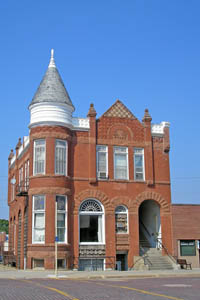
Old bank building in Seneca, Kansas by Kathy Alexander.
Also See:
Extinct Towns of Nemaha County, Kansas
Sources:
American Courthouses
Blackmar, Frank W. Kansas: A Cyclopedia of State History, Vol. I. Standard Publishing Company, Chicago, IL, 1912.
Cutler, William G; History of Kansas; A. T. Andreas, Chicago, IL, 1883.
National Register of Historic Places
Wikipedia – Seneca
Wikipedia – Seneca Tornado