
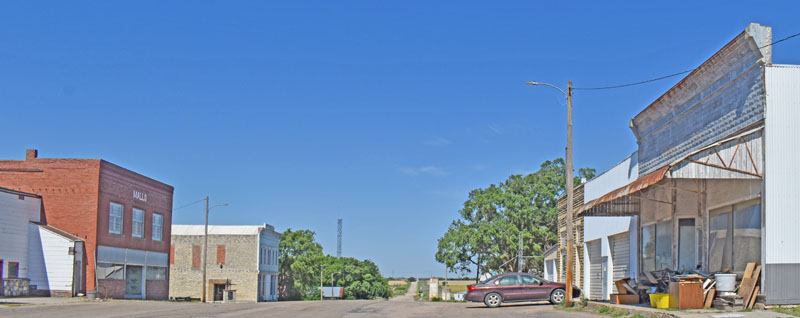
Aurora, Kansas Main Street.
Aurora, Kansas, is a small town in Aurora Township of Cloud County. As of the 2020 census, the city’s population was 56, and it had a total area of 0.10 square miles, all land.
French-Canadian settlers arrived in Aurora Township in 1870, and the early missionary priest, Father Louis Mollier, began offering Mass in residents’ homes in 1873.
In 1875, the first church was erected in the township. The Catholics built it in section three. A few years later, a little burgh was started at this point and called Saint Peter. The assumption was that the railroad entering this part of the county would pass through this point.
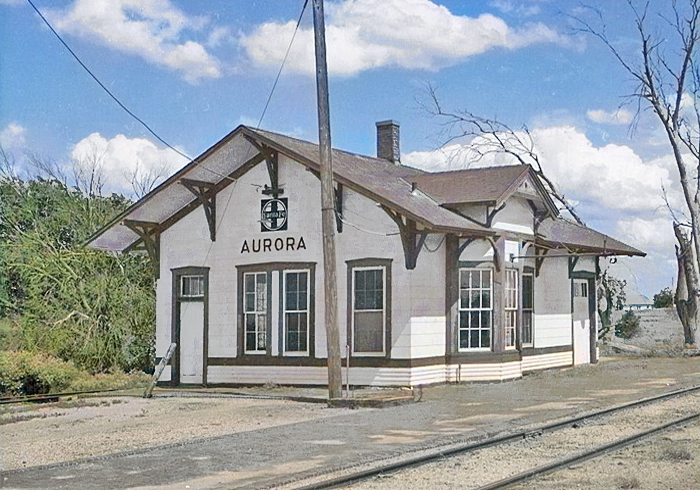
Atchison, Topeka & Santa Fe Railroad depot in Aurora, Kansas.
In 1886, a physician named F.A. McDonald settled in the township and hung out his shingle at Saint Peter. A post office called Saint Peter was established on December 2, 1886.
In 1887, the Atchison, Topeka & Santa Fe Railroad built a branch line from Neva, three miles West of Strong City, through Aurora to Superior, Nebraska.
The town of Aurora sprang into existence in 1888. I. Gennette moved his hardware store from St. Peter, Z. Cyrier came with his dry goods and grocery store. The latter was the first postmaster of Aurora, bringing the post office with him from St. Peter. But his career was short in the new town, for in less than six months, he sold out and moved to his farm. Mr. Gennette operated a hardware store and a feed barn for nearly two years, retired from business, and moved away. At about that time, Dr. F.A. McDonald also moved to Aurora.
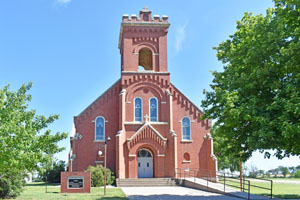
St. Peter’s Catholic Church in Aurora, Kansas by Kathy Alexander.
Saint Peter, located about three miles away, moved the town and the church to Aurora in 1892.
A school was founded in 1904 and staffed by the Sisters of St. Joseph of Concordia.
On December 2, 1906, the post office and the town’s name were changed from Saint Peter to Aurora. The town was named Aurora because the railroad supply camp’s spotlights illuminated the area for miles, resembling the Northern Lights.
Following vespers and benediction on the evening of Easter Sunday in 1909, a tornado struck just as Father Pierre Fortier was walking through the church door. The church was demolished, and Father Fortier reportedly was carried 60 feet by the winds but left unhurt. The priest immediately began work on building a new brick church, which was completed in 1910. Lumber salvaged from the destroyed church was used to build a convent for the sisters. Father Fortier, who was appointed to the parish in 1884, served there until his death at age 60 in 1912.
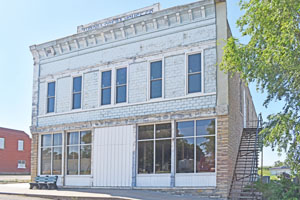
Aurora, Kansas Opera House by Kathy Alexander.
In 1910, Aurora was an incorporated town and still on the Atchison, Topeka & Santa Fe Railroad. At that time, it had a bank, the Catholic Church, some good stores, a money-order post office with two rural routes, telephone, telegraph, and express offices, good schools, and a population of 269.
The town’s population peaked at 275 in 1920.
Aurora’s school closed in 1966.
In 1996, the Atchison, Topeka, & Santa Fe Railroad merged with the Burlington Northern Railroad and was renamed the Burlington Northern and Santa Fe Railroad.
In 2025, Saint Peter Catholic Church celebrated its 150th anniversary.
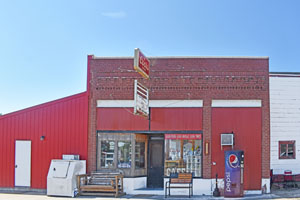
Aurora, Kansas, pub by Kathy Alexander.
Today, the community is served by the Concordia USD 333 public school district.
Aurora is 12 miles southeast of Concordia, the county seat.
©Kathy Alexander/Legends of Kansas, updated July 2026.
Also See:
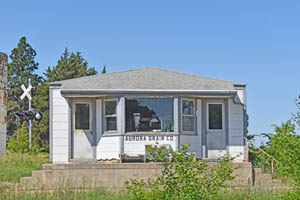
Grain Company in Aurora, Kansas by Kathy Alexander.
Sources:
Blackmar, Frank W.; Kansas: A Cyclopedia of State History, Vol I; Standard Publishing Company, Chicago, IL 1912.
Catholic Diocese of Salina
Hollibaugh, E.F.; Biographical history of Cloud County, Kansas; Creative Media Partners, LLC, 1903.
Wikipedia