
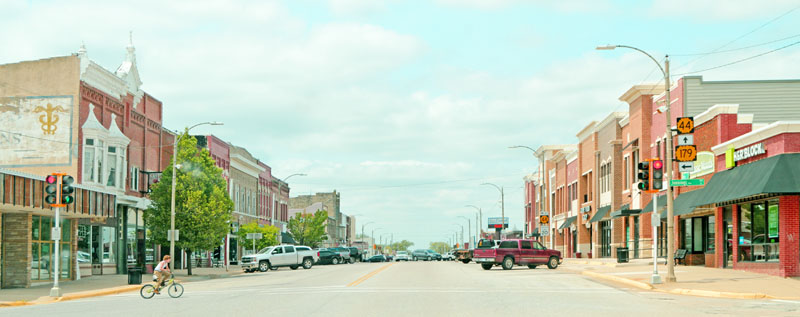
Main Street in Anthony, Kansas, by Kathy Alexander.
Anthony, Kansas, is a city and the county seat of Harper County. As of the 2020 census, the city’s population was 2,108, and its total area was 3.31 square miles, including 3.13 square miles of land and 0.18 square miles of water.
On April 2, 1878, a town company formed in Wichita, Kansas, set out to establish a town near the center of Harper County. They arrived at Harper City and hired B.F. Lee, who would later become the County Surveyor but was then a Harper resident and a member of the town company. Under Lee’s guidance, they reached the site of a lone house that had served as “Bluff City,” the county’s largest settlement at the time.
George P. Morgan, of the firm of Jennings & Morgan, real estate, loan and insurance agents, was a native of Petersburg, Virginia, who came West and settled in Harper County in 1878, forming one of a company organized at Wichita to locate and settle the present county seat of Anthony. He was appointed as one of the commissioners to survey and locate the townsites of Anthony and Harper City. In 1879, he was appointed Deputy County Clerk, serving three years; he served as Township Clerk from the organization of the county until he was elected Trustee in 1882; he was one of the first Councilmen of Anthony and Captain of the Third Independent Cavalry, Frontier Guard; he is now City Clerk of Anthony.
Following Spring Creek, the group traveled several miles northwest of the present town and began marking out streets using a plow to run lines. However, Lee and Dr. H. Owens were not satisfied with this location. They rode to a spot near where Anthony now stands, then returned to lead the party to a camp one mile South of Anthony. There, they found an attractive townsite but soon realized they were on a school section. They moved one mile North, where, on April 6, 1878, they officially established the town in its present location. They named it after Kansas’s 7th governor, George T. Anthony, who was in office then.
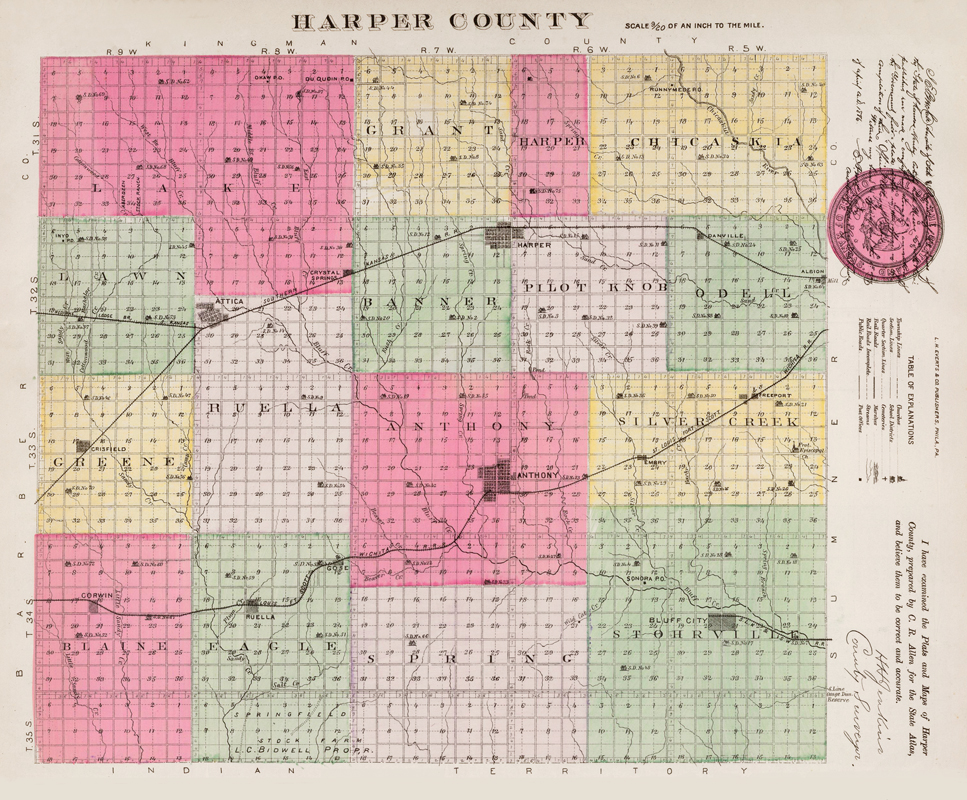
Harper County, Kansas Map by L.H. Everts & Co., 1887.
The townsite covered 320 acres, with a town company led by O. Jennings as President, St. Clair Gray as Secretary, and B.H. Stedman as Treasurer. They entered the land for pre-emption as a townsite and successfully proved ownership on June 10, 1878, through Judge E. Evans of Sumner County. The town company’s first actions included constructing a barracks measuring 18 by 30 feet to accommodate emigrants, as well as digging three public wells. Soon after, about a dozen box houses were built, and B.F. Lee moved to the area from Harper with a house already framed for assembly.
The Anthony Post Office began on June 14, 1878, with G.W. Maffett appointed Postmaster. A stage ran from Wichita to Anthony once per week. Later, the stagecoach ran daily; when the railway reached Harper, a short line was put on from that point, and the Wichita line was discontinued. Another line ran daily between Anthony and Caldwell.
Cornell & Wright built the first sizable store, stocked with general merchandise. F.M. Hester opened the first hardware store, while C.A. Miller established the first drug store. H.H. Kirkpatrick served as the first physician, and his brother, W.R. Kirkpatrick, became the first attorney in the town.
R.J. Simpson, of Ohio, came to Harper County with his family and first settled a 160-acre grain farm. He was elected Register of Deeds in 1878, came to Anthony, and took charge of the office. After serving in that capacity for three years, he opened a real estate, loan, and insurance agency. He joined the Anthony Town Company and soon owned 1,280 acres of land in Harper County.
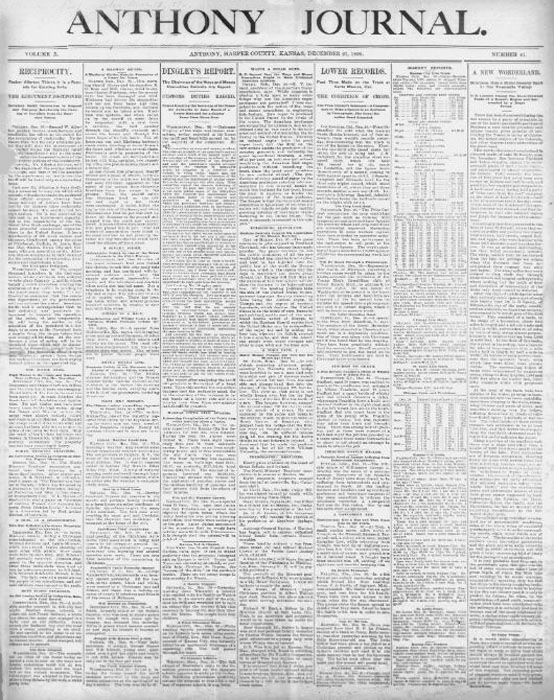
Anthony Journal Newspaper.
The Journal newspaper was first issued on August 22, 1878, as a five-column folio, and bore the name of J.S. Soule as editor and proprietor. On May 22, 1879, the newspaper passed to C.W. Greene, who ran it until April 8, 1881, when it was temporarily suspended. In the meantime, several changes were made: the paper was enlarged on August 15, 1879, to a six-column, and May 7, 1880, to a seven-column folio. In this latter shape, Fletcher Meredith resurrected it on October 27, 1881. On August 31, 1882, it became a six-column quarto, and on March 1, 1883, B.F. Widner leased the office for one year. The paper had a circulation of 350 and a good advertising patronage.
Reverend W.H. Mock formed the Methodist Episcopal Church in the fall of 1878, with nine members.
After Harper County reorganized that year, following its original fraudulent organization in 1873, Anthony became the temporary county seat because Bluff City, the county seat of the fraudulent organization, did not yet exist. In 1879, a county seat election was held, and Anthony won over Harper City even though 2,960 ballots were cast with 800 legal voters in the county.
A.H. Davis, a Missouri native and dealer in general hardware, saddlery, and harness, came to Anthony with his family in 1878 and located a 160-acre claim adjoining the city. He briefly ran a livery stable, then opened his hardware business. He also owned a blacksmith shop and tools. He was elected County Commissioner in 1880 and served on the City Council.
T.H. Stevens, a farmer, merchant, and stock-raiser from Knightstown, Indiana, came to Harper County with his family in 1878 and settled on a 160-acre farm, which he improved. That year, he also opened a lumber yard and began contracting and building, constructing three-fourths of Anthony. He also built the first brick kiln, opened the first general supply store, and hauled the first load of goods to Anthony. In 1881, he entered the stock business, bought and drove, and grazed 600 head in the territory. He was appointed County Commissioner in 1878 and was re-elected in 1879 and 1882; he was elected Chairman of the Board of Commissioners in 1878.
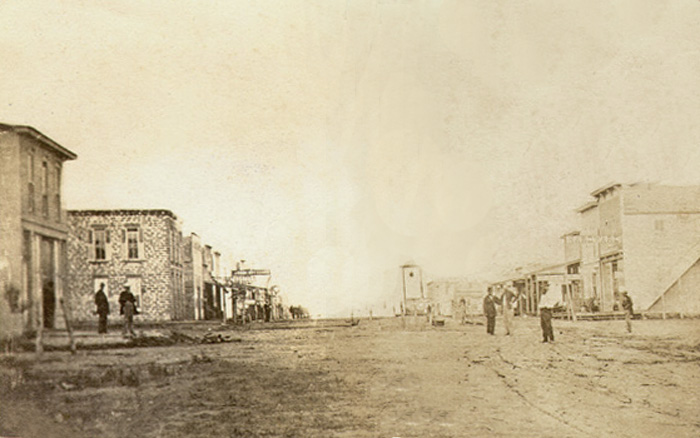
Anthony, Kansas, in 1879.
In early 1879, a petition to incorporate Anthony as a third-class city was created and presented to the Governor. The petition outlined the town’s location and confirmed a legitimate population of 275 residents. The petition was approved, and an election was scheduled for July 18, 1879. During this election, Henry Holmes was elected as Mayor, Jackson Brock as Police Judge, and Jacob Hummel, G.W. Vickers, George P. Morgan, Simpson Van Winkle, and David Hinsey as Councilmen. F.N. Hester was appointed City Clerk.
School District No. 1, which includes the city of Anthony, was formed in 1879, and the public school system began on May 5 with Clara Sherwood and Sarah Bidwell as teachers. On September 29, C.M. Cade and Mary Patton took charge of the school. The district completed a school building in July 1879 for $1,300. In the summer of 1882, the district added two large wings to the school for $1,000. The district secured funds for both outlays by issuing bonds and selling them to the Secretary of State at par.
The first bank established at Anthony began in July 1879 with P. Anderson, who started business in a small frame structure. They began a stone building at once and completed it for $2,500. The bank had $20,000 in capital.
W.S. Cade, an Ohio native, became a teacher and studied law. He came to Anthony in 1879 and began practicing law. In 1880, he was elected to the City Council, where he served two years; in 1882, he was elected Police Judge for a short time, and in the fall of the same year, he was elected Probate Judge.
O.F. Casteen, of the firm of Casteen & McDaniel, general merchants, was born in Versailles, Illinois, and was reared in the mercantile line. He came to Anthony with his family in 1879, and established another business. In August, 1882, he took Mr. McDaniel in as a partner. In August, 1880, they entered the cattle business and drove about 300 head from Texas. Before long, Casteen had a six-mile square ranch and 1,200 head of cattle. In 1879 and 1880, he improved a 160-acre farm. He served as township treasurer, City Treasurer, and School Treasurer.
The first regular church society in Anthony was the Congregational Church, organized in 1879 with 19 members. Reverend Mr. Hobbs was its first pastor. The first services were held in the old courthouse; then it moved to the schoolhouse, and later to the church building. The Congregational Church building was built in 1880 for $1,700 and has 250 seats. The Union Sabbath School, started in 1878, has always been connected with this church and, in 1882, averaged 120 attendees. A partition was made on January 1, 1883, when they had about 70 students.
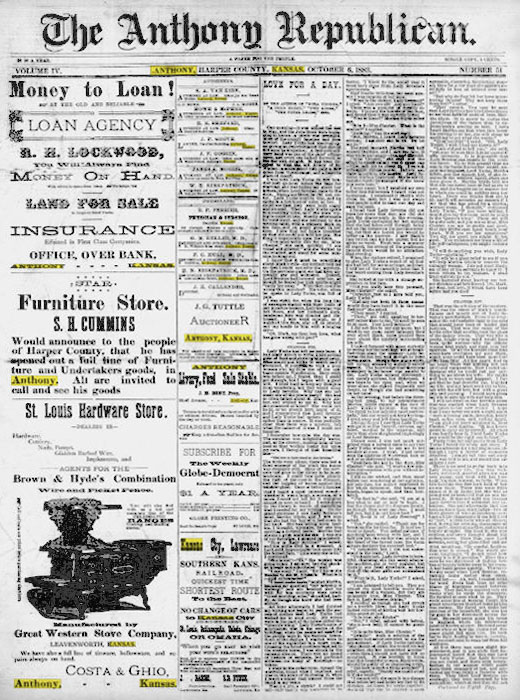
Republican Newspaper in Anthony, Kansas.
Moffett & Metcalf started the Anthony Republican on October 19, 1879. It first appeared as a six-column folio. This changed on January 8, 1880, to a seven-column, and on December 23, 1882, to a six-column quarto. Metcalf’s name disappears February 26, 1880, and George W. Moffett’s stands alone until May 27 of the same year, when A.S. Lindsay became a partner in the business, which, August 5 of the same year, passed into his sole possession. The paper is Republican, is issued Saturdays, and has a circulation of 450.
Since Brock did not meet the qualifications for his position, R. H. Lockwood was appointed as Police Judge on November 10, 1879, and G.W. Moffett was named City Clerk. On February 9, 1880, J. Brock was once again appointed as Police Judge.
The new town grew rapidly and by 1880 had a population of 500.
The Christian Church was organized in 1880, with 18 members. Reverends Embry, Collins, and Culverson have served it, but it is at present without a pastor. Its membership is about 25, but about 40 of this persuasion live in the immediate neighborhood and would join the church if it held regular services. The early services were held in the schoolhouse, but later in a building Mrs. Davis donated to the society.
S.A. Van Kirk, County Superintendent of Schools, was born in Pennsylvania, grew up there, and then began teaching and studying law. In 1877, he came to Kansas and was admitted to the bar in 1880. That year, he came to Anthony and opened his law office. He was elected County Superintendent of Schools in 1882 and had previously served as Deputy Treasurer for nine months. He helped organize the Teachers’ Association and served as its chairman. He improved a 160-acre farm, on which he built a good residence, and runs it as a stock and grain farm. He served briefly as local editor of the Anthony Journal.
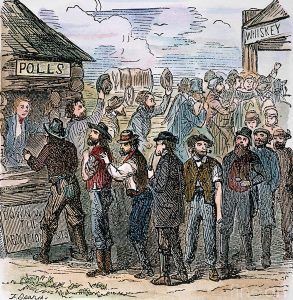
Voting in Kansas.
On April 5, 1880, the first regular election took place, but the voting was reported to be fraudulent. As a result, at its April 7 meeting, the Council declined to canvass the votes. This led to two sets of officers and two Councils claiming to be legally elected. On April 29, Acting Mayor Vickers and the Council met in response to a mandamus issued by the Supreme Court and counted the ballots cast on the 5th. Their tally revealed that Jackson Brock had been elected Mayor and W.S. Cade had been elected Police Judge. These officers took their positions, and George Vickers was appointed City Clerk.
From then on, a direct conflict ensued. On July 5, Vickers was removed from his position, and A.S. Lindsay was appointed as City Clerk. However, those who were out of power ultimately gained the upper hand in the struggle. On July 22, an entry indicated that H.N. Kirkpatrick had been elected Mayor on April 5 and L.S. Webb had been elected Police Judge. These officials secured their positions and appointed G.W. Bennett as City Clerk.
John D. Brown, born in England, moved his family to Anthony and began operating as a dealer in real estate, loans, and insurance. He was appointed City Treasurer in 1880; was elected Justice of the Peace in 1881, and was twice elected Police Judge of Anthony. He later served as Secretary of the Harper County Agricultural Society. He owned 2,000 acres of land in Harper County, partly improved, and had about $5,000 in notes and securities.
On January 10, 1881, the city of Anthony held an election to issue 12 bonds, each valued at $250. These bonds were set to run for ten years and bear 10% interest. The proceeds from the sale of these bonds were intended for constructing a town hall and jail. The bonds were successfully carried and sold to S.L. Davidson for $2,880.
Work on the courthouse commenced immediately, and on May 31 of the same year, the city of Anthony donated the city hall to the county for the nominal fee of $1. This donation included a stipulation that if the county eventually ceased using the building for courthouse purposes, it would revert to the city. Additionally, the city allocated $3,000 to ensure that the building was neat and habitable.
Holdridge, Connelly & Co. built the Globe Mills in 1880-81 and put them in operation on February 22 of the latter year. The mill building was of brown sandstone, measuring 38 by 40 feet, and had three stories and a basement. It had five runs of buhr-stones, one set of rolls, and a 70-horsepower engine. The mills had a capacity of 150 barrels of flour per day, and their total cost was a little over $25,000. They had a large trade with points in Oklahoma, as well as with surrounding towns.
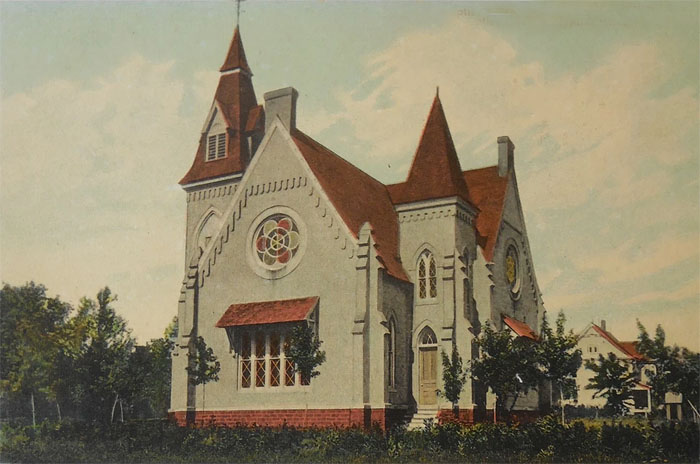
Baptist Church in Anthony, Kansas.
The Baptist Church was organized June 26, 1881, with 17 members. Early services were held in the schoolhouse, then in a rented store room in town, and later in the courthouse.
In the fall of 1882, work began on a church for the Methodist Episcopal Church, which was completed in 1883 and dedicated on January 28, for $2,500. J.W. Anderson was the church’s first regular pastor.
The rush to Oklahoma on April 22, 1889, took away about one-half the population, and another migration occurred some years later.
Anthony faced a debt crisis during the railway boom of the mid-to-late 1800s after issuing railroad bonds it could not afford. The town’s value plummeted from $512,000 in 1889 to $171,000 in 1898, and its population halved. Meanwhile, its debt grew significantly, increasing from $17,434,347 to $36,805,599. In 1897, the town declared bankruptcy and repudiated $32.4 million in bond debt.
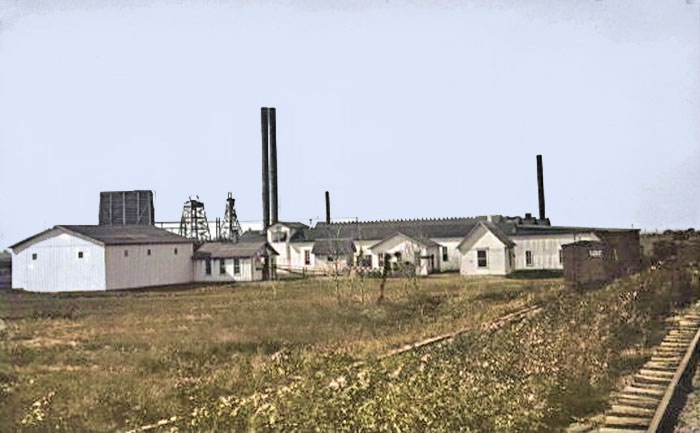
Salt and ice plant in Anthony, Kansas.
The Anthony Salt Company was organized in 1889. Underneath the city lay a vein of fine salt, 400 feet thick, which they developed, and the salt plant soon produced about 50,000 barrels annually.
By 1891, Anthony was at the intersection of the St. Louis & San Francisco Railroad and the Missouri Pacific Railroad.
By the early 20th Century, production at the salt plants in Anthony and neighboring Sterling had slowed significantly as larger consolidated salt mining operations took over the state’s market.
At that time, the city had a glove factory, a well-equipped municipal waterworks system, natural gas for fuel and light, an electric lighting plant, a fire department, large grain elevators, flour mills, two newspapers, a Carnegie library, and a good public school system. The city had ample banking facilities and sat at the junction of the Atchison, Topeka & Santa Fe Railroad, the Chicago, Rock Island & Pacific Railroad, the Kansas City, Mexico & Orient, the Kansas Southwestern Railway, and the Missouri Pacific Railroad, with unsurpassed transportation facilities. As a result, it became a prominent shipping and distribution point, exporting grain, livestock, salt, and products from its manufacturing establishments. The Anthony Commercial Club was organized on January 1, 1909, and under its auspices a building and loan association was organized to help people become homeowners. All the leading express companies had offices, and the telegraph and telephone service was better than that often found in cities of similar size.
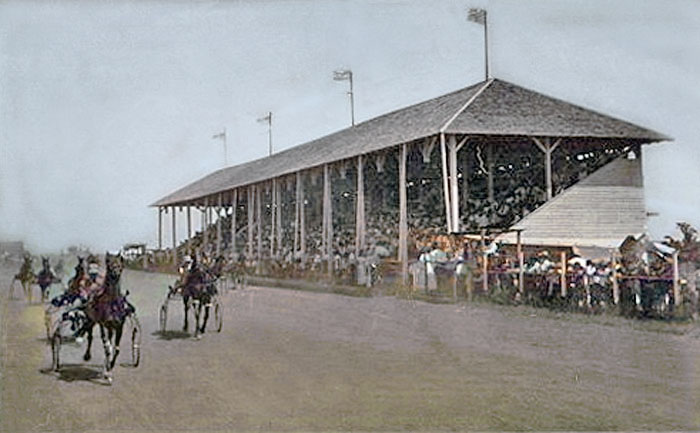
Anthony Downs.
Anthony Downs, a horse and Greyhound racing track, opened for its first season of racing in 1904. Racing was held annually on two weekends, offering a mixed program. In the early days, there was no Tote, although illegal side wagers were common.
A new Harper County Courthouse was constructed in 1908 and dubbed “Pride of Harper County.” Architect George P. Washburn designed the red brick and limestone building. The three-story building had an attic and a full basement. Cornerstone ceremonies were held on January 29, 1908, conducted by the Officers of the Kansas Masonic Grand Lodge. The total cost of the building, including electric wiring, fixtures, heating and plumbing, wood furniture, steel vault furniture, plans, and supervision, was $76,560.98. The courthouse was dedicated on November 10, 1908. It was listed on the National Register of Historic Places in August 1978.
The people of Anthony were progressive in their ideas, as shown by the adoption of a commission form of government in February 1909.
In 1910, Anthony was the largest city of Harper County, sitting slightly Southeast of the county’s geographic center in the Bluff Creek Valley, a fine agricultural district.
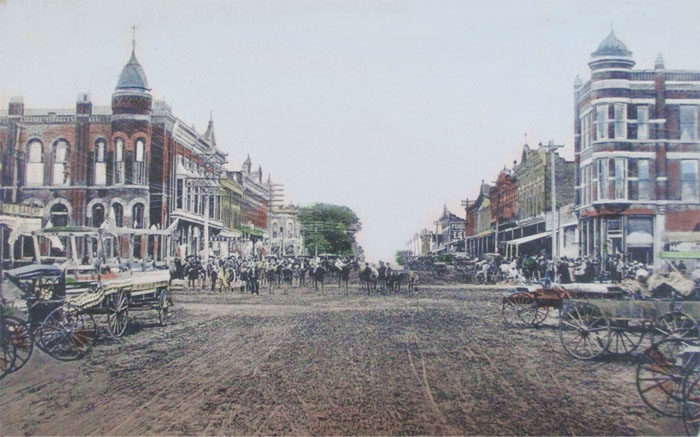
Anthony, Kansas, in 1910.
Anthony’s population peaked at 2,947 in 1930. In the next decades, its population gradually declined.
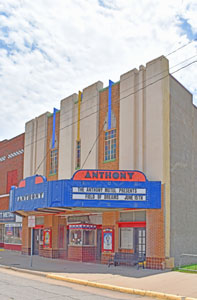
Theater in Anthony, Kansas by Kathy Alexander.
The Anthony Theater, located at 220 W. Main St. in Anthony, Kansas, is an Art Deco-style theater built in 1936. Designed by Architect S.S. Voigt, it is a two-story building of white concrete, buff brick, and copper-brown tiles. It measures 40 by 140 feet. The Anthony Theater opened on November 23, 1936, with Joan Crawford & Clark Gable in “Love on the Run“. The National Register of Historic Places added this Art Deco-style theater on April 18, 1991. In 2009, the Anthony Theater closed for renovation. It reopened in August 2017 and began hosting movies, community theatre, and live music events.
Pari-mutuel arrived in 1992 after the State of Kansas relaxed its gambling laws. Profits from the Tote supported racing not only at Anthony Downs, but also at Eureka Downs and Rooks County racetracks.
After the Wichita Greyhound Park closed in 2007 and The Woodlands racetrack closed in 2008, the Horse Racing Benefit Fund quickly depleted; the subsidy to Anthony Downs ended, and the track closed in 2009.
The track closed its doors for the final time in 2012, and the district held an auction that year. Afterward, the district demolished the facility to make way for a housing development.
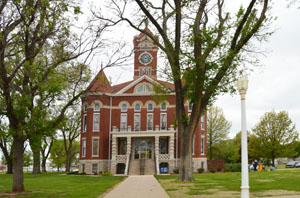
Harper County Courthouse in Anthony, Kansas, by Kathy Alexander.
Today, Chaparral USD serves the community. USD 361 was created through school unification, consolidating Anthony and Harper schools. The unified school district is headquartered in Anthony, Kansas. It includes Anthony, Harper, Bluff City, Danville, Waldron, Crystal Springs, Duquoin, Freeport, Runnymede, and nearby rural areas. It operates the following schools:
- Chaparral Jr/Sr High, located between Anthony and Harper
- Anthony Elementary, located in Anthony
- Harper Elementary, located in Harper
Anthony, Kansas, is located 60 miles Southwest of Wichita. With a large trade territory, Anthony is noted for its progressive businesses, excellent schools, and varied community services. Anthony’s city government operates under a Mayor-Commission charter and provides an excellent volunteer fire department.
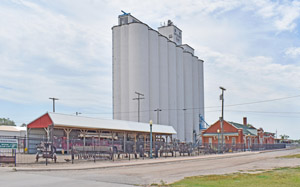
Depot Museum in Anthony, Kansas.
©Kathy Alexander/Legends of Kansas, updated June 2026.
Also See:
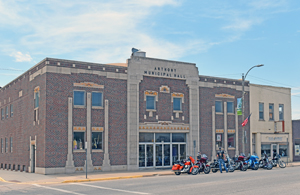
Municipal Hall in Anthony, Kansas by Kathy Alexander.
Sources:
City of Anthony
Blackmar, Frank W.; Kansas: A Cyclopedia of State History, Vol I; Standard Publishing Company, Chicago, IL 1912.
Cutler, William G.; History of Kansas; A.T. Andreas, Chicago, IL, 1883.
Greyhounder
Travel Kansas
Wikipedia
Wikipedia – Anthony Downs