
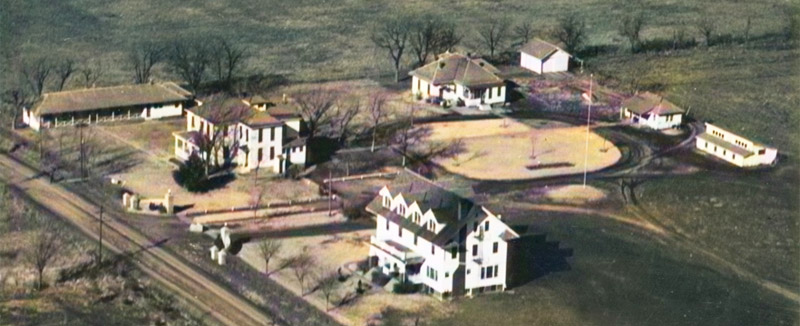
American Indian Institute in Wichita, Kansas.
The American Indian Institute, in Wichita, Kansas, was a Federal Native American Boarding School from 1915 to 1935.
Dr. Henry Roe Cloud established the school to integrate traditional Native American knowledge and practices within a Euro-American educational framework. He also aimed to promote higher education and Christian leadership among Native American youth.
In the early 1900s, the Bureau of Indian Affairs did not offer schooling for Native American students beyond the eighth grade.
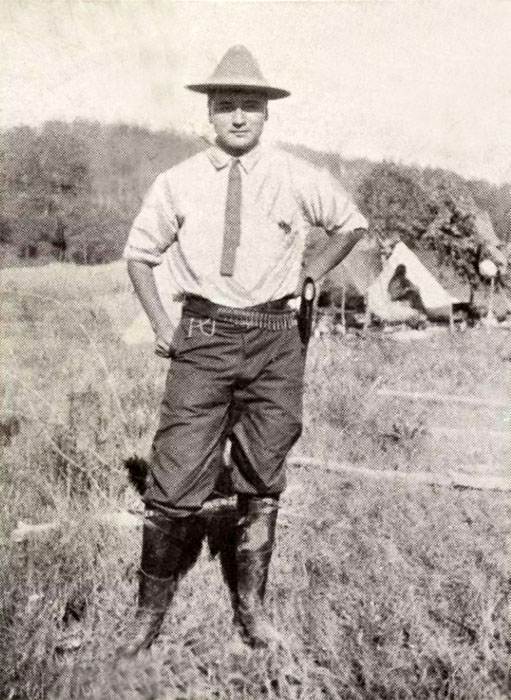
Reverend Henry Roe Cloud.
An educator and minister from the Ho-Chunk (Winnebago) tribe of Nebraska, Cloud attended schools on and off the reservations. He was orphaned at the age of 13. His intellectual ambition, academic performance, and personal qualities brought him to the private Mount Hermon Preparatory School (now Northfield Mount Hermon School) in Massachusetts in 1901. He financed his education through the school’s work-study program and was introduced to elite social circles. He graduated as a salutatorian in 1906, and the school served as his conduit into the Ivy League. Afterward, Cloud was the first Native American to earn undergraduate and graduate degrees from Yale University. He graduated from Yale in 1910. While in college, he befriended a missionary couple, Walter C. Roe and Mary Wickman Roe, who adopted him.
Later, he attended Auburn Theological Seminary in New York, where he earned a Bachelor of Divinity degree and was ordained as a Presbyterian minister in 1913.
Dr. Cloud eventually came back to the Midwest. Believing that education was necessary for Native Americans to succeed in American society, he established the Roe Indian Institute in Wichita. He chose Wichita because of its central location among Native Americans and in an agricultural area.
In the fall of 1915, Henry Roe Cloud founded the Roe Indian Institute in Wichita, Kansas, the first all-Indian high school in the United States. It was only one of many Presbyterian-affiliated Native American Schools. The school was operated by Native Americans, making it a unique educational opportunity for Indigenous youth. Spanning more than 80 acres, the institute comprised several dormitory buildings, barns for agricultural equipment, kitchens, and other facilities.
Students were encouraged to speak their tribal languages and decorate their living quarters with Indigenous art and reminders of their cultural heritage. The school stood in sharp contrast to the Bureau of Indian Affairs, which denied students educational opportunities beyond the eighth grade. Most education for young natives focused on skill development, such as cooking for girls and carpentry for boys, rather than on college preparation. Most students enrolled at the American Indian Institute were from Oklahoma.
Once established, funding was provided by Indigenous patrons, Wichita donors, the Kansas Chapter of the Daughters of the American Revolution, and various churches.
In 1916, Roe Cloud married Elizabeth Bender, an experienced educator and activist who helped incorporate curricula that recognized Indigenous cultures. She left her own teaching career to join Roe Cloud in Wichita to help run the American Indian Institute.
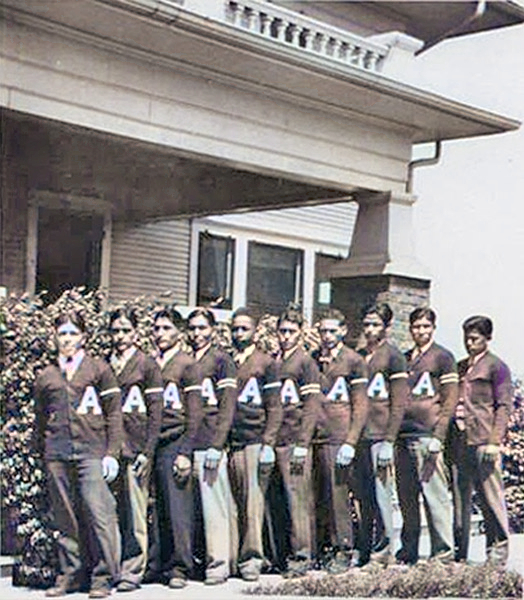
Lettermen at the American Indian Institute, 1930.
In 1921, the Roe Indian Institute changed its name to the American Indian Institute. That year, the school’s enrollment peaked at 46 students.
Enrollment numbers declined during the 1930s. Through the years, the student body was small, and the graduation rate was not always high.
Cloud officially transferred control of the American Indian Institute to the Board of National Missions in 1931. At that time, he left the school and began working for the federal government under the Bureau of Indian Affairs. The U.S. government viewed Cloud as an asset for fostering relations with Native peoples and for crafting policies.
Dr. Cloud returned to school and received a Doctor of Divinity from Emporia College, Kansas, in 1932.
After working at the Bureau of Indian Affairs, the couple moved to Lawrence, Kansas, in 1933, where he became the first Native American president of Haskell Institute, an Indian school now known as Haskell Indian Nations University. His career eventually led him to other Native institutions, such as the Umatilla Indian Agency and the Grande Ronde and Siletz Indian Agencies in Oregon.
The American Indian Institute remained under Presbyterian supervision until it closed in 1935. During its 16 years of operation, the Institute was an invaluable opportunity for Native American students, despite enrollment being limited to men.
Subsequently, the former institute property fell into disrepair, leaving only the dormitory building.
Dr. Henry Roe Cloud died of a heart attack on February 9, 1950, leaving behind his wife, Elizabeth, and their four daughters.
The Cloud family’s name endures in the community through Henry Roe Cloud Elementary School, located on 25th Street, which was built in 1953.
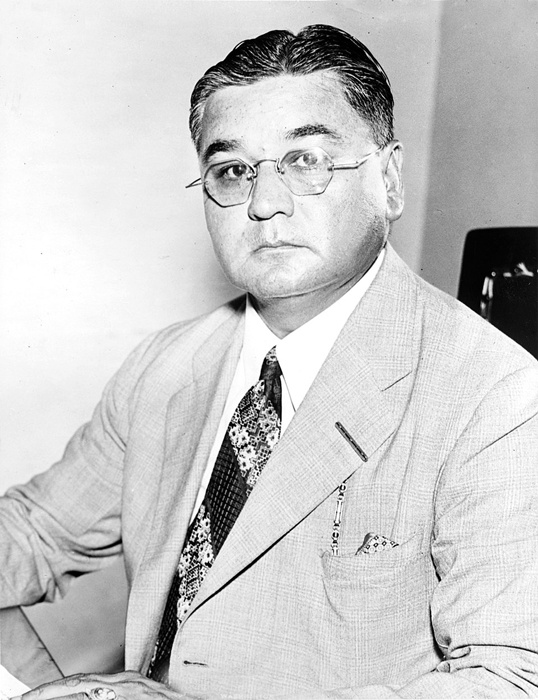
Dr. Henry Roe Cloud in 1931.
The school’s dormitory building was demolished in the 1990s and replaced with the Phi Delta Theta fraternity house, now standing at the corner of 21st and Bluff.
The property has now been extensively developed, with the land divided into plats for neighborhoods, a church, and a fraternity.
The Indian school was just north of Wichita State University at the present site of the University United Methodist Church.