
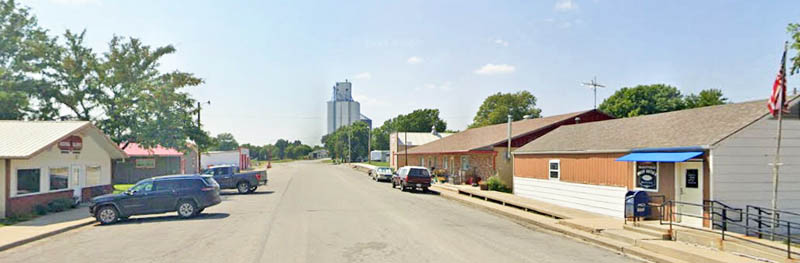
Main Street in Baileyville, Kansas, courtesy of Google Maps.
Baileyville, Kansas, is a census-designated place in western Nemaha County. As of the 2020 census, the population was 182.
The earliest settlers came to the area that is now the Baileyville community in 1857.
Before the town was founded, the railroad from Elwood, Kansas, reached the area in 1872, and the first train went through that year.
The Bailey family bought the first real estate in July 1879.
The community was initially founded as Haytown, due to the enormous quantities of prairie hay that were being shipped out. Bert Rice of St. Joseph, Missouri, was at the head of this hay-making, and he built the first house in town as a hotel for his men working during the hay season.
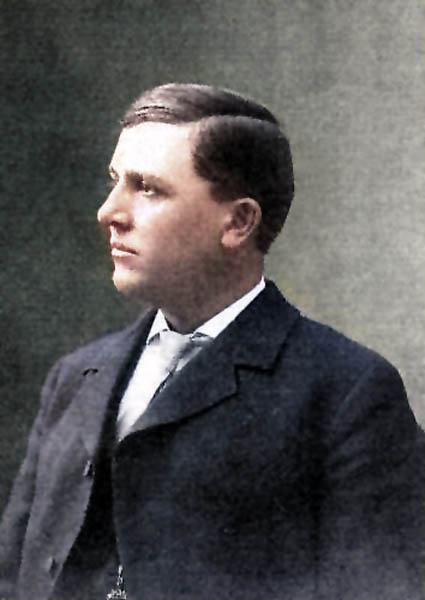
Willis Bailey.
Fritz Hann built the second house. He worked as a blacksmith for Bert Rice.
The community was renamed Baileyville by Willis J. Bailey and his father.
In 1880, N. Bailey, a substantial farmer in Clear Creek Township, laid out the town on the Union Pacific Railroad. A siding was established and a station built by the railroad company. Lots were given away if houses would be built, and lots were also sold. Vacant lots were planted with cherry trees, which bore abundantly.
A post office was established on February 25, 1880, with G.M. Rasp as postmaster. A large hay press and sheds were erected by S.H. Rice & Co., of St. Joseph, Missouri, which also established a store for the benefit of their employees and others.
Bill Funk ran the first livery.
Isaac Richmond built a home in 1881.
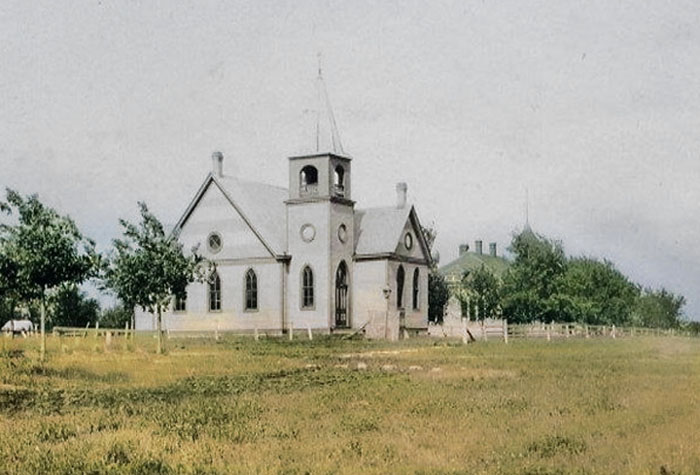
Baptist Church in Baileyville, Kansas.
In the spring of 1882, S.H. Rice & Co. sold their hay-pressing machinery to Bailey Brothers, along with two sections of hay lands. The store was transferred to Bay & McQuinch.
A Baptist Church was organized on August 23, 1884, largely supported by local pioneers like early settler Thomas Bronaugh.
The Baileyville State Bank was built in 1894.
Baileyville was described by the Evening Bulletin of Maysville, Kentucky, in 1902 as one of “two strong Republican towns in Kansas in which a negro is not allowed to live.”
In 1903, Willis Bailey became the 16th Governor of Kansas.
In 1910, Baileyville was on the St. Joseph & Grand Island Railroad and the Missouri Pacific Railroad. At that time, it had banking facilities, express and telegraph offices, a money order post office with two rural routes, and a population of 250.
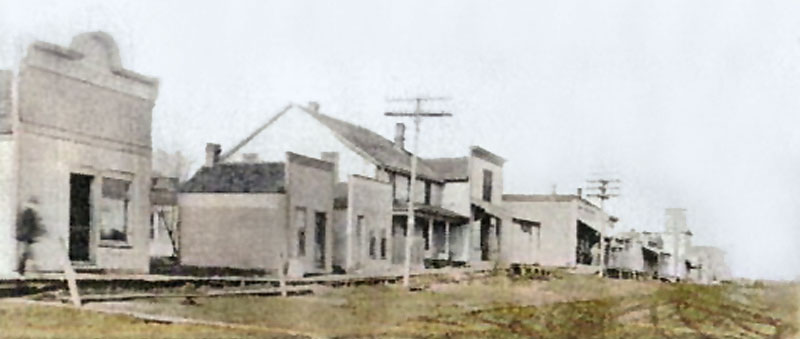
Baileyville, Kansas Main Street, 1913.
In 1911, a group of devout Catholics held a meeting in the home of Frank Broxterman, northeast of Baileyville. This meeting marked the beginning of the new Sacred Heart Parish, established in March of 1912. The idea of a Catholic parish and the construction of a church was overwhelmingly approved, and a committee was formed to obtain the signatures of the 50 or so Catholic families that were living in the area. This petition was presented to Bishop Thomas F. Lillis of the Leavenworth diocese, who favored the idea, and suggested that the group construct a building that would serve as a combined school and church.
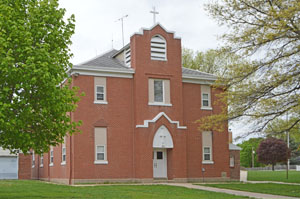
The initial Sacred Heart Church in Baileyville, Kansas by Kathy Alexander.
On March 10, 1912, Father Joseph Hohe came to Baileyville to say the first Holy Mass at the still-standing Marion Hall. Around this time, construction on the first church began. A building measuring 50 by 75 feet was built using brick, with asbestos shingles for the roof, for $16,000. The church building was dedicated on October 22, 1912. In the following years, it was used for Sunday Mass and weekly school classes, and it hosted many picnics, dinners, plays, and dances. Today, this building is still used and has been refurbished over the years to hold junior high classes.
In 1913, a beautiful rectory was built, which would later house the Benedictine nuns who taught in the school.
Over the next several years, the Sacred Heart Church was no longer big enough for all of its uses, and in September of 1924, the parish began excavation for the new 72-by-140-foot building. The people of the parish provided many hours of volunteer labor on the project. It was covered with a temporary roof with the hope of completing the building within five years.
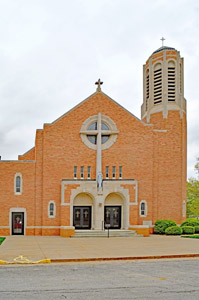
New Sacred Heart Catholic Church in Baileyville, Kansas by Kathy Alexander.
Father Arthur J. Trompeter was assigned to Sacred Heart Parish in June of 1949. He set out to oversee the construction of a new church at the site of the 25-year-old church. This church, completed in 1952, is of modern Gothic design and constructed of concrete, stone, and steel. The church is 147 feet long and 63 feet wide and bears a buff brick exterior trimmed with strip and cut variegated Indiana limestone. The communion rail, side altar, baptismal font, and holy water fonts are all made of Red Levanto and Rose Travemello Italian marble. The entire main floor is made of Mar-flex terrazzo poured over concrete. The first Mass in this church was celebrated on January 27, 1954.
Baileyville schools were closed in 2014 through school unification.
The Highland Community College Western Center in Baileyville, Kansas, officially opened its doors in the summer of 2014. It serves students in and around the Nemaha and Marshall County portions of Northeast Kansas and Southeast Nebraska. It offers six technical programs – Construction Technology, Diesel Technology, Welding Technology, Medical Assistant, Early Childhood, and Precision Agriculture. It also offers Allied Health courses including CNA, CMA, and EMT. The college has a variety of daytime and evening general education courses in the traditional face-to-face format, as well as “hybrid” classes with a portion of the coursework completed online and via the Interactive Distance Learning classroom.
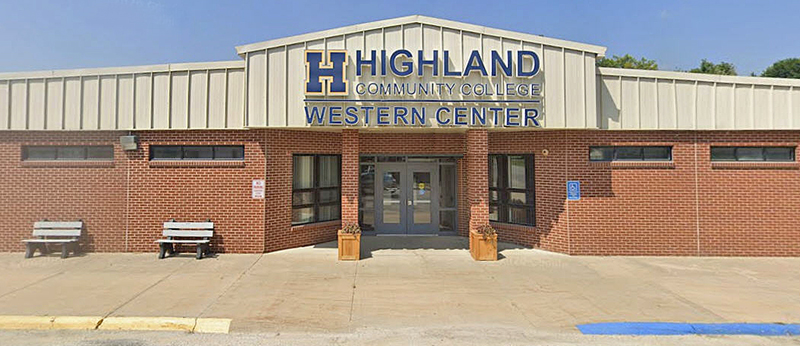
Highland Community College Western Center in Baileyville, Kansas, courtesy of Google Maps.
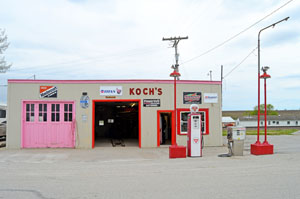
Baileyville, Kansas Gas Station by Kathy Alexander.
Today, the community is served by Nemaha Central USD 115 public school district in Seneca, Kansas.
The present-day Sacred Heart Church parish, consisting of about 200 families, continues to be a strong unified force.
The Union Pacific Railroad and U.S. Highway 36 run through Baileyville.
Baileyville is located six miles West of Seneca, the county seat, on U.S. Route 36.
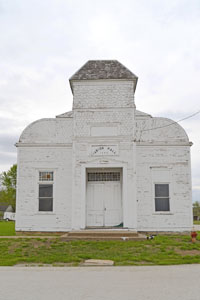
Marion Hall in Baileyville, Kansas by Kathy Alexander.
©Kathy Alexander/Legends of Kansas, July 2026.
Also See:
Sources:
Blackmar, Frank W. Kansas: A Cyclopedia of State History, Vol. I. Standard Publishing Company, Chicago, IL, 1912.
Cutler, William G. History of Kansas; A. T. Andreas, Chicago, IL, 1883.
Nemaha County History
Sacred Heart Catholic Church
Wikipedia