
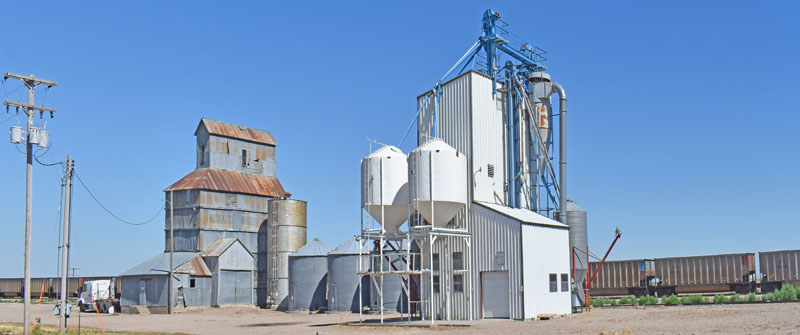
Railroad and silos in Edson, Kansas, by Kathy Alexander.
Edson, Kansas, is a tiny town and census-designated place in Washington Township of Sherman County. It is also an extinct town as it no longer has a post office. As of the 2020 census, the population was 17.
Edson’s first school, School District 71, was erected in 1886 and was made of sod.
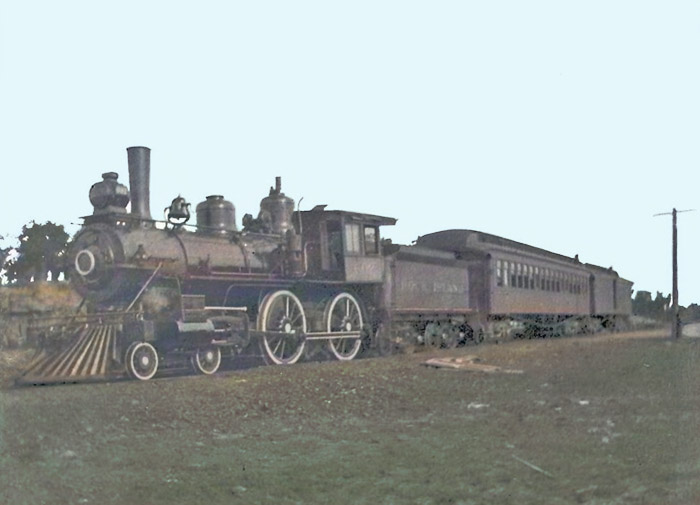
Chicago, Rock Island & Pacific Railroad.
Edson was initially a railroad town served by the Chicago, Rock Island & Pacific Railroad.
The plat for the town of Edson was filed on August 10, 1888, by Albert and Laura Harris. It was named for settler Ed Harris and his son, Albert. The first building constructed was the two-story depot, with the station on the first floor and a home for the station agent on the second. The first grocery store was brought to the area by Steele Yockey, and the post office was established on September 12, 1888.
Countless settlers throughout the United States, and especially in Kansas, headed west in search of land. Many migrants came from the Northern Midwestern states, such as Iowa and Illinois. Some of the first settlers of the community were Mary Brown, John Austin, John Atkinson, Mr. Holbrook, Casper Kipps, and Joe McKinney.
Industry in Edson, farming and grain production, played a huge part in the lives of Edson citizens. The Rock Island Line made transporting grain to better markets in Kansas more possible and accessible for Edson farmers.
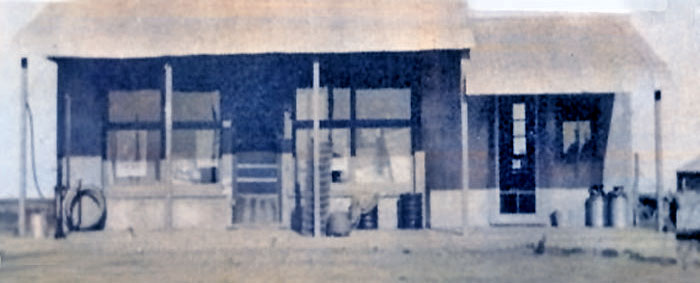
Early-day business buildings in Edson, Kansas.
Many homesteaders made a living working on the railroad, which offered opportunities to earn wages. The money earned could then be used to buy equipment and farm improvements.
Edson is located in a Kansas area without aboveground water sources. At first, settlers collected rainwater stored in underground cisterns.
A “Notice to Purchase School Land” was made in August of 1894, and construction soon began on the original Edson School. Several general stores, stations, and garages were opened in town.
The first grain elevator was built in 1915 by John Horney. More elevators were added in the following years, right alongside the railroad.
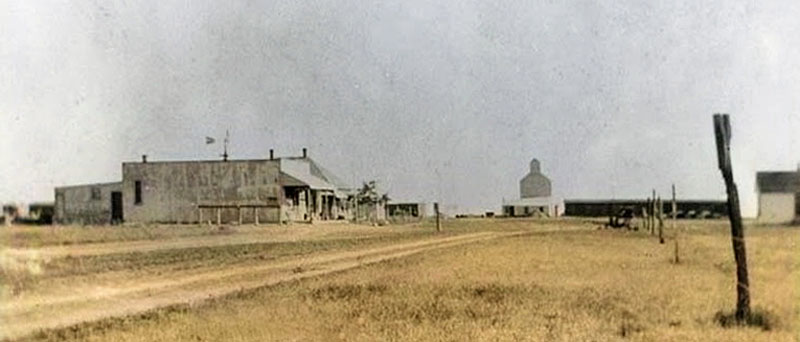
Edson, Kansas in 1920.
In 1923, a new schoolhouse was built, and several school districts were consolidated. In 1930, a brick building was constructed, and in 1963, a gymnasium was added.
In 1910, Edson was still a station on the Chicago, Rock Island & Pacific Railroad, and had a money order post office with one rural route, an express office, a general store, and did some shipping.
The Edson School was renovated and expanded in the early 1920s, but it was still unable to accommodate the growing student population.
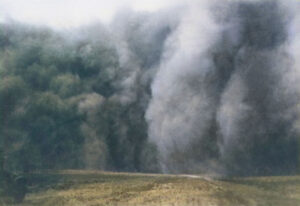
Dust Bowl in western Kansas.
Prosperity in Edson continued into and past the Great Depression and the 1930s Dust Bowl. By that time, residents were forced to drill wells into the Ogallala aquifer.
In April of 1931, the Edson Consolidated School District gave notice of a petition to build a new school building for $50,000. The new building opened to students in December 1931, and was named “The Edson Rockets” after the familiar Rock Island Rocket train.
A fire in November 1931 completely destroyed the Edson Store building, including its records and government post office supplies. The origin of the fire was unknown, and when a call was made to the Goodland Fire Department, they did not go to Edson because a city ruling didn’t allow the department to leave town, “as it would take all the firefighting equipment and leave no local protection.”
Throughout the Great Depression, the Edson Consolidated School thrived.
In the late 1940s and early 1950s, a home economics classroom and cafeteria were added to the schoolhouse, and a farm shop was constructed.
In 1953, diatomaceous marl deposits south of town were discovered, which led to the construction of a Lorite plant. The plant was built along the Rock Island, right next to the elevator, allowing easy transfer of the product to trains for distribution all over the country.
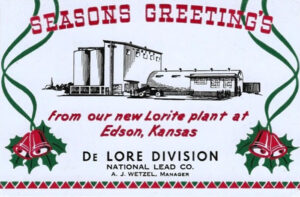
Lorite Plant in Edson, Kansas.
Diatomaceous marl is a naturally occurring, soft, siliceous sedimentary rock that can be crumbled into a fine, white-to-off-white powder. Found near the surface of the earth, it was deposited there thousands of years ago when a great inland lake covered this part of Kansas. This material is utilized in various applications, including as a filtration aid, a mild abrasive in products such as metal polishes and toothpaste, and as a mechanical insecticide. It also serves as an absorbent for liquids, a matting agent in coatings, and a reinforcing filler in plastics and rubber. Additionally, it acts as an anti-block agent in plastic films, a porous support for chemical catalysts, and cat litter.
The finished product, Lorite, was processed at a modern plant employing 15 to 20 men. Nearly every state in the union and many foreign nations received shipments of Lorite from the Edson plant.
In 1964, a gymnasium was built for the school.
Another fire on July 11, 1966, destroyed an undetermined amount of property at the Vinton L. Albers Salvage Yard, including two buildings.
By the 1970s, it was found that Lorite turned out to be poisoning countless people, as it was discovered to contain lead, and the Lorite plant closed in about 1973. By the end of the 1970s, lead was banned for commercial use.
By 1973, competition with the Sherman county seat, located in Goodland, ten miles west of Edson, forced the Edson High School to close. The students were then bused into Goodland, although some chose to attend Brewster High School, just ten miles to the east.
The grade school and junior high remained open for another six years, until the school closed in 1979.
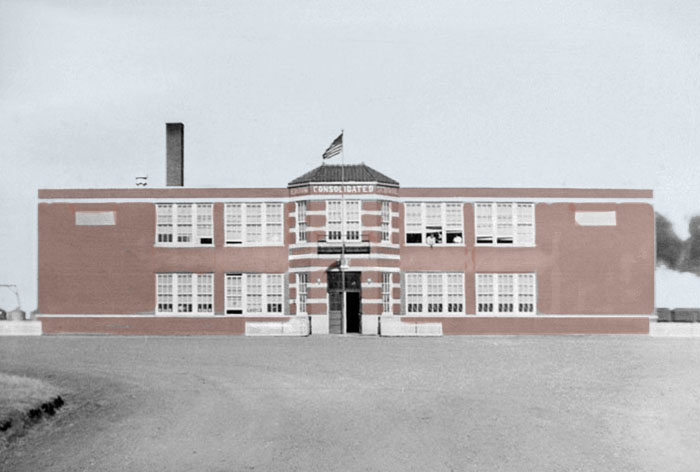
Edson, Kansas Consolidated School.
Melvin Musil and his brother, Marlin, purchased the school property, including the school building, bus barn, teachers’ housing, and football field, at an auction in 1979. In the following years, they used the bus barn to store farm equipment, the school and teachers’ houses were home to the Musil brothers and their families, and the football field was a small farm and personal garden
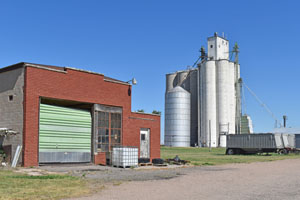
Business building and grain elevator in Edson, Kansas by Kathy Alexander.
However, by the late 1990s, the school and houses stood empty.
In about 2015, Melvin sold the entire property to Mike Cochran of Cochran Farm Supply in Edson, under the agreement that he could still use the football field as long as he liked. The following year, the Edson Consolidated School building and the teachers’ house were demolished.
The post office was converted to remote management under the direction of the Goodland Post Office postmaster on July 27, 2013. However, the post office closed in the early 2020s.
Today, Edson is served by the Goodland USD 352 public school district.
Grain elevators, the Kyle Railroad, a farm supply business, and several homes remain in Edson.
Edson is located near Interstate 70, nine miles east of Goodland.
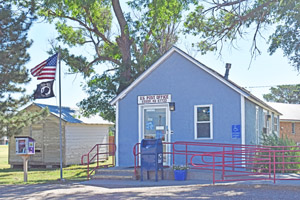
Post office in Edson, Kansas by Kathy Alexander.
©Kathy Alexander/Legends of Kansas, January 2026.
Also See:
Extinct Towns of Sherman County
Sources:
Fort Hays State University
Hanson, Maura; The Town That Somehow Stuck: Edson, Sherman County, Kansas, 1888-1979, Chapman Center for Rural Studies, Fall, 2016.
Kansas Post Office History
Sherman County Community Development
Wikipedia