
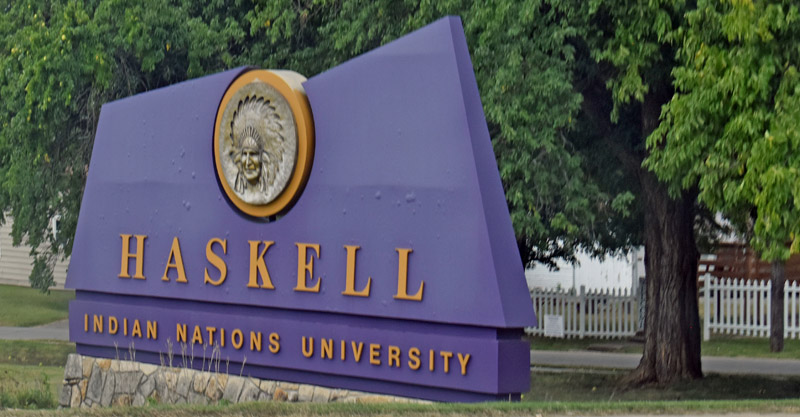
Haskell Indian Nations University in Lawrence, Kansas, by Kathy Alexander.
Haskell Indian Nations University is a public tribal university in Lawrence, Kansas. From its inception as a government-run residential boarding school for Native American children in 1884 to its current status as a fully accredited university, it has successfully evolved into a university for Native students, emphasizing Native culture, sovereignty, and self-determination.
The history of Haskell Indian Nations University reflects both U.S. Indian policy and self-determination efforts by American Indian communities. Haskell was founded during an era following the Indian Wars, when the federal government believed that Native Americans needed to assimilate into the majority culture in order to survive. The U.S. government had earlier provided schools on reservations, as stipulated in treaties, which were typically administered by religious missions.
In the late 19th century, the U.S. government began to establish off-reservation boarding schools. Native American children from various tribes were recruited to attend these schools and were expected to abandon their tribal traditions during their time there. The Carlisle Indian Industrial School, founded in 1879 in Pennsylvania, became the model for federal immersion education programs. In 1882, Congress authorized the establishment of three new boarding schools in Nebraska, Kansas, and Indian Territory (present-day Oklahoma) – a plan that would cost $150,000. The Carlisle school served as the blueprint for these upcoming institutions, including what eventually became Haskell Indian Nations University in Kansas.
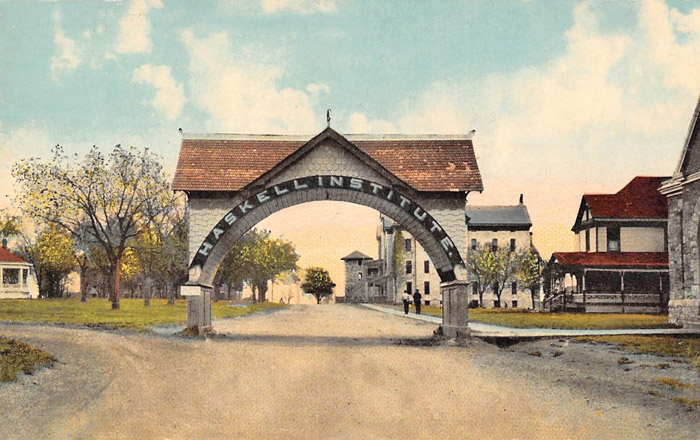
Indian Industrial Training School Entrance in Lawrence, Kansas.
When Haskell opened on September 31, 1884, it was known as the United States Indian Industrial Training School and served only children in grades one through five. The school opened with students from the Ponca, Sac and Fox, Shawnee, Kiowa, Comanche, Chippewa, and Munsee tribes. It began with 22 students in its first year.
As part of the federal government’s assimilation policy, it removed Indian children from their families, sometimes forcibly, and placed them in schools far from their homes for a period of up to four years. The assimilation policy was put in place to remove all connections to the tribes and cultural influences to “assimilate” the students into the dominant culture. This policy was very traumatic for Native families.
In the early years, Haskell was run like a military school, where students made their own uniforms and grew and preserved their own food. The rules were stringent — no speaking a tribal language, no conversing with siblings, no practicing tribal customs and traditions. Their traditional clothing and personal items were removed, their hair was cut, and they were forced to march to classes and to church. In those early years, the children were taught to speak English, and instruction was at an elementary school level. Students were often physically punished for failing to comply with the institute’s rules. At least 103 children died while attending the school.
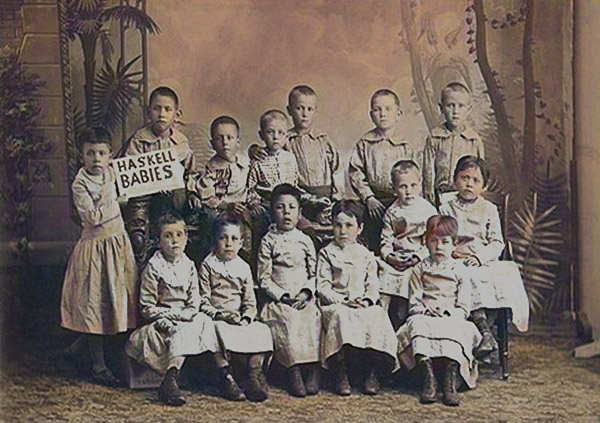
Haskell babies.
Boys were taught skills in tailoring, wagon-making, blacksmithing, harness-making, painting, shoemaking, and farming, reflecting trades common to their mostly rural, small-town reservation environments. Girls studied cooking, sewing, and homemaking. As was typical of many such rural schools, most of the students’ food was produced on the associated Haskell farm. Older students were expected to work while at the school, as in the Tuskegee Institute model and similar independent institutions.
In 1884, the Haskell Cultural Center and Museum opened. Still open today, it exhibits the school’s history, with archives and aspects of Native American history.
Osceola and Keokuk Halls, collectively known as “O-K Hall,” were also built that year. Osceola and Keokuk served as dormitories for men and women, respectively. Osceola was a renowned Seminole warrior, and Keokuk, a Sac and Fox, was not a hereditary chief but was recognized for his skillful leadership, force of character, and brilliant oratory. O-K Hall is currently a coeducational residential hall.
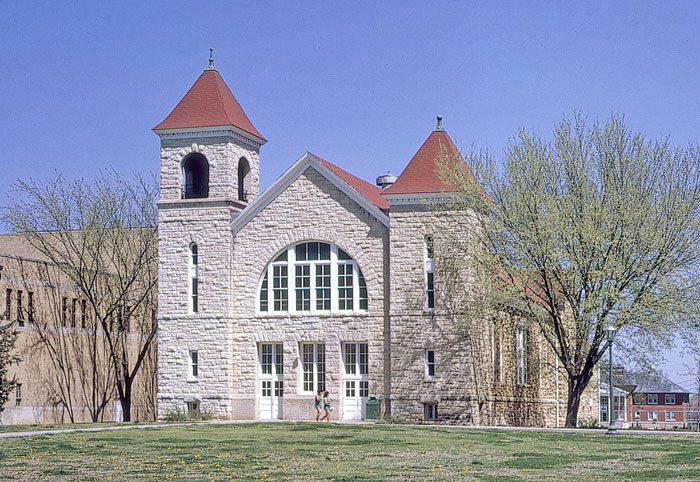
Hiawatha Hall at Haskell University, courtesy of the Kansas Geological Survey.
By the end of the first school year, 400 students were enrolled from tribes across the country.
In 1887, the school was renamed Haskell Institute in honor of Dudley C. Haskell, the U.S. representative from Kansas’s 2nd district who had helped secure funding for the school’s construction in Lawrence.
In 1889, Charles T. Meserve was appointed as the fifth superintendent in Haskell’s five-year history. His discharge of many employees brought criticism from the president of the National Education Association. Students responded to his harsh treatment by submitting four petitions protesting his actions to the Bureau of Indian Affairs in Washington, D.C. A Special Indian Agent appointed to investigate the incident whitewashed the situation.
Hiawatha Hall, constructed of native limestone in 1898, was dedicated on March 12, 1899, and named after the historic Onondaga leader Hiawatha. The United Methodist Church built the hall to serve as a campus chapel, although it has also served as a general auditorium and as a girls’ gym at various times in the school’s history. Today, it is the oldest building still standing on the Haskell campus. The federal government currently owns Hiawatha Hall and has kept it closed for decades because it has not allocated funds for necessary repairs, despite the building’s listing on the National Register of Historic Places. It is the oldest structure still standing on the campus.
In the early 20th century, Haskell continued to evolve while operated by the federal government. By that time, Haskell had become a tribal-based university with a curriculum serving the general goals of Native Americans.
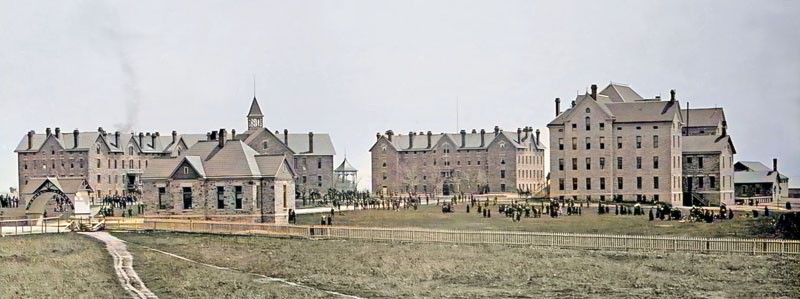
Haskell Indian Nations University, about 1900.
From the 1900s through the 1930s, Haskell became famous for its football teams. In competition with teams from colleges such as Harvard, Yale, and Brown, Haskell was known as the “Powerhouse of the West.”
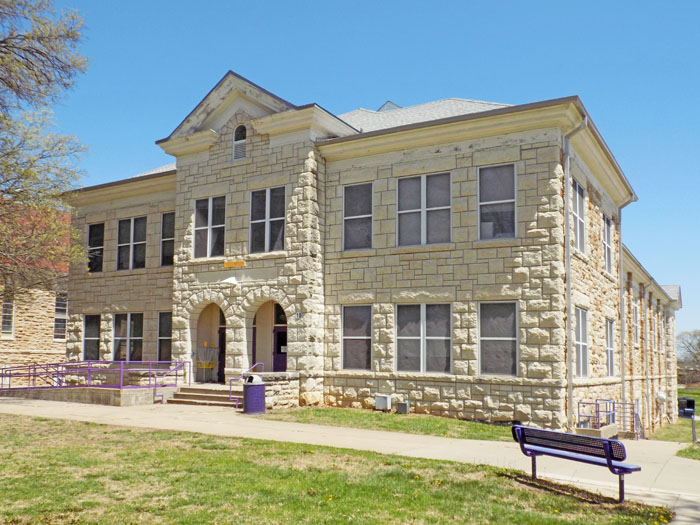
Tecumseh Hall at Haskell University, courtesy Wikipedia.
Built in 1915 as a gymnasium, Tecumseh Hall was named after the Shawnee chief who led an effort to repulse the European-American settlers from Indian territory west of the Appalachian Mountains. It houses the Campus Shoppe, offices of the Student Senate, Student Activities, and the Indian Leader, the campus newspaper.
The Haskell Arch and Stadium were built in 1926 for $166,000 and were entirely funded by donations from Native Americans. The stadium was the first lighted stadium in the Midwest.
As the school gained popularity, Haskell Institute began offering middle school and high school courses. In 1927, received accreditation as a Kansas high school.
Pushmataha Hall, the Administration Building, was built in 1929.
By the 1930s, people who came to Haskell loved the school and learned trades such as printing, nursing, business, and other vocational-technical fields, including electricity and refrigeration, while also earning high school diplomas.
Haskell’s enrollment peaked in 1931 with 1,240 students.
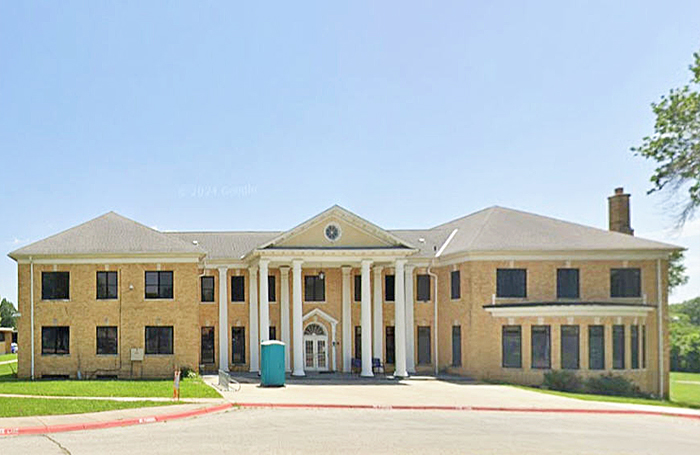
Pocahontas Hall at Haskell University, courtesy Google Maps.
Pocahontas Hall was constructed of buff brick at a cost of $31,000 in 1932. and named after Pocahontas, the daughter of Chief Powhatan, paramount chief of the Powhatan Confederacy. She married English colonist John Rolfe, and they were ancestors to many descendants of the First Families of Virginia. It serves as a residential hall for first-year women and female transfer students from other colleges and universities. This structure is the oldest surviving dormitory.
Powhatan Hall was constructed in 1932 and named after the paramount chief of the Powhatan Confederacy, which comprised 30 Algonquian-speaking tribes in coastal Virginia. Initially used as a classroom, it has been adapted into a residential hall that houses Student Residential Assistants.
The Auditorium was built in 1933 of buff brick at a cost of $55,000. This building features a white granite entrance with Art Deco pilasters and lamps. The facade features elements of the Art Deco style.
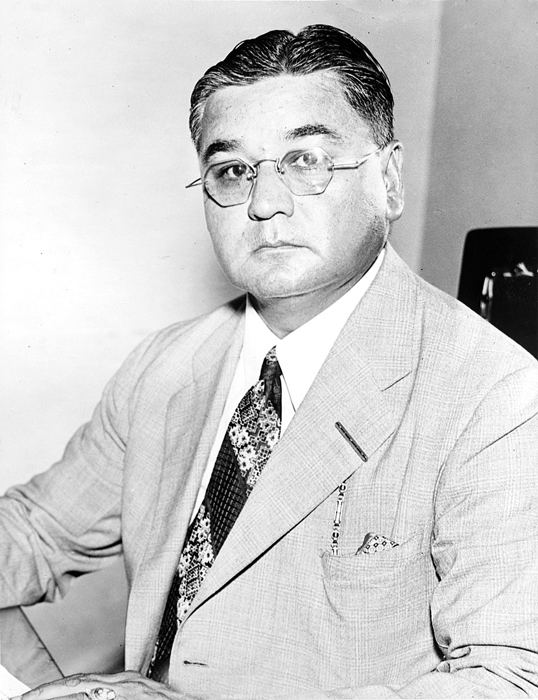
Dr. Henry Roe Cloud in 1931.
By 1933, Haskell got its first Native superintendent, Dr. Henry Roe Cloud. He was a progressive educator and the first Native American to graduate from Yale University. During his tenure at Haskell, Dr. Roe Cloud reversed the curriculum’s emphasis on assimilation and shifted it to emphasize Native culture.
Many students who attended Haskell remained on the staff and faculty. One notable individual, George Shawnee, who earned his degree at Haskell and remained on staff for 40 years, witnessed the graduation of 9,000 students. As these staff and faculty members remained at Haskell, they gradually turned the school around.
By 1935, the institution was classified as a vocational-technical school.
Encouraged by the African American Civil Rights Movement to press for the fulfillment of treaty conditions, Native Americans organized in the 1960s to assert their cultures and to realign the relationships between federally recognized tribes and the federal government.
Sequoyah Hall was built in 1961 and named for Sequoyah, the Cherokee who developed a syllabary writing system for the Cherokee language in the early 19th century; this was the first known independent development of a writing system. It lies on the eastern edge of the main quadrangle area.
Initially constructed in 1897, Winona Hall was rebuilt in 1962. In the Lakota tradition, the name Winona is given to the firstborn daughter of a family. Winona Hall is currently a co-ed honors residential hall, serving both women and men.
In 1965, Haskell University graduated its last high school class.
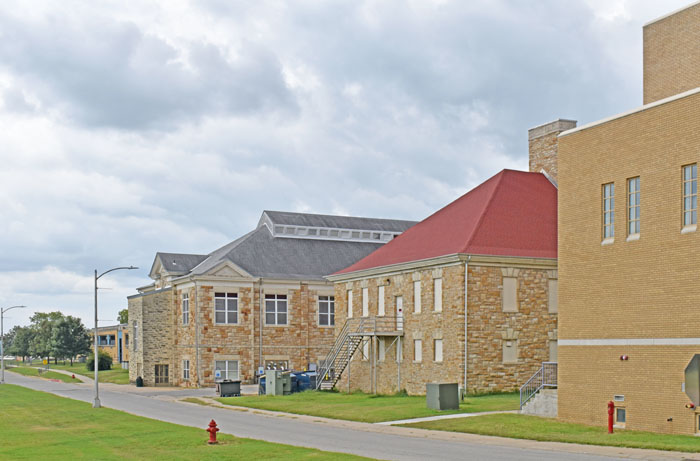
Haskell University buildings by Kathy Alexander.
Following further curriculum development, the school was renamed Haskell Indian Junior College in 1967 and was able to award associate degrees and certificates in specialized skills programs.
In 1970, changed its name to Haskell Indian Nations University to reflect its shift of focus to higher education.
Tommaney Library, completed in 1977, houses a million-volume library, a television studio, and a repository for the university’s textbooks. The building was named after Thomas Tommaney, Creek, who served as Superintendent at Haskell.
Blalock Hall was constructed in 1978. It was named in honor of Margaret Blalock, Chippewa, a Haskell alumna and longtime college employee who was committed to serving Haskell students. It is a residential hall for freshman men and male students transferring from other colleges and universities.
By the late 1980s, planning began to develop the institution into a four-year, bachelor’s-degree-granting university.
Roe Cloud Hall by Kathy Alexander.
In 1993, the Assistant Secretary for Indian Affairs approved that development, which had been built on the expansion of the curricula and programs, and the school was renamed Haskell Indian Nations University. Haskell offered its first four-year baccalaureate degree program in elementary teacher education. Within a few years, Haskell had developed its own specialized bachelor’s degree program in American Indian Studies; Business Administration and Environmental Sciences degree programs soon followed.
In 1994, Congress designated this college and 31 other tribal colleges as land-grant colleges to provide them with the benefits of related programs.
Completed in 1997, Roe Cloud Hall was named after Henry Roe Cloud, a member of the Winnebago Nation. He was the first American Indian superintendent of the Haskell Institute, serving from 1933 to 1935. He also later served in the presidential administrations of Herbert Hoover and Franklin Delano Roosevelt. He was a spokesman for American Indian issues and education throughout his life. It is a co-ed residential hall.
Haskell offers Associate of Arts degrees in Communication Studies, Liberal Arts, Media Communication, Para Professional Education, and Social Work. The school also offers Associate of Science degrees in Community Health, Natural Sciences, and Recreation and Fitness Management. After earning an associate’s degree, many students transfer to the University of Kansas or other institutions or enter the workforce. Haskell offers four baccalaureate degree programs and four associate degree programs in various subjects. The university ranked #13 on Washington Monthly’s 2010 “Top 50 Dropout Factory” list in its College Guide, with a 9% graduation rate.

Haskell Fighting Indians.
The school also offers the following four bachelor’s programs:
Indigenous and American Indian Studies – This program provides an integrated foundation of interdisciplinary knowledge and the practical skills needed to contribute to the development of Indigenous American Indian and Alaska Native communities and nations. The program is designed to prepare students for graduate or professional schools or for entry into the workforce after graduation.
Business Administration – The School of Business offers the Bachelor of Science in Business Administration with emphases in management or tribal management. The management track emphasizes traditional academic study of contemporary management practices and theories, with a focus on the management of human, financial, technical, natural, and other resources. The Tribal Management track examines contemporary and historical issues that specifically impact the management of tribal governments and enterprises.
Elementary Teacher Education: Education majors complete a Bachelor of Science Degree in Elementary Education and must pass the Principles of Learning and Teaching and Elementary Education exams to be eligible to apply for Kansas provisional licensure to teach kindergarten through grade 6. Other states may have differing requirements.
Environmental Sciences – This program provides a broad-based background that prepares students for graduate school or careers in environmental or biological fields. Courses offered include Biology, Ecology, Chemistry, Physics, Geography, Natural Resources, and Environmental Sciences. It is intended to add substance to indigenous concerns about sustainability.
More than 20 student organizations and clubs on campus offer students opportunities to engage in campus life and activities that connect with the broader community.
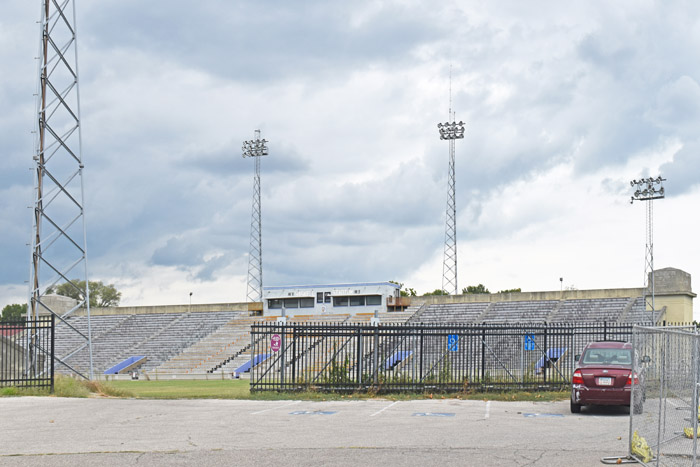
Stadium at Haskell University by Kathy Alexander.
The Haskell athletic teams are called the Fighting Indians.
The school’s team colors are purple, gold, and white. The university is a member of the National Association of Intercollegiate Athletics. The school competes in 11 intercollegiate varsity sports: Men’s sports include basketball, cross country, golf, and track & field (indoor and outdoor); women’s sports include basketball, cross country, softball, track & field (indoor and outdoor), and volleyball. Club sports include baseball and boxing. Former sports included football and co-ed cheerleading.
Haskell had one of the best college football teams in the nation from 1900 to 1930. Due to funding shortfalls, the football program was suspended beginning with the 2015 season.
Approximately 140 Tribal nations and Alaska Native communities are represented at Haskell, which is funded directly by the Bureau of Indian Education. While the school does not charge tuition, students are responsible for paying yearly fees.
Today, Haskell has an enrollment rate of around 1,000 students per semester.
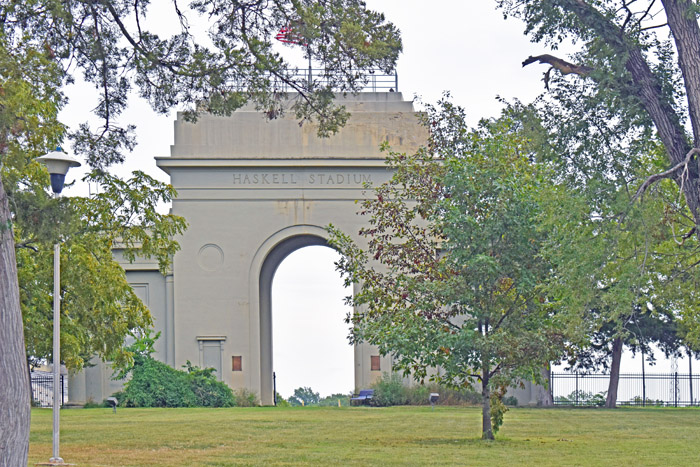
Haskell University Arch by Kathy Alexander.
Twelve campus buildings have been designated as U.S. National Historic Landmarks. Haskell is home to the Haskell Cultural Center and Museum, the American Indian Athletic Hall of Fame, the Indian Leader, the oldest Native American student newspaper in the country, and numerous student clubs and organizations. The school is also recognized for its collection of public sculptures, murals, photographs, and paintings.
The university is one of 37 members of the American Indian Higher Education Consortium, an organization of Tribal colleges and universities.
Currently, Haskell is the only government boarding school that has evolved into a four-year university for Native American students. It is also the only intertribal college that accepts students from all federally recognized tribes.
Haskell Indian Nations University is located at 23rd Street and Barker Avenue, immediately south of Kansas State Highway 10 in the southeast corner of Lawrence, Kansas.
155 Indian Avenue, Lawrence, Kansas 66046
(785) 749-8404
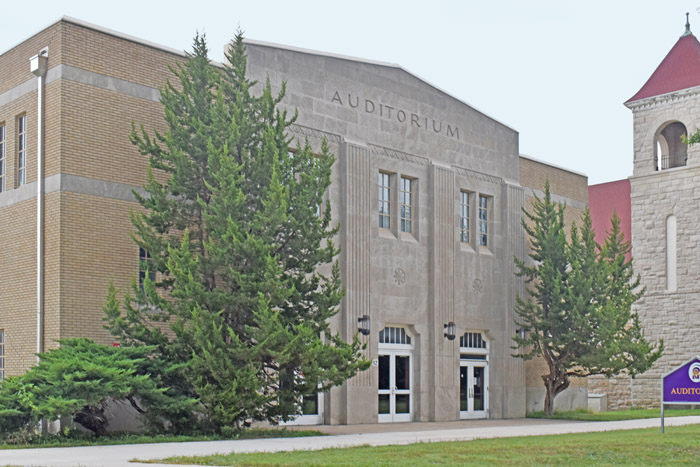
Haskell University Auditorium by Kathy Alexander.
©Kathy Alexander/Legends of Kansas, January 2026.
Also See:
Past Colleges & Universities of Kansas
Present Colleges & Universities of Kansas
One-Room, Country, & Historic Schools of Kansas
Sources:
Blackmar, Frank W.; Kansas: A Cyclopedia of State History, Vol I; Standard Publishing Company, Chicago, IL 1912.
Digital Douglas County History
Haskell Indian Nations University
Kansas Sampler
National Register of Historic Places
Wikipedia