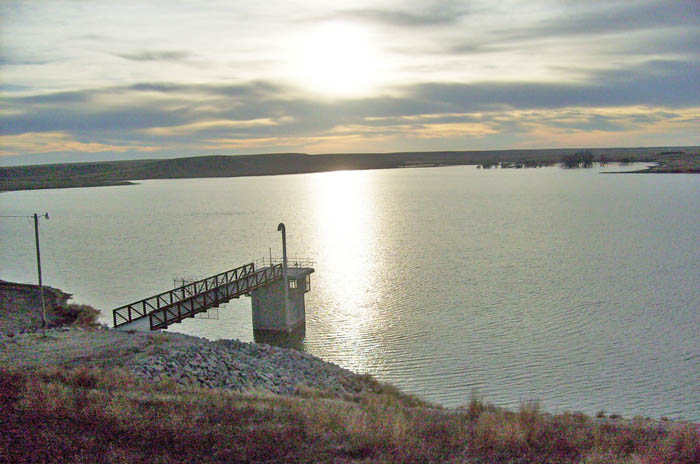
Horse Thief Reservoir in Hodgeman County, Kansas.
Horse Thief Reservoir, on Buckner Creek in Hodgeman County, Kansas, consists of 450 acres of water in 1,600 acres of prairie. The largest body of water in southwest Kansas, the reservoir takes its name from a nearby canyon where horse thieves were hanged during the days of the Wild West.
The Pawnee Watershed District was established in 1965 by a group of farmers and businessmen. It received its corporate charter in 1968 and is the largest watershed district in the United States, covering over 1.5 million acres across nine Southwest Kansas counties: Edwards, Finney, Ford, Gray, Hodgeman, Lane, Ness, Pawnee, and Rush.
On September 17, 1985, Pawnee Watershed Joint District No. 81 submitted a water rights application for the Horse Thief Reservoir, requesting 3,826 acre-feet of water from Buckner Creek. This reservoir aims to provide recreational opportunities, enhance groundwater recharge, and control flooding. Local landowners were informed about the project, and meetings were held from 1985 to 1995.
In June 2004, the Horse Thief Reservoir Benefit District was created, and a board of directors was formed. Although all nine counties had the opportunity to participate, only Ford, Finney, Gray, and Hodgeman counties expressed interest. A bond issue was approved in 2004 and issued in 2005, funded by a 0.005% sales tax. The Pawnee Watershed District owns the land, which is leased to the Horse Thief Benefit District.
In 2005, a team was formed to develop plans for the park at Horse Thief Reservoir, including boat ramps, utility campsites, cabins, primitive campsites, shower and restroom facilities, a water treatment facility, day-use areas, playgrounds, and trails.
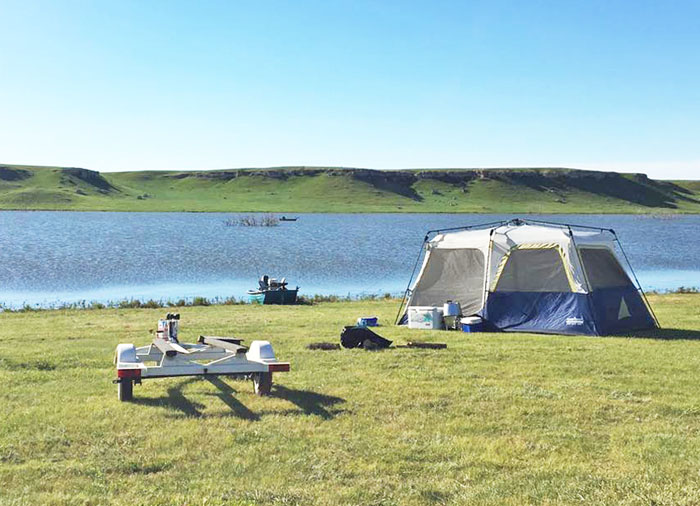
Camping at Horse Thief Reservoir.
Construction of the 7,200-foot-long dam began in early 2008 and was completed by September 2009. Work was also being completed on the 450-acre reservoir as the dam was being constructed. Boat ramps were constructed with funds administered by the Kansas Department of Wildlife and Parks, and roads were beginning to take shape in the park. A park manager was hired in July 2009.
By the spring of 2010, the reservoir was nearly 50% full, and the park opened on a limited basis for boating and fishing in June 2010.
The park opened to camping in June 2012. The reservoir reached capacity on July 1, 2016, and has remained near full since then.
The park now boasts an office/shop, 50 utility campsites, numerous primitive campsites, one rustic cabin, one modern cabin, shade/wind blockers, gazebos, a good-sized pavilion, restroom and shower houses, two Yurts (similar to a cabin), a basketball court, a large playground, and an 18-hole Frisbee golf course. The park also has an enclosed building called Horse Thief Lodge, complete with a kitchen and restrooms, that can be rented for large gatherings and special events. There are also huntable acres within the park and in the adjacent wildlife area.
Pleasure boating, water skiing, jet skiing, sail boating, windsurfing, kayaking, canoeing, and stand-up paddle boards can all be enjoyed at Horse Thief Reservoir. It provides crappie, largemouth bass, catfish, walleye, and bluegill for anglers. The park also offers swimming, hunting during season for deer, waterfowl, and upland birds, picnicking, hiking trails, trail riding, bike trails, wildlife viewing, and disc golf. The park hosts numerous special events, including archery shoots, running events, a large red-dirt music festival, and Zombie paintball in September and October.
Horse Thief Reservoir is located nine miles west of Jetmore, Kansas, at 19005 SW 156 Highway.
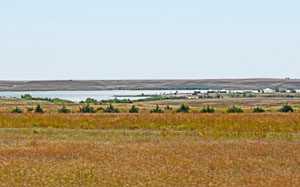
Horse Thief Reservoir in Hodgeman County, Kansas by Kathy Alexander.
©Kathy Alexander/Legends of Kansas, updated February 2026.
Also See:
Sources:
Geospectra
Horse Thief Reservoir
Kansas Department of Agriculture
Kansas State University