Ioway, Sac, & Fox Presbyterian Mission by Kathy Alexander.
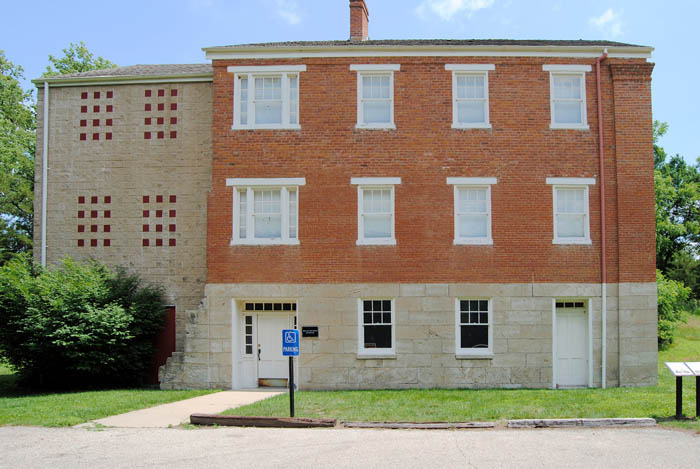
The Iowa and Sac & Fox Mission State Historic Site, also known as the Highland Presbyterian Mission, was a mission that housed children of two local tribes from 1845 to 1863 near Highland, Kansas.
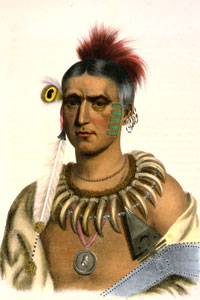
Ioway Chief.
In 1836, Superintendent of Indian Affairs William Clark (of the Corps of Discovery Expedition) negotiated a treaty at Fort Leavenworth, Kansas, with the Ioway and the Sac and Fox Nation of Missouri in Kansas and Nebraska.
The agreement stipulated that both tribes would relinquish all claims to lands between the state of Missouri and the Missouri River for $7,500. In addition to the monetary consideration, the government was to also “build five comfortable houses for each tribe, break up 200 acres of land, fence 200 acres of land, furnish a farmer, blacksmith, teacher, interpreter, provide agricultural implements, furnish livestock, and a host of other small items.
By the fall of 1837, the Ioway and the Sac and Fox had relocated to their respective reservations west of the Missouri River. Before the removal was complete, Andrew S. Hughes convinced missionaries to include both tribes in their efforts. Hughes contended that “the Sac and Fox exist in a declining fashion, and without the intervention of some supporting body, their desperate situation seems certain to worsen.” The missionaries, eager to reach more people, gladly accepted the new challenge.
A Presbyterian Mission was set up on the southern edge of the Ioway reservation in present-day Doniphan County, Kansas. In November 1837, Samuel M. Irvin and his wife, Eliza, established a mission two miles west of the mouth of Wolf River near present-day Highland, Kansas. They were joined in December by Reverend William Hamilton and his wife. They were sent to the area by the Presbyterian Board of Missions to establish an agricultural mission for the Iowa and Sac & Fox people, who were traditionally hunters.
The original mission building was a one-story log structure.
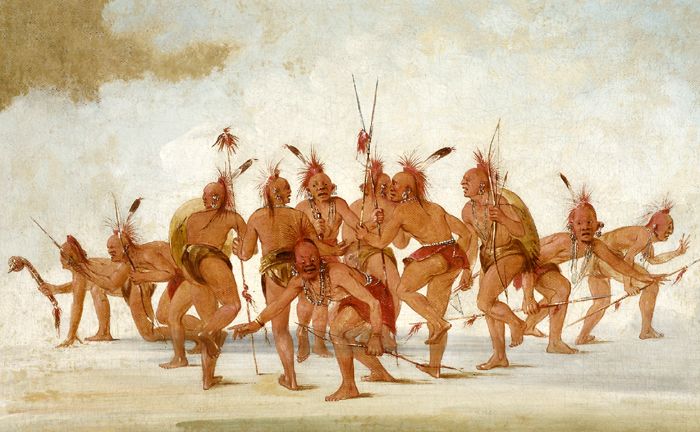
Sac-and-Fox Dance.
Samuel Irvin requested that the missionary board supply a printing press to print books and religious texts in the Ioway language. The request was approved and received at the mission in 1843. All lessons were taught in English and the Ioway language, with common study topics including spelling, Arithmetic, and geography, and an emphasis on industrial, domestic, and farming skills. Irvin and Hamilton printed several books in the Ioway language to aid in learning, including an Elementary Book of the Ioway Language and a religious book called Original Hymns in the Ioway Language. Irvin and Hamilton had to develop a Syllabary for the Ioway language to translate and print the books, as well as several grammar books.
Nine titles were produced out of the mission, and it was the second printing press in the state of Kansas.
The mission’s primary objective was to suppress tribal culture and transform Indigenous peoples into self-sufficient farmers who embraced Christian beliefs. On average, about 40 students lived at the mission. A typical day at the mission involves waking up at 5 am, attending 6 hours of school from 9 am, and spending the rest of the day at work under Irvin’s leadership. Mrs. Eliza Irvin taught girls homemaking and housekeeping.
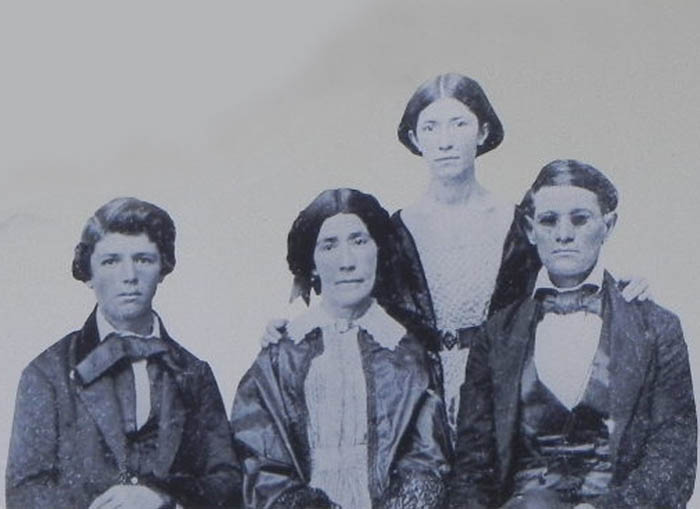
Reverend Samuel Irvin & Family.
The Presbyterian Board of Foreign Missions authorized a permanent structure in 1844, which was completed by July 1846. Measuring 107 feet by 37 feet, the building was made of limestone and bricks manufactured on site. The finished building was three stories high, with a belfry that raised the total height to 52 feet, and contained 32 rooms, including a dining hall and a chapel. The first story was walled with native limestone, and the upper two with brick manufactured on-site. Shingles, doors, windows, and finished lumber were shipped from Pittsburgh, Pennsylvania, while other building materials were sourced locally. The building cost of $8,000 was met by a $6,000 appropriation from tribal annuities and $2,000 from the mission board. This new structure was erected on the north side of Mission Creek, about 200 yards from the old mission complex.
Irvin sought to teach the tribes to raise livestock and practice agriculture. However, having little success, the missions board changed its tactics to teach younger children in an attempt to change the cultures.
From the early 1840s to 1865, the Oregon Trail was active, and the mission served as a lucrative destination because of its location along the trail. The tribes benefited from charging a toll over their bridge, but travelers who passed through introduced diseases, such as smallpox and cholera, which caused epidemics and led the tribes to relocate away from the mission.
Reverend William Hamilton and his wife left in 1853 after being sent to work among the Otoe in Nebraska.
With the passage of the Kansas-Nebraska Act in 1854, a new treaty was negotiated, resulting in a reduction in Indian lands. The treaty took effect that same year, and white settlement began then in earnest. In 1856, the mission had 44 students. As a result of the loss of land, the mission became too far from the two reservations to make attending the school convenient for Indian children. Consequently, the mission closed in 1863.
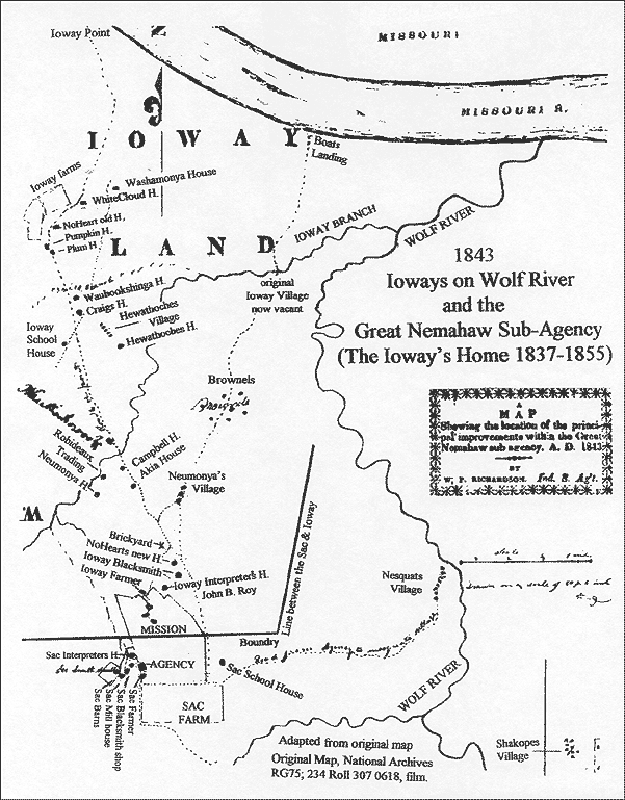
Ioway, Sac, & Fox Mission, Kansas Map.
Afterward, from 1863 to 1866, the mission operated as the Indian Orphanage Institute, but the proliferation of similar institutions in the Midwest limited its new role.
After the institute closed in 1866, the mission stood empty until 1868, when the western portion of the building was demolished, leaving approximately 40% of the original structure. The materials were used at the college in Highland.
In 1937, the Northeast Kansas Historical Society organized to preserve the remaining portion of the mission building, which had been used as a residence until about 1905.
In 1941, the state acquired the property, which became a state historical site in 1963. The building was added to the National Register of Historic Places in 1970.
In 1996, the mission was converted into a museum to showcase the arts and history of the American Indian emigrant tribes in northeast Kansas. The museum closed in 2008
In 2021, the state relinquished control of the property to the Ioway Tribe of Kansas, which was designated as part of the Ioway Tribal National Park. The Museum was reopened in May of 2022. Exterior signs tell the story of this site.
The site is located 1.5 miles east of Highland on 240th Road and .2 miles north on Elgin Road.
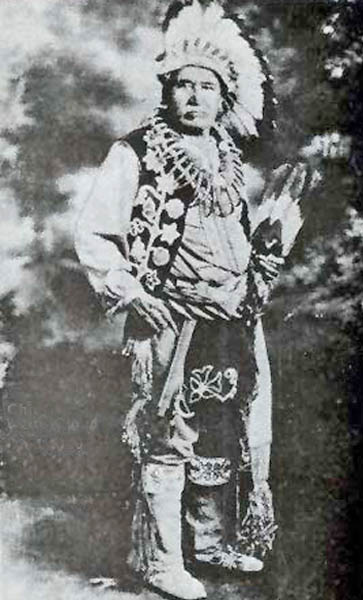
Ioway Chief James White Cloud attended school at the mission. He fought in the Union Army during the Civil War and served as chief from 1865 until he died in 1940.
1737 Elgin Rd, Highland, KS 66035-9801
785-272-8681
©Kathy Alexander/Legends of America, updated November 2025.
Also See:
Sources:
City of Highland, Kansas
Kansas Tourism
Lewis & Clark Travel
Wikipedia