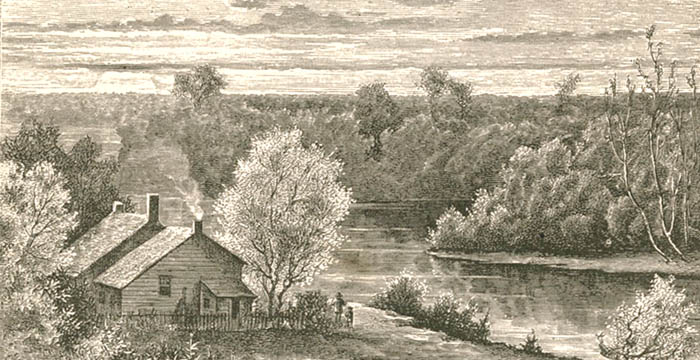
Neosho Valley, Kansas.
The Kansas & Neosho Valley Railroad (K&NW) was incorporated in March 1865 to build a line from Kansas City south into the Neosho Valley of eastern Kansas and then continue south to the Gulf of Mexico. Kersey Coates, of Kansas City, was President of the railroad. The railroad, also known as the “Border Tier Line,” was to run from Rosedale to Olathe, then south to Baxter Springs, Kansas, through the border tier counties of Kansas. There were just a few scattered residents in the valley in 1865, and the railroad was the first industry to come to this quiet, peaceful place.
Bonds were issued for the project, and by the spring of 1866, work commenced in Kansas City, and grading and bridging were completed in Olathe, Kansas. That same year, a treaty was concluded with the Cherokee, ceding the Cherokee Neutral Lands to the United States. The land, located in Crawford, Cherokee, and Bourbon Counties, was then to be sold for the benefit of the Indians. However, this created several disputes between white settlers who had “squatted” on the land and those trying to buy property. During this time, the Kansas & Neosho Valley Railroad directors could not obtain the needed property to build through the Cherokee Neutral Lands.
However, the property was acquired by a Boston group, represented by James F. Joy, president of the Chicago, Burlington & Quincy Railroad system, in August 1868. The previously issued bonds were then withdrawn and given to Joy and his group, who obtained the railroad. The name was then changed to the Missouri River, Fort Scott & Gulf Railroad Company in August 1868, and subsequently to the Kansas City, Fort Scott & Gulf Railroad Company.
©Kathy Alexander/Legends of Kansas, updated February 2026.
Also See:
See Sources.