
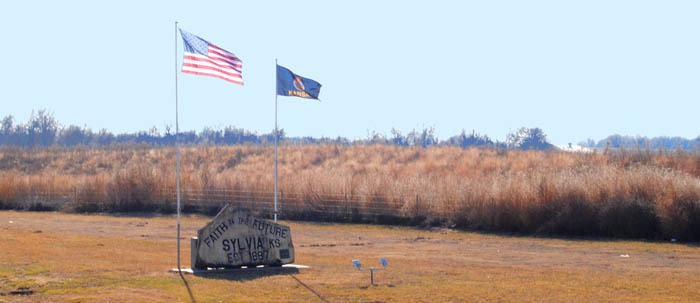
Welcome to Sylvia, Kansas by Kathy Alexander.
Sylvia, Kansas, located in the east-central portion of Reno County, got its start in 1874. The settlement was first called Zenith, and a post office opened in May 1876.
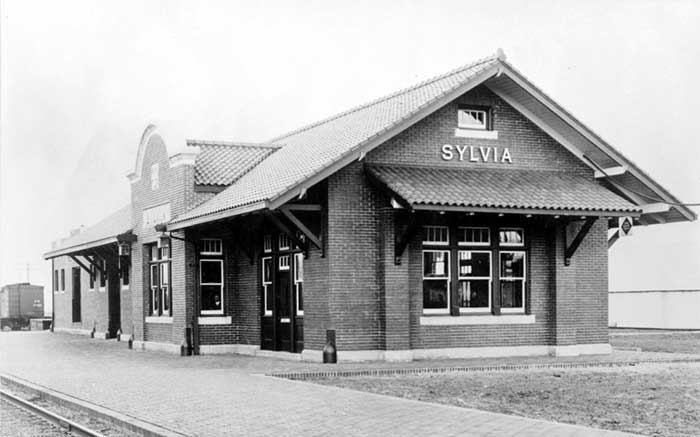
The Atchison, Topeka & Santa Fe Railroad in Sylvia, Kansas, is gone today.
However, when the Atchison, Topeka & Santa Fe Railroad planned to come through the area, the State of Kansas deeded much of the area’s land to the railroad in 1884. At that time, railroad companies encouraged the development of cities along their lines by offering railroad land at reasonable prices.
In 1885, the Sylvia school district was organized, before the official formation of the town. The first schoolhouse was built in 1886. It was a two-story frame building with a reputation for swaying with the Kansas wind. A one-story frame structure later replaced this building.
In 1886, much of the land was sold to H.S. Thompson and his wife, Mary, and immediately transferred to the Sylvia Town Company. Mr. Thompson had come to Kansas from Kentucky in 1882. In April of 1886, the town company platted the town of Sylvia.
The new town was named Sylvia by A.A. Robinson, a vice-president of the Santa Fe Railroad, in honor of his wife. Though Mr. Thompson wanted to call the new town Zenith like the original post office, Mr. Robinson prevailed. However, Robinson agreed to put in a station five miles to the west in Stafford County and call it Zenith. Robinson is credited with building over 5,000 miles of Santa Fe tracks. Sylvia was incorporated as a city of the third class in January 1887, and the post office was renamed to Sylvia in April. T.J. Ialhott was its first mayor.
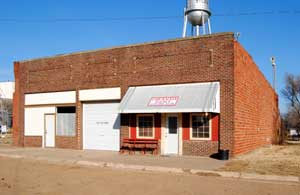
Business buildings in Sylvia, Kansas, by Kathy Alexander.
The new town grew rapidly and soon boasted a newspaper, two elevators, three lumber yards, a bank, a livery stable, and a hotel. Prosperity and growth continued through the turn of the century. Brick sidewalks were installed in 1900, and a telephone system in 1903.
By 1910, Sylvia was the third largest town in Reno County and was known for its wheat and corn crops and as a shipping point for livestock and grain. That year, its population peaked at 634. At that time, it had a bank, a mill, an elevator, a weekly newspaper called the Sun, telegraph and express offices, and an international money order post office with three rural routes. By that year, the old frame school had become overcrowded, and a new two-story brick building with a full basement was constructed on the site of the old school. Quite modern for its time, the first brick school had a room for domestic science, a laboratory, and restrooms in the basement; intermediate grades on the first floor, and upper grades, including a two-year high school, on the second floor. The school was dedicated on February 11, 1910, and named Lincoln High School in honor of President Lincoln. In the next decade, students who had completed the first two years of high school in Sylvia were sent to the Reno County High School in Nickerson for their final two years. The town gained street lights in 1911.
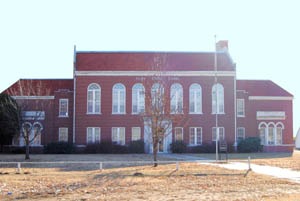
Old Sylvia, Kansas Grade School by Kathy Alexander.
By 1925, the school was overcrowded with both grade school and high school classes in the same building. By that time, total enrollment was 231 students, and plans began to build a new high school.
The Sylvia Rural High School, designed by Hutchinson architects Routledge & Hertz, was completed in November 1926. The two-story Colonial Revival-style red brick school stood as a monument to education in the small community. Its interior plan featured a modern design with a separate gymnasium and auditorium, and specialized spaces for science laboratories, manual arts, and domestic science classrooms.
The school was touted as semi-fireproof and “modern to the last word.” The gymnasium and auditorium were key features of the new school, designed and opened for public use.
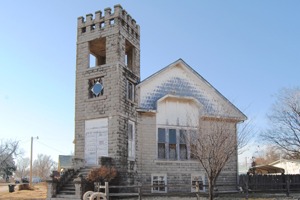
An old church in Sylvia, Kansas, by Kathy Alexander.
Just a year after the new school opened, the Sylvia High School football team was on the losing side of a lopsided game against another school from across the county, Haven. Played in 1927 with a final score of 256-0, the game produced multiple state high school records.
A new gymnasium was built on the east side of the school in 1949. A new shop building was constructed shortly after, and manual training was moved from the school to the new building.
By 1929, about 550 people were living in Sylvia, and the community’s businesses provided all basic goods and services. The local co-op, flour mill, and the railroad stockyards were primary supporters of the local agricultural economy. The town endured the challenges of the World Wars, the Great Depression, and the Dust Bowl; however, transportation advancements following World War II hastened the decline of its local economy.
By 1960, Sylvia’s population had dropped to 402, and in the next decade, the Sylvia depot, which had served as a busy freight and shipping center for more than 70 years, ceased major operations. It continued to be used as office space for the Santa Fe signal crew for the next 20 years, but was finally removed in 1886.
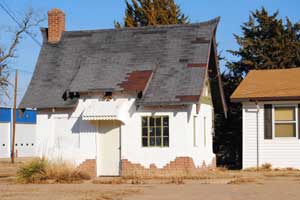
An old gas station in Sylvia, Kansas, by Kathy Alexander.
In the meantime, Unified School District 310 – Fairfield was formed in 1966 to consolidate several small schools in the area. Afterward, a new high school was built in Langdon, and Sylvia High School graduated its last students in 1969. The building became the Sylvia Grade School, serving kindergarten through 8th grade. Later, a new middle school was also constructed at Langdon, and the Sylvia school became pre-kindergarten through fifth grade and was called the Fairfield West Elementary.
However, district officials, citing the costly maintenance of the aging elementary school buildings, declining enrollment numbers, and a desire to have all students at one location, closed the Sylvia grade school in 2010.
Today, Sylvia has a population of about 200, an active grain elevator, a post office, and a church that still provides services. The old Sylvia High School, listed on the National Register of Historic Places, still stands along Old Highway 50.
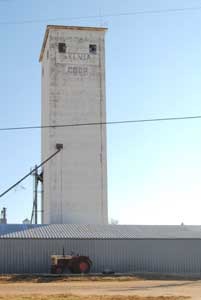
Co-op Grain Elevator in Sylvia, Kansas by Kathy Alexander.
Sylvia is located in western Reno County, about 30 miles southwest of Hutchinson, just south of Highway 50.
©Kathy Alexander/Legends of Kansas, updated April 2026.
Also See:
Sources:
Blackmar, Frank W.; Kansas: A Cyclopedia of State History, Vol I; Standard Publishing Company, Chicago, IL 1912.
National Register of Historic Places Nomination
Wikipedia