
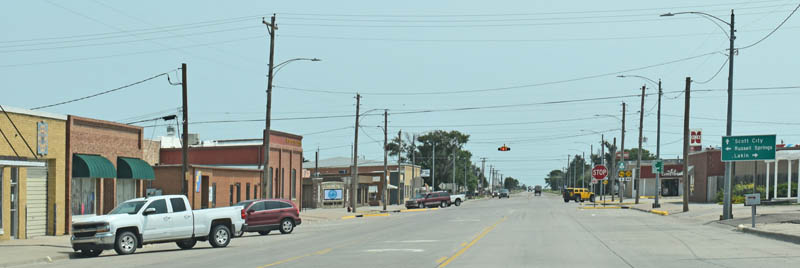
Leoti, Kansas Business District by Kathy Alexander.
Leoti, Kansas, pronounced (Lee-oh-tuh), is a city and the county seat of Wichita County in the farm country of western Kansas. As of the 2020 census, the city’s population was 1,475, and its total area was 1.31 square miles, all of which is land.
Leoti was founded in 1885 by a company of men from Garden City, Kansas. When the community first gained a post office on January 7, 1886, it was called Bonasa.
The town and post office name was changed to Leoti on February 19, 1887. The origin of the name “Leoti” is uncertain. One tradition suggests that it derives from an Indian term meaning “prairie flower.” Another theory posits that the name came from a settler named Leoti Kibbee. Additionally, some believe it was named after Leoti Gray, the daughter of a town founder.
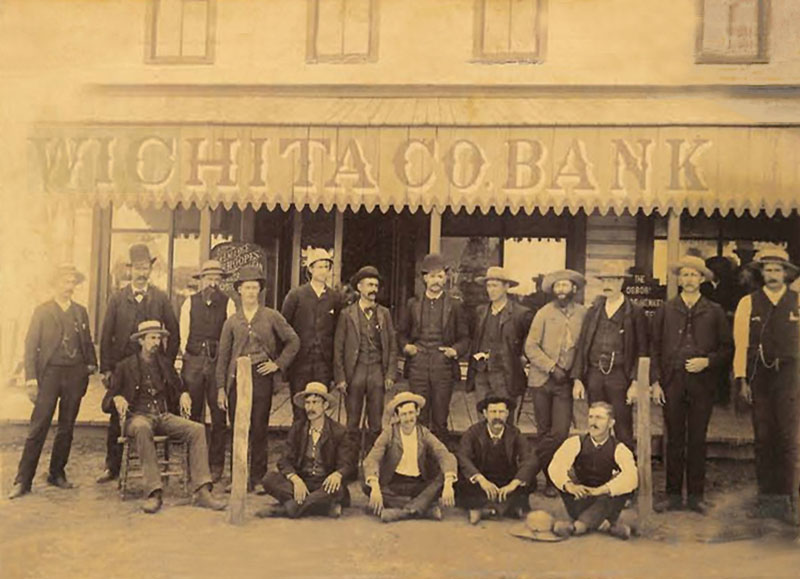
Dodge City men posing in front of Wichita County Bank, in Coronado, Kansas.
In 1887, Leoti was involved in the bloodiest county seat fight in the American West. A shoot-out occurred on February 27, 1887, when men from Leoti went to the neighboring, rival town of Coronado and left several people dead and wounded. A small town called Farmer City, located between Coronado and Leoti, was hoped by some would become the county seat, thereby ending the fighting.
Afterward, Leoti won the right to become the county seat on March 10, 1887. Now, the two other towns consist mainly of farmland.
That year, the Missouri Pacific Railroad came through Leoti. The Atchison, Topeka & Santa Fe Railroad also came through.
By 1890, the town’s population had grown to 341. Then came a depression that was common to all of western Kansas, and the population fell to 151 by 1900. Afterward, it recovered from the hard times and thrived again, as evidenced by increased population and the number of businesses.

Railroad tracks are being built in Wichita County.
In 1910, Leoti was still on the Missouri Pacific Railroad, with two banks, a flour mill, a weekly newspaper called the Standard, and tri-weekly stage lines to Lakin, Carwood, and St. Theresa. It also had telegraph and express offices, as well as an international money order post office. It was an incorporated third-class city with a population of 288 in 1910.
In the 1930s, a lack of rain and snow exacerbated many of the problems caused by the Dust Bowl. Planting rows of crops year after year in the same direction caused severe erosion of dirt and topsoil. Further, continual deep plowing of the fields in the fall each year further complicates wind erosion. Without stubble remaining in the fields of the previous crops, any amount of moisture was even more challenging to retain in the soil. During this time, everyone was affected, businessmen and farmers alike.
In 1935, President Franklin D. Roosevelt established the Works Progress Administration to provide valuable work for millions of unemployed victims of the Great Depression. The very first Works Progress Administration scheduled project in Wichita County was the “Construction of Reservoirs County Wide,” drawn up on October 2, 1935.
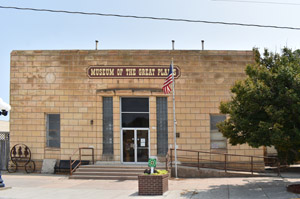
Museum of the Great Plains, Leoti, Kansas, by Kathy Alexander.
Leoti’s Municipal Auditorium and City Hall were constructed between 1939 and 1942. The one-story, restrained Moderne-style stone building was constructed as a local Works Progress Administration (WPA) project and is typical of the WPA’s simple building style. The buff colored limestone was quarried from the Frank Rody quarry in Logan County, about 20 miles north of Leoti. The prominently located building has two public façades; one faces west toward 4th Street and is the auditorium entrance, while the south façade fronts J Street and is the entrance to the city hall and fire station. The building measures 127 feet from east to west and 70 feet from north to south. The usable basement measures 127 feet east-west by 52 feet north-south. The building served as the city hall, fire department, municipal auditorium, and American Legion meeting hall. It was also used for a large variety of events, including performances, holiday celebrations, square dancing for adults, gymnastics, tap, and ballet lessons, activities, and meetings
The Municipal Auditorium served as a community building until 1965, when a new metal building was built at the fairgrounds.
The town’s population reached its peak in 1970, with 1,916 residents.
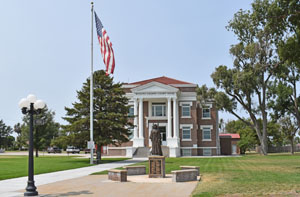
Wichita County Courthouse in Leoti, Kansas by Kathy Alexander.
In the early 1980s, the city of Leoti donated the Municipal Auditorium and City Hall to the Wichita County Historical Society. It has operated as the Museum of the Great Plains since 1983. The museum allows visitors to step back in time and experience the Old West by strolling down Leoti’s pioneer Main Street. The museum, located at 201 North 4th Street, is home to an incredible display of old west artifacts, local cattle brands, fossil finds, information on the Bloodiest County Seat Fight in Kansas, and much more. The museum is also home to the Wichita County Genealogy Society, where a wealth of resources is available to research your ancestry. Due to its association with the New Deal program, this building was nominated to the National Register of Historic Places as an example of the Civic property type. It was listed on the National Register of Historic Places in 2019. The museum is open Tuesday-Friday, 1:00 – 5:00 p.m., 620-375-2316.
Leoti is famous for its community-owned-and-operated carnival featuring 50-cent rides and games. The 100+-year-old Wichita County Fair also boasts many long-standing traditions, including a parade, Old Settlers’ Breakfast, and a rodeo. It is held on the last weekend in July and features four days of food, fun, and entertainment. It is located at 800 East “M” Street.
Visitors can check out the Wichita County Barn Quilt Tour featuring many barn quilt squares that adorn houses, barns, and businesses.
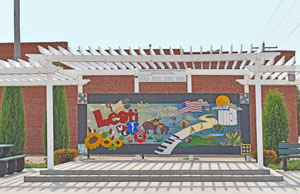
Leoti, Kansas, Mural by Kathy Alexander.
The community is served by the Leoti–Wichita County USD 467 public school district. The Wichita County High School mascot is the Wichita County Indians.
Leoti is about 25 miles west of Scott City.
©Kathy Alexander/Legends of Kansas, updated February 2026.
Also See:
Sources:
Blackmar, Frank W.; Kansas: A Cyclopedia of State History, Vol I; Standard Publishing Company, Chicago, IL 1912.
National Register of Historic Places
Travel Kansas
Wikipedia