
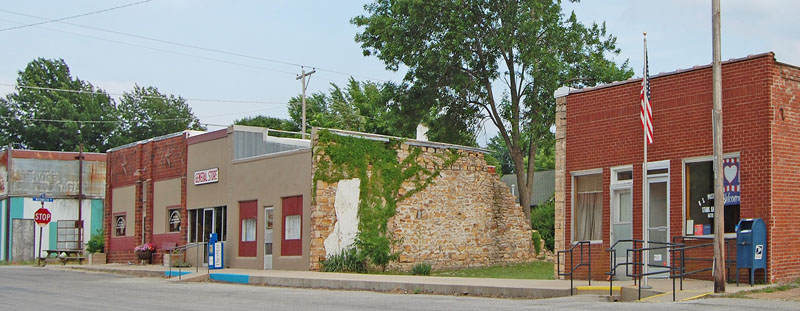
Stark, Kansas Business District by Kathy Alexander.
Stark, Kansas, is a small town in Grant Township of Neosho County. As of the 2020 census, the city’s population was 69, and its total area was 0.17 square miles, all land.
The youngest town in the county, Stark, was established in 1885 as Grant Center to provide a marketplace and trading point for the area. It was not a promoted town, nor a boom town, for the railroad had not been built through the vicinity. It derived its name from its nearness to the center of Grant Township. At that time, there was only a schoolhouse on the corner, known as the Grant Center.
A post office was established on January 7, 1886, with Frank Leighton appointed as postmaster. It was named “Stark,” in honor of Stark County, Illinois, his birthplace. The store and post office he built were just south of the schoolhouse.
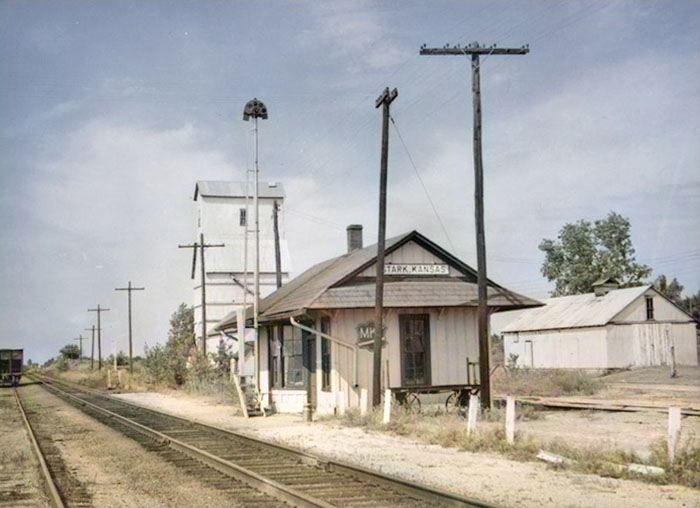
Missouri, Kansas & Texas Railway depot in Stark, Kansas by H. Killam, 1959.
Stark was laid out and platted in July 1888, after the arrival of the Kansas City & Pacific Railroad, which maintained passenger and freight depots in the town. The railroad entered the county from the south, crossed the line about two miles east of the center, and ran northeasterly before it passed out of the county about three miles west of the northeast corner. The stations on this line were Dudley, Hertha, Erie, Kimbal, and Stark.
At about that time, Frank Leighton sold his store to John Keen while they were laying the Missouri, Kansas & Texas Railway, and resigned as postmaster.
The Stark schoolhouse, with several teachers employed, was first used in the summer of 1888. It continued to serve Stark and the surrounding area for a period after the town’s establishment.
That year, Dr. William C. Cecil and his family came to Stark and soon enjoyed the complete confidence of a wide circle of friends in Neosho and adjoining counties.
The railroad soon became the Kansas City Division of the Missouri, Kansas & Texas Railway and remains active today as part of the Union Pacific Railroad.
The first grain elevator in Stark was erected by Hinsen & Herald in the summer of 1888.
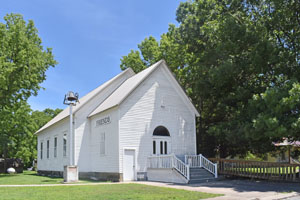
The Friends Church in Stark, Kansas, by Kathy Alexander.
The Friends congregation at Stark utilized the Grant Center schoolhouse, which was used just before the church was erected. In the fall of 1888, Joseph Henley Bundy, his three sons, and a daughter announced the gift of three lots in Stark for a “Quaker Meeting House,” the deed being dated July 26, 1889.
Most of the houses in the village of Porterville in Bourbon County were moved to Stark in 1889.
The Chard broom factory was moved to Stark in 1890.
The Friends church building was dedicated on June 15. 1890, with Lindley A. Wells serving as the first pastor.
The Methodist Church of Stark was first organized in the late 1880s, about two miles southeast of Stark, and was known as the Shiloh Church. When the town of Stark was founded, Dave Herrold opened a lumber yard there and was instrumental in moving the church to the new town in 1891. Reverend Ashbaugh and Reverend Leigh were among the early pastors.
David F. Deem, a druggist and chemist, established his business in 1896. His store was one of the city’s essential businesses, popular and thriving.
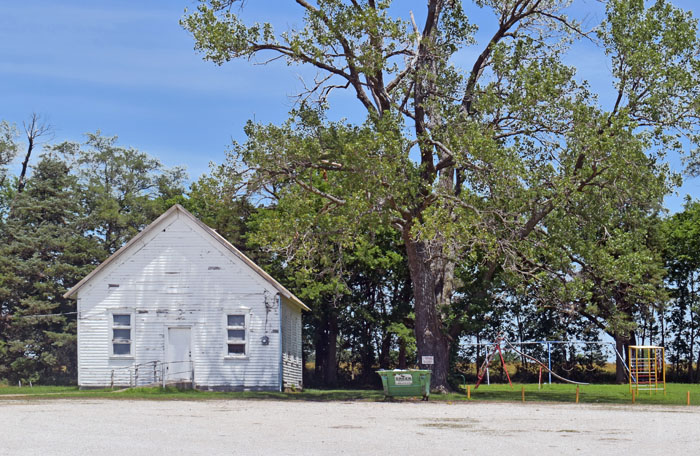
An old one-room school in Stark, Kansas, by Kathy Alexander.
In 1897, a new Grant Center School building was constructed for use as a grade school.
Dr. Arthur E. Hewett came in 1899.
On December 2, 1900, eight business buildings went up in smoke, including Singleton’s hardware, A.L. Worley’s harness shop, D.F. Deem’s drug store, Dr. Cecil’s office, Hennessy’s meat market, and four other buildings.
The firm of Chambers & Kimball began business in Stark in February 1901. Theirs was a general store and one of the county’s large and popular businesses. Later, Mr. Chambers exchanged his interest in Stark for a farm near Hepler, Kansas.
Stark was piped for gas in September 1901, the gas supply coming from local wells. However, it did not last long.
In 1902, several businesses were established, including: D.F. Deem, a druggist and editor of the Stark News; Singleton & Son, hardware and implements; Wells & Pike, department store; Mrs. W.W. Pike, millinery; R.T. Chaney, general merchandise; Harper & Hess, general merchandise; Dr. W.C. Cecil; A.B. Roberts, manger of the Chanute Grain Co.; Harper & Smith, real estate; A.E. Benny, harness dealer; J.A. Smith, stock buyer and feeder, meat market; J.R. Cotton, produce dealer; J.J. Allen, blacksmith; I.W. Teeple, furniture and undertaking; Thomas Wells, grain and implements; T.M. Smith, barber; E.W. Moore, livery stable; J. M. Jones, Mentor Hotel; Burgner-Bowrrian Lumber Co., C.E. Munday, mgr.; Henson & Co., confections and jewelry; W. Keen, shoemaker; and J.F. Cooper, horse buyer.
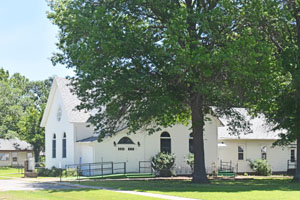
Methodist Church in Stark, Kansas by Kathy Alexander.
That year, the grain elevator was acquired by the Benedict Grain Company, with A.D. Roberts as manager.
The Stark State Bank was founded in 1903, and the First National Bank was founded in 1904. Both banks marked their 50th anniversaries, and Stark State Bank marked its 55th anniversary.
The Farmers Telephone Exchange in Stark was organized in June 1905, with John Lambdin as president. The switchboard was installed soon after.
In 1907, the four-room school building employed three teachers and afforded excellent educational opportunities. The course included two years of high school work.
In 1910, Stark was still on the Missouri, Kansas & Texas Railway, at which time, it had a bank, several stores, telegraph and express offices, a money order post office with one rural route, and a population of 191.
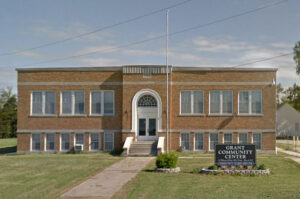
Stark School/Grant Community Center, courtesy Google Maps.
The school building was also used as a high school from 1912 to 1930, when the Grant Township High School building was completed.
Grant Murray owned the grain elevator when it burned on June 21, 1913.
The local Farmers Union erected a new grain elevator, which was later owned by the Burgner-Bowman and the Mathews Lumber Company, with Robert Williamson as the manager.
Stark’s population peaked at 197 in 1930. That year, the Grant Township High School was built of brick and was nicely arranged and equipped for a first-class high school.
The Teas hatchery was established in 1932.
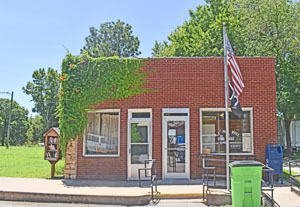
Post Office in Stark, Kansas by Kathy Alexander.
On December 18, 1938, fire destroyed the V.J. Mix grocery, Lillie Smith Creamery Co., and Olson’s store.
The former Stark High School building was renovated in 1993 by the school’s alumni. Today, it serves as the Grant Community Center.
Today, the community is served by the Erie–Galesburg USD 101 public school district. The nearest cemetery to Stark is the Huff Cemetery, located about three miles north.
Stark is located east of U.S. Route 59 on K-201, about 12 miles northeast of Erie.
©Kathy Alexander/Legends of Kansas, January 2025.
Also See:
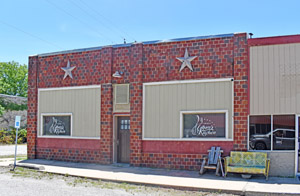
A business building in Stark, Kansas by Kathy Alexander.
Sources:
Cyclopedia
Duncan, L. Wallace (1902). History of Neosho and Wilson Counties, Kansas. Monitor Printing Company, 1902
Wikipedia