

Wilson County, Kansas by L.H. Everts & Co., 1887.
Guilford, Kansas, was a small town on the Verdigris River in Guilford Township of Wilson County. The old townsite is abandoned today.
Guilford’s history dates to May 1861, when J.H. Gunby built the first log cabin on the townsite on the west side of the Verdigris River. Gunby had intended to move into his cabin, but was motivated to seek elsewhere when the Osage Indians burned it down. Gunby then settled on Buffalo Creek.
In 1865, following the Civil War, a treaty was concluded with the Osage Indians in the fall. Many settlers then began moving in, all locating on precious bottom claims. Alex Shawver, H.T. Amsden, William Ball, and others took claims prior to or during 1865.
Andrew Akin and sons, Carlos G., and Charles M settled in the fall of 1867.
A post office was established on July 23, 1868, with Andrew Akin as postmaster.
Mr. Samuel Morse opened a store at Guilford on the west side of the town in 1869.
The Verdigris River was dammed, and the Akin flour mill was constructed in 1870. Another store was established that year by Luke Brook on the east side. The first issue of the Wilson County Citizen was published in Guilford, Kansas, on April 21, 1870, and was titled the Guilford Citizen. It was published by John S. Gilmore, a practical printer of Emporia, Kansas. It was a seven-column folio of pronounced Republican politics. That year, robbers and bandits found Guilford a good place to stay.
“During the last ten days, our county has been troubled by a gang of horse thieves who have displayed a boldness in their operations which is rarely to be met with, even among these longhaired bad guys.”
— Guilford Citizen
At that time, Guilford was a mere hamlet of ten or a dozen houses.
Guilford was formally planned in 1870 by the Guilford Town Company and incorporated by charter on August 5. The same year, a law office, a doctor’s office, a printing plant, a shoe shop, a blacksmith shop, and a snakebite antidote resort were established.
John S. Gilmore, the editor of the Guilford Citizen, soon decided that his newspaper prospects did not assure much fame or fortune, and on October 22, 1870, Vol. 1, No. 27, the paper contained its own obituary. Afterward, the printing materials were moved to Neodesha, one of the most frugal and promising towns in southern Kansas, which didn’t have a newspaper.
Guilford’s post office briefly closed on October 2, 1871. However, it reopened on December 1, 1871.
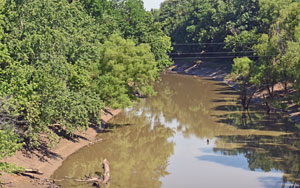
Verdisgris River in Wilson County, Kansas by Kathy Alexander.
In 1881, Guilford had a general merchandise store, a physician, a nursery, a miller, and several area farmers.
Gilford rapidly declined until 1886, when the Atchison, Topeka & Santa Fe Railroad and the Missouri Pacific Railroad were constructed through nearby Benedict, Kansas.
Guildford’s post office closed again on August 17, 1886, when it was moved to Benedict.
Many of the town’s buildings, including the post office, were relocated to Benedict from 1888 to 1889.
Guilford’s post office was resurrected on February 29, 1888.
It post office closed again on September 30, 1895. However, it was reopened on April 17, 1896.
A station on the Missouri Pacific Railroad in Guilford Township, it had a money order post office and a population of 32 in 1910.
Guilford’s post office closed for the final time on August 31, 1922.
Guilford was about three miles southeast of Benedict, Kansas, and eight miles northeast of Fredonia.
©Kathy Alexander/Legends of Kansas, January 2026.
Also See:
Extinct Towns of Wilson County
Sources:
Wilson County Directory, 1881
Wilson County Historical Society