
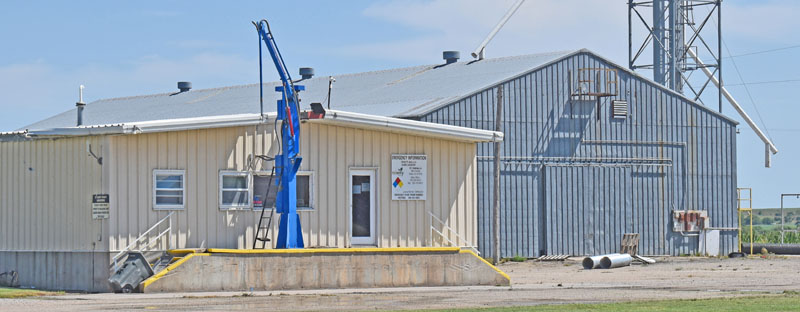
Agricultural Buildings in Glade, Kansas by Kathy Alexander.
Glade, Kansas, is a small town in southern Phillips County. It is also an “extinct” town, as its post office closed years ago. As of the 2020 census, its population was 52, and its total area was 0.25 square miles, all land.
Reverend Allen Enyart organized the first Methodist Episcopal organization in Phillips County, with John Sheckler as the first class leader. The meetings were held seven miles west of Kirwin, in what is now Glade. The Members were Thomas Cox, John Sheckler and wife, William Ray and wife, Allen Ward and wife, and Harry Hill. The first meeting was held at John Sheckler’s house, September 11, 1870.
This settlement was formed in 1871 on the north fork of the Solomon River. It was first called Chillicothe when a post office was established on August 27, 1872.
Peter Hansen of the firm of Wiltrout & Hansen, proprietors of Logan Flouring and Grist Mills, erected two flour mills in 1875. In size, they measured 32 by 50 feet, were two and one-half stories high, and had a capacity of 75 barrels per day. This mill cost $5,500. Afterward, he steadily expanded, and the mill was worth at least $10,000.
In 1878, the townsite was laid out by Lafayette and Eliza Nay. At that time, Chillicothe had a tri-weekly stage line to Kirwin and a weekly line to Hays City, which carried the mail, which was delivered to Amanda A. Pratt, the postmistress. The area people exported wheat and pork via the Kansas Pacific Railroad in Hays City, its nearest shipping point, some 60 miles distant. At that time, it had a Methodist preacher.
C.H. Edgecombe, an attorney who dealt in real estate, land, loans, and insurance, came to Chillicothe from Nebraska in 1879. His wife was the proprietor of the drugstore and kept a general stock of drugs, medicines, and druggists’ sundries. Dr. I. Miley, a physician and surgeon, arrived in the same year.
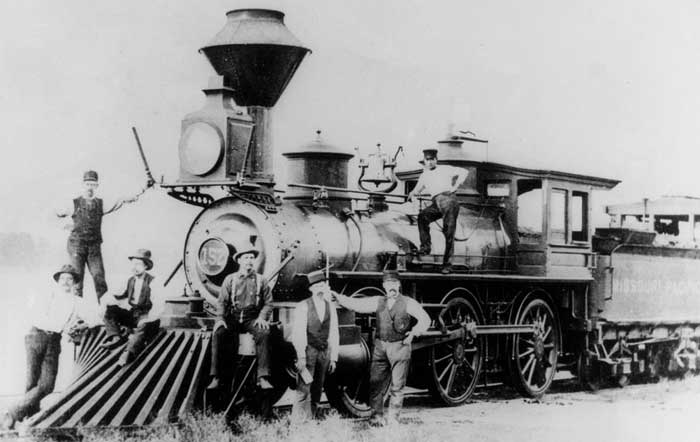
Missouri Pacific Railroad Locomotive.
Afterward, with the help of the railroad and the location of the shipping port on the Atchison and Lenora division of the Missouri Pacific Railroad, the town enjoyed healthy growth over the coming years. The railroad was a significant benefit to the county’s residents, providing materials and employment for the towns’ citizens.
On April 8, 1881, the town and post office were renamed Marvin after a local lieutenant overseeing Indian affairs.
That year, Dr. D.W. Stevens, a dealer in the general line of drugs, medicines, and druggists’ sundries, located at Marvin in the spring, and embarked in the drug trade with a stock of about $500. His store building was erected at a cost of $1,050 and measured 20 by 36 feet.
In 1882, Marvin was enjoying considerable trade. Its milling interests were larger than anywhere else in the county, with two excellent grist mills. The sale of grain was good, and stock was displayed on the merchants’ counters; they enjoyed a thriving trade. At that time, it had three general stores, two drug stores, a hotel, a blacksmith shop, a hardware store, and a livery stable. The Methodists had a large stone church.
Marvin was platted in 1883.
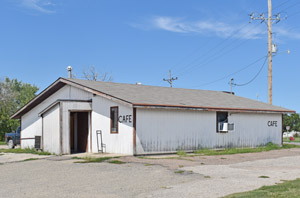
Glade, Kansas Cafe by Kathy Alexander.
There were problems with mail delivery to Marvin and Marion (in Marion County) because of the similarity of their names, so a petition was filed in 1908 to change Marvin’s name. On July 1, 1908, the town’s name and post office were changed from Marvin to Glade.
In 1910, Glade was still on the Atchison & Lenora division of the Missouri Pacific Railroad. At that time, it had a money order post office with two rural routes, telegraph and express offices, a good local retail trade, and was a shipping point of some importance, and had a population of 175.
Glade was incorporated in 1948.
Glade’s population peaked at 180 in 1970.
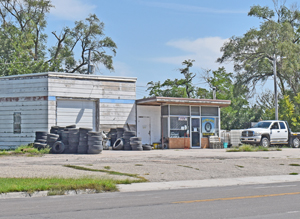
Old gas station in Glade, Kansas by Kathy Alexander.
At some point, the railroad through Glade was abandoned and its tracks removed.
Glade’s post office suspended service on June 30, 1989. It was officially closed in 1996.
Today, the community is served by the Phillipsburg USD 325 public school district.
The small town still has a cafe, a collision repair shop, numerous homes, several agricultural buildings, and the Marvin Cemetery is nearby. Its Methodist Church, which officially closed as an active congregation in 2018, is still used for special events
Glade is six miles south of Phillipsburg, the county seat.
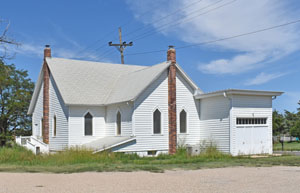
Old Methodist Church in Glade, Kansas by Kathy Alexander.
©Kathy Alexander/Legends of Kansas, January 2026.
Also See:
Extinct Towns of Phillips County
Sources:
Blackmar, Frank W.; Kansas: A Cyclopedia of State History, Vol I; Standard Publishing Company, Chicago, IL 1912.
Cutler, William G.; History of Kansas; A. T. Andreas, Chicago, IL, 1883.
Phillips County History
Phillips County Directory, 1878
Wikipedia