
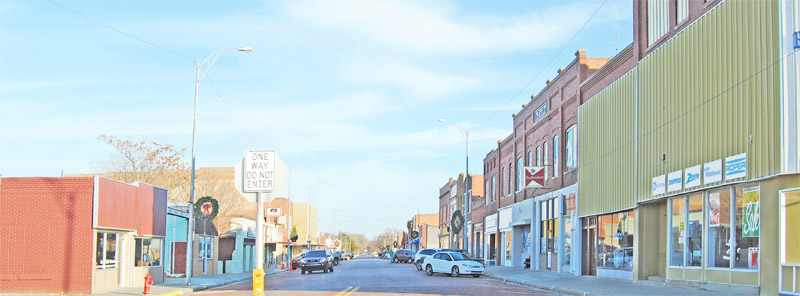
Downtown Kinsley, Kansas, by Kathy Alexander.
Kinsley, Kansas, is a city and the county seat of Edwards County. As of the 2020 census, the city’s population was 1,456, and its total area was 1.29 square miles.
Dr. Samuel Rodgers of Chicago, Illinois, founded the town in 1872, and it was initially called Peters. The townsite was then in Pawnee County. The railroad had built tracks to the present site of Kinsley by August 1, 1872. The town was laid out in 1873.
Meanwhile, F.C. Hawkins was appointed to take the census to organize Pawnee County. He had men on an immigrant train sign a petition stating that they were legal electors living in Pawnee County. The petition required 40 names, but not enough legal electors lived in the county. Afterward, Hawkins had to find 600 residents, and he reported counting 674. Dr. Samuel Rodgers reported the fraudulent count to authorities in Topeka, Kansas, but the Legislature and the governor ignored him and organized Pawnee County anyway.
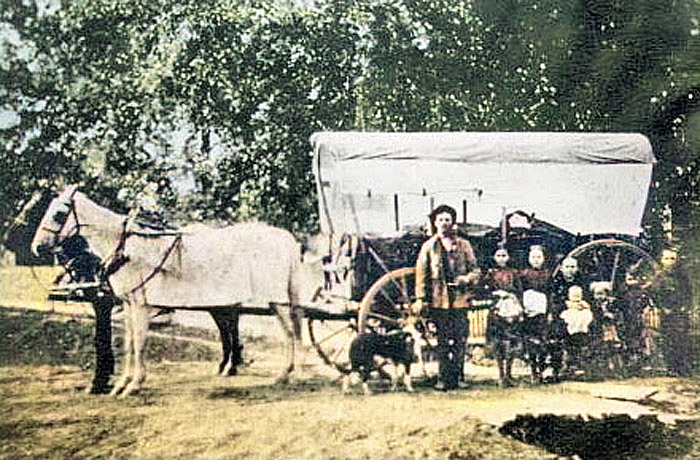
Pioneers coming to Kinsley, Kansas.
Dr. Rodgers continued to work on improvements in Peters. A telegraph office and the Buffalo Hotel opened in the first few months of 1873. Most of the community’s first residents came from New England, especially Massachusetts, drawn by the New England Homestead and Colonization Bureau, also known as the “New England Colony” or “Massachusetts Colony.”
The first post office in Kinsley was established as Peters on April 23, 1873. Boles was the first postmaster.
The Kinsley Reporter was established as a monthly in 1873.
The school district was organized in 1874. That year, efforts to begin a new county started in mid-1874. The first census showed only 301 residents in May, but the people asked for another census. In August, the second census showed 633 residents.
When Dr. Rodgers was away, Captain Henry Booth, the founder of Larned, went to the Legislature, and they passed a bill that changed the boundaries of Pawnee County. The main purpose was to remove the southern townships, thereby placing Larned at the center of the county and leaving Peters and Garfield out. Eventually, however, Garfield was restored to Pawnee County, but the 13 other townships were left without a county.
On January 19, 1874, Peters was renamed Kinsley after Edward Wilkinson Kinsley, a Boston, Massachusetts, capitalist. Mr. Kinsley had promoted the town for the New England Homestead and Colonization Bureau, which had joined forces with Dr. Samuel Rodgers and agreed to build a church if the community was named after him. Kinsley followed through and built the church for $2,000.
E.A. Noble, a dealer in general merchandise, of the firm of Edward Bros., Noble & Marsh. They carried an average stock of $15,000 and employed six men. They opened trade in 1876. It was the largest store in Edwards County. Mr. Nobles became a partner in 1878. He first came to Kinsley, Kansas, in 1877, and prospected and clerked in a store for some time. He was born in Summit County, Ohio, on October 19, 1842, and was raised and educated in Pittsburgh, Pennsylvania. He followed the milling business early in life. He enlisted on August 9, 1862, in Company E, 123rd Pennsylvania Volunteer Infantry, and re-enlisted in Company D, 77th Pennsylvania Volunteer Infantry.
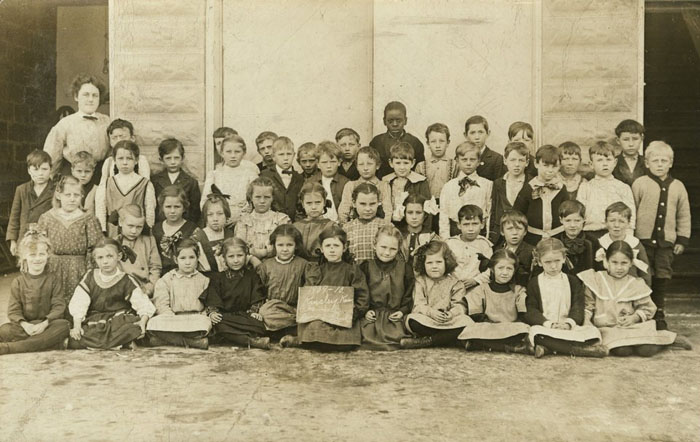
Grade School students in Kinsley, Kansas.
A school building was erected in 1877.
John E. Willey, a dealer in hardware and groceries, opened trade in April 1877 at Kinsley, in a general hardware line, and added groceries in August 1880. His store building measured 20 by 44 feet at the front and 24 by 40 feet at the back, for a total length of 84 feet, and was erected in April 1877 for $1,000. He carried an average stock of $4,000 and employed two men. He first came to Kinsley in December 1876. He was born in Sussex County, Delaware. He married Miss Sallie Seaman of Philadelphia, Pennsylvania, in 1876. He served as Justice of the Peace of Kinsley Township. He represented Edwards County in the Kansas Legislature of 1879.
L.G. Boies came to Kinsley in August 1877 and kept books for Edwards Brothers until he became the Cashier of the Edwards County Bank. He was born in Homer, Cortland County, New York, on March 20, 1847, and was raised and educated in his native county. Lived in Marengo, McHenry County, Illinois, for two years previous to emigrating to Kansas. He studied at Cornell University, Ithaca, New York, and graduated in the class of 1873. Being educated for the law profession, he entered the law office of A. B. Coons, of Marengo, Ill., and remained some time as a student. Then he pursued agricultural pursuits until he came to Kansas. He married Miss Ella Stone of Homer, New York, in 1876. They have two children, Emma Kate and Bessie Alice. He is the present Mayor of Kinsley, Kansas.
George W. Fulton, proprietor of the Anchor Steam Flouring Mills of Kinsley, erected these mills in the spring of 1878 for $20,000. They measured 30 by 50 feet, were three stories high, and included a one-story engine room measuring 23 by 30 feet. It had a 40-horsepower engine, a capacity of 300 bushels of wheat every 24 hours, and employed five men. He first came to Rice County, Kansas, in 1873, and farmed until he came to Kinsley. He was born in Fayette County, Pennsylvania, and moved with his parents to Ohio, where he was raised as a farmer. He enlisted in the spring of 1861 in Company E, Twenty-first Regiment Missouri Volunteer Infantry. He was afterward commissioned to raise a company, and after completing the full quota, was made captain of the same. He was a conspicuous Union man. He was assigned to the Twenty-first Missouri Regiment and was soon promoted to Major. He afterward followed the milling and mercantile business until he came to Kansas. He married Miss Hannah Sycks of Perry County, Ohio, in 1847.
John F. Marsh, a member of the firm of Edward Bros., Noble & Marsh, first came to Kansas in spring 1878 and settled there. He clerked in a store for some time and then became a partner in the above business on December 1, 1879. He was born in Tompkins County, New York, and was raised and educated there. He married Miss S. Bidwell in September 1882, an Illinois native.
The city government was incorporated in 1878.
By the early 1880s, Kinsley stretched over a large area, extending far on both sides of the railroad track. It had suffered famine, pestilence, and fire; it had also had two boldly planned train robberies.
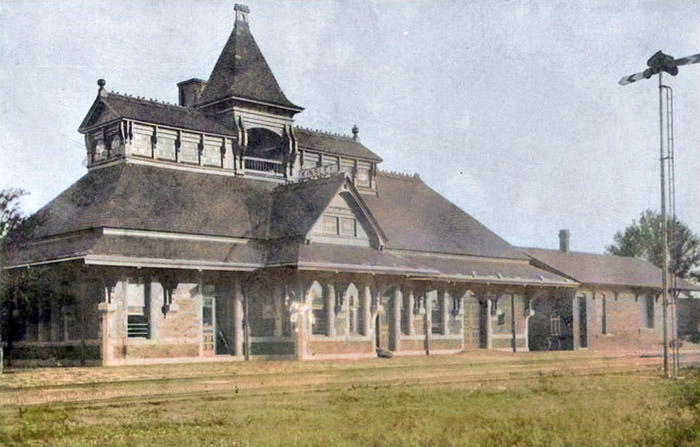
Atchison, Topeka & Santa Fe Railroad in Kinsley, Kansas.
Kinsley was abundantly supplied with stores of different kinds, with banks, mills, lumber-yards, and mechanics of almost every kind. It had the Ohio House, the Carlin house, and the pleasant and spacious eating house of the Atchison, Topeka & Santa Fe Railroad, situated a few rods West of the station, where the noonday meals were furnished to eastern and western passengers. Three resident clergymen, including the Reverend William M. Honnell, an early Kansas Missionary, ministered to the Presbyterian organization at stated intervals. The legal and medical professions were well represented, and from their ranks, men have arisen here of quite some marked distinction.
By that time, Kinsley was a city of the third class, and its city officers can be enrolled as follows: Mayor, L.G. Boies; Police Judge, P.C. Clapp; Clerk, H.C. Bingham; Treasurer, W.D. Erwin; Attorney, J.W. Crawford; Marshal, W.A. Snow; Councilmen, S.F. Griffith, John Fulton, George Grassell, I.V. Lewis, and Charles Reitler. Several secret organizations exist here in good standing.
The Edwards County Bank was chartered on September 18, 1882, and opened for business on October 17 with an authorized capital of $50,000 and a paid-up capital of $30,000. R.E. Edwards was President; E. Howard, Vice-President, and L.G. Boise, Cashier.
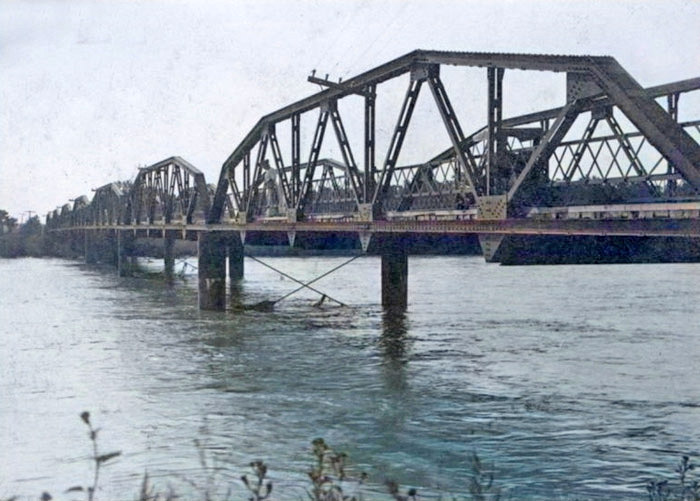
Arkansas River bridge in Kinsley, Kansas.
On December 9, 1882, a bank robbery occurred, in which the County Treasurer, J.W. Crawford, was seemingly implicated, and another afterward performed the duties of his office. The robbery proved to be but a small loss; all of the $12,000 supposed to have been taken therefrom was recovered, except about $400.
In 1910, Kinsley was at the junction of two Atchison, Topeka & Santa Fe Railroad lines and near the Arkansas River. At that time, it had about 100 business establishments, including a flour mill, a cement and brick plant, two banks, and two weekly newspapers called the Graphic and the Mercury. The city also had waterworks, churches, good public and high schools, daily stagecoach service to Fellsburg and Fullerton, telegraph and express offices, an international money-order post office with two rural routes, and a population of 1,547.
In 1924, the Commission/City Manager form of government was adopted.
In 1928, the Kinsley City Commission appointed V.I. Milner as Kansas’s first woman City Manager.
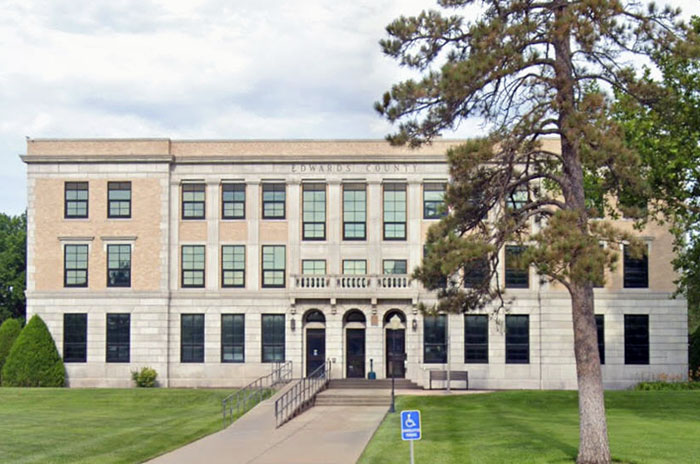
Edwards County Courthouse in Kinsley, Kansas, courtesy of Google Maps.
The Edwards County Courthouse was built in 1928. Kinsley City Hall was built in 1954.
Today, Kinsley sits at the intersection of U.S. Highways 50, 56, and 183 in the middle of the fertile farmland and recreational opportunities of the Arkansas River Valley. It is located about eight miles West of the center of the county, approximately 35 miles East of Dodge City.
©Kathy Alexander/Legends of Kansas, updated September 2026.
Also See:
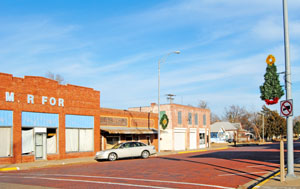
Business buildings in Kinsley, Kansas by Kathy Alexander.
Sources:
Blackmar, Frank W.; Kansas: A Cyclopedia of State History, Vol. I; Standard Publishing Company, Chicago, IL 1912.
City of Kinsley
Cutler, William G.; History of Kansas; A. T. Andreas, Chicago, IL, 1883.
Fort Hays State University
Wikipedia