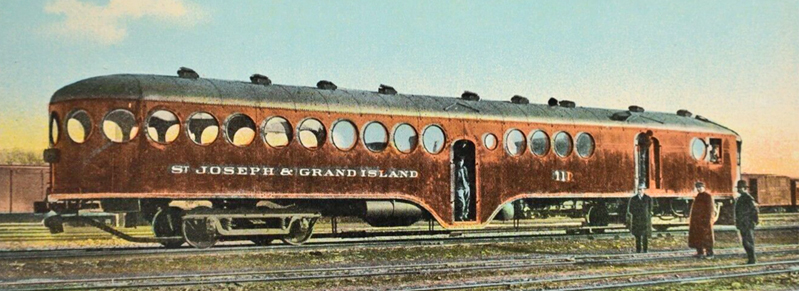
St. Joseph & Grand Island Railroad.
The St. Joseph & Grand Island Railway began as the St. Joseph & Denver City Railway, which, after several changes of destination, was completed as the St Joseph & Western Railroad between St. Joseph, Missouri, and Hastings, Nebraska, in 1872.
This abandoned railroad once played a very important role in the battle for railroad traffic in the Midwest. The predecessor of St. Joseph’s laid its first rail in 1860, making it the first railroad in the state of Kansas, just five miles West of Elwood, across the Missouri River from St. Joseph, Missouri.
In 1862, the early road, the Palmetto & Roseport Railroad, changed its name to the St. Joseph & Denver City Railway, reflecting its hoped-for destination of Denver, Colorado, a rapidly growing boom town 560 miles to the West.
The railroad struggled throughout the 1860s to gain financial investors. It was a small road among several with grand plans to connect the towns on the Missouri River with the mining towns in the Rocky Mountains, and to connect with the Union Pacific Railroad’s transcontinental line, which was being rushed to meet the Central Pacific Railroad in the Utah Territory. After the Kansas Pacific Railroad gained success in 1866 at changing its destination from the middle-of-nowhere to the 100th meridian to Denver, Colorado, the St. Joseph & Grand Island Railway decided to head northwest to a connection with the Union Pacific in central Nebraska.
By 1869, only 14 miles of track had been laid, but within three years, in December 1872, the St. Joseph & Denver City Railway reached Hastings, Nebraska, 227 miles from St. Joseph.
In 1873, a separate company completed a bridge over the Missouri River in St. Joseph, Missouri, providing a more direct route for railcars and eliminating the time-consuming use of cross-river ferries. This iron truss swing bridge was fabricated by the Detroit Bridge & Iron Works.
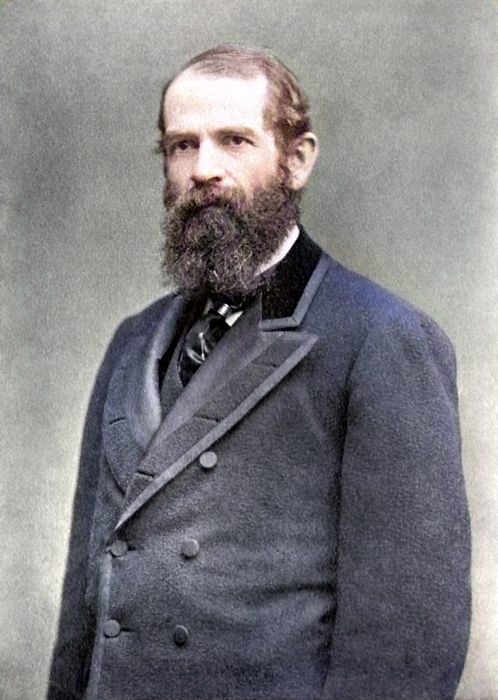
Jay Gould, American financier.
In the mid-1870s, New York financier Jay Gould and his associates on Wall Street began using the railroads serving Iowa and Missouri as tools in their strategy to gain control over all railroad traffic in the Midwest, from Chicago to the Missouri River. Control of these railroad companies was bought and sold like playing cards, and St. Joseph’s found itself entangled in the conflict as Gould and his rivals negotiated and competed for power.
The Jay Gould battles led to the foreclosure and reorganization of the St. Joseph & Denver City Railroad in 1875, which became the St. Joseph & Western Railroad. It extended 109 miles West from St. Joseph, Missouri, to Marysville, Kansas, and continued another 120 miles to Hastings, Nebraska. In 1879, the Hastings and Grand Island Railroad completed a 21-mile line connecting Hastings to Grand Island. St. Joseph later purchased this company, gaining a direct link to the Union Pacific mainline.
By 1880, Gould had exhausted almost everyone involved and turned his attention to other money-making schemes, but his shadow was always in the background as the dust settled, as others tried to make some sense out of the financial mess.
The Union Pacific Railroad wanted a connection with Kansas City, Missouri, to supplement its eastern terminal on the Missouri River at Omaha, Nebraska. Having connections with other railroads at both Omaha and Kansas City would allow the Union Pacific Railroad to take a much larger share of the railroad pie, and the Union Pacific saw the St. Joseph as a much-needed addition to its growing system of branches. Union Pacific began buying shares of the St. Joseph, but also began starving the road, holding back connecting traffic. By late 1883, the St. Joseph was in default of its financial obligations due to shrinking revenues, and the company was foreclosed on in January 1884. It emerged from bankruptcy in June 1885 as the Union Pacific-controlled St. Joseph and Grand Island Railroad.
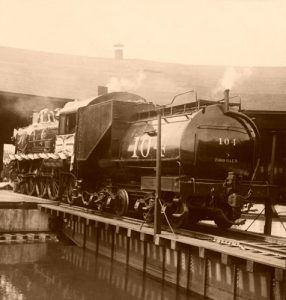
Union Pacific Railroad Engine by H.C. White, 1905
Union Pacific lost its battle with its bondholders and, on October 13, 1893, declared bankruptcy. It was a large empire of interconnecting mainlines and branches, each with its own unique financial arrangements and collateral for the construction loans. The St. Joseph was among the smaller roads that fell during the Union Pacific collapse. A separate receiver was named to look after the interests of the financial backers, and a new company emerged in February 1897, with a slight change in its name: St. Joseph and Grand Island Railway, instead of Railroad. The new company had every intention of becoming an independent railroad, free from the control of Union Pacific or any other large road that wanted branches in the region.
The Union Pacific Railroad lost control of the St. Joseph & Grand Island in 1898.
The St. Joseph & Grand Island Railway became an essential part of the Union Pacific Railroad’s system, providing a connection from the transcontinental mainline to eastern Kansas, and the Union Pacific Railroad undertook several steps to improve it.
By 1904, the iron truss bridge in St. Joseph, Missouri, had become too light for traffic and was replaced with a new bridge reusing the stone piers. It utilized two 298-foot and one 295-foot 12-panel pin-connected Pennsylvania through trusses, with a 358-foot pin-connected swing span.
The Union Pacific Railroad regained control of the St. Joseph & Grand Island in 1906.
In 1914, a connection was made between the Union Pacific’s mainline at Gibbon and Hastings, providing a shorter route than through to Grand Island. Also, a connection was made between Marysville on the St. Joseph & Grand Island Railway and Topeka in 1906, through which Union Pacific’s Kansas Pacific Railroad’s mainline provided access to Kansas City.
After the January 1936 system consolidation, the line was operated by the Union Pacific Railroad as the St. Joseph Branch, which it had acquired in 1897.
Use of the Hastings-to-Gibbon cutoff through Doniphan County, Kansas, gradually declined. It was abandoned in 1989.
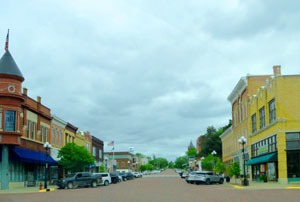
Marysville, Kansas today by Kathy Alexander.
Today, the portion of the St. Joseph & Grand Island Railway between Hastings and Marysville remains a core part of the Union Pacific Railroad’s mainline, seeing dozens of trains per day. The St. Joseph & Grand Island Railway exists East of Marysville as far as Hiawatha, Kansas, and is part of Union Pacific’s Hiawatha Subdivision. The line is a westbound-only mainline, primarily handling empty coal trains as well as merchandise and intermodal trains. These trains originate in Kansas City, Missouri, and travel on Union Pacific’s Falls City Subdivision to Hiawatha, then continue West to Marysville, Kansas, thereby increasing capacity on the Marysville Subdivision. A short stub exists at Grand Island to serve a nearby power plant.
In 1915, the pivot pier of the 1904 iron truss bridge in St. Joseph, Missouri, showed severe deterioration, prompting concerns about the other piers as well. The initial plan to build new piers downstream and shift the spans was rejected by the War Department, which required a larger swing span.
A revised design shifted the three Pennsylvania spans 140 feet westward and installed a new 465-foot riveted Warren through truss swing span. An additional 80-foot and 60-foot deck plate girder spans were added at the East end of the bridge.
Today, the iron truss bridge in St. Joseph, Missouri, is used by the Union Pacific Railroad to access industries in Elwood a handful of times each week.
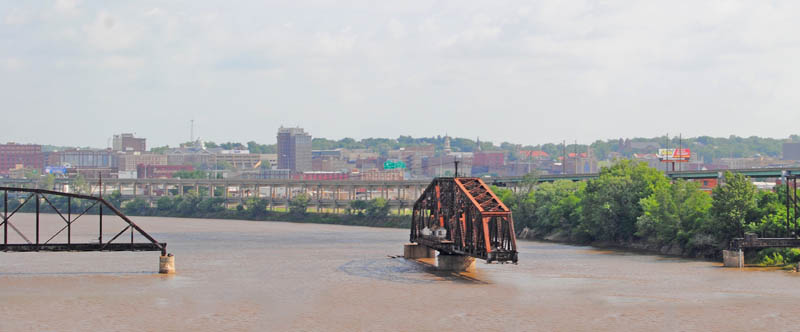
Iron truss bridge in St. Joseph, Missouri, by Kathy Alexander.
©Kathy Alexander/Legends of Kansas, updated July 2026
Also See:
Sources:
Explore Nebraska History
John Marvig Railroad Bridge Photography
Utah Rails
Wikipedia