
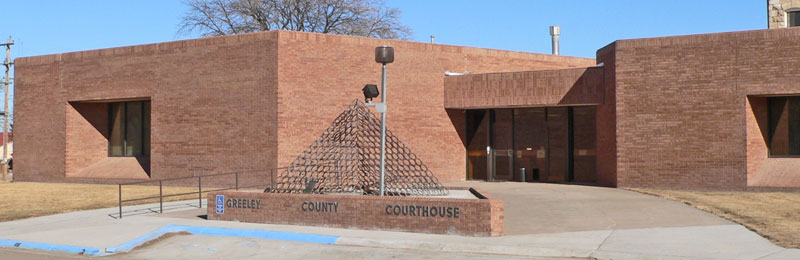
Greeley County, Kansas Courthouse in Tribune, courtesy of Wikipedia.
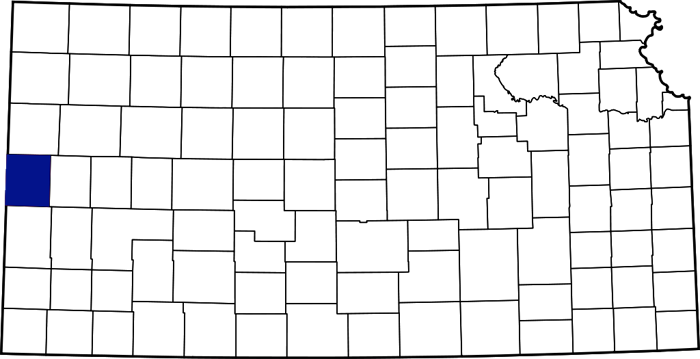
Greeley County, Kansas Location
Towns & Places:
Horace – Ghost Town
Tribune – County Seat
The Ghost of White Woman Creek
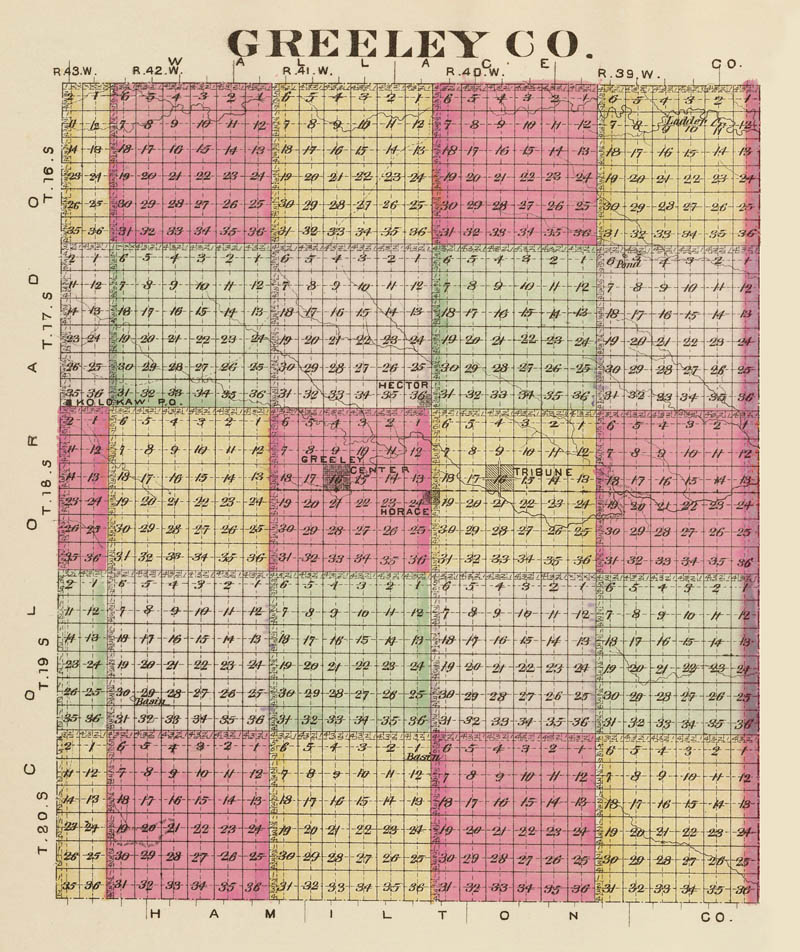
Greeley County, KS by L.H. Everts & Co., 1887.
Greeley County, Kansas, on the western tier, is midway between Oklahoma and Nebraska. Its county seat and largest city is Tribune. As of the 2020 census, the population was 1,284, making it Kansas’s least populous county. The county is named after Horace Greeley, editor of the New York Tribune, who encouraged western settlement with the motto “Go West, young man.”
In 1873, Greeley was the last county in the state to be created. It is bounded on the North by Wallace County, on the East by Wichita County, on the South by Hamilton County, and on the West by the State of Colorado. The surface is prairie, with an elevation of 3,000 to 4,000 feet. White Woman Creek is the principal stream. The streams have no water for most of the year, but undercurrents persist, as shown by water found at a depth of a few feet.
In 1880, the population in Greeley County was only three, and they were here to hunt for buffalo bones. In 1885, ten people lived in Greeley County, most of whom herded livestock.
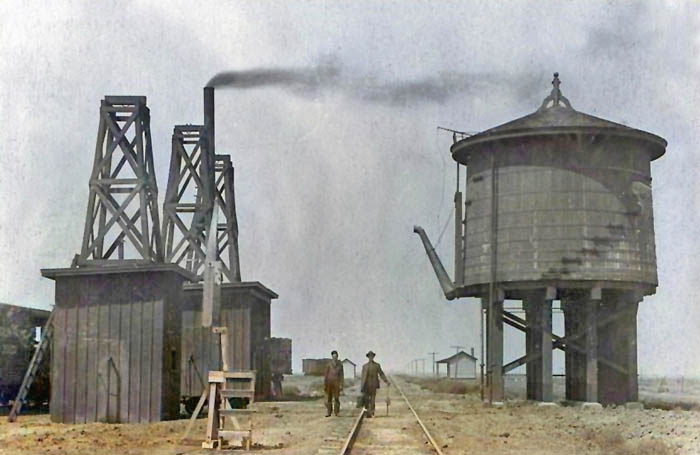
Missouri Pacific Railroad Company’s track line, in Tribune, Kansas, about 1885.
In the fall of 1885, more people began to settle in the county, and the first community created was Hector. In the next two years, many more people moved to the area, and several towns were established. So many towns were created that many people alleged there were more towns than there were claimed houses. Horace was established in June 1886, and at the time of the county seat fight, it had 300 inhabitants, a bank, and a newspaper. Tribune had 200 inhabitants and a newspaper. Colokan was a little town large enough to have a newspaper. Reid was established in September 1887 and, within three months, had two stores, a hotel, two restaurants, and a newspaper. The Missouri Pacific Railroad was built in the county’s early days, and a depot was erected at Tribune in 1887. It crossed almost directly East and West through the center.
In 1887, a census taker was appointed, and in June, he reported 2,638 inhabitants.
An injunction suit was filed to prevent the county from organizing, citing bribery and fraud charges related to the census. However, the injunction was not granted, and Governor John Martin proclaimed the organization in July 1888. Tribune was named the temporary county seat. The following officers were appointed: county clerk James W. Brown, sheriff Allen E. Webb, and commissioners A.J. Rymph, A.K. Webb, and R.Q. Thompson. The county created three townships: Colony, Harrison, and Tribune.
The election to decide the permanent location of the county seat was held in November 1888 and resulted in Tribune’s victory. The first county courthouse, built in 1889-90, was a two-story sandstone building constructed by Allen, Oleson, and William Ruff, all of Ness City, Kansas.
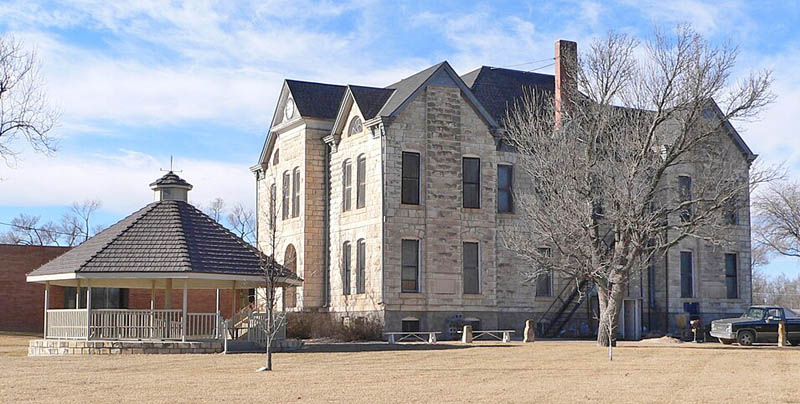
The old Greeley County Courthouse now serves as a museum. Photo courtesy of Wikipedia.
In the late 1890s, people began branding their cattle, with Robert Eadie the first to register his brand in Greeley County.
From 1895 to 1920, Greeley County faced challenging economic and environmental conditions, and its population declined. Simon Fishman helped save Greeley County in 1920 by investing in the development of the Pacific House in Horace and in modern tractors and machinery across the county. From 1920 to 1923, Greeley County started to grow once again.
By 1910, farm products were valued at $137,346, with sorghum, raised for forage and grain, the most valuable. Other crops included barley and corn, and raising livestock was profitable. The population was 1,335. The community had 13 organized school districts and 232 students. The value of the taxable property was $3,531,197, making the average wealth per capita $2,720, which was several hundred dollars over the state average.
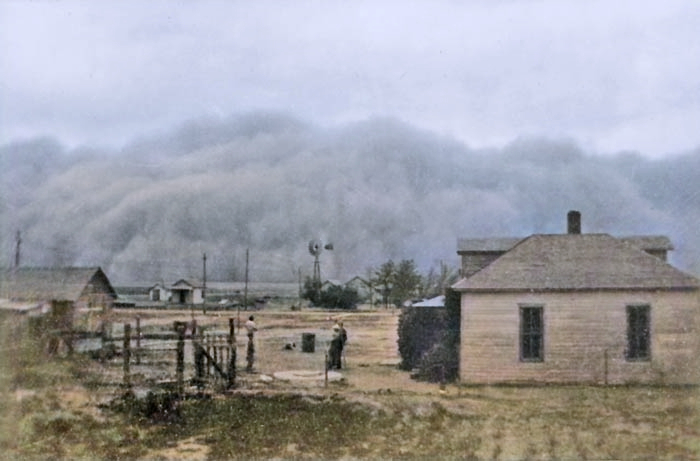
Dust storm in Tribune, Kansas, 1933.
The Great Depression hindered Greeley County, as it did nationwide.
The county’s population grew in the following decades, peaking at 2,087 in 1960.
Contractor Ewing Construction, Inc., built a new county courthouse from 1973 to 1975.
Ewing Construction, Inc. built the courthouse from 1973 to 1975. The modern-style, one-story red-brick courthouse sits on landscaped grounds in the city center. The old courthouse is located on the East side of the present courthouse grounds and houses the Greeley County Historical Society Museum.
©Kathy Alexander/Legends of Kansas, updated September 2026.
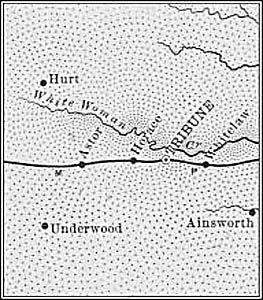
Greeley County, Kansas, vintage map.
Also See:
Sources:
Blackmar, Frank W.; Kansas: A Cyclopedia of State History, Vol. I; Standard Publishing Company, Chicago, IL 1912.
Fort Hays University Forsyth Library
Genealogy Trails
Wikipedia