
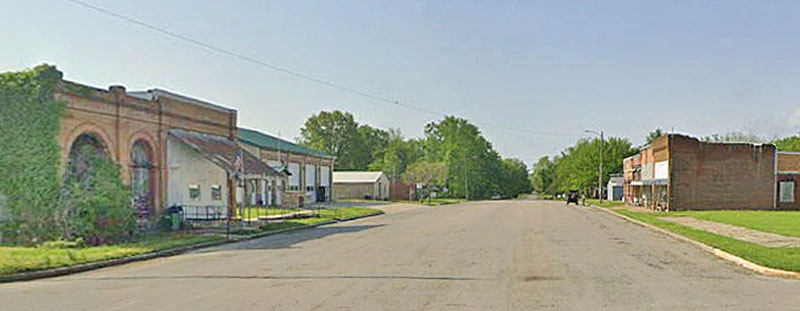
Main Street in Altoona, Kansas, courtesy of Google Maps.
Altoona is a small town along the Verdigris River in Cedar Township of Wilson County, Kansas. As of the 2020 census, the town’s population was 354 it had a total area of 0.55 square miles, all land.
The first known settlers in Cedar Township were J.W. Shawver, Mr. Cooper, and his son, James Cooper, all of whom took claims on the Verdigris River by the Great Osage Trail.

Wilson County, Kansas by L.H. Everts & Co., 1887.
R.J. Webster took a claim west at the present site of Altoona in 1865. The Osage Indians would not permit him to settle or improve it, but in December 1866, Mrs. Webster located on the same claim, and her husband finally preempted it.
Luke Brook ventured down the Verdigris River to the mouth of Cedar Creek in October 1865, while the Indians were off on their fall hunt. He then built and moved into a cabin and prepared to make other improvements. This was further down that river in Wilson County than any white man had gone. Though the Indians had just signed the Canville Treaty, they gave Brooks his walking papers. In November 1866, Thomas Gedds settled where Altoona stands and deeded the claim. James Hamlin was nearby at the same time. Matthew Hawkes, Rick Stafford, Henry Brown (alias Dutch Henry), and many others took claims in the winter of 1866-67.
Altoona was initially called Geddesburg when it was founded in 1869. Dr T.F.C. Dodd was president, and J.N.D. Brown was secretary of the town company. Dodd was the first physician to establish a practice in the town. The first business enterprise was a grocery store opened in that year by George Shultz and John Hooper, who, in 1869, sold groceries under a tree on the riverbank. Shortly after, W.H. Tatham opened a store and, in default of a newspaper to advertise in, cried the merits of his wares through a tin horn.
Spencer Bros., from Lyon County, set up a saw mill at Altoona in the summer of 1869, but could not turn out lumber as fast as they wanted. That year, Hannah Hite Tucker taught the first school in a cabin on the bank of the Verdigris River. At about the same time, the first Sunday school was organized as a union school at the house of A. Pollock, but was sometimes held at the sawmill, with logs for seats. A Congregational Church building was erected that year. The town grew rapidly and, in a year, had 65 buildings.
“Ho for Altoona, the future county seat of Wilson County!”
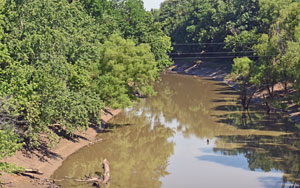
Verdisgris River in Wilson County, Kansas by Kathy Alexander.
Four weeks later, Bowser grew weary of his work and delegated the entire business to Brown, who retained the berth until July 9 of that year. Afterward, the paper passed into the hands of James A. Smith and his wife, Carrie A., who hoisted the Republican banner.
The town was renamed Altoona when a post office was established on April 11, 1870, with J.N.D. Brown appointed postmaster. It was named after Altoona, Pennsylvania.
A steam sawmill, located in timber near the Verdigris River, was portable and was put in operation near Altoona in about 1870. That year, the Methodist Church was organized by Sheldon Parker at the house of A. Pollock.
The Congregational Church was organized in 1871, with George A. Beckwith, the first preacher, of Neodesha.
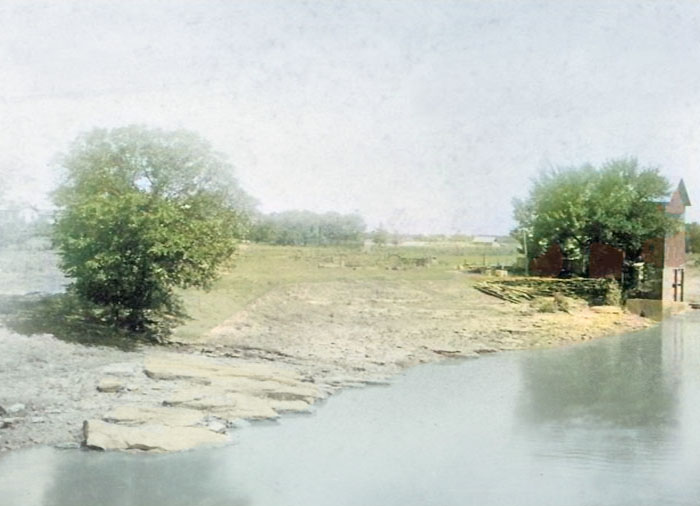
Old flour mill in Altoona, Kansas.
A water power flouring and grist mill on the Verdigris River was built in 1870-1871 by Spencer Bros. It had four runs of buhr stones, powered by a turbine water wheel. Its capacity was 100 barrels of flour per day for 24 hours.
A schoolhouse was built in 1871 for $3,000. A steam saw mill and a flour mill were set up that year on the Verdigris River.
The Altoona Union newspaper continued until December 5, 1872, when it chronicled the death of Horace Greeley and its own, appearing with inverted column rules.
Altoona had two churches, the Congregational, built in 1880, and the Methodist Episcopal, built in 1882. The Union Sabbath school, supported by the two churches, had a large attendance.
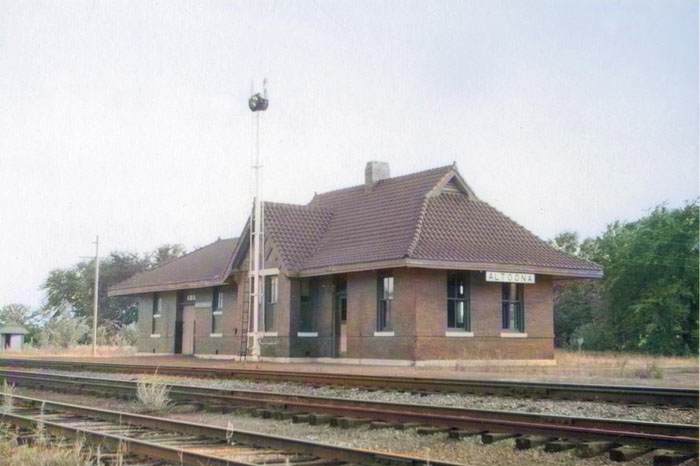
Missouri Pacific Railroad Company depot in Altoona, Kansas, by H. Killam, 1962.
That year, the schoolhouse was presided over by Misses Clara and Celia Kashner, who had about 100 students distributed in two rooms. At that time, the town had a population of 300 with the following industries: two general stores, three groceries, a drugstore, a hardware store, two hotels, three doctors, two dentists, a wagon shop, and two blacksmiths.
In 1880, the steam sawmill was purchased by Z.A. Benell for $1,000 and completely refitted. It was then valued at $3,200. Power was furnished by an engine of 25 horsepower.
In 1881, Altoona had a druggist, a miller, a hotel keeper, and a physician.
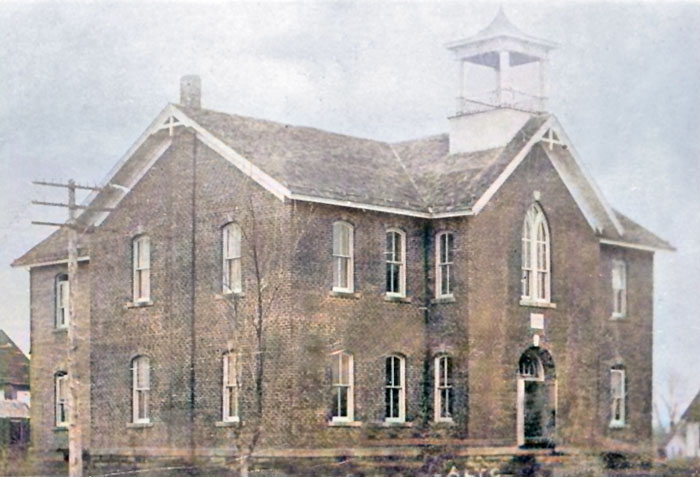
Two-story brick school in Altoona, Kansas.
By the early 1880s, the flouring mill was operated by Brown & Orr, and the buildings and machinery were valued at $8,000.
Altoona experienced growth when the Missouri Pacific Railroad was built through the settlement in 1885-1886, between Coffeyville and Kansas City, Missouri.
At that time, it was a town of approximately 300 residents and a dozen businesses.
The Adventist denomination was organized here in 1886, and construction of a church began the following year.
In 1887, a finer brick school building, with four rooms, was constructed for $5,000 and occupied in 1888.
On Sunday night, March 21, 1897, the city building, C.A. Stafford’s general store, and Dr. Dood’s drug store were destroyed by fire, resulting in a total loss of about $11,000.
The development of oil and gas fields in the vicinity in the 1890s greatly increased the city’s importance. The residents of the town used natural gas in their homes and believed that its advantages were numerous.
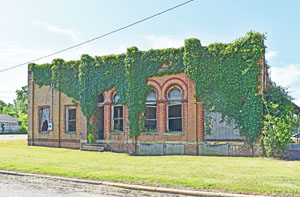
An old bank building in Altoona, Kansas by Kathy Alexander.
In 1910, Altoona was one of the larger incorporated cities in the county and was still served by the Missouri Pacific Railroad. At that time, it had two banks, a weekly newspaper, telegraph and express offices, and an international money order post office with three rural routes. That year, Altoona’s population peaked at 1,462.
In 1916, Altoona was a sundown town, where African Americans were not allowed to live.
In the next decades, Altoona’s population gradually declined.
Altoona is served by the Union Pacific Railroad today.
Students attend the Altoona–Midway USD 387 public school district.
Altoona is 11 miles east of Fredonia, the county seat.
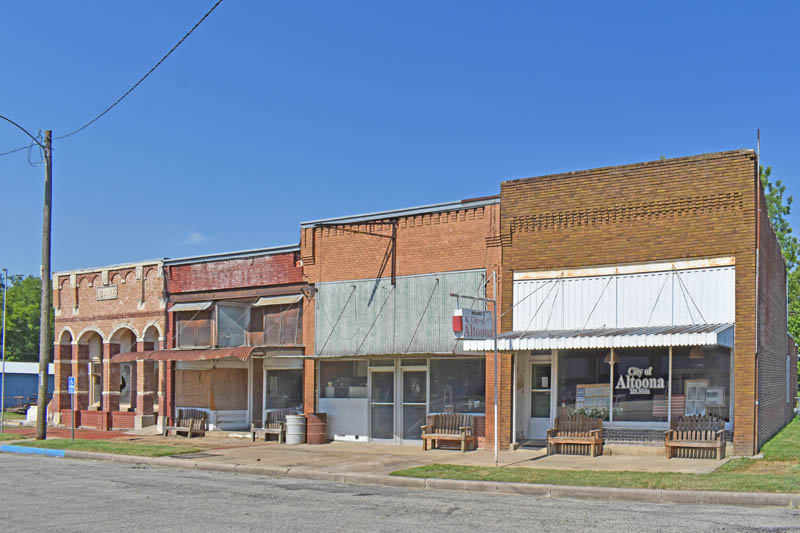
Main Street in Altoona, Kansas, today by Kathy Alexander.
©Kathy Alexander/Legends of Kansas, January 2026.
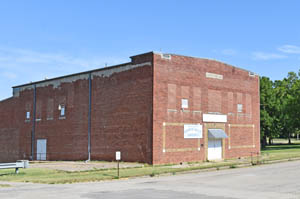
Community Hall in Altoona, Kansas by Kathy Alexander.
Also See:
Sources:
Blackmar, Frank W.; Kansas: A Cyclopedia of State History, Vol I; Standard Publishing Company, Chicago, IL 1912.
Cutler, William G.; History of Kansas; A.T. Andreas, Chicago, IL, 1883.
Duncan, L. Wallace; History of Neosho and Wilson Counties, Monitor Printing Company, Fort Scott, KS, 1902.
Wikipedia
Wilson County Historical Society