
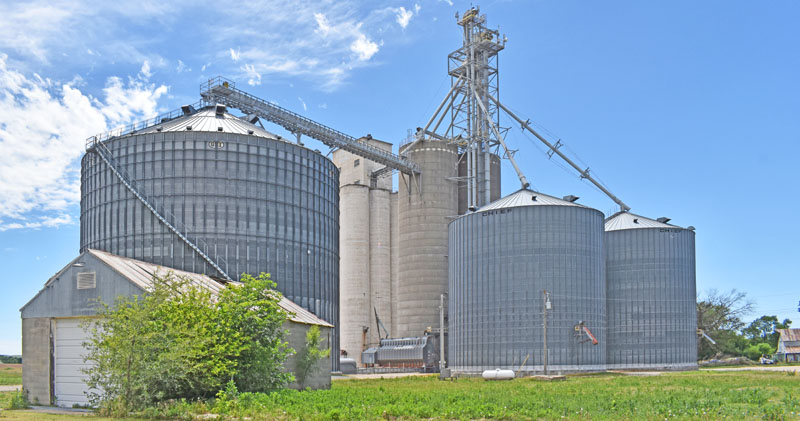
Grain elevators and silos in Asherville, Kansas by Kathy Alexander.
Asherville, Kansas, is a census-designated place in the Solomon Valley of Mitchell County. As of the 2020 census, the population was 19. It is also an “extinct town“, as its post office has been closed for decades.
The first settlement at Asherville was made in 1866 on Asher Creek, from which the community takes its name. John Rees, one of the first settlers, came to America from Liverpool, England, in 1841, locating in Pennsylvania and Missouri before enlisting in the army during the Civil War. While in the army, he rose from a private to major. After the war, he came to the Asherville area on April 26, 1866, where he became the owner of a third interest in the town. He had married Miss Nancy C. Goodwin in 1865, and the couple had eight children.
John Rees had a grocery store at this point since early in 1867.
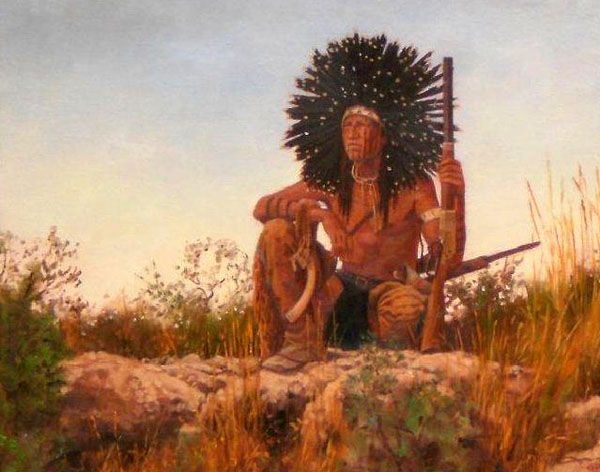
Cheyenne Dog Soldier.
Among those killed by Cheyenne Dog Soldiers, Sioux, and Arapaho warriors attacking settlers along the Solomon River in Cloud and Mitchell Counties in August 1868 were David Bogardus, Braxton Bell, and Elizabeth Bell. Two girls, Ester and Margaret Bell, were captured but later recovered.
Margaret and Esther Bell were also killed when the Indians raided two houses southeast of Beloit. They initially appeared friendly and then attacked. Those in the first house made a stand and fled. At the next house, they shot the woman they forced to cook and two young boys. One woman protected by her dog escaped. Margaret, age 6, and Esther Bell, age 8, were taken to a tipi while the Cheyenne continued attacking settlers, fled, and left the girls to wander for two days before being found.
Otto Borgen, a merchant initially from Denmark, located two miles from Asherville on April 17, 1869.
Asherville had the oldest post office in Mitchell County, established on November 15, 1869, with John Rees serving as the first postmaster. His son, Sherman Grant Rees, was the first white child born in Mitchell County.
The village of Asherville began in the early 1870s as a part of the Rees homestead. It was plotted and laid out but never incorporated. John Rees did his best trying to be a one-man chamber of commerce for Asherville.
The following letter from John was published in the Junction City Union on February 19, 1870.
This country was first settled in the spring of 1866 – nearly four years ago – then a desert-looking place. Buffalo and Indians were all that could be seen, and owing to the oft-repeated murdering of our citizens, it has retarded the settlement to a great extent.
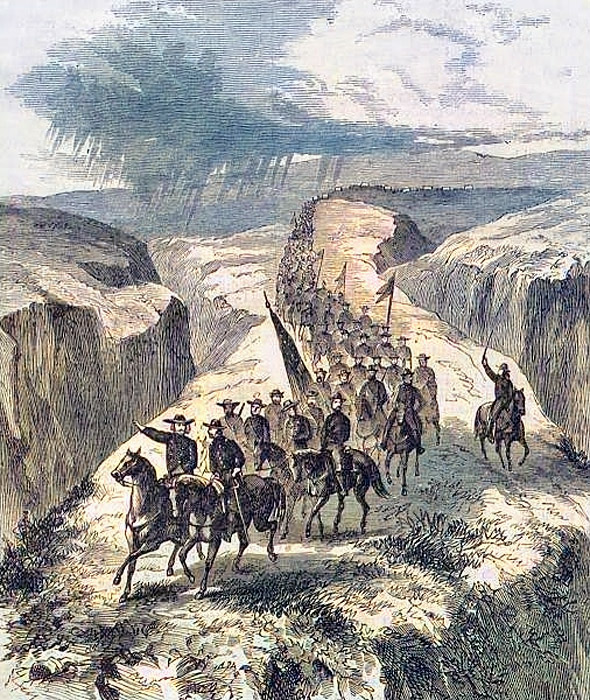
7th Cavalry in Western Kansas.
Troops have been sent here several times for our protection, except the company of U.S. troops sent here from Fort Hays last spring, commanded by First Lieutenant Edward Law, G Company, of the 7th Cavalry, in the company of Lieutenant March. These officers and men bore a noble part in trying to protect the settlers of this valley, going night and day to all points where any alarm was given and, in fact, were the only company of men in the regular service who seemed to take interest in protecting the frontier settlers.
During those four years, 16 of our settlers have been killed – only one being killed in 1869. This was owing to the troops sent here, and I am in hope that we will be blessed the coming summer with the same protection as that of last summer.
I understand there are to be troops sent here by April 1 next, but I am afraid that if we have an early spring, the Indians will certainly come in before that time. But as an old saying goes, “better late than never.”
Since the talk of running a railroad up this way, immigration seems to pour in here as thick as grasshoppers did the year of the drought. But let them come: we had good crops last year and have some grain to sell.
The sandstone is found in the bed of the river, forming nine or ten mill sites. There are already three mills in process of construction, one by Mr. Marshall 2.5 miles West of this place and five miles West of the East line of the county. This mill is in the heart of one of the best valleys in Kansas. Here would be a good place for a store, as we have none in the county. Our blacksmith, Mr. Mauk, is an old Kentuckian and knows how to do work well at low figures.
Farther up the valley we come to the Willow Spring, 11 miles West of the East county line. Here Mr. Hersey of Abilene is constructing a saw and grist mill. They have laid out a town to be called Beloit, and with the expectation of the county seat. As the county is, as yet, not organized, it will be somewhat mixed to tell where it will be.
All who want a home of 160 acres of land, under the Homestead Act, by simply paying $14.50, and proving settlement of the same for five years, come out and see us.
A word to the ladies: If you want to get married, come out here, as we have a host of bachelors; but be sure to bring plenty of means with you, for that is the excuse “can’t support a wife until I raise a crop.”
—- John Rees
In the spring of 1871, Samuel Carter, born in Middlesex County, Connecticut, came to Mitchell County, settled eight miles southeast of Beloit, and engaged in merchandising and farming. He owned 340 acres of land adjoining the town of Asherville. He held the office of Justice of the Peace, assessor, assistant postmaster, and school superintendent. He was married and had two children.
That year, the Baptists organized a church at this place. A.O. Foote, Daniel Culp, and E.C. Baker were the first trustees. O.N. Fletcher was the first pastor. By 1882, the church had 60 members and had an average of 80 Sabbath-school scholars. They have a good, substantial church, erected for $1,200.
John Rees was elected to the state Legislature in 1872, held the office of Justice of the Peace for 10 years, and was postmaster for seven years.
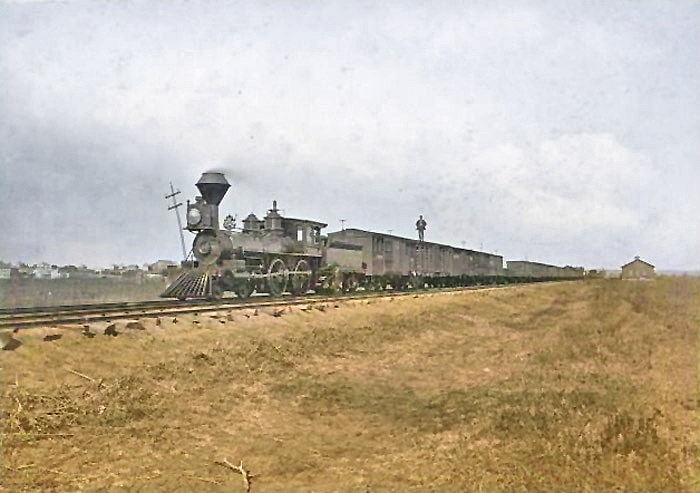
Kansas Pacific Railroad
By the early 1880s, Asherville was described as a flourishing station on the Kansas Pacific Railroad, from Solomon City to Beloit.
Otto Borgen engaged in business in the town of Asherville in March, 1881, and put in a general stock of goods. He was appointed Postmaster August 10, 1881. Married to Sarah Rees Borgen with four children, he owned 183 acres of land situated one mile from Asherville.
In 1910, Asherville, one of the thriving little towns of Mitchell County, was located on the Solomon River and on the Union Pacific Railroad. At that time, it had a money order post office with one rural route, telegraph, express offices, and a population of 125.
In the next years, the town’s population gradually declined.
Asherville’s post office closed on March 28, 1980.
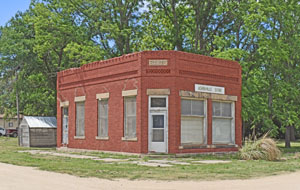
Old bank/store in Asherville, Kansas by Kathy Alexander.
By 2000, Asherville Township could still boast 122 people living within its borders. Through the years, it saw the coming and going of the Rees grocery store, a school, and a bank. Today, commerce exists in the form of a thriving grain elevator and acres of fertile Solomon River “bottom ground.”
Asherville still has several homes, a fire station, silos, a grain elevator, and a building that once held a bank and a store.
Visitors can see the Solomon Valley Heritage Alliance kiosk on the West side of the road just as you come into town from the North. The landowner, Richard Anderson, welcomes visitors and encourages them to get out and look at his collection of antique farm equipment.
The Indian raid victims’ cemetery is one mile North of Asherville, just off old Highway 24.
The small Bogardus-Bell Cemetery North of Asherville is a monument to those pioneers who first settled this land.
Asherville is 10 miles southeast of Beloit.
©Kathy Alexander/Legends of Kansas, updated July, 2026.
Also See:
Extinct towns of Mitchell County
Sources:
Blackmar, Frank W.; Kansas: A Cyclopedia of State History, Vol I; Standard Publishing Company, Chicago, IL 1912.
Cutler, William G; History of Kansas; A. T. Andreas, Chicago, IL, 1883.
Mitchell County, Kansas
Solomon Valley Highway 24 Heritage Alliance
Wikipedia