
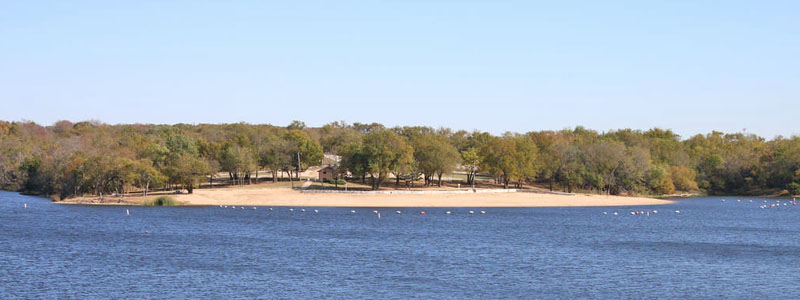
Big Hill Lake, Kansas.
Big Hill Lake in Labette County, Kansas, is a reservoir covering 1,240 acres, with 367 acres available for public use. Fishing, picnicking, boating, and swimming in a sandy beach area are popular activities.
Located in Kansas’ “Little Ozarks,” Big Hill Lake is one of the state’s clearest lakes. It was initially named Pearson-Skubitz Big Hill Lake in 1978. Construction of the lake was completed in 1981 by the U.S. Army Corps of Engineers.
The U.S. Army Corps of Engineers operates five beautiful park areas that offer a variety of recreational activities, including camping, picnicking, hiking, boating, water sports, and wildlife viewing. The parks feature designated campsites with and without electricity, group picnic and camping areas, primitive camping spots, potable water, sanitary facilities, boat-launching ramps, playgrounds, a ball field, and a swimming beach with changing rooms. Camping fees are collected at all park locations, and a day-use fee applies for access to the beach and boat ramps.
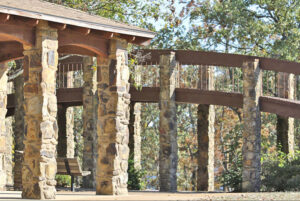
Bridge at Big Hill Lake, Kansas.
Due to the installation of fish shelters and the preservation of extensive areas of timber and vegetation, Big Hill has become one of the most productive and popular fishing spots in the region. The main species available for catch include largemouth bass, crappie, channel catfish, flathead catfish, bluegill, walleye, and smallmouth bass.
Big Hill Lakes’ alcohol-free, sand-covered beach has become a popular spot to cool off from the summer heat.
Other features include the Big Hill Lake Horse Trail, which is 17 miles long and winds along a scenic hardwood ridge. It also offers tethering areas and three parking areas, each equipped with limited facilities and suitable for overnight camping by trail riders. Various wildlife species can be seen along the trail.
There is also the one-mile-long Ruth Nixon Memorial Trail, which provides many wildlife-viewing opportunities and spectacular scenery.
Almost all project lands are open to public hunting, except in parks and around the dam and control structures. The principal species hunted are white-tailed deer, turkey, and squirrels. A hunting map and regulations are available at the project office. State laws and regulations also apply to public hunting areas.
Nearby, the Big Hill Wildlife Area covers 1,320 acres, which includes 870 acres of grassland, 180 acres of timber, and 100 acres of cropland and hayland. Two ponds provide fishing opportunities for black bass and channel catfish. Primary wildlife management targets deer, turkey, and small and upland game. The property was purchased in 1967 and 1968 by the Kansas Department of Wildlife, Parks, and Tourism. The wildlife area is operated separately from the Big Hill Reservoir, a Corps of Engineers property located 1/2 mile west.
The lake is located 3.5 miles east of Cherryvale and 9.5 miles southwest of Parsons.
Big Hill Lake History
This region between the Neosho and Verdigris Rivers was home to the Big Hill band of Osage Indians from 1822 to 1839, with their village located northwest of the reservoir. They moved from Missouri with their leader, Pa-In-No-Pa-She (Not Afraid of Longhairs), or Big Hill Joe, as he was known by the white men.
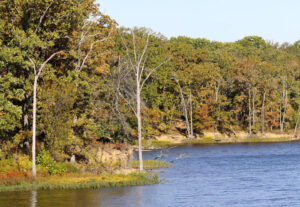
Autumn at Big Hill Lake, Kansas.
This area of southeast Kansas, referred to as the “Little Ozarks,” was first described by Washington Irving in 1832 as a “vast prairie without a tree or shrub in sight, with the exception of the protected areas, such as the hills and along the streams.” The absence of trees was not entirely due to natural causes; many prairie fires were started by nature, and those started by people destroyed much vegetation. The Indians were also known to have set fires to drive game animals onto the open prairie.
Seven white families were the first to homestead an area near the lake known as the Mount Zion Area. They lived along the banks of Big Hill Creek with the Osage Indians. In 1868, the first Mt. Zion school, a log building, was constructed. In 1869, it was moved and became the center of the Mt. Zion community, serving as both a church and a school.
The Osage Indians lived in the area peaceably until 1872, when the United States government purchased their land. The Indians then relocated south to Indian Territory, now part of Oklahoma.
The Mt. Zion Church was moved several times before it reached its present location, one mile west and one-fourth mile north of the reservoir office. The church was sold to community members in 1930 and flourished until 1963, when the doors closed. In 1975, the Mount Zion Church Association was formed to rebuild the church on its present-day site. The project was completed, and the church was rededicated by community members in May 1982. The Labette County Commissioners declared the church a county historical site in 1977, and it was recognized as a Kansas Historical Site in July of 1979.
During the summer of 1980, the Kansas State Historical Society conducted archaeological excavations at three prehistoric sites along Big Hill Creek prior to its impoundment. The work was conducted under contract with the U.S. Army Engineer District in Tulsa, Oklahoma, which provided the funding for the excavations and analysis. The investigation was based on recommendations from previous archaeological testing of the sites and was aimed at locating suspected structural remains. The excavated sites yielded four Cuesta Indian lodges, where many artifacts, such as knives, a grinding stone, and pottery, were found. The scattered distribution of the remains suggested that the site had been disturbed by flooding and associated sedimentation as well as by modern cultivation. The excavation sites are now within the conservation pool area of Big Hill Lake.
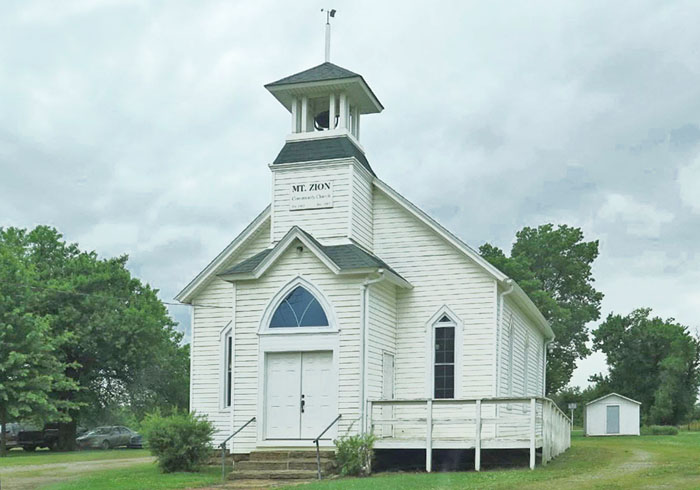
Mt. Zion Church near Cherryvale, Kansas.
©Kathy Alexander/Legends of Kansas, February 2026.
Also See:
Sources:
Kansas Department of Wildlife & Parks
Kansas State Historical Society
Recreation.gov
Travel Kansas
US Army Corps of Engineers Tulsa District
Wikipedia