
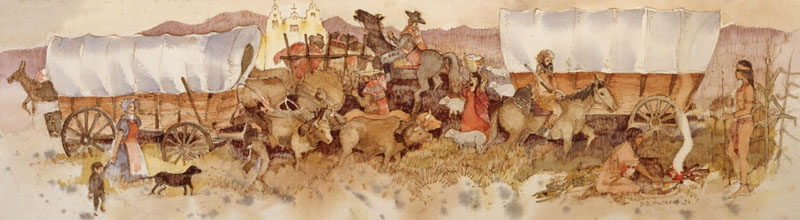
Santa Fe Trail.
Chouteau’s Island, in Kearny County, Kansas, was an island in the Arkansas River and a landmark of the old Santa Fe Trail. Today, the site is lost, having long since been eroded by the river. All that remains to mark this conflict is a small historical marker in a golf course parking lot.
For many years, this tree-filled island near the former town of Hartland served as a strategic spot for military camps, a turning point for the dangerous Cimarron Cutoff, and is historically significant as the site of several skirmishes, one of which earned the island its name.
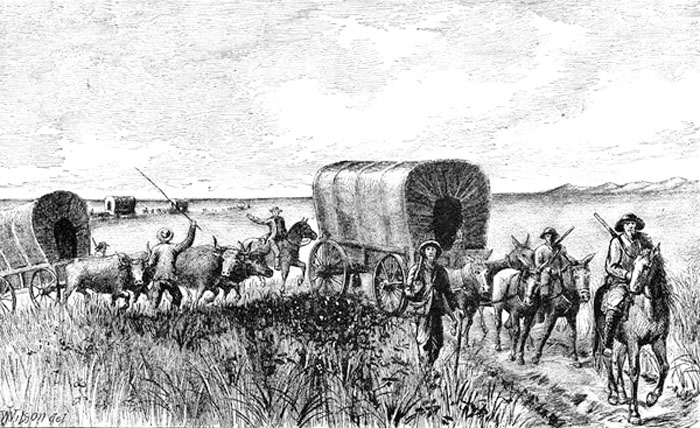
Kansas Wagon Train.
The Upper Arkansas River branch of the Santa Fe Trail followed the river north through Kearny County.
In the spring of 1816, Auguste P. Chouteau’s hunting party, traveling east with a winter’s catch of furs, was attacked near the Arkansas River by 200 Pawnee Warriors seeking to defend their land and relieve the pressure they were already experiencing from settlers. The Chouteaus and the rest of their group moved quickly to cross the Arkansas River, landing on an island where the grove of cottonwood trees, thick clumps of willows, and dense tallgrass provided excellent cover.
Despite being considerably outnumbered, they used their packs and fur as a barricade to stave off the attack; their firearms proved effective, with only one trapper killed and three injured. The Pawnee suffered heavier losses despite outnumbering the fur traders, with seven warriors killed in the “Battle of Chouteau’s Island“. The island is named for this incident. After the battle, the Indians declared that it was the most fatal affair in which they were ever engaged. It was their first acquaintance with American guns.
Though in the grand scheme of things, the Battle of Chouteau’s Island was a minor, inconsequential conflict between Native Americans and settlers advancing westward following the Louisiana Purchase. However, it set a precedent for subsequent years of conflict and bloodshed.
In 1825, increased travel on the Santa Fe Trail prompted a government survey. Chouteau’s Island was listed as a turning-off point for the shorter, but more dangerous, Cimarron Cutoff, due south to the Wagon Bed Spring of the Cimarron River near Ulysses, Kansas. This route was sometimes called the “Aubry Cutoff” since Francois X. Aubry was known to have partially followed it on at least one of his famous rides between Santa Fe, New Mexico, and Independence, Missouri. It was a much better-watered route than the one via Cimarron Crossing.
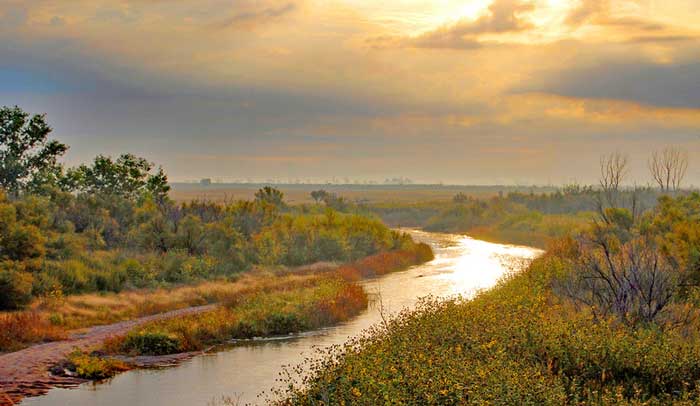
Arkansas River, near Lakin, KS. Photo by Kathy Alexander.
In 1828, more than $10,000 of silver was buried at Chouteau’s Island by a group of traders known as the Milton Bryan Party. The group was on the return trip from Santa Fe, New Mexico, and among the party was William Young Hitt, who kept a diary of the journey. One morning after arriving at the Upper Cimarron Springs, Bryan’s party was awakened just before dawn by a large band of Indians riding within rifle-shot of the wagon. A continuous battle raged for several hours.
After successfully stampeding all the horses and mules, the Indians retreated. Hitt was wounded six times. The next morning, some of the men took off in hopes of finding the lost stock. Hitt was on his way back to camp when Indians overtook him, but some of his traveling companions arrived in time to save him. Unable to secure any of their stock, the entourage left by foot in the morning with each man shouldering a rifle and a proportion of provisions. After eight days of travel, they had less than 100 pounds of flour left and had been unsuccessful in finding any game. Adding to their futility was a scarcity of water. In desperation, the troupe was once compelled to suck the moist clay from a buffalo wallow.
Along the way home, they were carrying the silver they had earned from their trip, which had become a greater burden than they could bear. They decided to bury it at the first good place they came upon. When they arrived at Chouteau’s Island, they dug a hole and deposited their treasure between two large trees.
Indian and Soldier Battle.
Finally, after traveling for more than two weeks on foot, the men were exhausted, emaciated, and weak upon their return home.
The following year, the traders returned to Chouteau’s Island, accompanied by Major Bennett Riley and his men, the first military escort on the trail. The silver was retrieved, and the trading party continued their trek to Santa Fe with their goods.
In the meantime, Major Bennett Riley and his four companies of infantry, serving as the first military escort on the trail, went into camp near the island. They spent the summer fighting off Indians, losing several men and part of their oxen. The return of the Santa Fe caravan, escorted by a Mexican force, was celebrated through a colorful exchange of military inspections.
Between 1865 and 1870, a caravan of traders was attacked by Indians in the valley between Chouteau’s Island and Indian Mound. Word of the attack reached Fort Garland, Colorado, and soldiers were dispatched to the scene. By the time they reached the area, the Indians had fled, and the traders were dead. The soldiers buried them and returned to Fort Garland.
The memory of Chouteau’s Island endures at the nearby Indian Mound, a significant landmark on the Santa Fe Trail that overlooks the former island’s location. There is also a historical marker commemorating the site west of modern-day Lakin, Kansas.
©Kathy Alexander/Legends of Kansas, updated December 2025.
Also See:
Kearny County, Kansas, Santa Fe Trail
Sources:
Blackmar, Frank W.; Kansas: A Cyclopedia of State History, Vol I; Standard Publishing Company, Chicago, IL 1912.
The Clio
Historic Marker Database
Kearny County Museum