
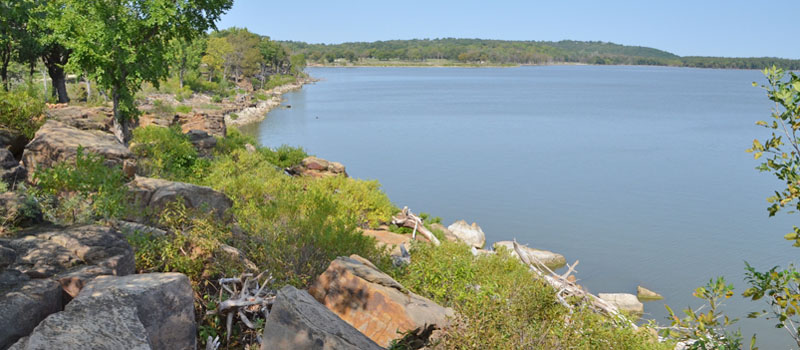
Fall River State Park, courtesy of Kansas Tourism.
Located between the Cross Timbers region and the Flint Hills grasslands, Fall River State Park in southeastern Greenwood County, Kansas, is home to a remarkable diversity of plant and animal life. The 1,107-acre park is a unique blend of forested floodplains, blackjack savannas, and tallgrass prairie. Six hiking trails offer visitors an up-close and personal perspective on this unique area.
Construction of the dam began on May 9, 1946; the embankment closure was completed on August 12, 1948. The conservation pool was filled on June 9, 1949, and the project was completed for full flood-control operations in April 1949.
The lake is about a mile wide at the Damsite and stretches up the picturesque Fall River for 15 miles.
Outdoor enthusiasts enjoy camping, swimming, boating, hiking, picnicking, and waterskiing on the 2,450-acre Fall River for which the state park is named. Camping facilities include 45 electric-water campsites, more than 50 primitive campsites, and three modern toilet-shower buildings. Children can enjoy the playgrounds and the mowed open areas for field games. Six trails, open to foot and bicycle traffic, allow visitors to see the region’s flora and fauna. During high lake levels or heavy rains, portions of the trails may be hazardous or impassible, and biking is prohibited when the trail is wet enough to cause damage. Portions of the Quarry Bay Trails may be open to archery hunting.
A favorite pastime is canoeing on Fall River, which feeds into the 2,450-acre reservoir of the same name. Bird watchers, photographers, and naturalists will enjoy a variety of native plants and animals here. More than 9,000 acres of public wildlife area next to the park are managed for a variety of game and non-game species. Dove, quail, deer, turkey, rabbit, squirrel, waterfowl, and prairie chicken are common.
Fall River offers good fishing opportunities for channel and flathead catfish, white bass, and crappie. More than 8,000 acres of public wildlife area adjacent to the park are managed for a variety of game and nongame species.
For birdwatchers, there are more than 400 bird species in the area, including migratory waterfowl. In the spring and again in the fall, there are wildflowers in the open pastures, along fence rows, and in the wooded areas. Hedgerows and former farmsteads produce persimmon, Osage orange, redbud, and dogwood.
Fall River State Park provides rustic cabins with modern conveniences available to visitors year-round. Cabins are located on the lake, in the Gobbler’s Knob area, with a beautiful view of Fall River Reservoir and the surrounding tall grass prairie. Cabins are close to amenities, including boat docks for loading and unloading, playgrounds, horseshoe pits, shoreline fishing, and hiking trails.
Casner Creek Trail is accessible at two trailheads: one in the Casner Creek Campground and one at the youth fishing pond at the entrance to South Rock Ridge Area. Winding through a wooded area and a profuse display of prairie wildflowers, this trail is a great way to introduce children to hiking and tallgrass prairie ecosystems. Casner Creek Trail is moderately difficult.
Turkey Run Trail runs through a wooded ravine, crosses an intermediate stream, and ascends across the tallgrass prairie that features a breathtaking view of Fall River Lake and the Flint Hills. Here, visitors often see white-tailed deer and other native wildlife. Bald Eagles are a common sight during the winter months. The trail is rated moderately difficult to hike and open to foot and bicycle traffic.
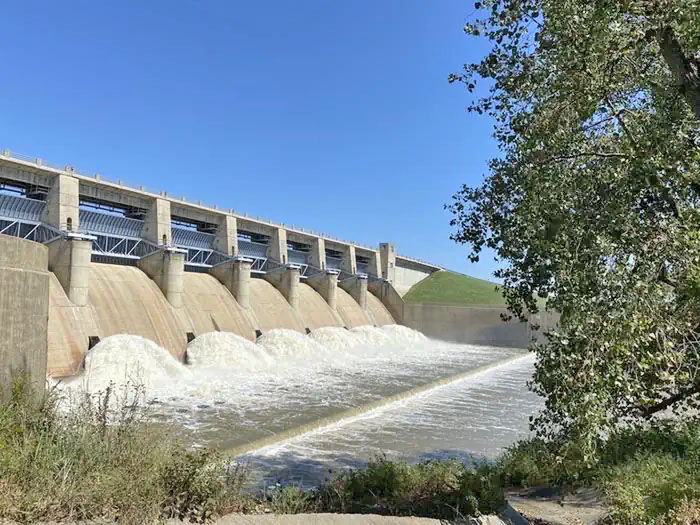
Fall River Dam, Kansas, courtesy of recreation.gov
Quarry Bay Trails, the ADA-accessible Overlook Trail offers a beautiful view of the lake. An interpretive sign with a history of the flora and fauna allows viewing from a wooded deck. Post Oak Trail loop follows along a portion of Craig Creek. Here, visitors \see post and blackjack oaks, lichen-covered sandstone outcroppings, and open grass meadows. This gently rolling trail offers hikers or mountain bikers a moderate challenge. Catclaw Trail passes through tallgrass prairie, sloping sandstone ridges, and wooded oak savannahs, offering a panoramic view of the lake. Native plants garnish the hillsides. The trail is moderate in difficulty and open to both foot and bicycle traffic. The Bluestem Prairie Trail can be accessed via the Catclaw Trail or at the north end of the quarry in Quarry Bay. Native grasses dominate the landscape, changing from high prairie to low woodlands. This is a moderate trail.
Most lands at Fall River are open to public hunting, except for Kansas State Park lands, developed camping areas, picnic areas, dam and project operation sites, and refuge areas. Game species managed by the Kansas Department of Wildlife and Parks and the U.S. Army Corps of Engineers include bobwhite quail primarily, mourning dove, greater prairie-chicken, cottontail rabbit, squirrel, white-tailed deer, and turkey.
Located southwest of Toronto, it is four miles northeast of Fall River and accessible via Highway 144 and Highway 105.
Fall River State Park
2350 Casner Creek Road
Fall River, KS 67047
Park Office – 620-637-2213