
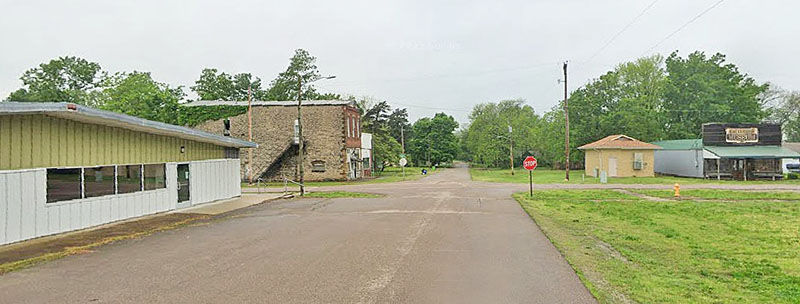
Galesburg, Kansas, Main Street, courtesy of Google Maps.
Galesburg, Kansas, is a small town in Centerville Township in central Neosho County. As of the 2020 census, its population was 149, and its total area was 0.17 square miles, all land.
The town began when the Missouri, Kansas & Texas Railway was extended to that point.
This was the first railroad to pass through the county, and for a time, Galesburg was a rival of Neva and New Chicago (now Chanute) as a lively railroad station. The building of the Leavenworth, Lawrence & Galveston Railroad through New Chicago gave that place the advantage. The rivalry of two small villages, Rose Hill and Neosho, gave rise to Galesburg. John Snyder had a store a mile or more north of present-day Galesburg in 1870, when the railroad was built. He applied for a switch at his place, but a grade in the road at that point made it an undesirable place for a switch. It was later built where Galesburg is now.
Christopher and Elvina Boje gave land to build the town of Galesburg in 1871. The surrounding country was a rolling prairie of great fertility and well-adapted to agricultural pursuits. The town was established that summer by a town company comprising J.W. Crees, David Bonham, E. Sapp, Levi A. Doan, and J. W. Snyder.
The town was laid out in September 1870 on John Tracy’s claim, and the survey was made by County Surveyor P.W. Hinsen, who later was a druggist in Osage Mission (St. Paul). The original site comprised 80 acres, to which another 40-acre tract was subsequently added.
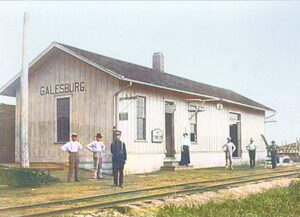
Galesburg, Kansas, Railroad Depot.
The first building on the site was a dwelling erected by William Young soon after the town was located. At approximately the same time, or soon thereafter, J.W. Snyder procured an ox team, had his store building moved from Rose Hill to Galesburg, and established a storeroom stocked with general merchandise.
In the fall, Carson & Smith erected a two-story frame building one block north of the city well, with the lower part used as a storeroom and the upper part as a town hall. Various forms of entertainment and church services were held there. Mrs. Hannah Enlow, an early settler, taught a Sunday school class there.
George Harris erected a storeroom and began dealing in general goods. The Osage Mission Journal, September 29, 1870, reported that the new town of Galesburg already had two stores and that a good hotel was being built. From the outset, the town’s growth was moderate.
A post office established in Rose Hill, about one mile south of Galesburg, moved to Galesburg and opened on March 6, 1871, with Squire Rosa as the postmaster.
Miss Parna Whittlesey taught the first school in the winter of 1871-72 in the Town Hall. A school building, measuring 36 by 40 feet, was erected in 1872.
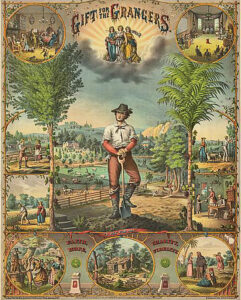
Grangers.
The railroad built a depot there in 1873. That year, the Grange operated a cooperative store, with J.W. Snider as manager. This was the first Grange store in this section.
In 1874, the Collings Brothers established a steam mill there in the fall, and Dr. T. Bartel located there at about the same time. The Grange had a store there in 1874.
The first physician in Galesburg was Dr. Bartl in 1875. Dr. C.W. Crees was there in 1880; Dr. D. C. Bryant and Dr. Ferguson were there in 1881.
By 1882, the population was about 150, and the town contained four general stores, a hardware store, two grain elevators, a lumber and coal yard, a hotel, a livery stable, a blacksmith shop, a school, two churches, and a post office. At that time, the school population was about 80. There were four church societies: the Methodist, Baptist, Christian, and Congregationalist. The Methodist and the Christian organizations had church buildings.
On June 20, 1883, the Galesburg Breeze was established, with printing conducted in Osage Mission. This was the first paper for Galesburg, but it was soon suspended.
The T.H. Condon bank was started in Galesburg in 1884. It did a private banking business for a few years.
In 1885, Galesburg had two good brass bands. They were frequently engaged to play in other towns.
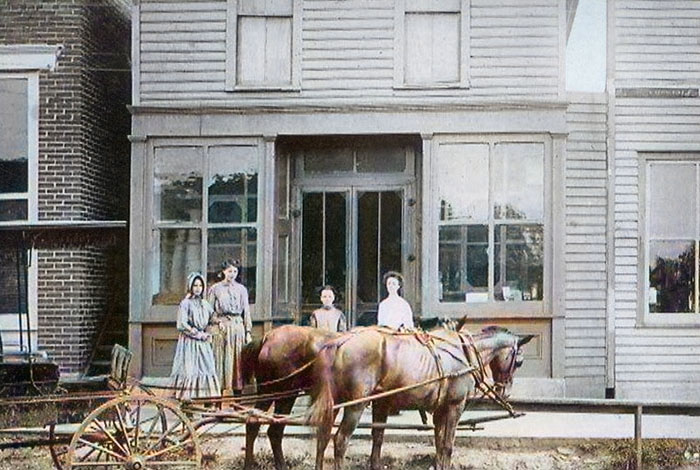
An early-day business in Galesburg, Kansas.
In March 1886, the Galesburg Enterprise newspaper was established by King & Schooneover. It had five columns and eight pages. Its first issue on March 26, 1886, showed the following business firms there: ”William Enlow, the oldest merchant here; Youmans & Pendergrass, dry goods; Yockey Bros. dry goods; A. & A. Fairbanks, queensware and grocery; John McCarthey, drugs, boots, shoes; S.G. Bryant, druggist, confectioner; Galesburg Furniture Company; McCreery & Clark, lumber; Slack & Flickinger Bro., manufacturers of architectual ornaments; J.V. Pierce & Co., and J.D. Adkinson. Real estate: Lucas & Abbey, hardware: Galesburg Exchange Bank, T.H. Condon, president; Parker Hotel; Kirby House; the Centerville Nursery, W.W. Oxley, proprietor, was located three miles north of Galesburg and did a large business in the early 1880s.”
That year, a large two-room frame school building was erected.
On February 19, 1887, the office of the Galesburg Enterprise was destroyed by fire. However, it was quickly re-established. Galesburg was formally incorporated that year. On October 3, 1907, the Galesburg Enterprise newspaper was suspended.
Dr. Lehew served the town in 1888. Dr. C.S Strahan. who came in 1893, was the only one to remain for long. He spent the remainder of his life there and was active in local and county affairs.
A telephone line was built from Parsons in 1899.
Hudson & Shaw had a custom feed mill in 1901.
The Farmers Union Elevator was erected by J.N. Shaw in 1902.
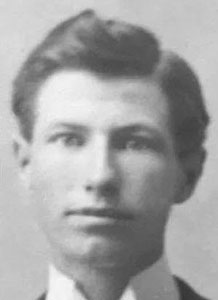
Stanley Shaw, 1900.
Stanley Shaw was born on a farm near Galesburg, April 12, 1881. He grew up there and began to demonstrate unusual mechanical skill while still a boy. In his early teens, he built a steam engine, using two bicycle pumps soldered together. In 1902, he made his first gasoline engine.
In 1903, Shaw Manufacturing Company was established by Stanley W. Shaw in Galesburg. He began operations in a rented space in an old drugstore. On one side, he had a dealership for Elgin and Waltham watches with a workbench and a lathe. On the other side, he had bike motors and machinery. The business grew to include farm machinery, motorcycles, and automobiles. As the town’s only industry, the manufacturing company soon dominated virtually all activities in Galesburg.
The Galesburg State Bank was opened for business on January 4, 1904, with a capital stock of $10,000. G.W. Hawk, of the Commercial Bank of Parsons, was its first president, and S.M. Sholl was cashier.
The Galesburg Telephone Exchange, locally owned, was organized in 1905, with Dave Womeldorf as the first switchboard attendant.
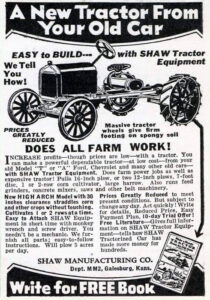
Shaw Manufacturing.
On September 7, 1905, Stanley Shaw patented a small, air-cooled gasoline engine to convert a bicycle into a motorbike. He used the engine to run a circular saw, a lathe, and various smaller machines. When he built the engine, he had very little to work with, but afterward, he fitted up a shop that could make a better engine without using parts from old machinery. He also has a forge and a jeweler’s gear cutter. When a watch needed repair, he could make new wheels. Stanley invented and patented a bicycle motor which was an improvement over any then in use. More than 13,000 kits were produced between 1905 and 1917.
Shaw’s genius and skill soon led to the development of a superior-quality gasoline engine.
Galesburg became a third-class city on December 4, 1906. Its first election, held on December 26, resulted in the selection of Dr. C.S. Strahan as mayor and A.H. Snow, F.E. Enlow, W.E. Craig, C.W. Whaley, and H.I. Shaw as councilmen, and O.H.P. Bowers was the first city clerk. The first meeting of the council was on February 16, 1907.
In 1908, under the name of Shaw Manufacturing Company, he began building and selling engines and equipment. He built a small engine that let him convert a bicycle into a motorcycle. He sold thousands of these little engines and completed motorcycles annually until low-priced motor cars destroyed demand. Then he turned his attention to manufacturing small tractors for market gardeners. From these, he developed his well-known Du-All tractors, which were sold across America and in parts of South America.
In 1910, Galesburg was still on the Missouri, Kansas & Texas Railroad, when it had a bank, telegraph, and express offices, a money order post office with two rural routes, and a population of 183.
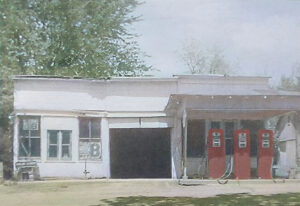
An old gas station in Galesburg, Kansas.
In November 1911, Mr. Shaw erected a building 50 by 100 feet in size for his shop.
Mr. Shaw’s skill contributed to the war effort during World War I. As a subcontractor, his shop produced thousands of components for aircraft, firearms, and other equipment.
In 1917, the school building was enlarged to accommodate the high school department, which began that fall. This was one of the county’s regular accredited high schools. Usually, five teachers were employed.
J.N. Shaw sold his elevator to the Farmers Union in 1918.
In January 1919, Joseph Spohr, Ansel Sample, Frank Malson, Jas. Ross, N. Thomas, S.B. Potts, Frank Nelson, and J.W. Daggett initiated efforts to organize a Farmers Union elevator. They erected an elevator that year, and after Mr. Weil’s death, Mr. Weil’s elevator was purchased. This elevator was then operated by Henry Smith of St. Paul, doing good business. The Farmers Union Mercantile Company was organized in July 1920, but remained independent of the elevator.
Galesburg’s population peaked in 1920 at 205.
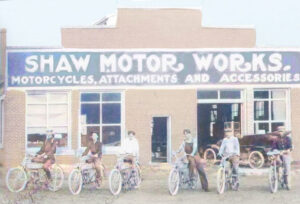
Shaw Motor Works in Galesburg, Kansas.
In 1922, Stanley Shaw built a complete automobile for his son that was only six feet long, had bicycle wheels, and carried two passengers at 15 miles per hour.
At a special election held on October 12, 1925, bonds totaling $5,000 were approved to construct a transmission line and distribution system to provide electricity to the city. Their transmission line connected to the St. Paul Service line near South Mound. The city maintained its own transmission and distribution systems and had high-quality electric service.
In 1928, Mr. Shaw’s motorized lawn mower was introduced, and before long, the use of these small tractors became widespread. By that time, his payroll was substantial, and his business had grown so large that, in 1928, Galesburg became the smallest town in the United States to have a second-class post office. He used many thousands of postage stamps each week to send out mail advertising his motor-powered vehicles, bicycles, and other products from his shop.
In 1928-29, Stanley Shaw erected a modern building measuring 80 x 100 feet to accommodate his significant business and converted his other shop into a warehouse. His new shop was equipped with the highest-quality machinery and tools available, and with its aid, he produced a class of work not surpassed elsewhere. He opened a wholesale house in Columbus, Ohio, to which he shipped tractors by the carload.
Shaw’s business was somewhat of a family affair. He was his own foreman and head worker. His son, Stanley Byrne Shaw, who studied mechanical engineering at the State Colleges in Manhattan, Kansas, and Boulder, Colorado, was an assistant manager at the company and one of the most skilled workers. A brother who inherited some of the family’s mechanical genius was a machinist. Other men, lifelong friends of the family, were trained for their parts in the plant.
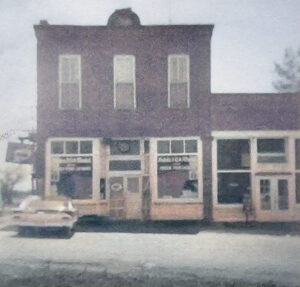
Grocery store and former post office in Galesburg, Kansas, in 1960.
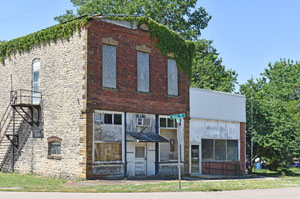
Grocery store and old post office in Galesburg today, by Kathy Alexander.
All of his workers owned their own homes in Galesburg and were proud of their role in the city’s chief enterprise. Stanley Shaw was a rare combination of sound common sense, sound business judgment, and high-class mechanical skill, seldom found in one man. He treated his helpers as fellow workers, fellow citizens, and good friends, all of whom contributed significantly to the company’s success. Mr. Shaw also gave his hometown many benefits from the success of his business. He gave the city $ 6,000 toward a water system and fire protection equipment, and has also given $30,000 toward the construction of a new high school building. Many more minor benefactions were made privately.
The first gas franchise was granted to James T. Favlicek on April 16, 1929. It passed into the hands of S.S. Linscott and Carl Rice, who sold it to the Veeder Supply Company of Cherryvale in 1934, which increased the number of producing gas wells in that locality and supplied the city with gas.
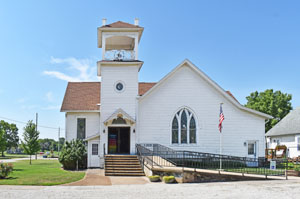
Methodist Church in Galesburg, Kansas by Kathy Alexander.
In May 1938, the Veeder Supply Company contracted to supply the city with Natural gas.
The Farmers Union Elevator was sold to C.C. Ducey in 1939. He was operating a commercial enterprise when it was destroyed by fire on August 29, 1939. However, Ducey immediately rebuilt.
On April 30, 1946, the city voted 86 to 2 to sell its distribution system to the Kansas Electric Power Company and gave it a franchise to furnish the city with electricity.
The Union Gas Company put in a pipeline in 1947. That year, bonds were approved for a new school building, which was soon under construction.
After serving as a major employer in Galesburg for many years, Shaw Manufacturing Company was sold to Bush Hog Manufacturing Company in 1962. However, it remained a division until 1974.
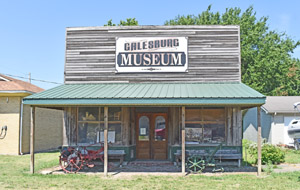
Galesburg, Kansas Museum by Kathy Alexander.
Galesburg High School was closed in 1967 as part of school unification. Today, the community is served by the Erie–Galesburg USD 101 public school district, headquartered in Erie, Kansas. Students attend Elementary and High School in Erie. The Middle School is located in Galesburg.
In the mid-1990s, the Galesburg Historical Society and Museum was created. The old post office in Galesburg was donated to the group by Everett and Lois Shrum for use as a museum. Work began on the building, and community members began donating a variety of old items, including materials related to Galesburg’s history, photographs, and extensive documents related to Shaw Manufacturing Equipment. The Galesburg Museum opened in 2003.
Subsequently, it was determined that additional space was required, and the society constructed a new building in 2005-2006. It is located on 2nd Street in Galesburg.
Galesburg is ten miles southwest of Erie, the county seat.
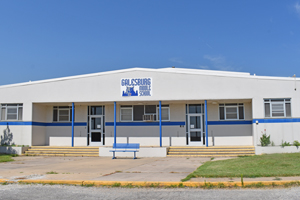
Middle School in Galesburg, Kansas by Kathy Alexander.
©Kathy Alexander/Legends of Kansas, updated January 2026.
Also See:

Agriculture buildings in Galesburg, Kansas by Kathy Alexander.
Sources:
Blackmar, Frank W.; Kansas: A Cyclopedia of State History, Vol I; Standard Publishing Company, Chicago, IL 1912.
Cutler, William G.; History of Kansas; A. T. Andreas, Chicago, IL, 1883.
Galesburg Historical Society & Museum
Graves, W.W.; History of Neosho County, Volume I was published in 1949 and Volume II in 1951, Journal Press, St. Paul, Kansas.
Wikipedia