
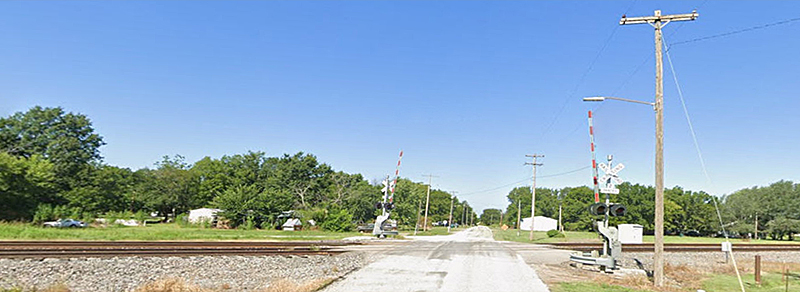
Labette, Kansas, Railroad, courtesy Google Maps.
Labette, Kansas, is a small town in eastern Labette County. It is officially an extinct town as its post office closed years ago. As of the 2020 census, the city’s population was 50, and it had a total area of 0.22 square miles, all land.
With the intention of making it the county seat, Labette was laid out in Liberty Township in May 1870 by a town company composed of several area citizens and railroad officers. The promoters were Dempsey Elliott, J.S. Waters, James H. Crichton, W.A. Hodges, John W. Homer, and W.J. Conner. W.J. Conner was made president of the town company, and J.S. Waters secretary. The town was named after Pierre Labette, a pioneer settler.
Labette absorbed the town of Neola, about a mile and a half south, where a post office had been established in 1869. On July 5, 1870, Neola’s post office was moved from Labette, with J.W. Conner serving as postmaster.
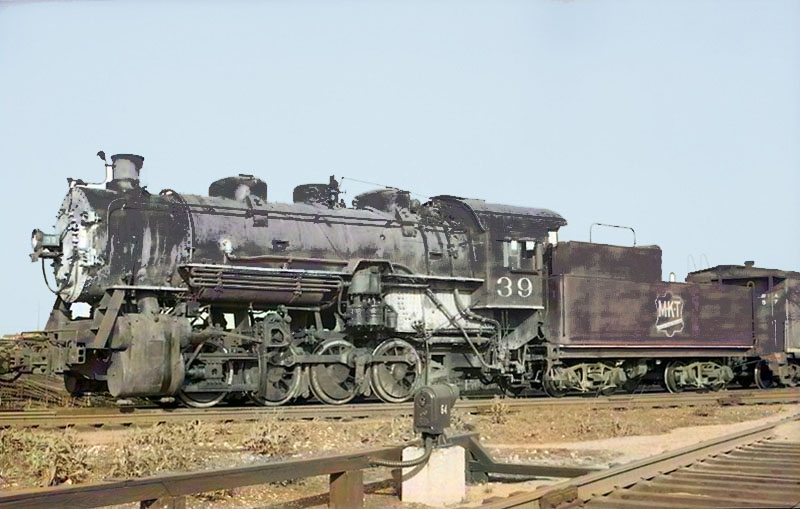
Missouri, Kansas & Texas Railway.
The Missouri, Kansas & Texas Railway owned half the land and helped promote the new town. The first house erected on the site, besides the claim houses, was that built by John Conner for a store room, in which he put a general stock of goods. The railroad company’s assistance in building the town significantly accelerated its progress, and the hope that it would become the county seat caused it to spring up as if by magic. Building was rapid, so that, within about two months of its establishment, about 70 houses were completed.
Montana, then a flourishing little city about six miles east, was nearly all pulled up, and the houses were moved to Labette. The first house to be thus moved was a saloon building belonging to J.A. Weider, in which he continued dealing out liquors in the new place.
Located at the junction of the Neosho Division and the main line of the Missouri, Kansas & Texas Railway, the building progress was so rapid that, in about six months, the place had attained a population of about 600, with about 15 business houses of various kinds and a large number of residence buildings. The Labette Sentinel was published for the first two years.
The first school was taught by J.L. Williams and his wife in the city hall in the winter of 1871. In the same year, Captain Anderson started a brewery, which he ran for about two years before the enterprise failed.
The Baptist Church was erected in 1874.
A flour mill was located on the creek in 1875 by Williams & Bowen.

An old barn in Labette,, Kansas by Kathy Alexander.
The Methodist Church building was erected in 1876.
A new one-story frame school building was erected in 1879. A wing addition was erected to this in 1880. By 1882, the school had about 110 students, taught by H. Jenkins and Miss Lizzie Sullivan.
However, the railroad company’s failure to carry out its promises scattered hopes, as well as the houses, which were again moved, some back to Montana and others scattered about the country in all directions.
By the early 1880s, it contained but three small stores, a post office, two churches, a few residences, and a population of about 200.
By 1882, the flouring mill was abandoned, the machinery removed, and only the building remained.
Later, the town rebounded to some extent.
In 1910, Labette was still on the Missouri, Kansas & Texas Railway, had telegraph and express offices, a money order post office with one rural route, a good local trade, and a population of 261.
In the following decades, Labette gradually declined, and its post office closed on January 17, 1986.
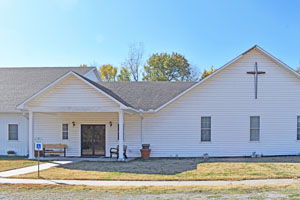
Baptist Church in Labette, Kansas by Kathy Alexander.
Today, this small town still has named streets, several homes, an active Baptist Church, and the United Pacific Railroad still runs along its tracks.
The community is served by the Labette County USD 506 public school district, headquartered in Altamont, Kansas.
Labette is located six miles northwest of Oswego, the county seat.
©Kathy Alexander/Legends of Kansas, updated December 2025.
Also See:
Extinct Towns of Labette County
Sources:
Blackmar, Frank W.; Kansas: A Cyclopedia of State History, Vol I; Standard Publishing Company, Chicago, IL 1912.
Cutler, William G.; History of Kansas; A. T. Andreas, Chicago, IL, 1883.
Wikipedia