
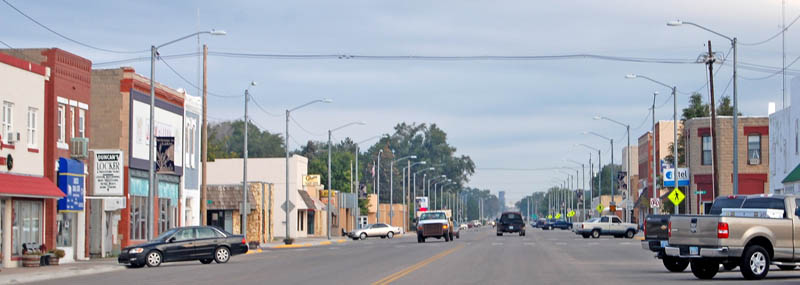
Lakin, Kansas Main Street by Kathy Alexander.
Lakin, Kansas, located in southern Kearny County along the Arkansas River, is a small town and the county seat. As of the 2020 census, the city’s population was 2,205, and its total area was 0.98 square miles, all land.
The Atchison, Topeka & Santa Fe Railroad was constructed in 1872, during which the buffalo were so numerous as to impede work. The line was completed to the western state line on December 28, 1872. On that day, the first cars ran over the entire route from Atchison, Kansas, to Colorado. On more than one occasion, trains were delayed by running into herds of buffalo.
Immediately after the construction of this road, John O’Loughlin saw the advantage of locating a trading post at Lakin. In April 1873, he established himself in an abandoned dug-out that the railroad’s construction crews had used. From there, he served passengers on the newly completed Atchison, Topeka & Santa Fe Railroad and pioneers traveling by wagon along the Santa Fe Trail. So far as is known, John O’Loughlin was the first settler in Southwest Kansas. As there was no money in the country at that time, the young pioneer merchant traded provisions for buffalo meat and, later, for buffalo bones. These, in turn, he traded to wholesalers for provisions, clothing, ammunition, and other supplies.
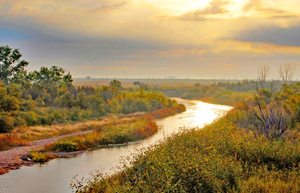
Arkansas River near Lakin, Kansas by Kathy Alexander.
There was no bridge across the Arkansas River from Dodge City, Kansas, to Granada, Colorado, so John O’Loughlin’s store was the only place where a large variety of supplies could be obtained through trade. The stock had to be varied to meet the needs of the railroad crews, trappers, freighters, soldiers, buffalo hunters, and cowboys. Besides the ordinary line of staple groceries and dry goods, travelers could buy Sharps rifles, Colts’ six-shooters, ammunition, chaps, spurs, saddles, boots, ox bows, ox yokes, and shoes, and everything necessary for the outfitting of an ox-team, he would take their worn-out oxen and horses and trade them for teams that he had kept and fed until they were in condition to take up again the long overland trek across the western part of the continent.
Though it might seem that a storekeeper’s life was dull, that was not the case with John O’Loughlin’s store, where the lines of cattle movement were established so that chuck wagons from the north loaded at Lakin for the roundup on the south, and many times in a single day the clerk was instructed to send bills for one outfit to Chicago, Illinois; another to Kansas City, Missouri, and a third to Denver, Colorado, thus showing the ramifications of the cattle trade.
Not only was John O’Loughlin the first merchant, but he was also appointed postmaster when the post office was established on March 6, 1874. The city was named after David Long Lakin, a trustee of the railroad company.
Early settlers reported that herds of buffalo, extending as far as the eye could see, roamed the prairies. The meat from these animals was about the only kind to be obtained, although there was some antelope and deer.
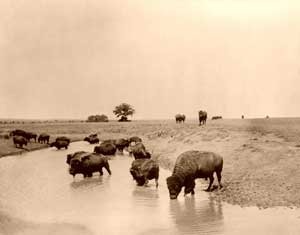
Buffalo at water by the Detroit Publishing Company, 1904.
Where the Indians killed one buffalo for food, the hide and tongue hunters killed 50. This slaughter kept up year after year, thousands of hunters being employed to kill as many as they could. The construction of the Pacific railroads divided the buffalo into two large herds, which ranged on both sides of the Platte River, with an estimated total of about three million. Western men never thought that it would be possible to kill such a number, but by 1875, the southern herd was practically exterminated, which gave rise to a large industry for Lakin. Upon arrival, newcomers would see huge piles of bones, with as many as 30 carloads, stacked along the railroad track. The buffalo bones were gathered and shipped to the East, where their principal use was in the making of commercial fertilizer. Each wagonload of bones weighed about 300 pounds. The average price was $6 per ton, and hundreds of carloads were shipped.
The first telegraph operator and station agent in Lakin was A.B. Boylan, who came in 1875. Before that time, he had made his home in Dodge City, but made daily trips to the end of the line. He carried his telegraph instrument in the caboose and, whenever communication was necessary, attached the instrument to the wire. After the station was built, he was transferred to Lakin.
The Atchison, Topeka & Santa Fe Railroad constructed a two-story dining hall in Lakin in 1876, west of John O’Loughlin’s trading post near present-day Hamilton Street. The wooden structure was built at a cost of little more than $5,000, and announcements of the eating house’s opening appeared in papers across the state in May of that year.
By the end of the year, Guy Potter had relocated to Lakin and was managing the railroad’s eating house, often referred to as the Lakin House. Potter had a reputation for being good-natured and hospitable, and for serving square meals. Potter and Fred Harvey, a competitor, remained friends, and when the Potters’ 19-year-old daughter, Frankie, passed away that summer, her remains were taken back to Leavenworth, and the funeral was held at the Harvey home.
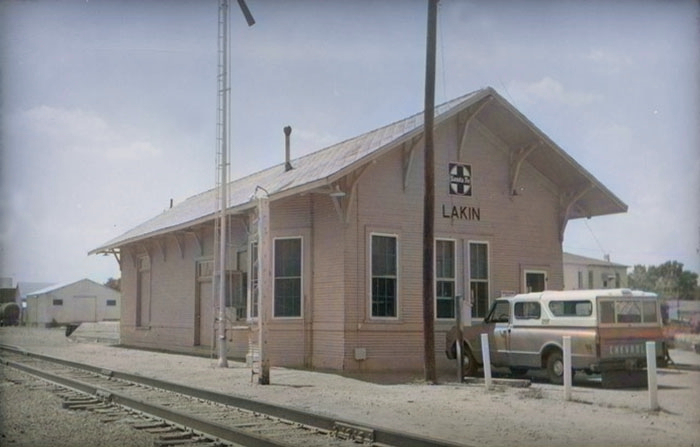
Atchison, Topeka & Santa Fe Railroad Depot in Lakin, Kansas.
In March of 1878, the Leavenworth Times reported that Fred Harvey was the new proprietor of Lakin’s eating house. Guy Potter and his wife continued to manage the facility and provide services. Although Lakin’s depot hotel was not as extravagant as other Harvey Houses, excellent service, imported linens, and consistently good fresh food were always on the menu. “The best place to eat and sleep in the Wild West,” the hotel quickly became Harvey’s home away from home.
Joseph Dillon arrived in Lakin on May 1, 1879, and Franklin Pierce arrived just two days later. Franklin L. Pierce started raising watermelons and was very successful. For a time, he was in the real estate business with C.O. Chapman and later with J. Longstreth. Other prominent pioneers were William Russel, J.H. Waterman, and C.A. Louck. During the summer of 1879, the Louck and Dillon residences were built.
By that time, Lakin had grown, and O’Loughlin’s business flourished, having had more business than the dugout store could handle. He built a 30×50-foot store building just a few feet away from the dug-out. By that time, Lakin boasted the Harvey House, a section house, a station, Theodore Brown’s drugstore, the O’Loughlin store, the Lakin Eagle office, Potter & Mitchell real estate office, and Gray & Jones Supply Company, all of which faced the railroad.
By August 1879, rumors circulated that the railroad would relocate the eating station. The dining hall was relocated in December 1880 to Coolidge, Kansas, which became the division point of the Atchison, Topeka & Santa Fe Railroad in 1881. This same Harvey House was later moved to Syracuse, where it was destroyed by fire in 1906.
Mrs. A.M. Louck, who located on a homestead near Deerfield in 1879, went to Lakin in November of that year and established a hotel.
In the early 1880s, there was a well-attended school here, and a new stone schoolhouse was built in the quarry west of Lakin.
Lakin was platted in 1882. That year, the first issue of the Lakin Herald was published on December 2, 1882, by Joseph Dillon, editor and proprietor. It was a nice, well-conducted, seven-column newspaper, with excellent prospects.
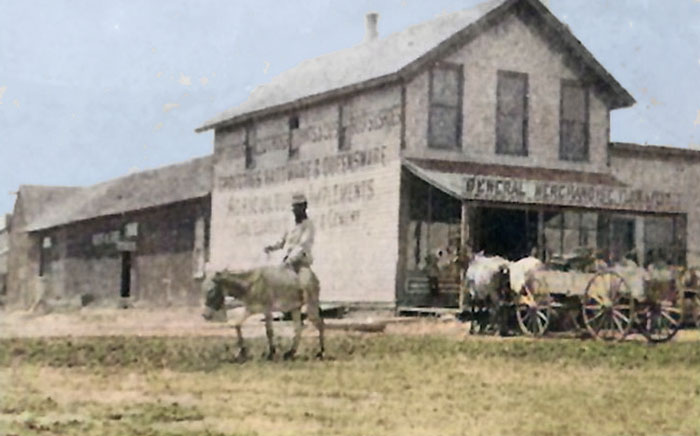
John O’Loughlin’s general store in Lakin, Kansas.
In 1883, using eight horses, chains, and large logs, O’Loughlin moved his store building to Main Street. At one point, John’s brother-in-law, Michael Weber, joined him in the mercantile business, and they expanded their services to include clothing, hardware, agricultural implements, cement, lumber, coal, and more. Early on, O’Loughlin saw the advantage of the allied businesses of farming and ranching. His extensive holdings included farms and ranches in southern Kansas, Oklahoma, and Texas, the best-known of which was the Pig Pen ranch in northern Grant County, so named for its cattle brand. He also
For a period thereafter, the dugout served as a storehouse but was later demolished.
The town was included in Finney County in 1884 and remained there until 1887, when Kearny was organized as a county.
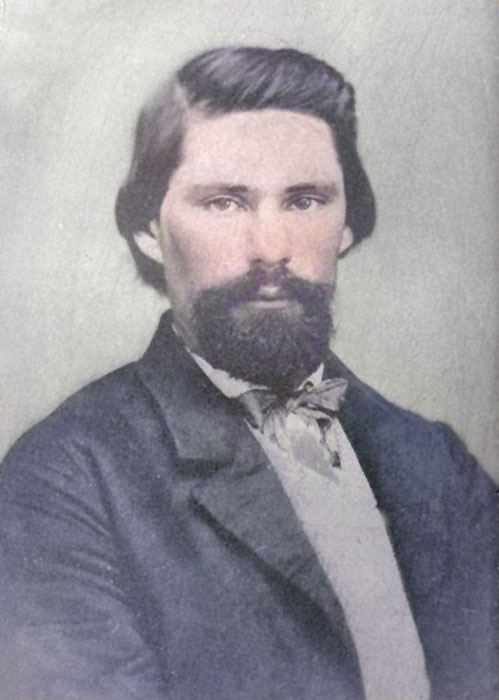
John O’Loughlin
On February 5, 1885, John O’Loughlin married Miss Mary Farrell, and the couple would eventually have seven children. When their sons were grown, they took over the O’Loughlin store and John’s ranching interests.
The first courthouse was a two-story frame structure built in 1885.
The Kearny County Advocate was established as a weekly newspaper in Lakin in May 1885 by F.R. French. The Pioneer Democrat was established in November 1885 by G.K. Estes.
The Bank of Lakin was established on February 8, 1886, with L.R. Holmes as president, John O’Loughlin as vice president, R.M. Spivey as cashier, and Sam H. Carr as assistant cashier.
That year, George H. Tate had a shoe store; J.B. Harbolt and A.W. Smith were among the carpenters of the town; William Shakespeare was a clerk in one of the stores; S.V. Goeden and Richardson & Judd were operating cigar and confectionery stores; V.D. Bond was the proprietor of a hotel, and W.J. Price was one of the real estate agents.
Lakin was designated as the temporary county seat of Kearny County in 1888, when the county was organized.
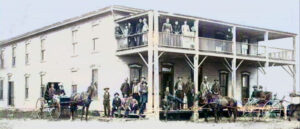
The Kearney House in Hartland served as a courthouse until it was destroyed by fire on January 17, 1894.
In February 1889, a county seat election was held. Hartland defeated Lakin, but the county officers, who were Lakin men, refused to relocate the offices. Again, the matter was taken to court, and after considerable litigation, the Supreme Court ordered that the records be transferred to Hartland in January 1890.
The Columbia schoolhouse was built north of Lakin in 1893, with Willard Miller serving as the first teacher.
Hartland continued to serve as the seat of justice until September 1894, when the county seat was relocated to Lakin, where it has remained ever since.
In 1910, Lakin was still on the Atchison, Topeka & Santa Fe Railroad; there were two banks, with combined capital of $20,000 and $160,000 in deposits; the Kearny County Advocate newspaper, telegraph, and express offices; and an international money order post office with one rural route. The population in 1910 was 337.
John O’Loughlin died at the age of 73 in 1915. Afterwards, his business was managed by his sons.
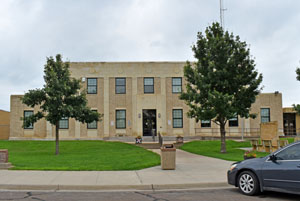
Kearny County Courthouse in Lakin, Kansas, by Kathy Alexander.
The second and present courthouse was constructed in 1939 at the corner of 304 North Main Street and Washington Avenue. It was designed by Overend & Boucher of Wichita, Kansas, and built by A. W. Soderberg Construction Company.
The Art Deco-style building faces southwest and is a two-story buff-colored brick-and-concrete structure. The rectangular-shaped building is located on landscaped grounds in the center of Lakin. The main entrance is located in the center of the first story and is trimmed with stone. There is one story wing on the southeast side and another one-story wing on the northwest side. In the interior, the central corridor runs southeast-northwest. The County District Court courtroom is located on the northeast side of the second story. The building houses the County District Court of the 25th Judicial District. On the northwest side is the County Public Library.
After the Lakin Depot was closed in 1982, it was relocated to the Kearny County Museum.
Lakin’s population peaked in 2000 at 2,316.

Kearny County Museum, Lakin, Kansas. Photo by Kathy Alexander.
The community is served by the Lakin USD 215 public school district.
To learn more about Lakin and Kearny County, visit the Kearny County Museum, which features over 20,000 square feet of historical displays and includes the main museum building and annex, the Great White House, Columbia School (1893), Santa Fe depot (1876), a machinery building, Conestoga wagons used to haul freight on the Santa Fe Trail; an 1800s survey wagon; and a 12-sided barn built in 1909.
There are several Santa Fe Trail attractions and landmarks in Kearny County, including Chouteau’s Island, Indian Mound, and Bluff Station, where the caravans sometimes went south to join the Cimarron Cut-Off. The mountain route of the trail followed the Arkansas River west to Bent’s Fort. Approximately three miles east of Lakin, old wagon ruts are visible.
Lakin is located along U.S. Highway 50/US 400, about 24 miles southwest of Garden City, Kansas.
©Kathy Alexander/Legends of Kansas, updated December 2025.
Also See:
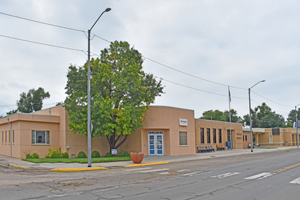
Business buildings in Lakin, Kansas, by Kathy Alexander.
Sources:
American Courthouses
Blackmar, Frank W.; Kansas: A Cyclopedia of State History, Vol I; Standard Publishing Company, Chicago, IL 1912.
City of Lakin
Kearny County Museum
Wikipedia