
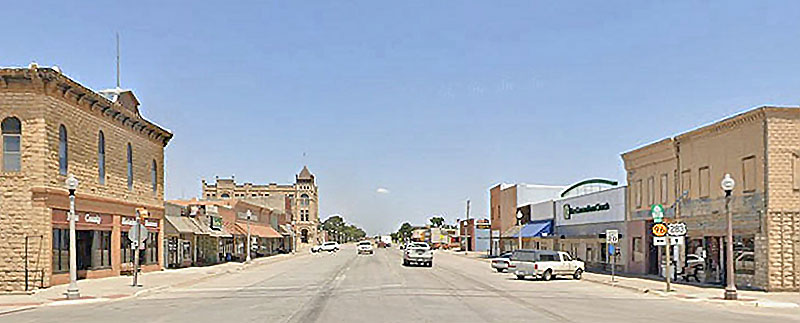
Ness City, Kansas, courtesy of Google Maps.
Ness City, Kansas, the county seat of Ness County, is located on Walnut Creek, a short distance south of the county’s geographic center. As of the 2020 census, the city’s population was 1,329, and it has a total area of 1.02 square miles, all of which is land.
The first residents in the area were buffalo hunters. Joe Dickson was one of the first settlers, arriving in the early 1870s and filing a claim in 1875.
Although there were fewer than ten inhabitants in the early 1870s, a hustler from Chicago, Illinois, hatched an outrageous plan for personal gain. Dr. Rodgers, with help from the Kansas City Directory, borrowed about 600 names and presented them to the governor as a petition for county organization. Rodgers sold bonds and took his plans a step further by getting elected to the state legislature, where his fraud was exposed. It was shown that there were closer to 14 residents in the county. His tenure as a state legislator lasted only 30 days. It resulted in Ness County being disorganized. In the meantime, Dr. Rodgers managed to escape with the money he had raised by selling the phony bonds and never stood trial.
Ness City was officially founded in 1878 by Richard Dighton. Both the city and county were named in honor of Noah V. Ness, corporal of Company G, Seventh Kansas Cavalry, who died August 24, 1864, at Abbeyville, Mississippi, of wounds received in action on August 19, 1864. Corporal Ness never lived in Ness County; the name was selected by the State. The townsite was surveyed on October 22, 1878, by Richard Dighton.
The Le Grand Hotel was one of the earliest buildings constructed. Built by Mr. Harwood, it was christened the “HarWood”. It soon passed into the hands of George F. Webster, an old and successful hotel man who did a fine business for three months when it went into other hands again.
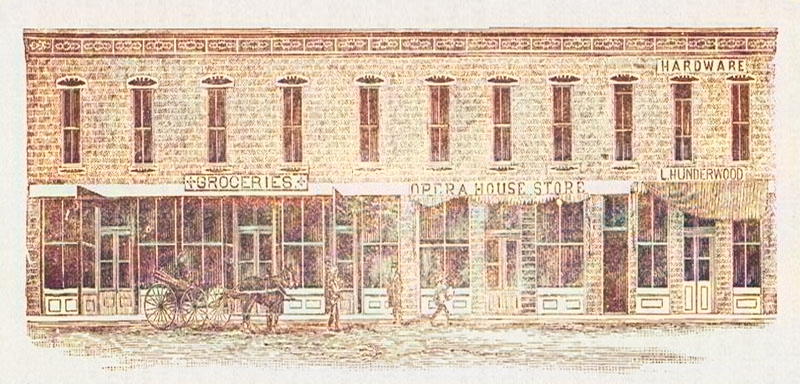
Opera House and other businesses in Ness City, Kansas.
When the post office was established on January 22, 1879, the town was initially called Iowa.
William H. Hoover, an early settler from Pennsylvania, began a general merchandise business in 1879.
The Ness City Times, the oldest paper in the county, originated as the Walnut Valley Times, founded on September 20, 1879, at Clarinda, by N.C. Merrill. It was purchased by John F. Wood, who moved it to Ness City on January 22, 1880, and christened it the Ness City Times. A Republican newspaper, it was recognized as one of the best country journals in Western Kansas.
In 1880, Sidney was declared the county seat.
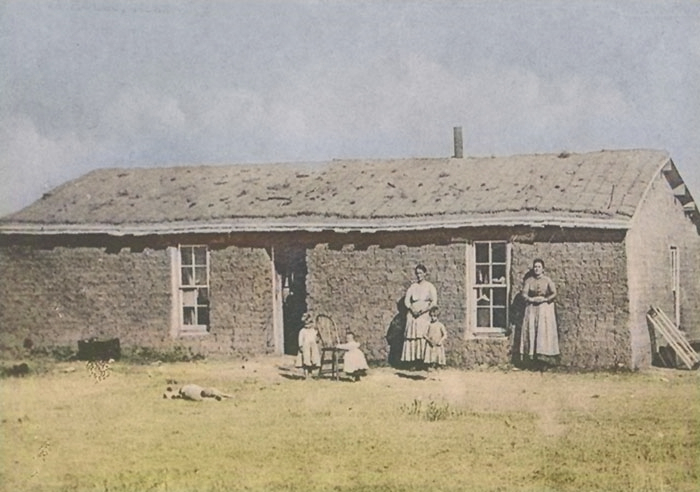
A sod house in Ness City, Kansas.
By that time, early capitalist Robert Stephens made a substantial addition to the town, which ultimately helped attract the Atchison, Topeka & Santa Fe Railroad several years later. That year, early founder Ross Calhoun donated land for a courthouse, but it would not be built for years.
The town’s name was changed to Ness City on January 31, 1881.
In 1882, Ness City was declared the county seat. The county initially utilized rented premises.
At that time, it boasted a general store, a post office, a hotel, a land office, a wagon shop, a Blacksmith, and other local businesses.
In the 1880s, William H. Hoover built two handsome stores in the Hayward-Hoover Block. He also owned 480 acres of choice farmland.
The Ness County News was founded in November 1884 by Judge J.K. Barnd, and was edited and published by Barnd & McFarland. A Republican journal, it soon had a large circulation. The publishers are both old settlers of Ness County.
The Ness County Bank was founded on July 1, 1885. N.C. Merrill, its founder, president, and manager, was recognized as an able and successful business manager and financier who had acquired property in farm lands, herds, real estate, and commercial securities. Mr. Merrill has been especially fortunate in his investments in Ness County and was popular with the farmers, stockmen, and businessmen there. The Ness County Bank was the headquarters for the county’s stockmen and was practically a stockmen’s exchange, carrying full lists of marketable livestock for sale in this region.
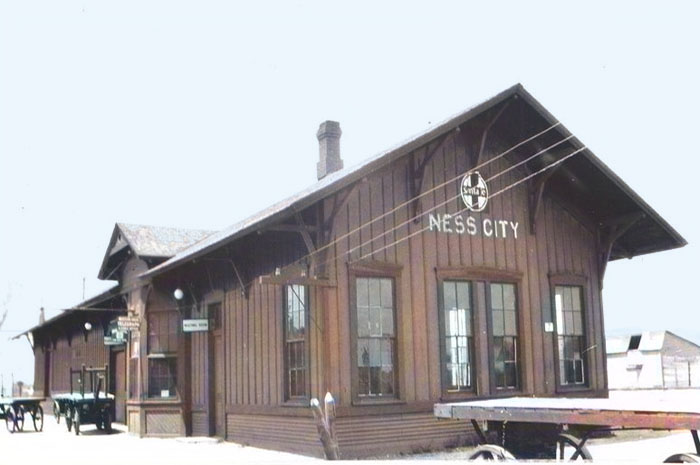
Atchison, Topeka & Santa Fe Railroad Depot in Ness City, Kansas.
The Bank of Ness City was opened on the same day as the Ness County Bank, on July 1, 1885, by Borthwick Brothers. It was a strong, conservative bank.
Its proprietors and managers were trained in banking in northeastern Iowa and came here in the spring of 1885 to conduct the business
By 1885, the IOOF Lodge, which was established in Sidney in 1879, relocated to the Ness City Opera House. It was active in helping their neighbors, uplifting the sick and dying, and assisting with funerals and burials. They organized social functions to raise money for their endeavors.
When the Atchison, Topeka & Santa Fe Railroad arrived in 1886, it created an economic boom, and soon new businesses were established, including a creamery, an ice plant, stone quarries, grain elevators and mills, and baking facilities. That year, the city was incorporated.
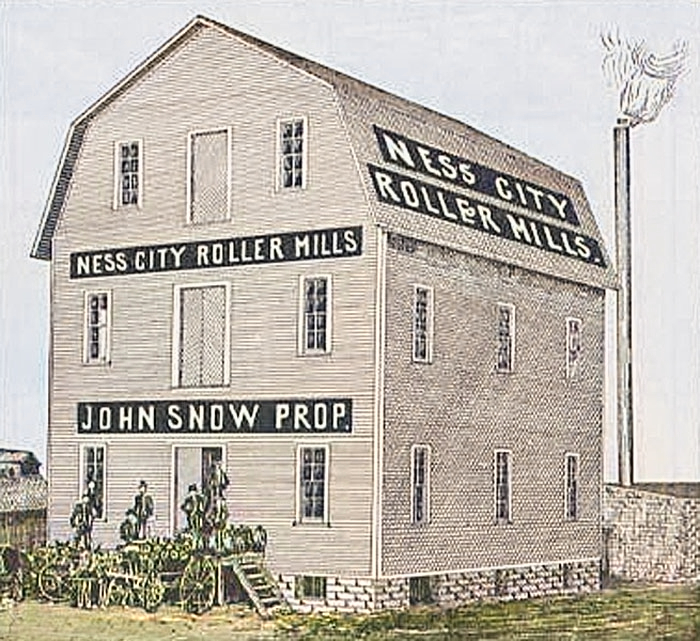
Ness City, Kansas, roller mills.
That year, John Snow built the Ness City Flouring Mills. Measuring 24 by 42 feet on the ground, and were three stories high. The steam-driven mills were equipped with a full roller process and other modern mill machinery; had a daily capacity of 75 barrels; and were among the most valuable mill properties in Western Kansas. Snow, a native of England, was a square, earnest, energetic businessman.
The Walnut Valley Sentinel was founded in May 1886 by McDowell & Weisell, who were originally from Indiana, and it was a democratic journal. Under the editorship of Mr. D.E. McDowell, it soon attained a wide circulation and commanding influence.
The State Bank of Ness City was incorporated in early summer 1886 with a capital of $100,000. It was opened for business in July. Ross Calhoun, the founder of the city and a well-known and wealthy merchant and real estate owner, was president; Jacob Nicholson, a prominent farmer, was vice president; and C.E. Clarkson was cashier. The State Bank was a home institution, with all shareholders being Ness County men, and it quickly made a record that many an older bank might envy. It had surplus earnings that quickly equaled 20% of its capital.
The First National Bank of Ness City was organized in June 1886, with a cash capital of $50,000. The Honorable J.W. Rush, president of the First National Bank of Larned and State Senator from this district, was president, and Charles L. Rogers, cashier and manager. The new National Bank building was one of the finest in the city, and its offices among the most convenient and elegantly appointed in the western country. It soon had a large and rapidly growing patronage and a most promising future.
In November 1886, the Ness City Times was purchased by Messrs. Burton & Black, who also purchased the Graphic at about the same time and merged it with the Times.
Larger western Kansas towns like Garden City and Dodge City built streetcar and waterworks systems during this period to compete for business and residents as the railroads developed. Smaller towns like Ness City were not immune to this early development. As a town with fewer than 1,000 people in 1887, Ness City leaders were already planning a $25,000 waterworks and a street railway.
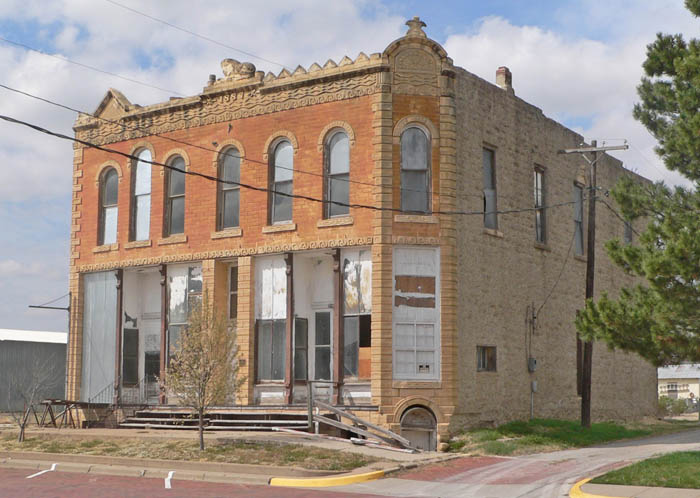
Lion Block in Ness City, Kansas, courtesy Wikipedia.
By that time, the Borthwick Brothers had constructed a beautiful bank building for the Bank of Ness City, land agents and loan companies were multiplying, and offices and stores could scarcely be built fast enough to accommodate the businesses coming in.
By April 1887, there were 62 buildings under construction in Ness City. During this economic boom, the Lion Block was also being built. It is significant as an example of commercial Italianate architecture. Stephen A. Shepard was an accomplished photographer and artist who, along with his brother, financed the construction of the Lion Block to house his studio and collection. They expected the building to be completed and occupied by August 15, 1887.
Local newspapers from that year provide colorful accounts of the building’s construction and opening. The earliest newspaper articles refer to the building as the Lion Block, referencing the carved stone lion atop the parapet, or the Shepard Brothers Block. An early sketch of the Lion Block appeared in the 1887 publication, the Handbook of Ness County, Kansas. The sketch depicts the building as “Shepard’s Art Gallery”, with the west storefront housing the post office. Other early businesses occupying the Block included a land office operated by McCartney and Busick,10 George O. Hunt and Company dry goods, H and J.E. Reid Dry Goods, to name a few. The building was listed on the National Register of Historic Places in October 2008.
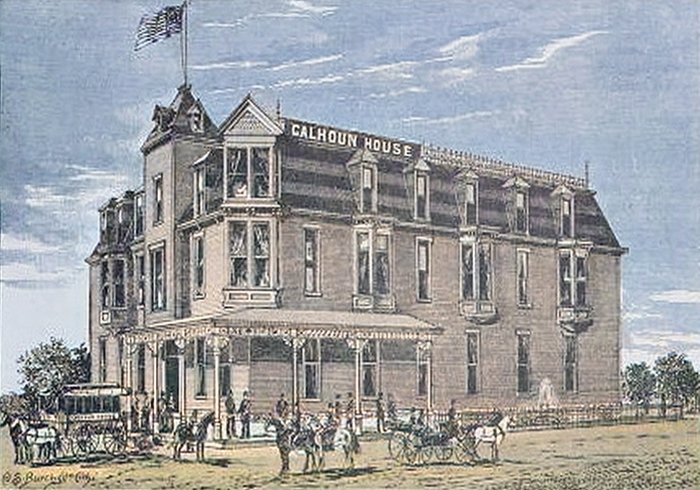
Calhoun House in Ness City, Kansas.
At about that time, the Calhoun Hotel was built and furnished by Ross Calhoun at a cost of $16,000. The handsome hotel was a beautiful specimen\, whose fine style, superior finish, and elegant furnishings were a splendid compliment to the builder and the city. It is admirably planned, and perfectly heated by a superior hot-air heating plant; it has not a single dark or dingy corner, and from the base to the attic was aglow with light and warmth. The ample office and dining room, elegantly furnished parlors and sleeping rooms, spacious and airy halls and corridors, fine table service and delightful cuisine, gave the new hostelry great favor with the citizens and traveling public. The Calhoun had waterworks of its own, bringing the clear waters of Sunset Lake to every portion of the house and grounds, which looked out upon a pretty park, whose well-shaded walks and drives.
By 1887, the Le Grand Hotel had been destroyed by fire.
The New Arlington House was built by Steele & Forester and was opened by the end of 1887.
Construction of the Ness County Bank building began in the fall of 1888. The four-story, 18,700-square-foot stone building was designed by the architectural firm of Holland & Hopkins of Topeka, Kansas, and the building contract was awarded to William Ruff in November 1888 for $34,000. The stone masonry was subcontracted to Daniel J. Rogers of Newton, Kansas, for $2,900, and P.A. Narey of Bazine, Kansas, carved the stone detailing on the arches. Estimates placed the building’s ultimate cost at $75,000.
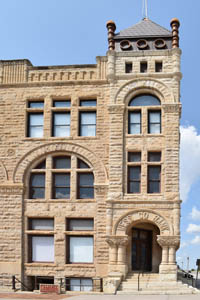
Old Bank Building in Ness City, Kansas by Kathy Alexander.
The bank building was designed in the Romanesque Revival style. It had the bank building, which has 30 rooms and features an elevator shaft, unique for its time. Instead of sand, crushed and ground limestone was used as an aggregate for the mortar to ensure an exact match with adjoining stone. The windows are typically arranged in groups of three, with the second-floor windows contained within large semi-circular arches that extend from the first floor, creating a striking accent on the facade. Four cut-stone spires rise from the pyramid’s roof, showcasing the fine craftsmanship characteristic of the 1880s.
In October 1889, Eaton and Cramer installed the cornice roof. The Ness County Bank moved into its new quarters in July 1890 with N.C. Merrill as president and J.G. Arnold as vice-president. The reported cost of the finished structure was $35,000. It was located at Main Street and Pennsylvania Avenue. At that time, Ness City had a population of 869.
By the close of the 1880s, the courthouse square was faced on two sides with solid blocks of two-story commercial buildings.
By 1890, the town’s population had grown to 869.
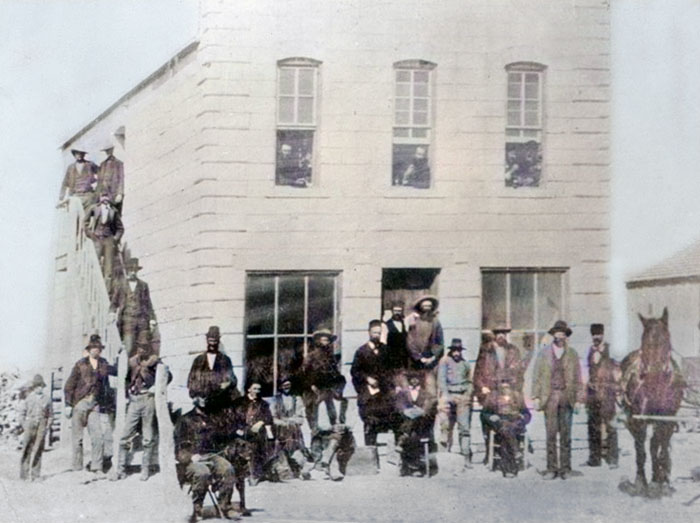
Ness City Courthouse in the 1880s.
Merrill’s banking business, which served wide areas of Kansas and Colorado, thrived for a time, but when the population declined due to the financial panic and poor crop yields, the Ness County Bank building was sold at tax sale in 1893.
The Ness County State Bank, the successor to the Ness County Bank, continued to operate in the building until January 8, 1898.
The Ness City Baptist Church, which was organized in June 1900 with 29 charter members. They first met on the first floor of the Lion Block, as did the Boy Scouts during the 1920s and early 1930s.
The local IOOF Lodge, on the second story of the Lion Block, served for many years as the lodge’s meeting space, beginning about 1900.
The first courthouse was located in an old bank building in 1903.
That year, the First State Bank merged with the Citizens State Bank. At that time, the third-floor iron stairway was installed in September 1903. Jasper Walton painted the Woodwork on the third floor, the finished room making a courtroom any county in Kansas would be justly proud to have.
In 1910, Ness City was still on the Atchison, Topeka & Santa Fe Railroad. At that time, it was a third-class incorporated city. It had two national banks, two newspapers — the News and the Echo, an electric light plant, a flour mill, an ice plant, a creamery, telegraph and express offices, an international money order post office with two rural routes, and a population of 712.
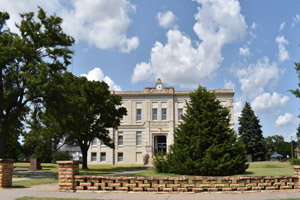
Ness County Courthouse in Ness City, Kansas by Kathy Alexander.
The Ness County courthouse was built in 1917 and 1918. The Classical Revival building was designed by J.C. Holland & Son of Topeka, Kansas, and built by Cuthbert & Sons. Still used today, the south-facing three-story stone-and-concrete structure is located on spacious, landscaped grounds in the center of Ness City. The building has a raised basement. It has entrances on the south and east sides, entering the second story. On the roof above the entrances are parapets with crests. In the interior, the courtroom is located on the north side of the third story. The building houses the County District Court of the 24th Judicial District, which includes Edwards County, Hodgeman County, Lane County, Pawnee County, and Rush County. It is located at 202 West Sycamore Street and South Kansas Avenue.
The Citizens State Bank occupied the old Ness County Bank building until 1922.
The last bank in the original bank building for any length of time was the First National Bank, which operated until the early 1930s. The Ness County Bank building also housed the county court and offices from 1903 until 1917, served as a U.S. post office for approximately 20 years, beginning around 1940, and was used for apartments and business offices.
The Clod Hopper Dance Club began hosting dances at the Lion Block in the late 1930s. Music was provided by local citizens. Square dances, round dances, waltzes, and polkas were popular. Generally, a 25¢ fee was charged per person, and those attending typically provided coffee and desserts. No alcohol consumption was allowed, and if one elected to leave, they were not permitted to come back that night.
In 1938, the historic bank building was sold at tax auction and purchased by R.B. Christy, a banker-philanthropist from Scott City, Kansas. He spent considerable time and money repairing the building, hiring Charles Blackburn of Scott City, Kansas, who worked on it for almost a year, painting, repairing, and generally bringing it into better shape. A new floor of oak was put in the bank room. The tenant for that time was an oil company.
The post office then became the next tenant and leased the floor for the next ten years.
In 1971, the Masonic Lodge occupied the third floor of the old Ness County Bank building, as it had since 1919; the first floor was used as a meeting room for elderly citizens; a Christian Science reading room was in the basement; and several offices were still in use. Architecturally, this handsome stone building stands as a monument to the fine craftsmanship prevalent in the late 19th century. Its imposing size and exquisite detailing make it a landmark on the western Kansas plains.
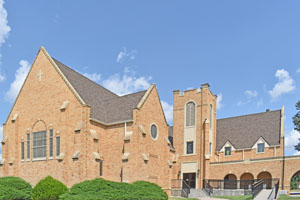
Methodist Church in Ness City, Kansas by Kathy Alexander.
In February 1972, the historic bank building was added to the National Register of Historic Places. Four large walk-in vaults with original burglar alarms remained in working order throughout the years. An original oil painting, finished in 22-karat gold, adorns the vault door in the Great Room, further enhancing the interior’s beauty. Throughout the building, the ceilings are 13 feet high. Brass door knobs and fixtures with a sunflower design indicate the use of high-quality hardware.
The Lion Block was sold to Donald Bain in 1973, and the IOOF Lodge then met at the Old Christian Church building. The second floor was also the meeting place for other organizations and events, including extension unit and Farm Bureau meetings, receptions, family and class reunions, soup suppers, dances, and meetings.
Ness City’s population peaked in 1980 at 1,769.
In 1984, after ten years of vacancy, and at a point critical to its preservation, the rapidly deteriorating bank building was purchased by the Ness County Bank Building Foundation, Inc., using $30,000 in Federal Revenue Funds, donated by Ness County, and $15,000 in Industrial Revenue Funds, donated by Ness City. The Foundation enlisted the help of both engineering and architectural firms to determine the steps needed to prevent further deterioration and stabilize the building structurally. Following their recommendations, a new roof was installed; exterior stone was re-pointed; gutters and downspouts were replaced; windows were re-glazed; unwanted material was removed; and the building and grounds were cleaned.
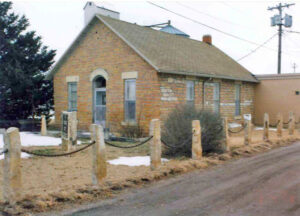
Ness City Old School in Ness City, Kansas.
In 1988, the west portion of the main floor old Ness County Bank building was remodeled to house the Ness City Chamber of Commerce office.
In 1990, the Great Room in the east portion of the historic bank’s main floor was renovated. The Great Room serves as a common hall and an exhibit area, and it lends itself well to community meetings, programs, and a variety of events.
Nicknamed the Skyscraper of the Plains, the four-story old Ness County Bank Building is located at the intersection of Main Street and Pennsylvania Avenue in downtown Ness City.
The city provides two museums. The Ness County Historical Museum is located at 123 S. Pennsylvania, and the Ness County Oil and Ag Museum is at 210 E Sycamore.
Ness City, Kansas, is located at the intersection of highways K-96 and US-283. This rural community offers over 80 businesses, five churches, private & public schools, a library, a museum, a swimming pool, and many other amenities. It is 54 Miles north of Dodge City and 65 Miles west of Great Bend.
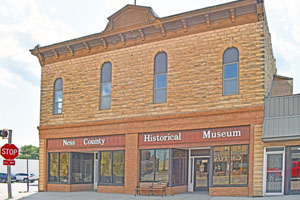
Ness County Historical Museum in Ness City, Kansas by Kathy Alexander.
©Kathy Alexander/Legends of Kansas, January 2026.
Also See:
Sources:
American Courthouses
Blackmar, Frank W.; Kansas: A Cyclopedia of State History, Vol I; Standard Publishing Company, Chicago, IL 1912.
Cutler, William G.; History of Kansas; A. T. Andreas, Chicago, IL, 1883.
Handbook of Ness County, Kansas; C.S. Burch Publishing Co; 1887
National Register of Historic Places – Ness County Bank
National Register of Historic Places – Lion Block
Ness County Chamber of Commerce
Texas Escapes
Wikipedia
Kansas & Its Surnames