
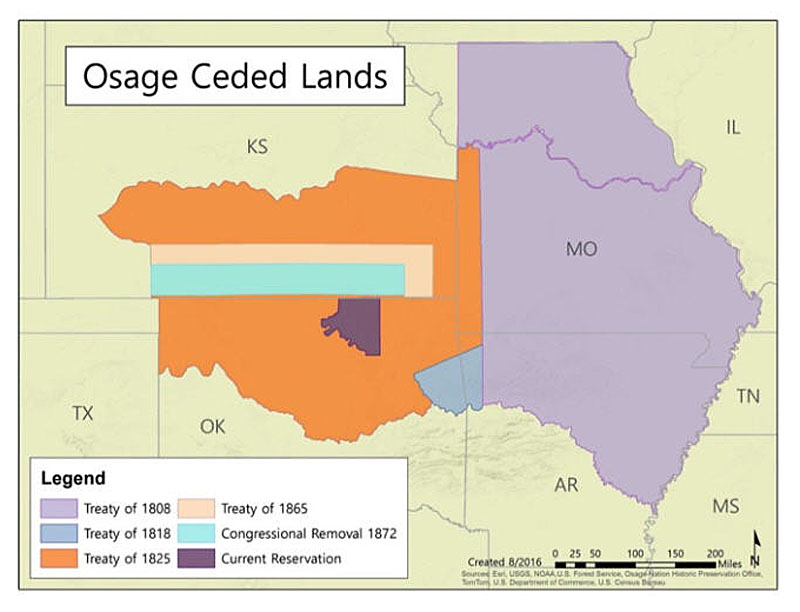
Osage Ceded Lands.
Neosho County, Kansas, is located in the northern part of the Osage ceded lands. These ceded lands were situated immediately west of the Cherokee Neutral Lands and spanned 50 miles north-south and 30 miles east-west. The total Osage Reservation, which extended westward from the Neutral Lands for 375 miles, was granted to the Osage Tribe by treaty on June 2, 1825. At some point during that year, the tribe relocated to its new reservation.
In 1820, the Osage conferred authority upon Reverend De Bourg, the Roman Catholic Bishop of New Orleans, Louisiana, who was visiting Missouri, to appoint a missionary to visit their towns and teach them the principles of Christianity. Reverend De Bourg appointed Reverend Charles De La Croix as the missionary. Reverend De La Croix traveled to western Missouri and what is now eastern Kansas to organize churches among the Osage.
In May 1822, he arrived in Neosho County at a location that would soon be known as Osage Mission (St. Paul). There, he administered the rite of baptism to two individuals, James and Francis Choteau, making them the first people baptized within the present-day state limits. Shortly after, Reverend De La Croix returned to Missouri but soon succumbed to exhaustion and illness from his labors in the field.
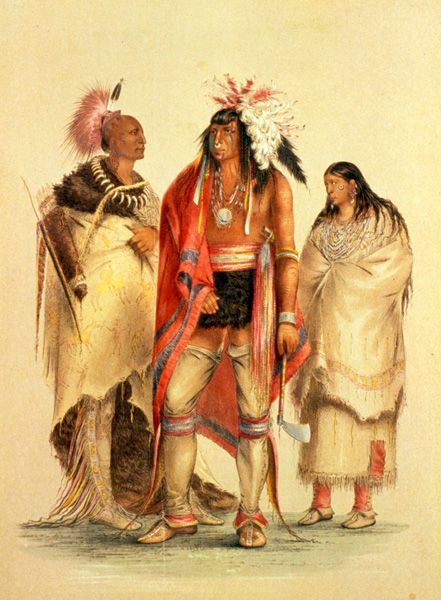
Osage indians by George Catlin.
Reverend La Croix was succeeded by Reverend Charles Van Quickenborn, who visited many of the Osage towns and was untiring in his efforts to provide education for their youth. In 1824, he established the first manual-labor school among them, collecting the boys at the house of St. Stanislaus, near the town of Florissant, St. Louis County, Missouri, and the girls at the Convent of the Sacred Heart in St. Charles County. But the following year, a new treaty having been concluded between the United States and the Osage, they removed to their new reservation. As a consequence, Van Quickenborn’s manual-labor school came to an early end. However, he continued to visit them in their new home and care for them for several years.
Upon arriving in the vicinity of the present town of Walnut in Crawford County, which was for the most part destitute of water and timber, one of the Osage chiefs sent forward a group to select a location suitable for their camp. They soon discovered a long stretch of timber, and upon entering it came to a beautiful, clear stream of water, the gravelly bottom of which could be distinctly seen. Highly pleased with their discovery, they returned to their Chief, reported their success, and guided their colleagues to the river. Those who arrived first rode along the river and let their horses drink, and, as a consequence, when the Chief arrived a few moments later, the water was anything but “beautiful and clear.” He then gently rallied the discoverers of the river upon the subject, and from the circumstance of the roiling of the water, named the river Ne-o-sho, (Ne, water, o-sho, made muddy – water that has been made muddy.
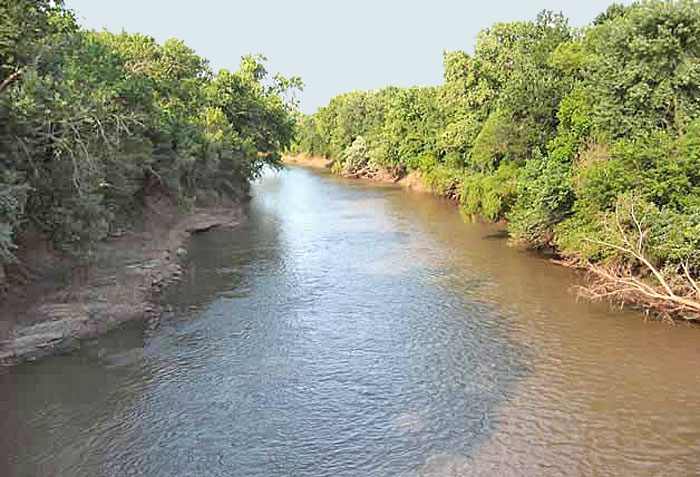
Neosho River, Kansas.
For a year or two, Reverend Van Quickenborn remained for the most part with the Osage at Harmony Mission on the Marais des Cygnes River, near Pappinsville, Missouri. In 1827, he reached the Neosho River, where residents were establishing permanent settlements. Around this time, the Osage Nation was divided into two divisions: one on the Neosho River and the other on the Verdigris River. The Indian Towns on the Verdigris River extended from the mouth of Pumpkin Creek to that of Chetopa Creek, while those on the Neosho extended from the mouth of Labette Creek to that of Owl Creek. Each division had a Chief, the principal Chief being that over the Neosho division.
In 1828, Van Quickenborn performed a marriage ceremony, the parties united being Francis Daybeau, a half-breed, and an Osage woman named Mary. This was the first marriage solemnized in the territory now included in the State of Kansas. Van Quickenborn died in 1828.
In 1837, the first trading posts among the Osage were established by Edward Choteau, Gerald Pappin, and John Mathews, the latter of whom located near White Hair’s village, now Oswego, in Labette County. A half-breed settlement was established between Canville and Flat Rock Creek. The former creek was named after A.B. Canville, who came to the Osage in 1844, married in 1845, and settled on Canville Creek in 1847.
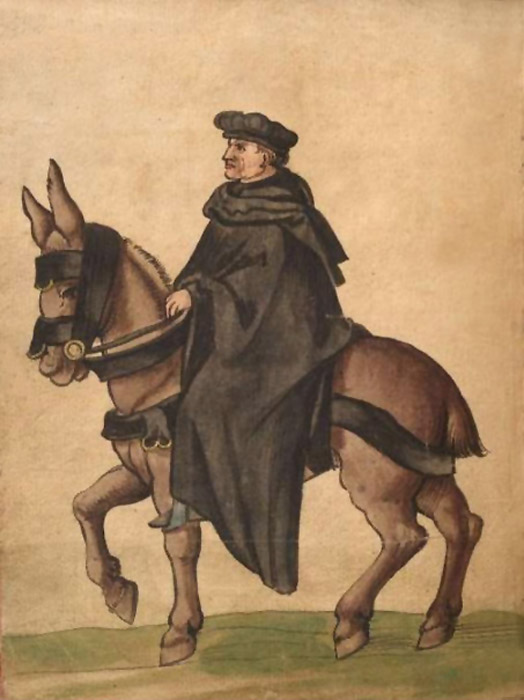
Catholic Priest.
From 1829 to 1847, various Catholic Fathers visited the Osage. Still, they, desiring a missionary permanently settled among them, requested that Reverend Peter R. Kendrick, Bishop of St. Louis, Missouri, make an appointment on their behalf. Consequently, the Bishop appointed Reverend Father John Schoenmakers, S.J., Superior of the Mission. Bather S. arrived on April 29, 1847, and took possession of two buildings that were then under construction by the Indian Department. Father Schoenmakers was accompanied by Fathers John J. Bax and Paul Ponziglione, who visited the Osage villages and urged them to adopt the importance of civilization and Christianity. On May 10, a small number of Osage children were removed, and a manual-labor school was established. The two buildings, which were now completed, were designed – one for the education of Indian boys, the other for the education of Indian girls. On October 5, 1847, several sisters of Loretto arrived at the Mission from Kentucky to educate Indian girls; a convent was established, which, with the school for boys, continues to flourish. As the number of scholars increased, additional, larger buildings were erected to accommodate them. The principal school buildings were two large, three-story stone structures, besides which there were two large three-story dwellings – one for the boys, the other for the girls. The first church, a frame building measuring 30 by 93 feet, was superseded by a magnificent stone church, measuring 75 by 175 feet, for approximately $75,000. The spire was 110 feet high. These schools were always popular among the Indians until their removal from the Reservation in 1865. The highest attendance in any year was 236, and over the ten years from 1855 to 1865, the average annual attendance was 150.
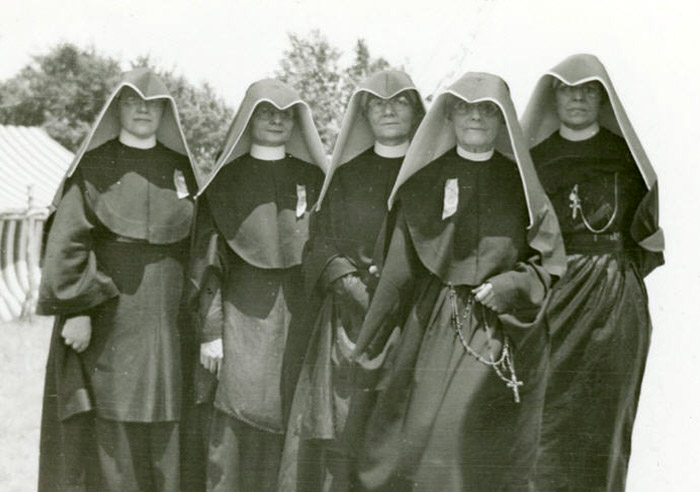
Sisters of Loretto.
During the Civil War, the Osage suffered greatly from various forms of depredation. Their newly built houses were torn down, their crops destroyed, their hogs and cattle stolen, and, becoming discouraged with their prospects, they ceded to the United States Government a strip off the east end of their reservation, measuring 50 by 30 miles in extent, containing 960,000 acres for $300,000 with the money deposited in the treasury of the United States, and to draw 5% interest. The interest was to be paid to them semi-annually in money, clothing, provisions, or such articles of utility as the Secretary of the Interior might from time to time direct. At the same time, they transferred, in trust to the Government for sale to their benefit, a strip off the north of the balance of their reservation, 20 miles in width from north to south and extending to the western limits of their reservation. The reservation thus reduced was called the “Diminished Osage Reserve” and was sold to the Government in 1870, and the Osage were relocated to a new reservation in the Indian Territory (Oklahoma).
After the war, southeastern Kansas was rapidly settled, and the need for educational facilities became increasingly urgent. The Osage Mission Manual Labor Schools were the central point of settlement, and the conductors deemed it expedient to admit white children. Accordingly, on May 7, 1870, the school for boys was chartered under the name and title of “St. Francis Institute,” with the view of making it a high school; and the school for girls was chartered on September 19, 1870, under the name of “St. Ann’s Academy.” The Sisters of Loretto operated the school, with Bridget Hayden serving as principal for girls from its establishment on October 5, 1847, for 35 years. Fathers Schoenmakers and Ponziglione lived at the Mission and were among the very oldest settlers in Kansas. With them were three other Jesuit priests, namely Fathers Kuleman, Condon, and Hagan.
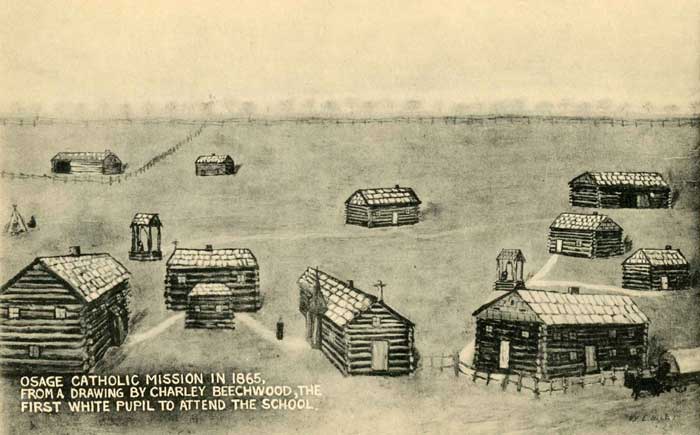
Osage Catholic Mission, 1865.
Compiled and edited by Kathy Alexander/Legends of Kansas, January 2026.
Also See:
St. Paul and the Osage Mission
Source: Cutler, William G.; History of Kansas; A. T. Andreas, Chicago, IL, 1883.