
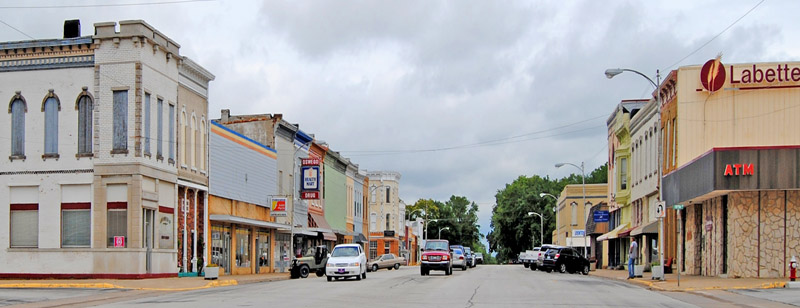
Oswego, Kansas Business District by Kathy Alexander.
Oswego, Kansas, situated along the southern bluffs overlooking the Neosho River Valley, is the county seat of Labette County and is two miles from its eastern boundary. As of the 2020 census, the city’s population was 1,668, and it had a total area of 2.30 square miles, comprising 2.24 square miles of land and 0.06 square miles of water.
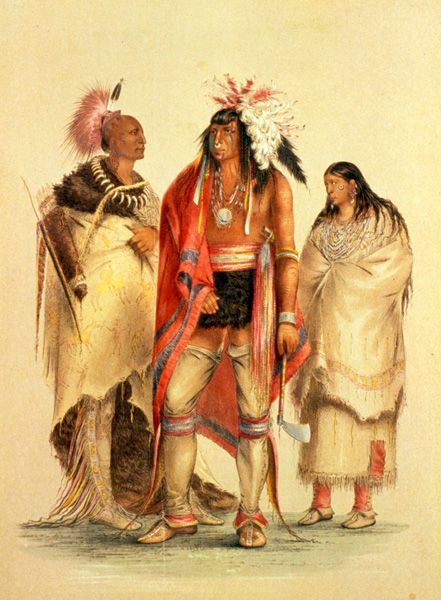
Osage indians by George Catlin.
Oswego was established on the site of an Osage village called No tse Wa spe, which means “Heart Stays” or, more loosely, “Quiet Heart.” Jesuit Missionaries from Osage Mission (now St. Paul, Kansas) who worked among the Osage called the village “Little Town,” probably because the band living there was of the “Little Osage” division of the Osage tribe. While Osage villages were often moved according to weather, hunting conditions, and sanitary conditions, Little Town Above was generally located on the bluff overlooking the Neosho River, where Oswego sits today. Little Town Below often sat near Horseshoe Lake, in the Neosho River Valley, about a mile due east of Oswego.
During the 1850s, Little Town was often called “White Hair’s Town” in honor of a resident named Iron Hawk. Iron Hawk was named Grand Tsi Shu Chief (or Peace Chief) of the Osage Nation through the 19th Century. It was traditional for the Osage Chief to take the name “White Hair.”
A study of the Jesuits’ baptismal records at Osage Mission reveals that several white or mixed white-and-Osage families lived in or near Little Town before the Civil War. Several mixed white and Cherokee families also lived in or near the present site of Little Town, likely just east of the village in the Cherokee Neutral Lands or to the south, near Chetopa.
The first missionary work in Labette County was conducted by preachers of the First Methodist Episcopal Church as early as 1858.
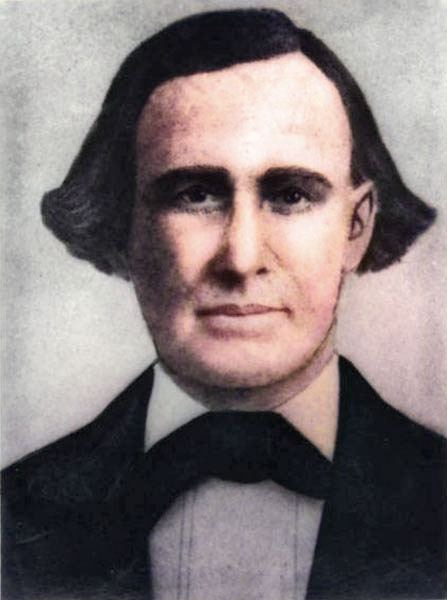
John Allen Matthews.
One family of mixed Osage blood that lived at Little Town before the Civil War was the John Allen Mathews family, who operated a blacksmith/gunsmith shop on the site and ran a trading post here, as well as one at Osage Mission and one at Fort Gibson, Oklahoma. Mathews first purchased the trading post at Little Town from Augustus Chouteau in either 1838 or 1843, depending upon the source. Mathews was married to Mary Ann Williams until her death, and then to her sister, Sarah Jane Williams, the daughter of William Sherley Williams, better known as “Old Bill Williams,” and his Osage wife, A-Ci’n-Ga or Wind Blossom.
Mathews was a slaveholder from Kentucky, as evidenced by the Osage Mission’s baptismal records. Before the Civil War, Mathews was involved in driving off settlers from the adjacent Cherokee Neutral Lands and in stirring Southern sympathies among Native Americans living on the frontier. Early in the spring of 1861, Mathews was commissioned a captain in the Confederate Army and given orders to organize a company of soldiers from among sympathetic Native Americans, specifically, the Quapaw. In June 1861, he held a meeting at the house of Larkin McGhee in the nearby Osage village of Chetopa. He organized a company of Osage and mixed-blood Cherokee for the Confederate Army. One of his sons, John Mathews, Jr., joined this company.
On September 8, 1861, Mathews led another company, this one composed of Osages, mixed-blood Osages, Cherokees, and border ruffians. This second company raided and looted Humboldt, Kansas, capturing no less than a dozen freed slaves. James Lane put a $1000.00 bounty on the head of Mathews, who was soon betrayed by a man who worked at his ranch. The man helped James G. Blunt and the Kansas 6th Volunteer Cavalry (and the Humboldt Home Guard) track down Mathews. He was killed at the house of William Blythe, rented by Lewis Rogers, just southeast of Chetopa on the Cherokee Neutral Lands.
The next day, residents were tried by James G. Blunt in an impromptu court-martial. Mathews’ ranch and trading post at Little Town were subsequently burned. The ranch had consisted of a two-story double log cabin (covered with burr siding and sporting plastered walls), a blacksmith shop, a stable, slaves’ quarters, a well house, a smoke house, a woodshed, and other outbuildings, as well as two race tracks. He had title to 100 acres (0.40 km2) on the bluff and 30 acres below. He had no less than 100 head of cattle and 50 horses. His possessions and the trading post’s stock (including 50 buffalo robes and six bear skins) were distributed among the volunteers who had tracked him down. Little Town and many houses at Chetopa were also burned. The site of Little Town remained unoccupied by whites during the war. Most, but not all, of the Osage fled Kansas during the Civil War. Mathews’s own children fled to Texas and Kentucky.
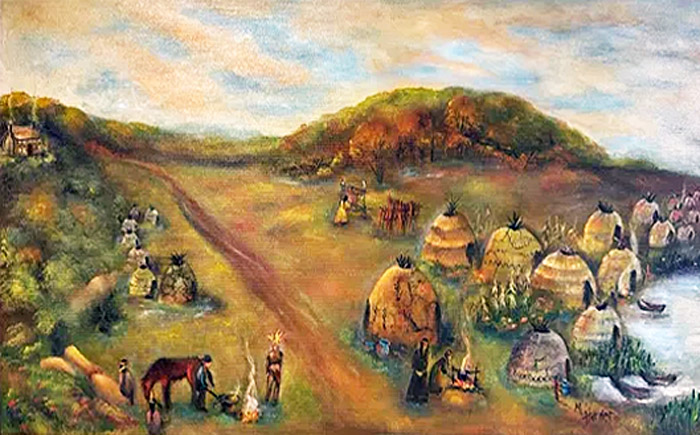
White Hair’s Village, Kansas.
Up to 1865, there were no other white people in the area. That year, a number of settlers established a presence at this location, and the name was subsequently changed to “Little Town.”
The post office was established on October 4, 1866, with Nelson Carr as postmaster. At that time, there were four stores and a blacksmith shop, the stores being kept by Carr & Bridgeman, Waskey & Sons, J.Q. Cowell, and R.W. Wright. Besides these, there were two provision stores. The first blacksmith was M. George. D.W. Clover kept the first hotel. It was a log building with a frame front that served many purposes. Besides serving as the hotel office and reception room, it also served as the County Clerk’s office, the County Attorney’s office, the Justice of the Peace’s office, and as a place of general rendezvous for all the people within reach, where all kinds of neighborhood, foreign, and political discussions occurred.
In 1867, the Oswego Town Company was organized and named after Oswego, New York, from which many of the settlers had originated. The members of the corporation were: President, Dr. John F. Newlon; Secretary, D.W. Clover; J.Q. Cowell, C.C. Clover, T.J. Flournoy, Thomas J. Buntain, and D.M. Clover. They gave away lots to anyone who would build, resulting in the town growing very rapidly. Dr. William S. Newlon put up the first frame house in September of that year. Thomas J. Buntain erected the first frame store building, though the first store was opened in a log building in 1865 by Rexford & Elsbee.
A town lot was donated to every person who would erect thereon a dwelling house, to private business enterprises, which gave a promise of being of material benefit to the town, to the public schools, to other public enterprises, and to every church organization that desired a lot for the purpose of erecting thereon a house of worship.
In the summer of 1867, a number of new and valuable settlers arrived. Among them were Dr. William S. Newlon, Reverend T.H. Canfield, D.W. McCue, W.P. Bishop, A.L. Austin, Dr. R.W. Wright, and the Waskey brothers.
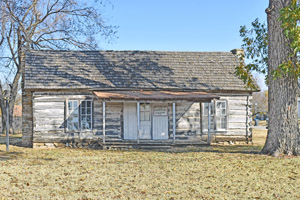
The old 1867 Oswego Log House still stands, photo by Kathy Alexander.
That year, the first school in the county was held at Oswego by Mrs. Herbaugh, in a small log house in the southern part of the town. The building had no floor except the earth, and the seats were rough planks resting upon large stones. The school furniture, however, was soon improved by boring holes in the planks and inserting legs, thus affording the excellence of benches. The district was not officially organized; instead, it was formed and supported among the citizens through individual contributions.
A school district, also the first in the county, was organized soon after the election of J.S. Newlon as County Superintendent, and a school building was erected. It was a small frame structure.
Up to the close of 1867, Oswego had no regular mail service. Although D.W. Carr had previously been appointed postmaster, no mail route had been established, and the mails were brought from Humboldt and Osage Mission by private individuals, employed by the citizens of the town and country.
That year, the Oswego House was built by David Williams Clover, who later made it a stagecoach stop and hotel before rebuilding it as a larger building by 1870. This historic log structure, still standing in Thomas Park, is the only log house in southeast Kansas to remain on its original foundations. The house is fully furnished and ready to welcome you.
The First Congregational Church, under the efforts of Reverend Mr. Canfield, was organized in Oswego in December 1867.
The town company was reorganized in the winter of 1867-68, and the stock was distributed into 32 shares. From the time of the company’s complete and final organization, the town experienced rapid growth.

A stagecoach in Oswego, Kansas.
At the beginning of 1868, the Government established a weekly mail route, and soon a commodious office room was provided from which a large amount of mail was distributed daily.
The First Methodist Episcopal Church was organized in February 1868 by Reverend J. Mark, with a membership of about 12
That year, Mr. Shanks operated the first pottery and fired several stoneware kilns. The Presbyterian Church was founded in July 1868 under the leadership of Reverend C.V. Morfort. The first newspaper was the Oswego Register, established that year by E.R. Trask. A cotton gin was set up the same year. The first bank was also opened by W.M. Johnson, who was forced, two years later, to assign all he had to satisfy his creditors.
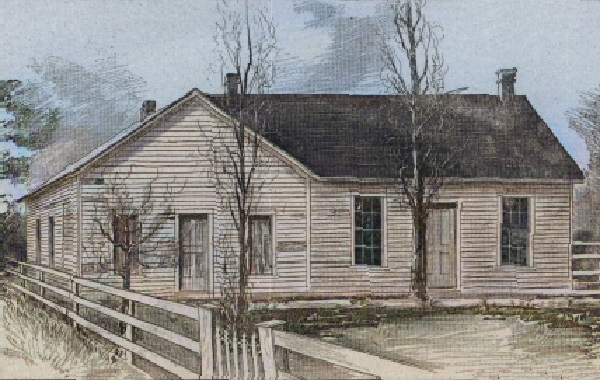
The first courthouse in Labette County, Kansas.
The first courts met on the second floors of the Buntain Building and the Fleming Building in Oswego. The first courthouse was a one-story frame building erected in 1868 and transferred to the county in 1869.
The First Congregational Church building, a small stone house, was erected in 1869 as the first in the town, at a cost of about $1,100. That year, the Baptists of Oswego first met in the courthouse on April 29, 1869, and under the direction of Reverends. F.L. Walker, F. Clark, and C.A. Bateman formed an organization into a church body, with Reverend F. Clark serving as moderator. The society was incorporated on May 31, 1870, with 17 members.
The second courthouse, a moderately large, plain, two-story stone structure, was erected by J.H. Swain in 1869. In 1870, Reverend Joseph A. Cox built an addition for $900.
The organization of Oswego as a city of the third class took place in February 1870, it being found to have over 1,000 inhabitants. An election was held in April, resulting in the following officers: Mayor, J.F. Newlon; councilmen, D.W. Clover, R.W. Wright, William Wells, J.F. Pierson, and E.R. Trask.
The Oswego Flouring Mills were built that year by Joseph Macon & Company. The building was a two-story frame structure measuring 10 by 60 feet, with a 12-by-40-foot shed addition. The machinery had been refitted and was of the most improved patterns. Three buhrs were used, each with a capacity of 100 barrels per day, and the power was provided by a 40-horsepower engine.
The First Methodist Episcopal Church building, a one-story frame house measuring 40 by 60 feet, was erected in 1870 at a cost of approximately $4,000.
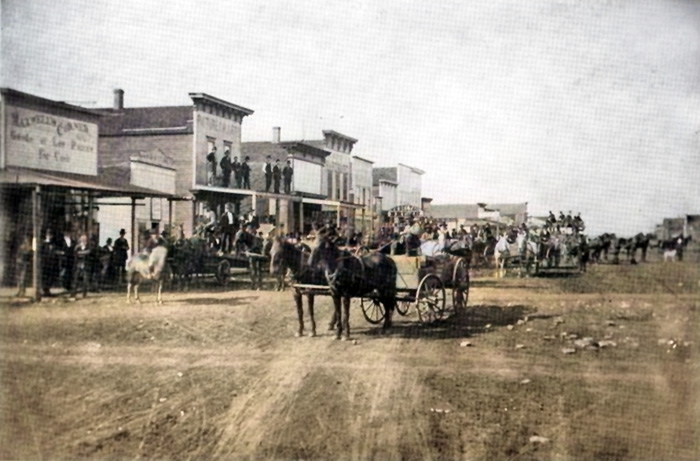
Early day Commercial Street in Oswego, Kansas.
The second bank was started in July 1870 by B.F. Hibart and H.L. Taylor, and it was a success. The State Bank of Oswego began operations a few weeks later but was discontinued after a short time, as there was not enough business to support two banks.
C.M. Condon’s banking house was established in 1870 by B.F. Hobart and H.R. Taylor. In 1872, J.C. Longwell bought Taylor’s share, becoming a part-owner. In 1875, it belonged solely to Hobart, and the following year, C.M. Condon became a partner, forming the firm of Hobart & Condon. A new bank building was erected in 1880. In 1882, C.M. Condon became sole proprietor. It was a private bank and had a capital of $100,000.
In September 1870, Macon, Krell & Cowell erected a steam sawmill.
Oswego was organized as a second-class city on March 16, 1871. That year, the Neosho River Flouring Mills were built by R. Howell and N.W. Rathbun. That year, school grading began.
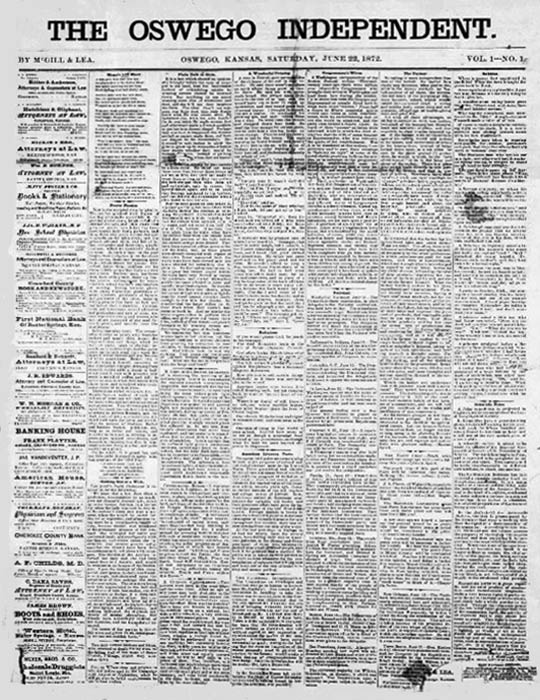
Oswego Independent Newspaper.
The Oswego Independent was established on January 15, 1872, by F.P. McGill as a Republican journal. In the spring of 1879, it came under the proprietorship and management of Mrs. Mary McGill, her husband having died, and was edited jointly by J.S. Waters and J.E. Bryan.
In the fall of 1872, H.C. Hall purchased Rathbun’s interest in the Neosho River Flouring Mills, which became Howell & Hall. The mill building was two stories high and was constructed entirely of walnut lumber. The mill featured four runs of buhrs, capable of producing 100 barrels of flour per day. The power was derived from a solid dam across the Neosho River, with a nine-foot head, driven by two water-driven turbine wheels. All the machinery was of the latest improvements, having been thoroughly refitted.
The Baptist Church was erected in the summer of 1873 and dedicated on the second Sunday in August of that year. The same year, the Presbyterian Church building was constructed in 1873 and dedicated in December. It was a small frame structure.
The Christian Church was established in Oswego in 1874 under the direction of Elder J.W. Randall, with 15 members. A one-story frame building was erected in 1879.
The St. Louis and San Francisco Railroad reached Oswego in 1876.
The Oswego Manufacturing Company was established at Oswego in 1876 by James Pierson and M.S. Douglass as a planing mill and manufactory of various kinds of woodwork. The establishment passed through several hands and was later owned by F. Jarnett, D. Goff, and C.C. Clover. The building was two stories, with shed additions, measuring 64 feet by 55 feet. A corn grinder was added to the machinery in the fall of 1882. The entire enterprise employed five men and represented a capital of $7,000.
The Public Library Association was organized in 1877 and continues today as the Oswego Public Library, a Carnegie Library. The same year, the waterworks were established.
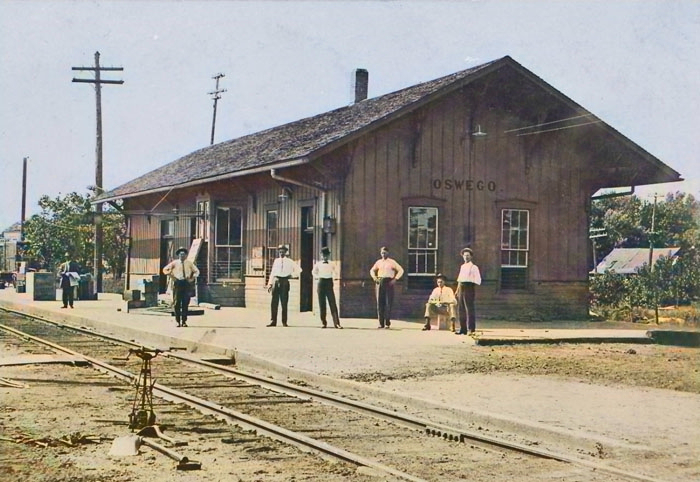
St. Louis and San Francisco Railroad Depot in Oswego, Kansas.
After passing through several hands, the Oswego Flouring Mills came into the possession of H.G. Miller and his son, S.B. Miller, in July 1878. That year, the Catholic Church organized a society, comprising three families under Father Bonanziul. The church structure, a small frame, was built the same year, at a cost of about $1,000. The membership has increased to 25 families and was under the spiritual guidance of Father Haspenthal.
After the stone schoolhouse was erected, the old frame school building was donated to the county for use as a courthouse. This stone house was a substantial two-story building, containing four rooms, two in the upper story and two in the lower.
The Labette County Democrat, published at Oswego, was founded and distributed by Messrs. King, Capell & Frye, and its first issue was on October 16, 1879. As the only Democratic paper in the county, it enjoyed an extensive patronage from members of that party. It had a substantial subscriber base, being a lively and engaging paper attentive to all critical issues.
The town was made a second-class city by the governor’s proclamation in 1880. That year, H.C. Hall and C.O. Perkins built the third Labette County courthouse when the county’s population was 22,736.
The Second Methodist Episcopal Church was established by the city’s African American community in 1880. An old store building was acquired and converted into a church, with Reverend D. Ross as the pastor. There was also the African M. E. Church, composed of colored people, of which Reverend J. Brewer was pastor. Also, a colored Baptist Church with Reverend A.W. Green as pastor.
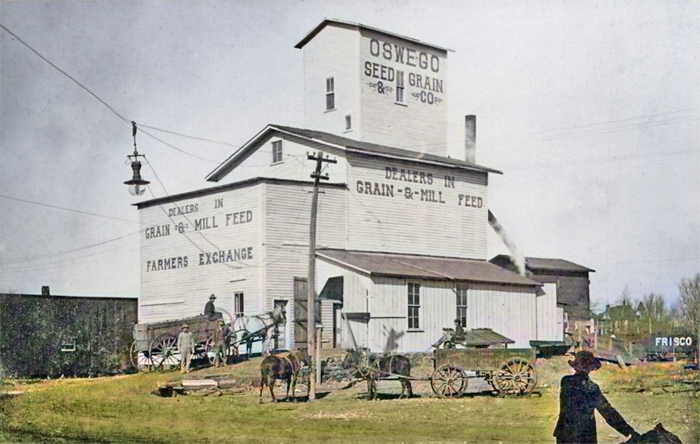
Oswego, Kansas Seed & Grain Company.
The banking house of Marley & Marley was established as a private institution on December 13, 1880, with a capital of $50,000, by H.A. and J.W. Marley. Prior to the establishment of the bank, the firm had been engaged in the discount and loaning business.
The Republican newspaper began publication on August 5, 1881, under the editorship of H.H. Brookes and I.W. Patrick. In August 1882, Patrick bought Brookes’ interest and became sole editor and proprietor. The paper was initially published both daily and weekly and was Republican in its politics.
The Oswego Valley Flouring Mills were started in December 1881 by G.W. Bird & Co. The mills were under the exceptional management of Bird, with the other members of the firm residing in Galveston, Texas. The mill building was a six-story brick structure, 50×70 feet in dimensions, containing six runs of buhrs and three pairs of steel rollers, and was fitted with the best mill machinery and propelled by an 80-horsepower engine. Two straight grades and one patent grade of flour were produced, with a mill capacity of 300 barrels per day. All the goods manufactured were shipped to the Texas markets.
The Oswego Wagon Manufactory was established on May 1, 1882, by John Shotliff, for the making of the Oswego wagon. The shop was a one-story brick building, 50×100 feet, adjoining which is a two-story brick building, 36×80 feet, the upper story of which is used as a paint shop and the lower as a wareroom. A force of twelve first-class workmen is employed, the enterprise representing an investment of about $10,000. The aim is to produce only the best class of work, and the shops were constructed with a view to manufacturing about 500 wagons per year.
The telephone system was put into operation in that year.
The stone school building also soon became insufficient, and several departments found alternative accommodations in buildings rented from private parties. In the summer of 1882, work on a new building began and was completed in the fall of the same year. It was a large, two-story brick structure 82 feet long by 70 feet wide, containing eight large rooms, and costing about $12,000. By that time, the city’s school population was 814, enrollment was 695, and average daily attendance was 399, under the charge of a superintendent and eight efficient teachers.
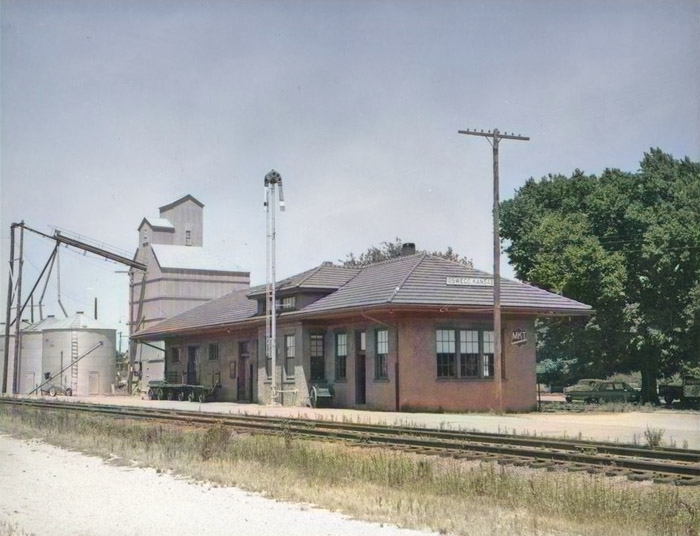
Missouri, Kansas & Texas Railway in Oswego, Kansas.
In September 1882, H.C. Draper began manufacturing roofing, drain tile, and brick. His enterprise, although of recent origin, was the most extensive of the kind in the State, and arrangements were being made to open the works on a larger scale during the coming spring.
By the end of 1882, Oswego also had four drug stores, five dry goods stores, 12 groceries, two photograph galleries, 11 physicians, 12 lawyers, four hardware stores, nine hotels, one marble monument factory, a pork packing establishment, a furniture factory, three saw mills, five loan and insurance offices, three furniture stores, two agricultural implement dealers, four livery stables, five blacksmith shops, a public reading room and library, two jewelry stores, two book stores, a patent medicine factory, five grain dealers, and a population of over 2,500.
The city waterworks were established in 1887, and the first electric lights were turned on July 12, 1888.
Oswego’s population peaked in 1890 at 2,574.
In 1910, Oswego was served by the Missouri, Kansas & Texas Railway and the St. Louis & San Francisco Railroad. At that time, it was a city of the second class; was lighted by electricity; has natural gas for domestic and manufacturing purposes, a sound waterworks system, a fire department, an opera house, two banks, three flour mills, two grain elevators, a creamery, an ice plant, machine shops, two colleges, three weekly newspapers, and other lines of business. There were telegraph and express offices, as well as an international money order post office, serving five rural routes, and its population was 2,317, making it the second-largest city in the county.
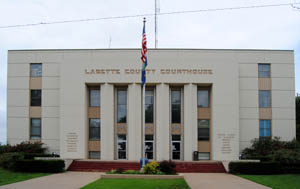
Labette County Courthouse in Oswego, Kansas, by Kathy Alexander.
In the subsequent decades, Oswego’s population gradually declined.
From 1947 to 1949, the fourth and present courthouse was built at 517 Merchant and 6th Streets. The modern Art Deco-style courthouse was designed by Thomas W Williamson and Company of Topeka; Dalton Construction Company of Joplin, Missouri, built it. The three-story cream-colored stone-and-concrete structure is located on landscaped grounds in the center of Oswego. The interior features an entrance lobby with dual staircases that rise to the third story. The County District courtroom is located on the third story at the center of the west side of the building. It has wood paneling. The building houses the County District Court of the 11th Judicial District.
In 2011, the City Council voted to annex the city-owned Oswego Municipal Airport into the city limits, expanding Oswego into neighboring Cherokee County.

Oswego, Kansas City Hall by Kathy Alexander.
Today, Oswego is served by the Union Pacific Railroad and the South Kansas and Oklahoma Railroad, a shortline railroad operating on former Frisco Railway trackage that provides direct connections to the Burlington Northern and Santa Fe Railway and the Kansas City Southern Railway.
The community is served by the Oswego USD 504 public school district, which has four schools and serves more than 500 students.
Recreational opportunities abound in the city and its surrounding area, including Riverside Park with its many amenities, Oswego Golf Course, Oswego Municipal Airport, and organized activities sponsored by Oswego Recreation Commission or Oswego Summer Ball. The Mined Land Area at the east edge of Oswego and many local hunting lodges, including one of the finest in the world — Claythorne Lodge, provide just a few of the hunting and fishing opportunities to be discovered.
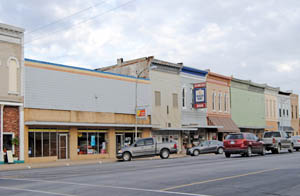
Main Street buildings in Oswego, Kansas, by Kathy Alexander.
The Oswego Historical Museum and Genealogy Department, owned by the Oswego Historical Society, Inc., offers guided museum tours featuring period-style themed rooms, genealogical research, and a tour of an original log cabin, a partially reconstructed building original to the Oswego townsite.
Oswego is located approximately 12 miles north of the Oklahoma state line and 30 miles west of the Missouri line at the junction of U.S. Route 59 and U.S. Route 160.
©Kathy Alexander/Legends of Kansas, updated March 2026.
Also See:
Extinct Towns of Labette County

An old theater in Oswego, Kansas, by Kathy Alexander.
Sources:
Blackmar, Frank W.; Kansas: A Cyclopedia of State History, Vol I; Standard Publishing Company, Chicago, IL 1912.
Case, Nelson; History of Labette County, Kansas, Biographical Publishing Co., Chicago, Ill. 1901.
Cutler, William G.; History of Kansas; A. T. Andreas, Chicago, IL, 1883.
Oswego, Kansas
Wikipedia