
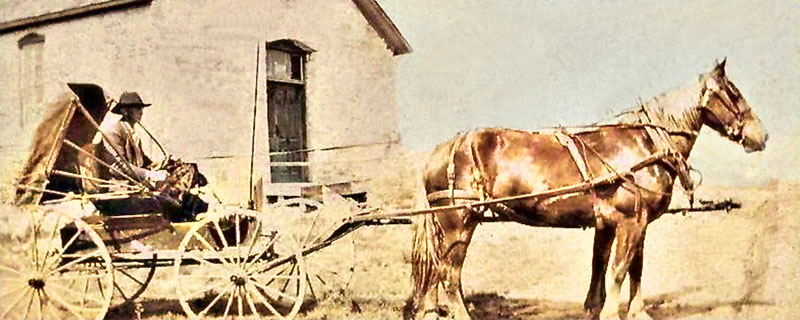
Phillips County, Kansas, horse and wagon.
| Town | Post Office Dates | Additional Information |
| Bloomfield | 1884-1888 | Bloomfield initially had a post office and a store. Its first postmaster was Charles E. Wake. |
| Bow Creek | 1874-1905 | Bow Creek was a small settlement formed in 1870, on the stream from which it takes its name, in southeastern Phillips County. A post office was established on December 8, 1874, to which Samuel Hebrew, the postmaster, received weekly mail. Early on, there was a weekly stage in Kirwin and Stockton. Bow Creek’s post office closed on August 31, 1905. Afterward, its mail was delivered by rural free delivery from Stockton. In 1910, the population was 66, and Kirwin was the nearest railroad station. It was 14 miles from Phillipsburg, the county seat, and 50 miles from Hays City. |
| Camp Kirwin-Fort Kirwin | None | In the summer of 1865, Camp Kirwan, a temporary encampment in Phillips County, Kansas, was established by Colonel John S. Kirwin and a company of Tennessee Cavalry volunteers. |
| Coyote | 1874-1875 | Coyote was established in December 1874 on Medicine Creek. It soon had a store, a blacksmith shop, and a post office with Martha Kappen serving as postmaster. |
| Crow | 1881-1901 | Crow, an inland hamlet of Phillips County, was situated in the northeastern part, near the headwaters of Big Creek and about 15 miles from Phillipsburg, the county seat, from which place it received its mail by rural free delivery after its post office closed. |
| Crow Creek | 1875-1876 | Crow Creek was established in 1874 and was platted as a town in 1885. It had a store, a blacksmith, and a post office, with George W. Chapman serving as the first postmaster. |
| Dickeyville | 1874-1895 | Dickeyville was established in 1873 on Russell Creek in the northern-central part of Phillips County. A post office was established on September 19, 1874, with Charles Dickey as postmaster. Its population in 1878 was 20, and its mail was delivered semi-weekly. The post office closed on March 31, 1889, but reopened on March 13, 1890. It was seven miles from Phillipsburg, the county seat, with which and Orleans, Nebraska, there was a stage communication. Ellis, on the Kansas Pacific Railroad, was the nearest shipping point. Semi-weekly mail. Its post office closed on August 31, 1895. |
| Eli | 1901 | Eli was established on June 12, 1901. Though it was never platted as a town, it had a store and a post office, with Frederick A. Massey serving as postmaster. However, the post office’s Order of Change was rescinded. |
| Emville | 1874-1875 | |
| Fort Bissell | None | Fort Bissell, built in 1872 in Phillips County, Kansas, on the land of John Bissell, was built while roving bands of Indians were still in the area. |
| Fredericksburgh | 1874-1883 | Fredericksburgh was a post office located in the extreme north of Phillips County, about 15 miles from Phillipsburg, the county seat. |
| Glade-Marvin-Chillicothe | 1872-1989 |
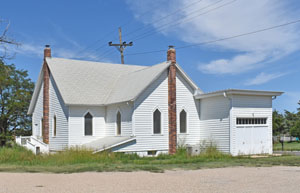 Old Methodist Church. This place was first called Chillicothe when a post office was established on August 27, 1872. Its name was changed to Marvin in 1881, and to Glade in 1908. Its post office closed in 1989. It still has a few businesses, numerous homes, and a small population. |
| Goode | 1874-1887 1889-1904 |
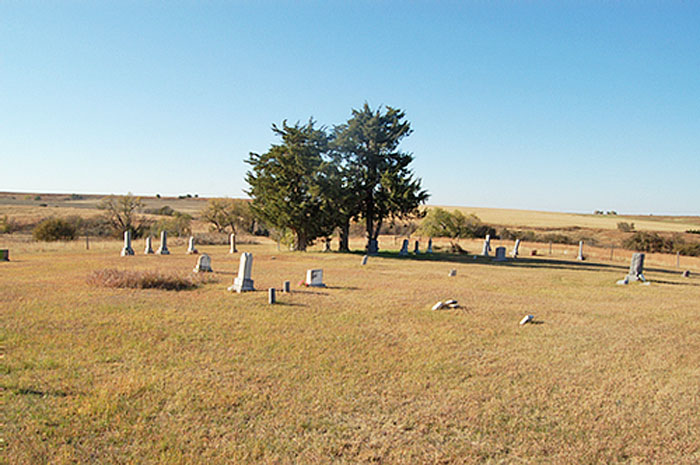 Goode, Kansas Cemetery. Goode was a small hamlet in the northwestern part of Phillips County. It was about 14 miles from Phillipsburg, the county seat, from which its mail was delivered by rural route, after its post office closed. Long Island, on the Chicago, Burlington & Quincy Railroad, was the nearest railroad station. |
| Granite Bluff | 1873-1880 | Granite Bluff was established in 1871, on Prairie Dog Creek, in the northwest corner of Phillips County. It gained a post office on February 13, 1873, to which mail was delivered semi-weekly to I.M. Bailey, postmaster. In 1878, it had two general stores, a flour mill, a district school, and Methodist and United Brethren Churches. Wheat is the principal agricultural export produced in this area. Kearney Junction, Nebraska, is the nearest railroad station. Its post office closed on July 12, 1880. It was 20 miles from Phillipsburg, the county seat. |
| Gretna-Dana | 1888-1945 | The town of Gretna was initially known to many as Dana. The city was laid out in September of 1887, and the name was later changed when the railroad arrived. At one point, it was a thriving trading point, with a bank, an elevator, and a few stores. Gretna was located halfway between Phillipsburg and Agra. |
| Handy-Hillside | 1882-1898 1899-1905 |
This place was initially called Hillside when a post office was opened on July 24, 1882. The post office closed on September 15, 1898. It reopened on October 14, 1899. On October 17, 1902, the town and post office were renamed from Hillside to Handy. The post office closed on December 31, 1905. |
| Heisler | 1885-1886 | A post office was established here on March 3, 1885, with Nancy Heisler as the postmistress. However, it didn’t last long, as it was discontinued on June 15, 1886. |
| Jimtown | 1875-1889 | Jimtown was a small country village settled in 1873 and located on Spring Creek in central Phillips County. In 1878, it had a teacher and a blacksmith. Mail was delivered to Zalmon H. Horton, the postmaster, four times weekly by stagecoach on the line between Hays and Kearney, Nebraska. Wheat and livestock were the principal exports, shipped from Russell, Kansas, on the Kansas Pacific Railroad, 65 miles away. It was six miles from Phillipsburg, the county seat. |
| Kildare | 1872-1881 | The Kidare post office was established in 1872 on the north fork of the Solomon River in southeastern Phillips County. Located on the north-south road of the Fort Hays-Fort Kearney route, it contained a Methodist Episcopal church and a common school and exported grain. The mail was delivered by a daily stagecoach to Kirwin, to the postmaster, Jeremiah Taylor. It was six miles from Phillipsburg, the county seat, and 60 miles from Russell, on the Kansas Pacific Railroad, the nearest shipping point. |
| Luctor | 1885-1914 |
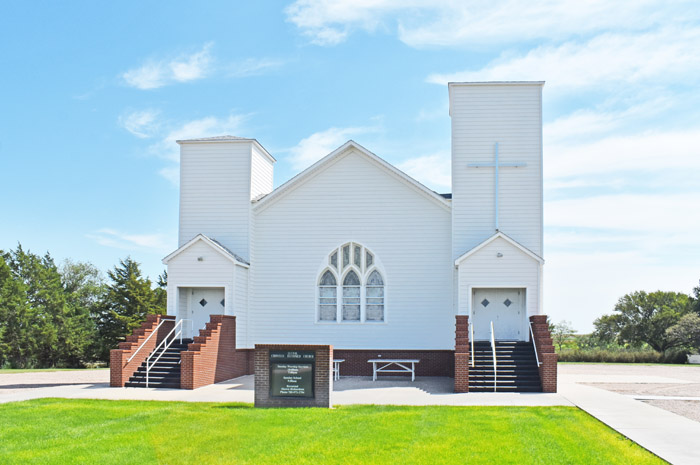 Luctor Christian Reformed Church 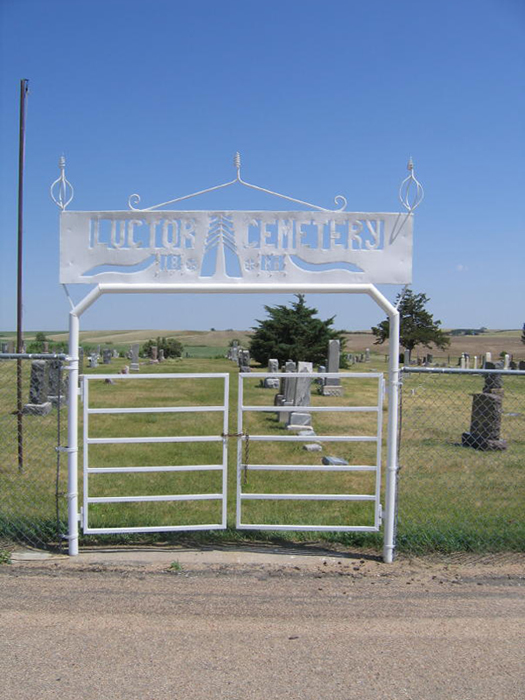 Luctor, Kansas Cemetery. Luctor was established by Hollanders in 1877. A post office opened on August 10, 1885, with Jacob Poppen serving as postmaster. After its post office closed in October 1903, its mail was delivered from Prairie View, three miles away. It was also the nearest railroad station. In 1910, it had a population of 53. Luctor was 17 miles northwest of Phillipsburg, the county seat. In 1972, it still had a store, metal buildings, and the Luctor Christian Reformed Church. Today, only the Luctor Christian Reformed Church and a cemetery remain.
|
| Matteson | 1875-1894 | A post office in the northeastern part of Phillips County, Matteson was 18 miles from Phillipsburg, the county seat, and 200 miles northwest of Topeka. |
| Mound | 1873-1882 | Mound was a post office in Phillipsburg Township, Phillips County. There was a daily stage to Phillipsburg, from which the mail was delivered to Harrison D. Rogers, the postmaster, six times per week. In 1878, it had a blacksmith and a wagonmaker. It was 11 miles west of Phillipsburg, the county seat, and 75 miles south of Kearney, Nebraska. |
| Mount Zion | 1875-1876 | Mount Zion was located in Deer Creek Township on the Old Deer Creek, Phillipsburg to Kirwin Road. It had a store and a post office established in 1875, with Homer C. Spaulding serving as postmaster. |
| Myrtle | 1878-1904 | A country hamlet, Myrtle was located 14 miles north of Phillipsburg, the county seat, and miles east of Woodruff on the Chicago, Burlington & Quincy Railroad, the nearest shipping point, and seven miles south of Alma, Nebraska, the post office from which it received its mail after its post office closed. |
| Nance | 1880-1903 | Nance was located in Sumner Township on the Agra to Naponee Road. It had a store, a blacksmith shop, and a post office, with Joseph Griffin serving as the first postmaster. |
| Norman | 1875-1877 | Norman was a farming district located in the extreme northern part of Phillips County. It was 20 miles northeast of Phillipsburg, the county seat. |
| Osma | 1877-1881 | Osma was a village in Logan Township in the southwestern part of Phillips County. It was first settled in March 1875. In 1878, it had a sawmill, a grist mill, a woolen mill, an attorney, a doctor, a hotel, a civil engineer, two preachers, and a population of 50. There was a tri-weekly stage line to Concordia and Solomon City from which the mail was delivered daily to D.G. Hoover, the postmaster. Corn, wheat, rye, pork, and sheep were exported from Ellis, Kansas, on the Kansas Pacific Railroad, the nearest shipping point. |
| Pleasant Green | 1877-1904 | A hamlet in Phillips County Pleasant Green was 16 miles northeast of Phillipsburg, the county seat, and 11 miles north of Agra, the nearest shipping point. After its post office closed, it received mail from Naponee, Nebraska. |
| Plumb Creek | 1873-1880 | Located on a stream of the same name, Plum Creek was established in 1873 in the eastern-central part of Phillips County. In 1878, it had 75 residents. At that time, there was a daily stage line to Smith Center, Kirwin, Phillipsburg, and Bloomington, Nebraska, from which the mail was delivered to W.H. Barker, the postmaster. It also had a hotel operated by Palmer Robinson. Wheat and pork were exported from Russell, Kansas, the nearest shipping point, which was 65 miles away. It was nine miles from Phillipsburg, the county seat. |
| Powell | 1882-1905 | Powell was a hamlet located ten miles south of Phillipsburg, the county seat, and six miles south of Glade, the post office from which it received its mail by rural route after its post office closed. |
| Sanford | 1903 | Located in Dayton Township, Albert Boland served as the first postmaster. The post office was only open for about six months. |
| Silica | 1887-1890 | Silica was located in Plainview Township. The first postmaster was Adam C. Shoemaker, who operated a grist mill on Bow Creek. |
| Speed-Big Bend | 1876-1964 | Big Bend, situated between Logan and Glade, was laid out in 1880 and had two stores, a sawmill, a blacksmith shop, and a post office. The town’s name was changed to Speed in 1895. Its post office closed on December 30, 1964. |
| Stuttgart | 1888-2000 | Established in 1872, Stuttgart became home to several early settlers. It was named after Stuttgart, Germany, from which many of the pioneers originated. When the Chicago, Rock Island & Pacific Railroad ran through the county in 1888, a station was established in Stuttgart, and the community thrived. Its post closed on August 1, 2000. It is located halfway between Phillipsburg and Prairie View. |
| Truesdell | 1872-1875 | Truesdell was in Solomon Township on the Fort Hays to Fort Kearney Road, running north and south, and on Pike’s Peak Road, which followed Deer Creek east and west. It was established in 1870. It had a store, a school, and a church, and about 50 people lived there at one time. Its first postmaster was Cyrus Post in 1872. |
| Upton | 1885-1889 | Upton was located in Walnut Township. It was also known as Wolfsburg. The postmaster was William A. Boevey. |
| Wagnerville | 1882-1888 | Wagnerville was established in 1876, but the town moved the following year. It had a store and a post office with Mrs. Charles Mueller as its postmaster. |
| West Cedar | 1874-1888 | Located on West Cedar Creek, in Plumb Creek Township, this town was near the center of the eastern line, 12 miles from the county seat. Centoria, a railroad station on the Burlington and Missouri River Railroad, in Nebraska, was about 70 miles north, and Hays City, a railroad station on the Kansas Pacific Railroad, was 60 miles south. |
| Wilton | 1874-1875 | Wilton was located on the west side of Cedar Creek in Plum Township. It had a store and a post office with Thomas DuBoise serving as the first postmaster. |
| Woodruff | 1885-1956 |
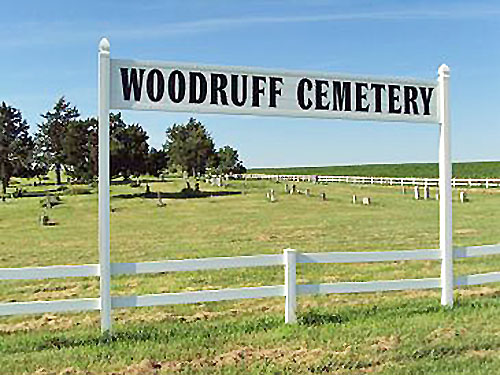 Woodruff, Kansas Cemetery. Woodruff, Kansas, is a census-designated place in Granite Township of Phillips County. It is also officially an “extinct” town as its post office closed decades ago. As of the 2020 census, the population was 13. Woodruff’s post office closed on March 15, 1956. Woodruff was located just south of the Nebraska State Line, 20 miles north of Phillipsburg, the county seat. |
| Worthen | 1881-1883 |
©Kathy Alexander/Legends of Kansas, January 2026.
Also See:
Sources:
1878 Polk’s Gazetteer and Business Directory
Blackmar, Frank W.; Kansas: A Cyclopedia of State History, Vol I; Standard Publishing Company, Chicago, IL 1912.
Fort Hays State University
Kansas Post Office History
Phillips County GenWeb
Phillips County, Kansas