
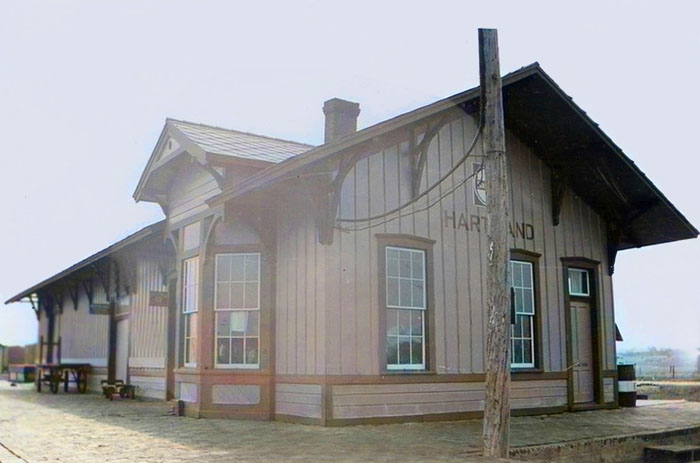
Atchison, Topeka & Santa Fe Railroad Depot in Hartland, Kansas.
Hartland, Kansas, in Kearny County, was a station on the Atchison, Topeka & Santa Fe Railroad. Although the community served as the county seat and grew into a bustling town of more than 2,000 residents, nothing remains of it today except the cemetery.
Settlement in the area was sparse in the early 1880s. Traffic had once populated the Santa Fe Trail that wound toward Colorado, but only a few settlements were established by the time the trail closed in 1880.
This was the scene when A.A.G. Stayton brought his family to Kearny County in 1881. The town of Lakin was founded about a decade earlier, but otherwise, settlement was sparse, with no doctors, stores, or schools.
A town company, organized in Hutchinson, Kansas, arrived in early summer 1885 and purchased a section of land from the railroad for a new townsite near where Stayton had homesteaded. They established it on a plot of land next to the Santa Fe Railroad and along the Arkansas River. The town company began to plot and survey town lots. It was approximately seven miles southwest of Lakin, a 20-minute train ride.
The Hartland Town Company advertised extensively, using alluring, glamorous descriptions of the area to attract speculators, land seekers, businessmen, and laborers to the “Rose of the Valley.” Located near the north end of Bear Creek, a natural dry creek that cuts through the sandhills to the Arkansas River Valley, Hartland was at the right place at the right time.
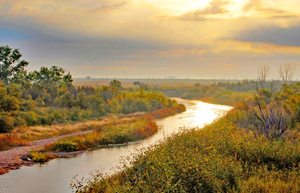
Arkansas River near Lakin, Kansas by Kathy Alexander.
On the south, just over a sand ridge, was an extensive grazing plain of wild land dotted sparsely with cowboy camps or, less often, with homesteaders’ dugouts. To the north, the prairie, called the short-grass country, seemed boundless.
Then the people began to come — speculators, land seekers, businessmen, and laborers arrived on every train. There was no place to accommodate such numbers, so Mr. McFarland built a large barn, and men slept in the stalls and loft. A long table was set up in the driveway, and Mr. and Mrs. Cole cooked in a corner of the barn for transient travelers. A.A.G. Stayton accommodated as many as he could, including the town company, on his homestead on the west side. He was then the section boss. The nearest homestead to the east was that of John Carter.
The town company offered a free lot to anyone who would build a hotel. When Mrs. Sarah E. Searle Madison, who was visiting her brother in Carthage, Missouri, heard about it, she accepted the offer. Ahead of her arrival in 1885, she shipped a train carload of lumber and hardware, including windows and doors, sufficient to build a small hotel, along with household goods, to the townsite.
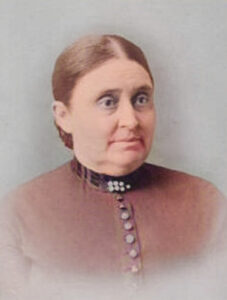
Sarah E. Madison.
Accompanying Mrs. Madison to Kearny County were two daughters, Lena June Madison and Jessie Cochran, and the Cochran children. Sarah’s son-in-law, Henry H. Cochran, was already working at Hartland for the town company and had been the one to inform Sarah of the opportunity that awaited her in the up-and-coming community. With his assistance, Accompanying Mrs. Madison to Kearny County were two daughters, Lena June Madison and Jessie Cochran, and the Cochran children. Sarah’s son-in-law, Henry Cochran, was already working at Hartland for the town company and had been the one to inform Sarah of the opportunity that awaited her in the up-and-coming community. The town lot that Sarah had been given was not nearly large enough for a hotel, so she had to purchase another lot.
With the assistance of her son-in-law, construction of the hotel began. The family lived in a large tent for a couple of months while the hotel was under construction. It was soon completed, was named the Madison House, and opened for business.
Within no time, people began coming to Hartland in droves, beckoned there through glamorous and alluring circulars and pamphlets advertising the benefits of settling at the “Rose of the Valley.”
Ed Snow moved to Hartland in November 1885, where he established a lumber yard and general merchandise business, became a partner in a livery, and erected several buildings. The highly respected businessman was elected Hartland’s first mayor, served as a director for the Bank of Hartland, and organized the Knights of Pythias. He also started branch lumber yards at Surprise and Cincinnati, Grant County towns with fates similar to Hartland’s.

Madison House in Hartland, Kansas.
Life soon changed on the once unsettled prairie. Pioneers came and began to build. Soon, a new station was built to replace the boxcar then in use. A schoolhouse was built on West Broadway, with Mr. Hovey as the first teacher. Mr. Burns, a Methodist preacher, delivered the first sermon in the schoolhouse. Main Street built up rapidly. Kirtland and Flash were the first bankers. L.S. Jones operated the first general store. Doctors Richards and Gabard were the first physicians. B.D. Williams and Gabard had the first dry goods store. Soon, additional businesses opened, including a newspaper and a roller-skating rink. There were more than 500 people in Hartland by the fall of 1885.
A post office was established on December 11, 1885, with H.H. Cochran, the express agent, serving as the first postmaster.
By February of 1886, the boom was on at Hartland.
In April of 1886, the Bank of Hartland was established with a capital of $50,000. The following month, Hartland reportedly had more than 125 residences and businesses, including six lumber and hardware stores, seven general stores and groceries, four land and real estate agencies, two hotels, a livery, a blacksmith, a harness maker, and a furniture store.
A great rush was made to western Kansas in 1886 and 1887 to secure land under the homestead and timber claim acts. Every quarter section of government land was taken. In 1887, the original lines of Kearny County were reestablished, and Governor John Martin appointed Colonel S.S. Prouty to enumerate the inhabitants and get an expression of their preference for the location of a county seat. However, this was not an easy task. Each eligible voter was entitled to sign the petition to designate one of the rival towns as the county seat. The residents of Chantilly charged that Lakin had shipped in 200 to 300 transient voters, who were distributed throughout the county, and Hartland openly offered town lots in exchange for signatures. Promoters representing each town did everything they could to have as many as possible counted who would be on their side, and to leave those opposed uncounted.
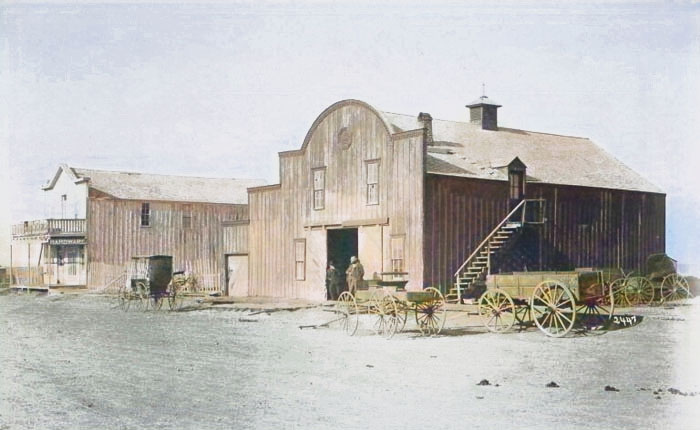
Snow’s lumber-hardware and livery business in Hartland, Kansas.
By 1887, Hartland was a thriving small city of approximately 1,000 residents, with all lines of business apparently well represented. There were three hotels, two newspapers, a bank, three hardware stores, one wholesale grocery store, feed stores, livery stables, harness shops, barber shops, a millinery store, and five lumber yards. As Hartland had the only natural pass through the sand hills, much of the freighting was done from there. It was a common sight to see 50 to 60 wagon loads of lumber start from Hartland in the early morning.
A daily stage line from Hartland to Ulysses connected with another from Hugoton to Ulysses. One driver boasted that he could drive from Ulysses to Hartland in three hours and 75 minutes.
Kearny County was finally organized on March 27, 1888, with a temporary county seat at Lakin. At that time, Chantilly dropped out of the contest, leaving Lakin and Hartland to fight it out.
The permanent location of the county seat became a problem, as Lakin believed it should be there. An election was held on February 19, 1889, and Hartland became the county seat. The matter, however, didn’t end there. County officers were Lakin men, and they refused to turn over the records. The towns brought the issue to court, and after considerable litigation, the Kansas Supreme Court, in January 1890, ordered the records moved to Hartland.
In the meantime, business thrived in Hartland. G.M. Smith had the first law office, and Jesse Osborne was the first lawyer. Mr. and Mrs. Hardin Smith operated the first restaurant and barbershop. Several other lines of business were established, including lumber yards, coal yards, livery stables, general stores, and meat markets. A printing press was brought, managed by Joseph Dillon. Ed Watt was a printer. Logan Garten was the printer of the Times.
A new schoolhouse was built on the hill north of the railroad. Among the first teachers were Mr. Druly, Mr. and Mrs. Hamer, and Mr. and Mrs. Armstrong.
“The prospects were very encouraging for Hartland to be a large city. Good businessmen strove for a clean town. Drunkenness was unpopular. A saloon was not needed.”
— Sarah E. Searle Madison
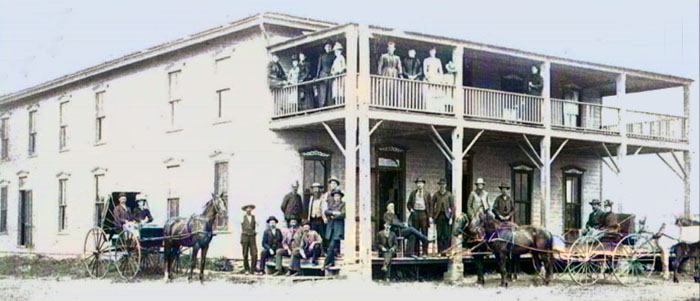
The Kearney House in Hartland served as a courthouse until it was destroyed by fire on January 17, 1894.
The Kearny House was built just north of the train station and was afterwards used for a courthouse. A Presbyterian Church was built on Main Street, with two lots donated by the town company. A free bridge was built over the Arkansas River by the town company, and hundreds of wagon loads of supplies were sent over the Bear Creek route, a natural pass through the sand hills, to Grant County and other counties to the south. The mail with four or six horses was sent to the south every day. The prospects were encouraging for Hartland’s development into a large city.
The Kearney House in Hartland served as a courthouse until it was destroyed by fire on January 17, 1894.
When the time arrived for another election, the county-seat question had to be settled. The courthouse had burned, and the tug of war between Lakin and Hartland was imminent. Another election for the permanent location of the county seat was held on June 26, 1894, and Lakin won.
County officials relocated to Lakin, and several families followed. Businessmen also began to move away. Some moved to Ulysses in Grant County and to other places in the southern counties; some went to Colorado and the West. E.S. Snow, who then kept a general store, remained a while after the others left, but making a living in the dying town was difficult. He finally gave up and moved to Lakin. The Madison House was dismantled, relocated to Lakin, and rebuilt as a dwelling. From a busy thoroughfare with every encouraging prospect of becoming a large city, Hartland diminished.
In the meantime, Chantilly disappeared from the map.
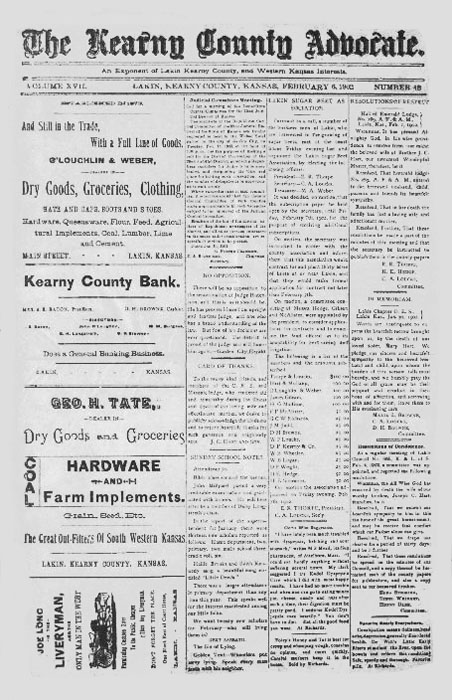
Kearny County Advocate Newspaper, 1902.
Ed Snow purchased the Kearny County Advocate in 1902 and dabbled for a short time in the newspaper business.
In February 1907, it was announced that Ed Snow was having an opera house erected at the southeast corner of Main and Lincoln in Lakin, Kansas. The concrete, fireproof 50-by-100-foot building was to be two stories high, with the top story housing Snow’s Opera House, also known as the Lakin Opera House or Snow’s Theatre. The theatre had a seating capacity of 250 and included a 14-by-28-foot stage, dressing rooms, and scenery. Dances, lodge and religious meetings, graduation exercises, and festivals were held there, and local as well as traveling entertainment performed for crowds of theatre-goers. Mr. Snow’s furniture, hardware, and undertaking business occupied the first floor.
In 1910, Hartland was still a station on the Atchison, Topeka & Santa Fe Railroad, and had a money order post office, telegraph and express offices, telephone connections, a hotel, was the principal shipping point for the western portion of the county, and had a population 80 of 80.
Ed Snow’s wife of 46 years, Margaret Collins Snow, passed in 1922. Edmond Snow retired the following year and continued to travel as much as he could until ill health prevented him from doing so. Kearny County sheriff-elect Roy Puyear and his wife moved in with Snow at his home on Buffalo Street in 1924, and Snow died in 1926. Today, their former home and the building which housed Snow’s Theatre still stand in Lakin. The building was, and remains, considered one of the best in town. According to Edmond Snow’s obituary, the structure at 122 N. Main stood as a memorial to his life and activities in Lakin. The building has housed The Agency since 1982.
Hartland’s post office closed on July 15, 1933.
The school closed in about 1945.
Hartland’s last business building burned to the ground on April 12, 1957.
Today, the site of the once prosperous town of Hartland is on the River Road, which follows the dry Arkansas River west of Lakin. All that is left is prairie grass trampled by the cattle that graze here, and an old cemetery a couple of miles to the northeast. A stone nearby marks the location of the Santa Fe Trail.
Hartland was seven miles southwest of Lakin, the county seat.
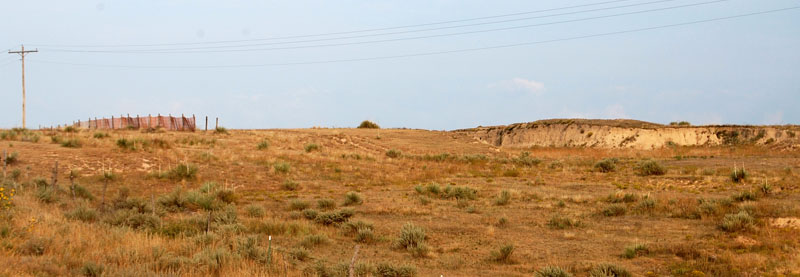
Santa Fe Trail area near Hartland, Kansas by Kathy Alexander.
©Kathy Alexander/Legends of Kansas, updated December 2025.

Hartland, Kansas Cemetery.
Also See:
Santa Fe Trail in Kearny County
Sources:
Blackmar, Frank W.; Kansas: A Cyclopedia of State History, Vol I; Standard Publishing Company, Chicago, IL 1912.
Kearny County, Kansas Genealogy Research
Kearny County Museum
Lawrence Journal World