
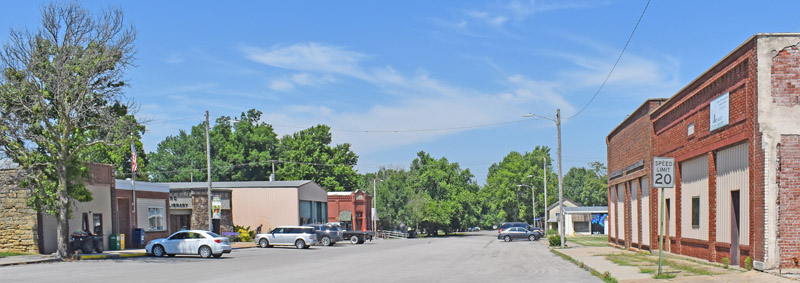
Thayer, Kansas Business District by Kathy Alexander.
Thayer, Kansas, is a small town in Chetopa Township of western Neosho County. As of the 2020 census, the city’s population was 432, and its total area was 0.80 square miles, of which 0.75 square miles was land and 0.05 square miles was water.
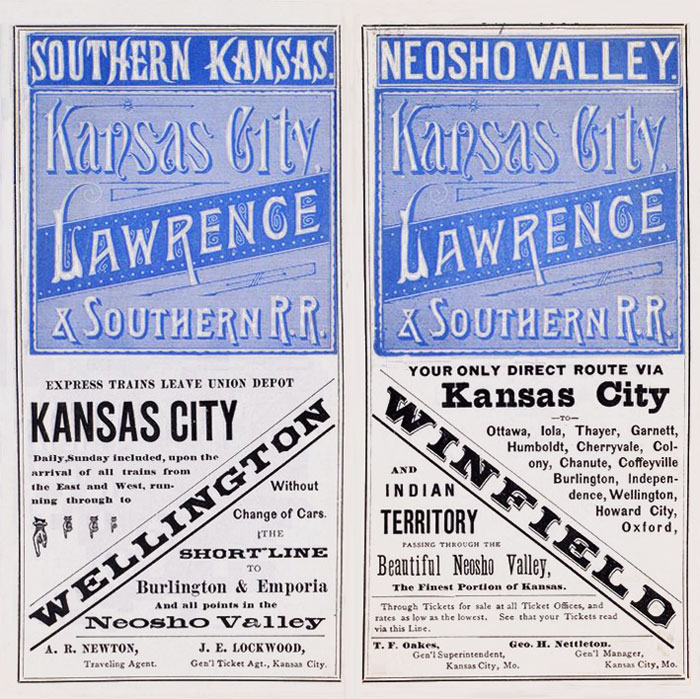
Kansas City, Lawrence, and Southern Kansas Railroad Timetable.
Initially, Thayer was located along the Kansas City, Lawrence & Southern Kansas Railroad. The surrounding country was a fertile, rolling prairie, much of which was initially uncultivated. John Hamar owned the land, which comprised 160 acres. The town was laid out in the fall of 1870, when the railroad was extended to that point by J.M. Walker, Colonel Smith, Judge Thatcher, J. Richmond, and H.M. Baldwin, railroad officials. It was named for Nathaniel Thayer, a railroad employee. During the autumn of that year and the following winter, hundreds came to the locality to get work on the railroad, which was then under construction. At about that time, a small frame schoolhouse was built, and the first school of Thayer was taught in the winter of 1870-71.
The foundation of the first structure was laid on the townsite on November 3, 1870, by I. Hopkins. The first building, a frame store room, was erected by H.L. Mills, in which he began the merchandising business. George Weaver and W.W. Work erected a two-story frame building in which they put a stock of general merchandise. H. M. Baldwin, a railroad official, erected a hotel, which was known as the Baldwin House. Holmes & Hinman began in the drug business, and Foults & Ingersoll started a cabinet and furniture shop. Around the same time, Thomas Thompson built and began operating a hotel and saloon. Following this, in almost consecutive order, J.M. Halstead opened a general store, and Harris & Sax, from Cincinnati, established a clothing store.
From this time on, the rush was intense, and by the end of the year, the town had a population of nearly 1,000. It was said that among all this crowd, there were but three women, and the motley and promiscuous town was made up of shanties, tents, saloons, covered wagons, and old bachelors. Among the population at this time, many construction hands had taken up their abode, awaiting to resume employment upon the further extension of the road. As would naturally be expected, there were among these many men of rough and dissolute habits who kept the town ablaze with drunkenness, quarreling, fighting, and sometimes murder.
The post office was moved from Prairie du Chien, approximately three miles east of Thayer, on January 13, 1871, with A.I. Sherwood serving as the first postmaster. That year, the town was incorporated as a city, and Charles Coffin, the railroad engineer, was elected Mayor.
The first newspaper published at Thayer was the Thayer Criterion, published by Perry & Olney; the first issue appeared on February 27, 1871. The newspaper was suspended after only about four months. On August 16, 1871, C.T. Ewing issued the first issue of a newspaper called the Headlight. It was initially printed at the Criterion office, after which its material, press, and other materials were procured for the Headlight publication.
A new one-story brick schoolhouse with two departments was built in 1872 for $5,000. To raise funds for the building, bonds were issued.
With the extension of the railroad, Thayer’s rough element was eliminated, and the town settled into a normal condition, with a vastly reduced population, and began a period of slower but more substantial growth.
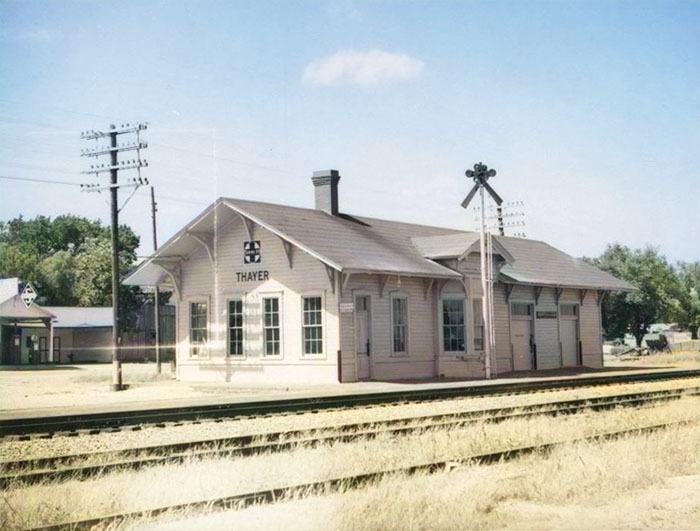
Atchison, Topeka & Santa Fe Railroad Depot in Thayer, Kansas by H. Killam, 1959.
The Thayer City Mills were built in 1875 by the firm of Marshall & McCrone. After about one year, McCrone purchased Marshall’s interest, and in about three years thereafter, the concern was sold to Sapp & Cross. It is now held by L. Hunting and is operated by J. McCullough. The mill contains two runs of stone and has a daily capacity to grind 80 bushels of wheat and 100 bushels of corn. The power is a 40-horsepower engine.
The office and Headlight newspaper were sold to G.W. McMillan on April 1, 1876, who published just two issues of the paper at Thaye. On April 15, it was relocated to Erie, the county seat, and first issued as the Erie Headlight on April 21, 1876. On May 26, 1876, the Thayer Headlight was restarted by T.C. Ewing, who purchased new materials for this purpose.
By 1882, Thayer had three drug stores, two hardware stores, two dry goods stores, five grocery stores, a harness shop, a shoe shop, a blacksmith shop, a hotel, a bank, a post office, a newspaper, and a population of about 500. At some point, the brick schoolhouse proved too small to accommodate the scholars. The building was demolished, and a two-story stone house with six rooms was constructed, providing ample space for all the district’s students.
The town contained four church organizations – the Methodist, Baptist, Catholic, and Presbyterian, each of which is liberally supported.
In 1890, Thayer’s population was 544.
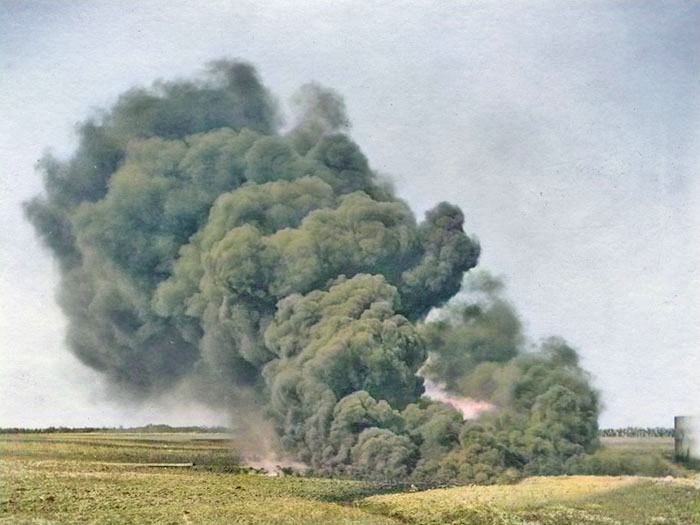
An oil well in Neosho County, Kansas.
In the mid-1890s, oil and gas were discovered in Neosho County, bringing a flush of temporary prosperity to Thayer.
In 1900, two well-known Neosho County businessmen, J.H. Sperry, established Thayer State Bank, with a capital stock of $6,500. The handsome brick one-story building opened in May 1900.
The city’s population, as reported in 1902, was 590. At that time, the valuation of all taxable property was $71,796.
In 1910, Thayer was on the Atchison, Topeka & Santa Fe Railroad. At that time, it had natural gas wells that yielded sufficient quantities for commercial purposes, two banks, a weekly newspaper called the News, telegraph and express offices, an international money order post office with four rural routes, and a population of 542.
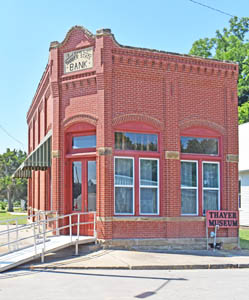
The old Thayer State Bank now serves as the Thayer Museum, photo by Kathy Alexander.
Thayer State Bank continued to serve the community until 1932. At that time, the town had two banks — one too many for the small community to support during the economic downturn of the 1930s. Afterward, the building housed various entities, including the post office, an insurance company, a restaurant, and a doctor’s office.
In 1997, the last owner’s estate donated the structure to the City of Thayer for use as a community museum. The Thayer Museum is located at 201 W. Neosho Avenue. The building was placed on the Kansas Register of Historic Places in 2003.
Thayer High School was closed when it was a part of Erie USD 101. Today, Thayer is served by USD 447 in Cherryvale, Kansas.
Burlington Northern Santa Fe Railway (BNSF) still passes through Thayer.
Thayer is 14 miles southwest of Erie, the county seat.
©Kathy Alexander/Legends of Kansas, updated December 2025.
Also See:

Business building in Thayer, Kansas, by Kathy Alexander.
Sources:
Blackmar, Frank W.; Kansas: A Cyclopedia of State History, Vol I; Standard Publishing Company, Chicago, IL 1912.
Cutler, William G.; History of Kansas; A. T. Andreas, Chicago, IL, 1883.
Duncan, Lew Wallace; History of Neosho and Wilson Counties, Kansas, Monitor Printing Company, Fort Scott, Kansas, 1902.
Graves, W.W.; History of Neosho County, Volume I was published in 1949 and Volume II in 1951, Journal Press, St. Paul, Kansas.
Kansas Historic Resources Inventory
Wikipedia