
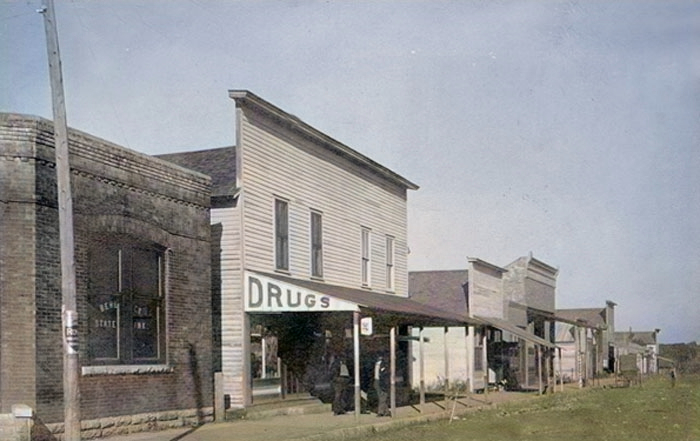
Street Scene in Benedict, Kansas, 1909.
Benedict, Kansas, is a small town on the Verdigris River in Guilford Township of Wilson County. As of the 2020 census, the city’s population was 69, and its total area was 0.15 square miles, all land.
Lewis F. Davis, from Iowa, was the first settler in Guilford Township, locating in 1858 on the Verdigris River just west of the present town of Benedict, and was then farther downstream than any other settler. In 1859, Moses Davis, his brother, settled adjacent to him. John Circle and Alex Elder came in the same year. John Carter was another early settler.
In 1865, following the Civil War, a treaty was concluded with the Osage Indians in the fall. Many settlers came in, making claims. The tide of immigration flowed strongly the ensuing year, and every available valley claim had an occupant. William Sutton settled on the Sutton branch no later than 1865. T.C. and S.M. Singleton were located in 1867, and S.S. Benedict and Frank Farwell settled in 1868.

Atchison, Topeka & Santa Fe Railroad Depot in Benedict, Kansas.
Benedict began in 1886 with the construction of the railroad through that territory. It was laid out at the junction of the Atchison, Topeka & Santa Fe Railroad and the Missouri Pacific Railroad. It was named for S.S. Benedict. The townsite was surveyed in May 1886. The post office was moved from Guilford to Benedict and opened on August 17, 1886. A Notice of Change of the voting place in Guilford Township from Guilford to Benedict was given in October 1886. That year, a frame church of fair dimensions was built by the Christian denomination. The Benedict Echo newspaper published its first issue on November 11, 1886. The town began promisingly and soon had eight or ten stores and shops, a hotel, a livery stable, beautiful residences, and comfortable cottages.
Substantial iron bridges were built over the Verdigris River at Benedict and Guilford in 1887, $10,000 in Township bonds having been voted to construct them. That year, a two-story brick schoolhouse was erected at a cost of $4,000, and a graded school of three departments was maintained.
The last issue of the Benedict Echo was issued on January 24, 1890.
The Wilson County Old Settlers’ Society was organized at Benedict on September 8, 1897.
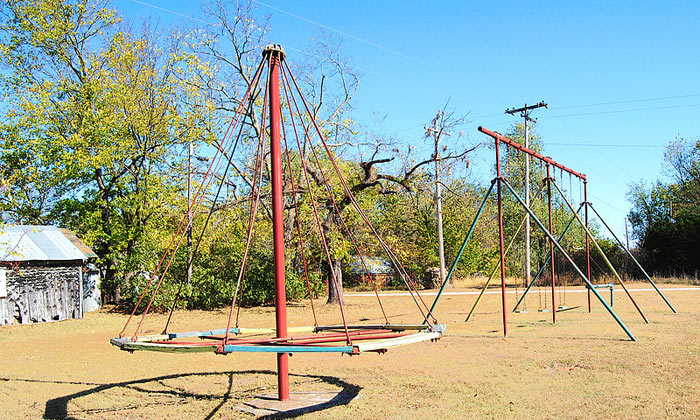
Playground in Benedict, Kansas. Photo by Kathy Alexander.
The town was piped for gas in 1898 from nearby wells for heating and lighting. At that time, Benedict was also at the eastern junction of the Verdigris Valley branch of the Santa Fe Railroad, giving the place access to three railroads.
The first issue of the Benedict Courier newspaper was published on March 10, 1899. The final issue of the Benedict Courier was issued on July 25, 1902.
Benedict was incorporated as a third-class city in 1905.
In 1910, Benedict was an incorporated town still at the junction of the Atchison, Topeka & Santa Fe and the Missouri Pacific Railroads. At that time, the city boasted the Benedict State Bank, with C.A. Sprague as president and J.B. Nelson as cashier, a livery, feed stable, and dray line operated by W.E. Gillispie; a hardware and implement dealer named Frank Prunty, a general merchandise store run by C.A. Sprague, a miller, contractor, and several farmers and stock raisers. It also had express offices, a money order post office with one rural route, and a population of 215.
Benedict’s population peaked at 275 in 1920.
Benedict High School was closed as part of school unification.

City Hall in Benedict, Kansas, photo by Kathy Alexander.
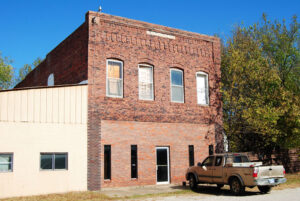
Business building in Benedict, Kansas, photo by Kathy Alexander.
Today, Benedict is served by USD 484 in Fredonia, Kansas.
Benedict still has a post office with limited hours.
Benedict is located eight miles northeast of Fredonia, the county seat.
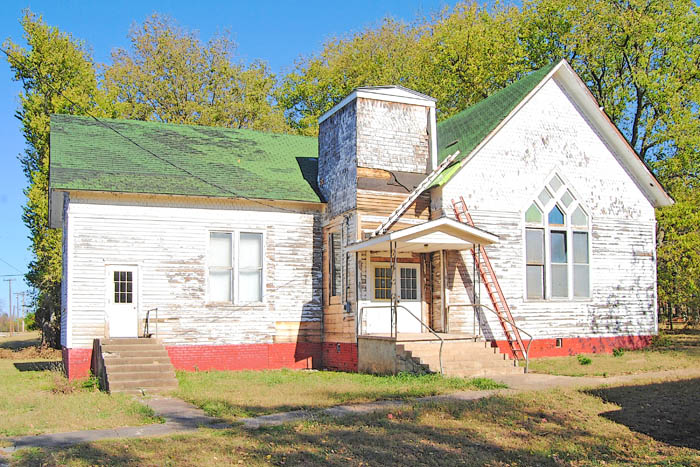
Old church in Benedict, Kansas, photo by Kathy Alexander.
©Kathy Alexander/Legends of Kansas, January 2026.
Also See:
Sources:
Blackmar, Frank W.; Kansas: A Cyclopedia of State History, Vol I; Standard Publishing Company, Chicago, IL 1912.
Benedict County Directory 1910
Duncan, L. Wallace; History of Neosho and Wilson Counties, Monitor Printing Company, Fort Scott, KS, 1902.
Wikipedia