
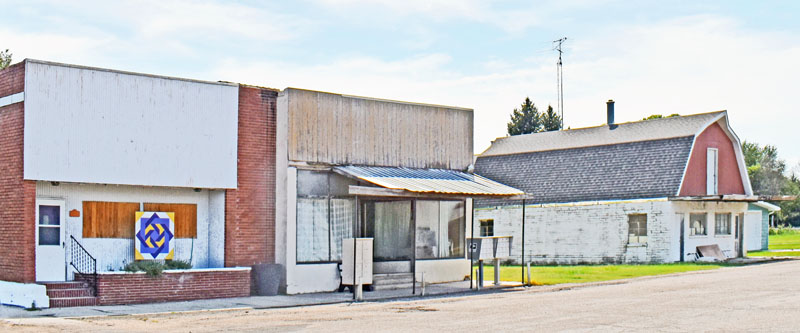
Business buildings in Stuttgart, Kansas, by Kathy Alexander.
Stuttgart, Kansas, is an unincorporated community and census-designated place on the banks of Deer Creek in Mound Township of Phillips County. As of the 2020 census, the population was 44. It is named after Stuttgart, Germany, where many of its settlers originally came from.
The community traces its origins to the early 1872, when the first settlers arrived in the area and named the site Wagnerville. At that time, it was nothing but unsettled prairie, inhabited by Indians and buffalo. These were Mike Miller, Leonard Merklein, Michael Merklein, and George Veeh, who arrived from Marshall County on foot to claim fertile lands along Deer Creek under the provisions of the Homestead Act of 1862. These settlers, many of whom were German immigrants or descendants, were drawn to the region’s prairie for wheat cultivation and cattle ranching. After selecting the best, most fertile land, they entered their names in the land register at the land office and immediately set out to build their dugouts and cabins.
In the spring, they went back to Marshall County to earn money. When they returned, they had acquired wagons and oxen.
In March 1873, Mr. and Mrs. Fred Hoff arrived from Marshall County. On April 12-13, there was a terrible blizzard, killing people and livestock.
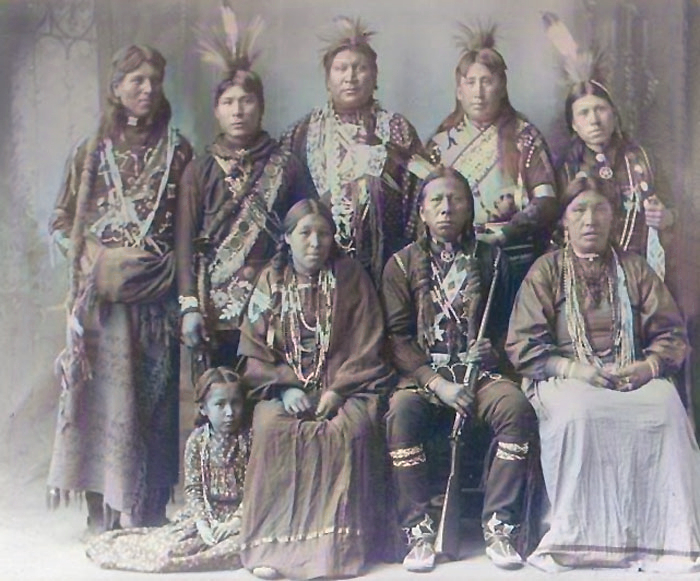
Omaha Indians.
Afterward, more settlers arrived, including J. Bach, F. Krafft, George Krafft, George Weinman, Michael Preuss, F. Veeh, J. Merklein, H. Vogel, L. Schuck, M. Stepper, and George Merklein. Some of these men were married, and others were still single. Some of them came from Marshall County, and some from Germany.
At that time, there was plenty of wildlife, including antelope, buffalo herds, prairie chickens, quail, beavers, porcupines, wolves, wild turkeys, and rattlesnakes. Occasionally, a deer or elk could be found. The creeks were alive with fish.
There were occasional encounters with Omaha and Sioux Indians. On one occasion, they hung a dead child from a tree limb. When George Veeh buried the child, the Indians took after him, and he ran all the way to Fort Bissell.
Another time, when Mary Hemrick Dusin was baking bread, an Indian walked in the door carrying a tomahawk. He asked for a loaf of bread, so she gave him one. A little later, two more came and asked for two more loaves. Later, three more came, but she didn’t have any more. She offered them flour, but they refused it. They became gruff and began swinging their tomahawks. Thankfully, John Miller arrived at the scene and saw a revolver in the room. He got them quieted down, and they left. However, the Indians took a mare and a colt, but somehow they got loose and returned home.
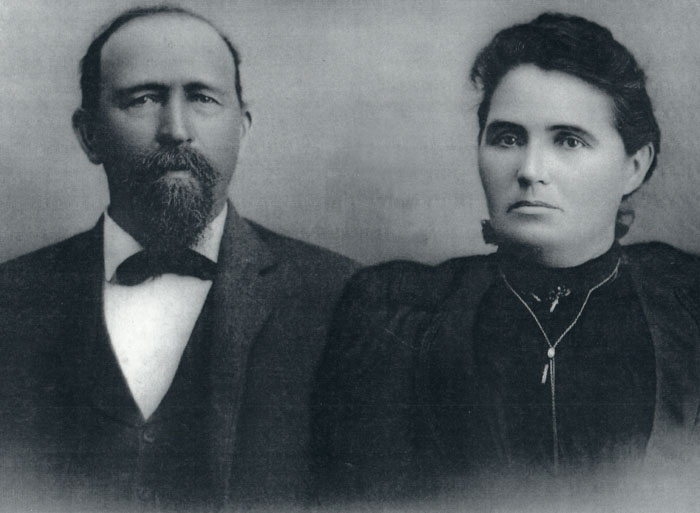
George and Margaret Veeh.
Prairie fires were another danger the settlers had to contend with. Mike Merklein owned a large part of the land. Other tracts of land were owned by Annie Sprague, Jermish Coursan, Henery Sherman, Mike Nugent, Martin Kistner, James Smith, Leonard Merklein, A. Spaulding, and George Veeh and wife, Margaret.
George Veeh and his wife purchased land and tracts from the Kansas Town and Land Company, and Veeh laid out the town of Stuttgart.
A school district was organized around 1879-1880 on land donated by Michael Merklein, with Theodore Close as the first teacher.
On March 13, 1881, the Stuttgart Church was formally organized by Pastor Hast. The congregation adopted the name of Evangelical Lutheran Emmanuel Congregation on Deer Creek. Michael Preuss donated a parcel of land near the cemetery for the church to be built on. Some of the other acreage was purchased from Mike Miller.
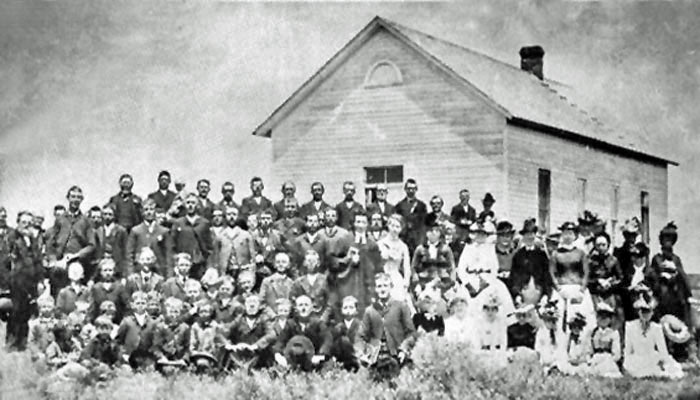
First building for the Emmanuel Lutheran Church.
The Evangelical Lutheran Emmanuel church building was constructed in 1885. It included a small residence for the pastor under the same roof. The building measured 40 feet by 22 feet, with 10 feet by 22 feet reserved for the pastor’s residence. The lumber had to be hauled from Orleans, Nebraska, which was 25 miles away.
George Veeh, an early settler from 1872, played a central role in organizing the community and opening the first general merchandise store in 1887 to supply essentials such as sugar, salt, and locally milled flour.
Michael Merklein donated the land for the District #127 schoolhouse. At first, it was just one room. The school was organized in about 1879-1880. Mr. Theodore Close was the first teacher. His salary was $150.00 a year. 21 boys and 16 girls attended school. The receipts for the year were $268.87. Later, it was enlarged.
The George Veeh General Merchandise Store was the first store in Stuttgart. It was opened in 1887 when the Chicago, Rock Island & Pacific Railroad was being built through the town.
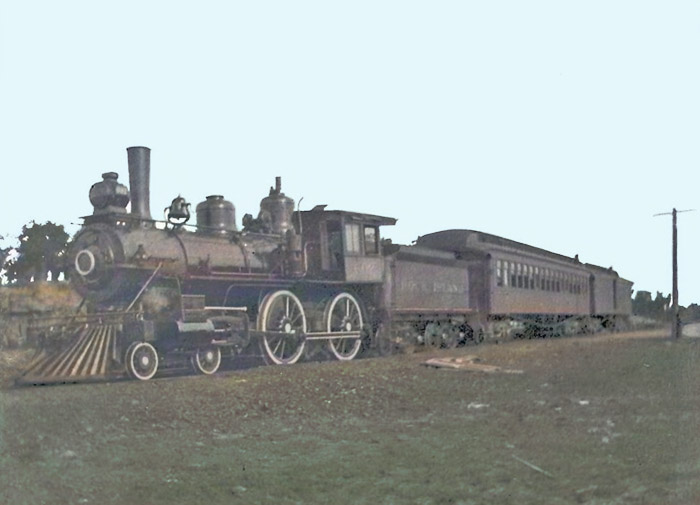
Chicago, Rock Island & Pacific Railroad.
The Chicago, Rock Island & Pacific Railroad came through Stuttgart in 1888, bringing new hope and better times. The depot, which was a large structure, had three rooms downstairs: a waiting room, the main office, which housed the telegraph equipment, and the baggage room. The upper level had four rooms where the agents and their families lived.
The railroad soon did booming business, bringing in merchandise for the stores, gas and oil for the garage, stock cars for the stockyard, and grain cars for the elevator. No. 7, the early-morning fast train, and No. 8, the evening train, ran daily. There were always grain and livestock cars being set out on the side track to be filled.
A livery stable was located just north of the depot. When traveling salesmen arrived by train, they needed transportation. Usually, a local person was hired to provide horses for the salesmen and drive them around.
The town of Stuttgart was formally founded on February 6, 1888, succeeding the earlier settlement of Wagnerville, established in 1876 and discontinued in 1883. It was named after the German city of Stuttgart to honor the heritage of its immigrant founders. The site was laid out by George Veeh and his wife Margaret, who purchased tracts from the Kansas Town and Land Company in Mound Township. On the same day the town was founded, the post office opened, with George Veeh as the first postmaster.
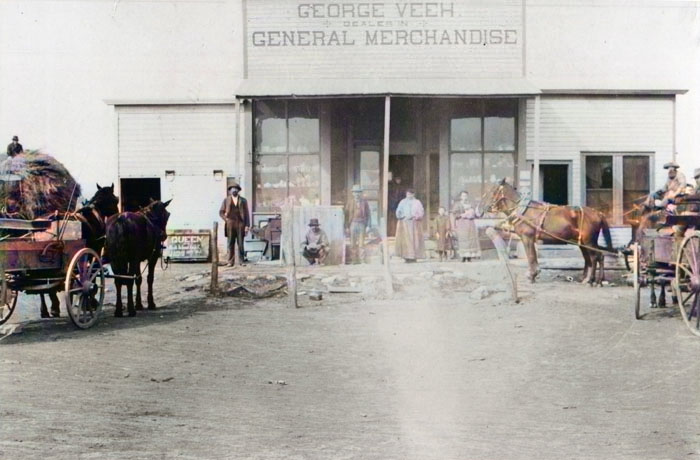
Veeh General Merchandise Store.
George Veeh and his wife, Margaret, operated the general merchandise store until 1900, when it was sold to Martin Kistner. It was then operated by various people in the next decades until the building burned to the ground.
The Trinity Lutheran Church was founded in 1900 by members of the Lutheran Church-Missouri Synod, one-fourth of a mile West of Stuttgart.
Theodore Hempler was the first to operate a cream-and-separator business in Stuttgart. Farmers would bring their milk to this facility for separation into cream and butterfat.
In the early 1900s, Martin Nistner built a hotel, located just south of the Veeh General Store. It was a two-story structure, with one large room and several smaller rooms on the second floor. Dances were frequently held in the large room above the restaurant. The upstairs was later used for hotel rooms. Traveling salesmen stayed in these rooms.
At about the same time, John Kellerman, Sr., operated a saloon called Fred’s Place. It was soon closed under Prohibition-era laws.
A hardware store operated by John Vogel was built by George Veeh in 1901. In addition to hardware, household equipment such as pots, pans, brooms, buckets, and cream separators was sold, along with rifles, shotguns, knives, bicycles, and more.
The Stuttgart Band was founded in 1903 by Theodore Hempler, who was also the church organist and director of music.
The German State Bank of Stuttgart, Kansas, was chartered on December 20, 1909. A lot was purchased from George Veeh on February 24, 1910. Henry Bethke, of Arlington, Minnesota, arrived in Stuttgart, Kansas, before June 1910 to manage the bank, which opened on June 21, 1910.
In 1910, Stuttgart was still on the Chicago, Rock Island & Pacific Railroad. At that time, it had general stores, a mill and grain elevator, telegraph and express offices, a money order post office, and a population of 125.
The Farmers Union Store opened around 1916, alongside cream stations, garages, and stockyards that handled shipments to major markets in Omaha and Kansas City.
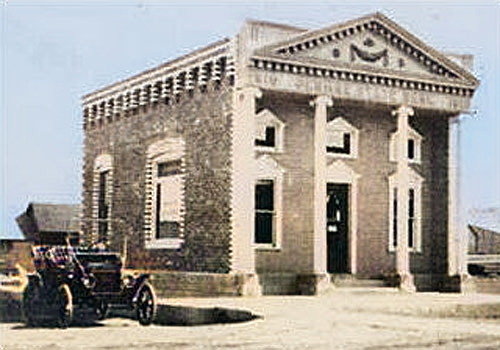
Farmers State Bank in Stuttgart, Kansas.
William Grote purchased a building site on November 24, 1916, just south of the bank. Called the William Grote General Store, he ran the business for several years.
On May 2, 1918, an amendment was filed to change the bank’s name from the German State Bank to the Farmers State Bank. On June 25, 1919, 40 feet East of the present building site was purchased from Martin Kistner so that the East addition could be added to the first structure.
Due to ill health, the hardware store’s goods were sold out on March 4, 1920. Some hardware stock was traded to a salesman for 240 acres of land in Jewell County, near Burr Oak, Kansas.
Theodore Hempler discontinued his cream business in 1920, at which time, John Kellerman became the next operator of the Creamery.
In the 1920s, Stuttgart experienced a period of growth fueled by the expansion of the Rock Island Railroad, which solidified the town’s role as a regional hub for grain, livestock, and dairy trade. Around that time, the Stuttgart Baseball Club was established, drawing crowds twice a week in the summer.
On May 26, 1923, William Grote sold his store to August C. Veeh and August M. Veeh, who started a partnership known as Veeh and Veeh. Operated by August M. and Alma Veeh, the grocery store also sold tobacco and cotton material for sewing. The post office was also in this store.
The Veeh and Veeh grocery was established in 1923.
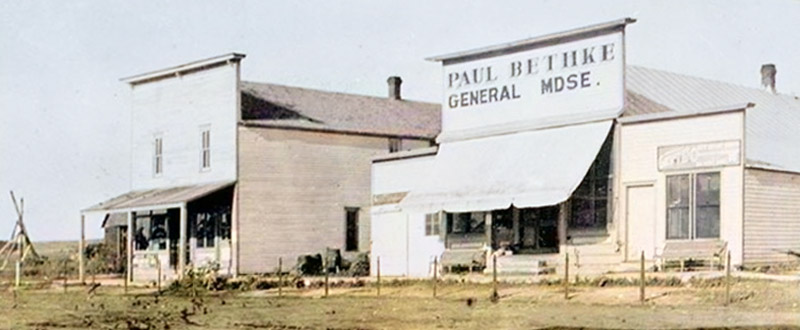
Stuttgart, Kansas Buildings.
In the late 1920s and early 1930s, there was extensive oil drilling, but no success.
The Great Depression and Dust Bowl in the 1930s brought significant decline to Stuttgart, as the area suffered severe droughts, dust storms, grasshopper plagues, and plummeting crop prices, which devastated local agriculture and forced many farmers to liquidate livestock. The once-bustling stockyards saw reduced activity as economic hardships led to business closures and out-migration.
The Stuttgart Ramblers basketball team was organized in 1934. The coach was Edwin Veeh. They played teams at Prairie View, Long Island, Phillipsburg, and Athol.
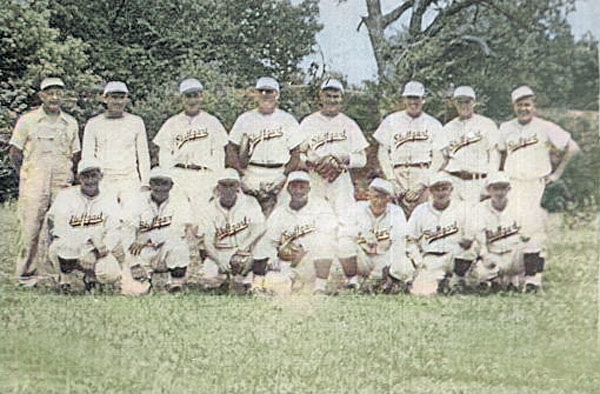
Baseball Club in Stuttgart, Kansas.
In 1936, the Cudahy Creamery Company opened its doors. Ellsworth (Mike) and Hilda Miller operated this business. They also installed gas pumps that sold Standard gas and oil. After operating the business for several years, Willard and Esther Weinman took over the station.
Pete Cowlin opened a beer parlor in the late 1930s. He sold beer, pop, ice cream, candy bars, peanuts, etc.
In the 1930s and 1940s, a baseball club was formed that played teams from Phillipsburg, Norton, Almena, Alma, Nebraska, Logan, Kensington, Agra, Gaylord, Harlan, Palco, Penokee, Bogue, Damar, Stockton, Nicodemus, Speed, Glade, and Norcatur. When they played their games at home, they did so at the ball diamond located one-half mile East of Stuttgart.
In the 1940s, after Pete Cowlin closed his beer parlor, Fred and Margaret Kellerman reopened it as a cafe.
Following World War II, mechanization in farming reduced the demand for manual labor, contributing to further population shifts away from Stuttgart.
In 1945, the Trinity Lutheran Church was disbanded, with most members joining the new mission congregation, First Lutheran in Phillipsburg. Others transferred to Emmanuel Lutheran in Stuttgart and to other Lutheran churches.
The last cream station was destroyed by fire in 1946.
The grocery store was sold in October 1947 to Herman and Selma Zillinger. In the next several years, the building served various purposes.
During the late 1940s and early 1950s, the Stuttgart Business Men sponsored free movies for the community on Wednesday nights. The crowds that attended these movies were large.
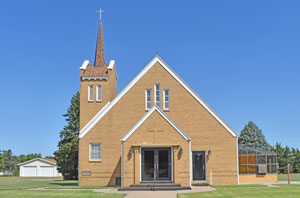
Emmanuel Lutheran Church in Stuttgart today by Kathy Alexander.
A new Emmanuel Lutheran Church was built in 1952.
Edwin and Carl Wilderman, sons of Bertha and George Wilderman, started the Wilderman Implement in Stuttgart in 1953. They sold the Ferguson and Case line of tractors and machinery. In 1973, they moved their business to their farm north of Stuttgart.
In the early 1950s, more leasing and drilling occurred. This time, due to improved methods, they brought in many oil wells in the area. Though these provided temporary economic relief, the town had become a quiet rural enclave.
At about the same time, the school burned down, so the district set up a Quonset hut as a temporary classroom. This served the purpose until the next school was built. The new school had three classrooms, an auditorium, a kitchen, restrooms, and a basement. They put on very good plays, participated in track meets, played basketball and softball, and had a good music program.
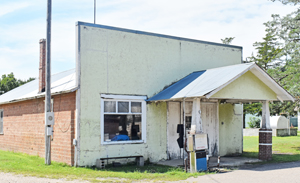
Old gas station in Stuttgart, Kansas by Kathy Alexander.
The movie theater was razed in 1960.
School consolidation took place in 1970, and the school closed on June 30, 1970. Emma Miller and Marilyn Adee were the last teachers.
Fred Kellerman operated the cafe until he died in 1978. Afterward, his wife, Margaret Kellerman, continued running the cafe.
Rail service, once vital to Stuttgart’s development, has been discontinued since the abandonment of the Rock Island and Pacific Railroad lines in the 1980s, following the carrier’s 1980 bankruptcy.
Margaret Kellerman ran the cafe until 1983, shortly before she died in 1984.
On December 31, 1987, the total assets of the Farmers State Bank were $13,541,000.00.
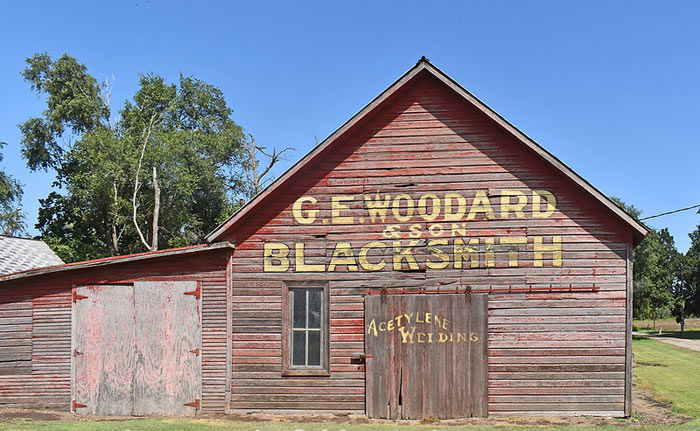
An old blacksmith shop in Stuttgart, Kansas, by Kathy Alexander.
The town’s centennial celebration in 1988 highlighted its enduring community spirit through historical booklets and events.
The Farmers State Bank’s charter moved to Phillipsburg, Kansas, in 1995.
The post office closed on August 1, 2000.
Today, Stuttgart remains a quiet farming hub with limited amenities. Key crops include wheat, grain sorghum, corn, and soybeans, with wheat and sorghum particularly prominent. Livestock operations focus on beef cattle ranching and farming, including feedlots, with supplemental hog production.
Public services in Stuttgart operate on a county-wide basis. Law enforcement is managed by the Phillips County Sheriff’s Office, which is responsible for patrols, investigations, and emergency responses throughout the entire county. Fire protection is provided by local volunteer fire departments, coordinated through the Phillips County Fire Departments network, which relies on community members for quick responses to emergencies. Education is primarily supported by local public school districts, with most students attending Phillipsburg USD 325, which serves the county’s central region.

Stuttgart’s old school is now used as a community center. Photo by Kathy Alexander.
Today, there is a Lutheran church, a grain elevator, the old school, which serves as a community center, and several homes and old business buildings.
Stuttgart lies in northern Kansas along U.S. Route 36, positioned midway between the communities of Prairie View to the East and Phillipsburg to the West.
©Kathy Alexander/Legends of Kansas, June 2026.
Also See:
Extinct Towns in Phillips County
Sources:
Blackmar, Frank W.; Kansas: A Cyclopedia of State History, Vol I; Standard Publishing Company, Chicago, IL 1912.
Fort Hays State University
Grokipedia
Stuttgart Anniversary
Wikipedia