
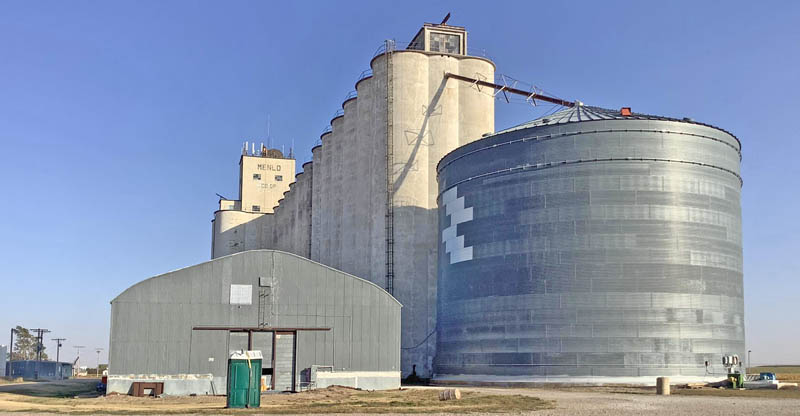
Grain Elevator in Menlo, Kansas.
Menlo, Kansas, is a small town in Thomas Township of Thomas County. As of the 2020 census, the city’s population was 33, and it had a total area of 0.12 square miles, all land. Menlo is also an extinct town, as its post office closed years ago.
Menlo, a village in Thomas County, is located in the township of the same name. It gained a post office on December 20, 1888.
Menlo got its start in 1888 when the Union Pacific Railroad line from Salina, Kansas, reached the county. A townsite named Zillah had been laid out along the Sheridan-Thomas County line. One and a quarter miles northwest, another small settlement named Mystic, in Sheridan County, had a post office, store, hotel, livery stable, blacksmith shop, and several dwellings, which were moved to Zillah when the railroad came there.
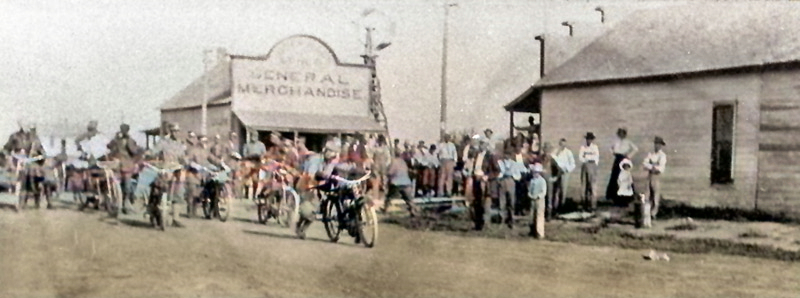
Vintage Menlo, Kansas.
The new town was renamed Menlo when the post office opened on December 20, 1888.
The first school was built in 1890. There was also a general store, an implement building, and a short-lived broom factory. As more families moved to the Menlo area, additional businesses were established.
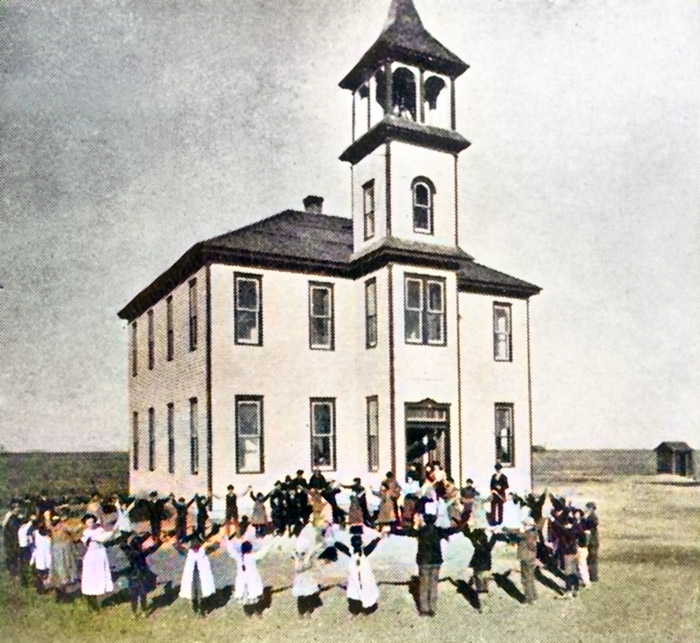
Menlo School in about 1905.
Between 1890 and 1900, a hardware store, a drug store, a doctor’s office, a lumberyard, and the Farmer’s Cooperative Creamery.
In 1894, Menlo had a blacksmith, a livery, a general store, and a lumber and implement dealer.
Both Shellabarger Grain and Robinson Grain Company constructed elevators in 1903. C.A. Bailey built a blacksmith and machinery shop with a hall above, which served as a community gathering place. Jacob Shroth built a large two-story frame hotel. A lumberyard was established, first by the Chicago Lumber Company, then by the Foster Lumber Company.
The Menlo Farmers Mutual Telephone Company was organized in 1905, as was the Menlo State Bank that same year, with H.V. Christensen as cashier. That year, Fred Christensen, affectionately known as Little Fred, opened a confectionery and short-order business. Later, it became a variety store that he operated for over 40 years until his death.
In 1909, rural mail service was established, with Wilbur Maxwell and Lee Cummins as carriers, using horse-and-buggies and later motorcycles.
In 1910, Menlo was still located on the Union Pacific Railroad, at which time it had a bank, two grain elevators, telegraph and express offices, a money order post office with two rural routes, and a population of 200.
The first newspaper in Menlo was the Menlo Enterprise with Asa Scott as editor in 1910. It was published until 1912.
As the automobile became part of rural life and good roads made it easier to reach larger commercial centers, more businesses closed.
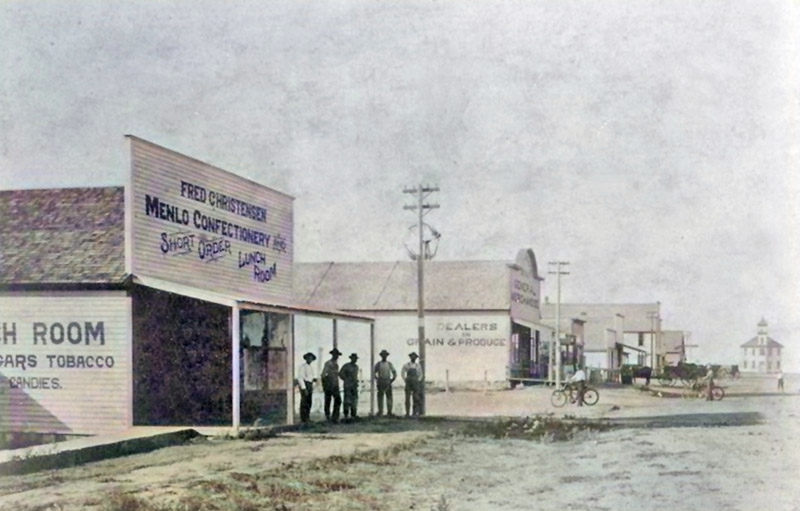
Menlo, Kansas Main Street in about 1915.
The Menlo State Bank was robbed of $4,800 in September 1921 by a bandit who locked the cashier, J.E. McKinney, in the vault. Though a $5,000 reward was offered, he was apparently never caught.
In the early 1920s, Menlo was at its height, boasting railroad depot, three grain elevators, stockyards, a two-story hotel, a hardware store, a cafe, three general merchandise stores, a bank, a meat market, a lumberyard, a variety store, a barber shop, a machine shop, a blacksmith shop, five gas stations, a creamery, the newspaper the Menlo Leader newspaper, a dress shop, and a movie theatre. The town was noted for its windmills. There were about 40 residences, many with their own windmills, as well as living quarters in the shops and stores. There were community dances, parties, and many other social activities.
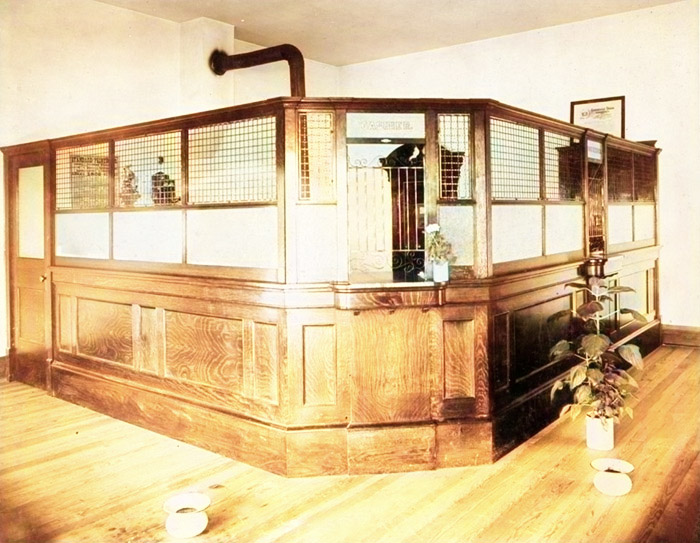
Menlo Bank Interior.
At the time of school consolidation in the 1920s, other elementary districts joined the Menlo district, and a high school was added, requiring the construction of a large brick structure beside the old building. The enrollment reached about 200 elementary and 100 high school students. During these years, students of the Menlo Schools excelled in athletics and scholarship. There were two State Championships in basketball and a finalist in the National Scholarship program.
The Menlo Leader newspaper began publication in 1924. It ceased publication in 1929.
During the Great Depression, the economy led to the closure of many businesses.
The Menlo Mentor newspaper was first published in 1929 and continued until 1943.
H.V. Christensen was associated with the bank until it was sold in December 1951 to the Farmers and Merchants State Bank in Colby.
The first school building was later used as a Methodist Church, and services were held there continuously until October 1938, when the congregation dedicated a new frame church building.
In March 1939, the Methodist Church building burned to the ground. Services were then held in the schoolhouse again until June 1944, when a new brick church building was dedicated.
The first schoolhouse, built in 1890, was a frame building that remained in use until 1904, when a new, larger frame structure was built at the north end of Main Street.
As times changed, dwindling enrollment led to the school district’s dissolution in 1963, and the territory was added to adjoining districts.
Even though located in the center of a rich farming area, the town of Menlo had declined from about 25 institutions in 1905 to three in 1975. By that time, the population was down to around 40, with a post office, a recreational center, a church, and the Menlo-Rexford Cooperative Elevator serving the community. In the summer, transient workers added around 20 to the population.
The rail line subsequently moved south, and the tracks through Menlo have been removed.
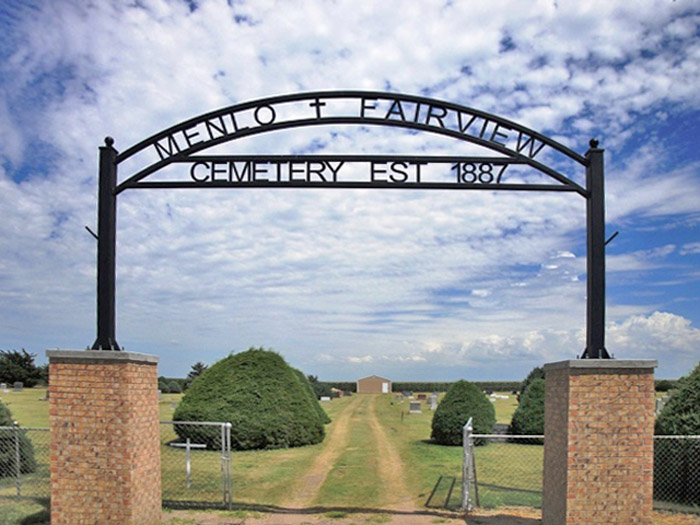
Menlo, Kansas Cemetery.
Menlo’s post office closed on June 27, 1992.
Menlo is part of the larger USD 316 Golden Plains school district. This district was formed by combining schools from Menlo, Rexford, and Selden. The high school for this district is Golden Plains High School.
Today, Menlo is a ghost town. It is 16 miles southeast of Colby
©Kathy Alexander/Legends of America, updated January 2026.
Also See:
Sources:
Blackmar, Frank W.; Kansas: A Cyclopedia of State History, Vol I; Standard Publishing Company, Chicago, IL 1912.
Fort Hays State University
Prairie Museum
Wikipedia