
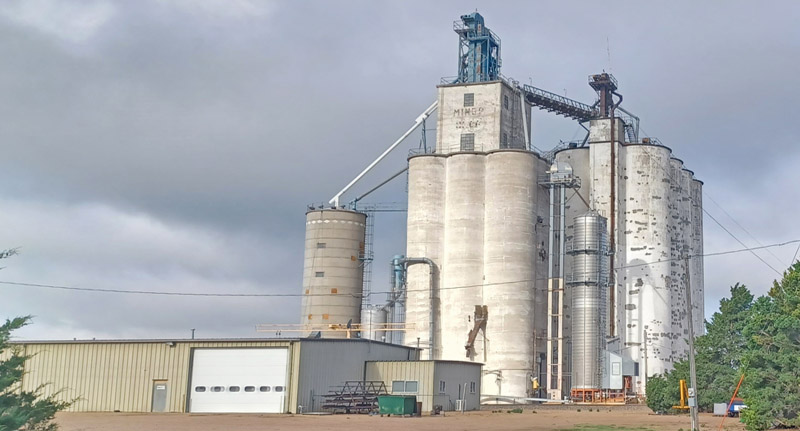
Mingo, Kansas Grain Elevator.
Mingo, Kansas, is an unincorporated community in Summers Township of Thomas County, in the northwestern part of the state. It is also an extinct town, as its post office closed decades ago. Situated in the High Plains region of the Great Plains, it is characterized by its elevated terrain and expansive landscapes.
Prior to white settlement, the area encompassing Thomas County, including the site of present-day Mingo, served as hunting grounds for various migratory Native American tribes, drawn by abundant wildlife, including bison and antelope, on the rich grass prairies.
The late 19th-century settlement of Thomas County occurred amid a broader homesteading boom in Kansas following the Civil War, fueled by the Homestead Act of 1862, which offered 160-acre plots to settlers, including many Union Army veterans. Over 100,000 individuals took advantage of these opportunities in Kansas, leading to rapid population growth and the construction of sod houses and dugouts in treeless regions such as western Kansas.
Pioneers in Thomas County arrived as early as 1879, migrating primarily from eastern states and European countries, attracted by promises of free land and the expansion of railroads that facilitated access and economic prospects.
The Union Pacific Railroad, in particular, played a pivotal role by laying tracks through the county in 1887, spurring town development along its routes.
This place was first called Thurford when a post office was opened on October 3, 1888. It was the last town to be established in the county and was the midway point between Oakley and Colby.
In 1893, Reuben “Doc” Misner persuaded the Union Pacific Railroad to relocate its station from the nearby post office of Thurford, located two miles south, thereby establishing a new settlement.
The town and post office were renamed Mingo on April 4, 1894.
Mingo once featured its own short-lived high school from 1895 to 1896, alongside a one-room schoolhouse that served grades one through eight.
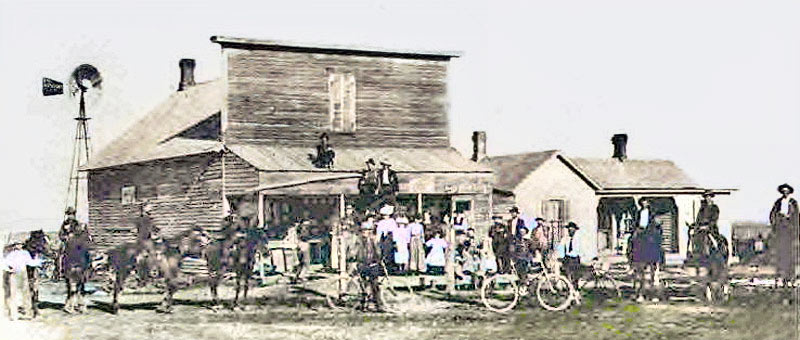
Early day, Mingo, Kansas, Main Street.
Community activity in Mingo reached its peak in the early 20th century, driven by the wheat farming boom that transformed Thomas County into the “Golden Buckle of the Wheat Belt.”
During this period, the town supported a general store that served as a social gathering spot, a one-room schoolhouse for grades 1-8 that hosted Christmas performances, a blacksmith shop, a livery, a lumber and implements dealer, and two grain elevators essential for handling crops.
Mingo was platted in 1907, facilitating essential mail services and connectivity for local farmers in Thomas County.
In 1910, Mingo was still on the Union Pacific Railroad, with a population of 45.
Several families from Goessel, Kansas, in Marion County, came to this area in 1920 to take advantage of farming opportunities. They started a Sunday school on September 3, 1920, meeting for about a year before any church services were held. That year, Mingo set the county’s record yield of three million bushels in crops.
Agricultural cooperatives, including the 1930 Kansas Wheat Pool, enrolled 200,000 acres around Mingo, underscoring the elevator’s role in enhancing farmers’ returns through collective storage and bargaining.
On September 3, 1937, with the help of Pastor John Epp, the Meadow Mennonite Church was organized with 18 charter members. Both the Sunday School and the church met in the Antelope School, southwest of Mingo. Within a year, the church decided to rent a vacant church building closer to Mingo.
Mingo’s decline was accelerated by rural depopulation, the Dust Bowl droughts of the 1930s, and postwar mechanization that consolidated farming into larger operations, reducing the need for small-town services.
Mingo’s post office closed on May 15, 1940.
In 1940, the Meadow Mennonite Church hired a standing minister. In December of 1941, the group bought and moved the Prairie Bell School building, which was three miles south and ten miles west of Mingo, to their present site, put it on a full basement, remodeled it, and dedicated it in May 1942.
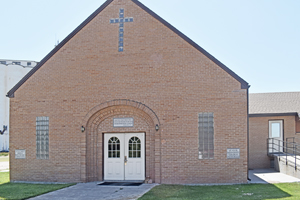
The old Mennonite Church in Mingo is now called the Mingo Bible Church. Photo by Kathy Alexander.
After 11 years, the Meadow Mennonite Church congregation had outgrown its church and built the present one, which was dedicated on November 30, 1952. Most of the work was done by members and friends.
Over decades, technological advances in farming led to larger operations and population decline, with many current inhabitants commuting to jobs in nearby Colby.
The general store closed in the 1950s, and a blacksmith shop and a one-room public school for grades one through eight were later burned down.
Mingo’s 16,000 bushel grain elevator, owned by long-time county resident William Engelhardt, burned in April 1952. From the ashes of this old wooden elevator, Engelhardt constructed a new concrete elevator in 1954. Additions to the Engelhardt elevator in 1957 and 1958 increased its capacity to 830,000 bushels. Today, the grain elevator is operated by Frontier Ag, Inc. as the Mingo Elevator and is associated with the Mingo Cooperative Grain Co. It continues to handle wheat, corn, and sorghum, facilitating marketing and transport for the area’s dryland operations.
In 1971, the members left the Mennonite denomination and changed the name to Mingo Bible Church. A new parsonage was built in 1973, and an annex was added in 1976.
Heartland Christian School was started in 1995 using the church’s facilities.
As residents increasingly commuted to nearby Colby for work, education, and amenities, amid Thomas County’s population stagnation and school consolidations in surrounding areas, Mingo evolved into an unincorporated village of about 25 people by the late 20th century.
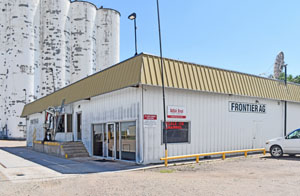
Frontier Ag building in Mingo, Kansas by Kathy Alexander.
Mingo Bible Church has been affiliated with Village Missions since 2000.
Heartland Christian School moved to its present location in Colby in 2001.
The oldest active geocache in the world is near Mingo. Here is the GC30 Mingo, hidden on May 11, 2000, as the seventh geocache ever created and the first in Kansas. This simple PVC container, with only its lid exposed, attracts thousands of enthusiasts annually.
Today, Mingo’s flat, dry terrain is dominated by grain elevators. It is home to a large granary operation, a couple of large farms, the Mingo Bible Church, a row of free-standing self-service gasoline pumps, and about 12 homes.
With a population of about 25, the community is served by the Colby USD 315 public school district. This district operates three schools offering instruction from pre-kindergarten through grade 12. Students residing in Mingo are transported to Colby daily by school buses.
Mingo is about 13 miles southeast of Colby, the county seat and nearest banking point. Take Thomas County Rd K south for five miles, turn 5.0 right onto KS-25 N/S Range Ave and travel 8.2 miles, then turn right onto W 3rd St.
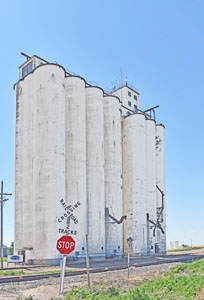
Another grain elevator in Mingo, Kansas, by Kathy Alexander.
©Kathy Alexander/Legends of America, updated January 2026.
Also See:
Sources:
Blackmar, Frank W.; Kansas: A Cyclopedia of State History, Vol I; Standard Publishing Company, Chicago, IL 1912.
Colby Free Press Wednesday, August 22, 2012
Grokipedia
Village Missions