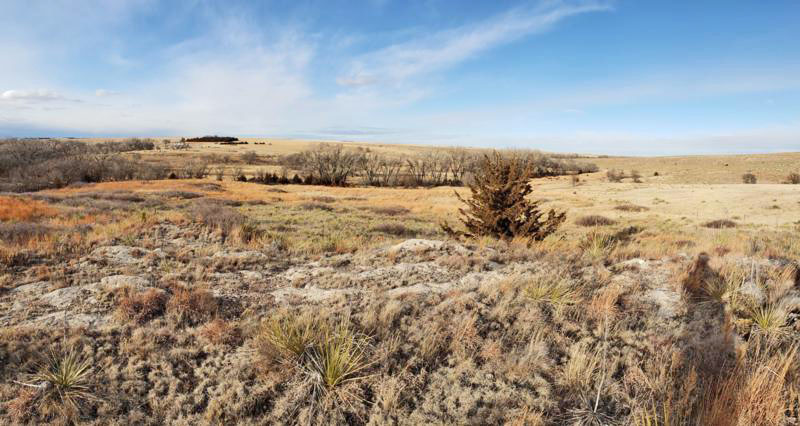
Sappa Creek Massacre Site in Rawlins County, Kansas.
Sappa Creek is a stream in the central Great Plains of North America. A tributary of the Republican River, it flows generally eastward for 150 miles through Kansas and Nebraska.
Sappa Creek originates in the Great Plains of northwest Kansas. Formed by the confluence of North Fork Sappa Creek and South Fork Sappa Creek, it is roughly 3.5 miles southwest of Oberlin, Kansas, in Decatur County. From there, it flows generally northeast into south-central Nebraska. In west-central Harlan County, Nebraska, it joins the Republican River.
It was historically traversed by Native American hunting parties, buffalo herds, and early settlers before homesteaders arrived in the 1870s.
Here, the infamous Battle of Sappa Creek took place on April 23, 1875. It was the deadliest clash in the waning engagements of the Red River War, where a detachment of the U.S. Sixth Cavalry assaulted a Northern Cheyenne encampment.
In 1878, the Sappa Creek Valley in Kansas was the scene of the last Indian raid in the state during the Northern Cheyenne Exodus from Oklahoma.
After the Battle of Punished Woman’s Fork, on September 27, 1878, in Scott County, a band of Cheyenne needing horses and provisions raged through the valley, killing more than 30 civilians and raping several women. Several Cheyenne elderly women and children were also killed in the region by soldiers and civilians. In Oberlin, Kansas, the Decatur County Last Indian Raid Museum commemorates the Cheyenne Raid.
On October 1, 1878, they crossed Beaver Creek, and 40 settlers were killed in what was called the Cheyenne Raid. After the raid, they killed many cattle in the canyon to the south, which is now known as Hundred Head Draw. As they fled North, the Cheyenne left behind a wounded indian boy, who was later killed by white settlers.
©Kathy Alexander/Legends of America, July 2026.
Also See:
Sources: