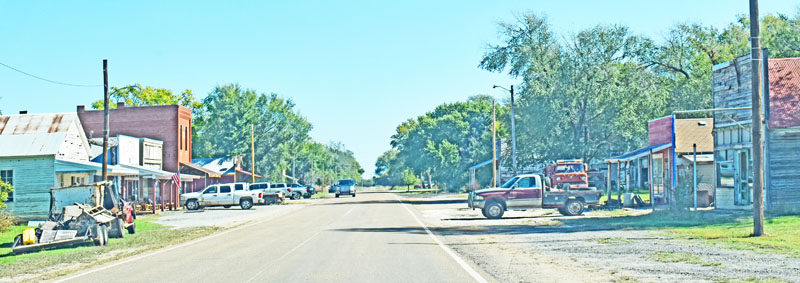
Sun City, Kansas, Street by Kathy Alexander.
Sun City, Kansas, is a small town along the Medicine Lodge River in Sun City Township of Barber County. As of the 2020 census, the city’s population was 37, and its total area was 0.14 square miles.
In 1871, young George Walker, his brother, and an Army Officer established a trading post in a dugout on the East bank of Turkey Creek, Kansas’s most picturesque stream, which joins the Medicine Lodge River in what was then known as the Shutts pasture.
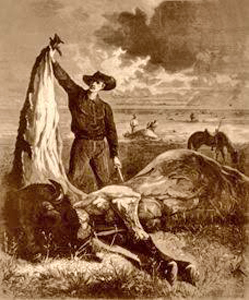
Buffalo Hunter.
In the Winter of 1871-1872, Colonel Griffin, a buffalo hunter, became the first settler when he opened a Trading Post. Unfortunately, he was killed and scalped by the Indians the following summer.
Sun City was platted in 1872. That year, Milton H. Clements came to Sun City with a party of buffalo hunters.
Sun City was settled in 1873, and the first post office was established on August 19, 1873.
Among the earliest settlers were the Reverend and Mrs. J.M. Adams and sons, Green and William. They arrived from Kentucky on April 3, 1873. Others were Minerva Adams, C.H. Douglas, Mrs. Molly Saunders, Mr. and Mrs. John Bullock, Sam Helton, Mr. and Mrs. C.W. Owens, Mr. and Mrs. Milton Clements, Estelle Whitaker, George Walker, Jim Carl, Thomas and Henry Walker, Mr. and Mrs. Tom Whitaker, Mr. and Mrs. John Montgomery, Frank Whitaker, Mr. and Mrs. S. Flemings, Bob Adams, Ed Coon, Charlie Walker, Major Bowlus, Mr. and Mrs. VanderPool, Frank Saunders, Henry Van Trees, and Mr. and Mrs. Lee Adams.
Sun City’s first residents lived in dugouts. Stories about how it got the name Sun City include that settlers arrived at sunrise, that they arrived at sunset, or that it was named for an Indian named “Sun.”
Tensions grew between native people as traffic on the trails increased and settlers moved into the area. Years before Kansas was a territory, the U.S. moved native peoples from different tribes in the East to a permanent Indian frontier. The Osage Indians were assigned reservation lands in this area, which was also rich hunting grounds for the Plains Tribes, including the Comanche and Cheyenne.
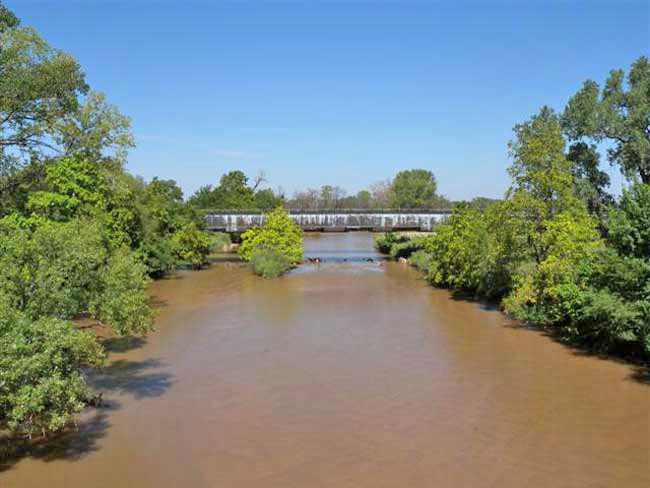
Medicine Lodge River, Kansas.
In the summer of 1874, an Indian raid occurred-when a band of Indians, led by several white men, it is alleged, came to this county and murdered several citizens up the Medicine Lodge River. Different versions of the story exist. One was that the invaders were Indians who were opposed to the whites settling up the country and destroying their hunting grounds. Another version was that they were white men, in Indian disguise, who were hired by interested parties to drive out the population, so that the bondswindlers might not be detected or interrupted.
The encounter took place northwest of Sharon at the foot of the big hills. There were about 50 Indians, and six were killed. Fifty-four ponies, six mules, all their camp outfit, saddles, guns, bows, arrows, clothes, and scalps were taken.
Afterward, some residents left the county and returned once the danger passed. Others never returned.
After the battle with the Indians, Thomas A. Osborne, the Governor of Kansas, organized the Kansas State Guards. Sun City and Medicine Lodge furnished the two companies for this section. Captain Ricker commanded the Barber County organization. John Mosley was second in command. The Sun City and Medicine Lodge Militia guarded the territory from Caldwell to Dodge City and South to the Cimarron River, keeping it clear of marauding bands of Indians.
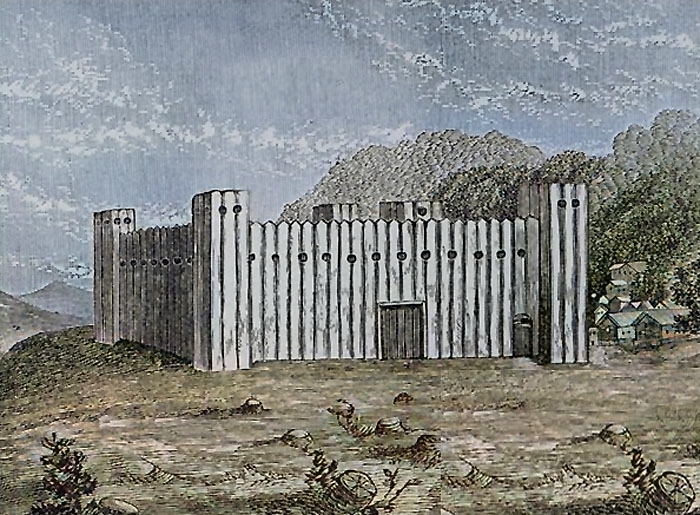
Stockade.
That year, a stockade was built. A buffalo hunters’ camp, of which Milton H. Clements was a member, served as the basis for establishing the stockade. A blockhouse stood in the center, surrounded by rifle pits and picket fences. That year, they organized a militia, including a company of 60 men.
January 8, 1875, while returning from a trip to Hutchinson, Kansas, where he had gone in an official capacity to get supplies for the garrison at Sun City, his party, which consisted of himself and three other soldiers, was caught in a blizzard. Two of the party were frozen to death, and Milton Clements and Reuben Marshall were so badly frozen that their feet had to be amputated at the ankles. Another of the party, Harry Van Trees, had all of his toes frozen off. Congress granted Clements a pension for this disability by special act in 1884, and the state appropriated $500.00 for him. He took up government land near Sun City, which he improved, along with other property in Barber and Pratt Counties and Oklahoma.
The first schoolhouse was built in 1875.
Another stockade stood on the William Ward farm on the West side at the end of Main Street. It was a sod stockade eight feet high and eight feet wide, enclosing about five acres. Each night the settlers brought their families to the stockade. In the morning, the men accompanied the soldiers to scout the neighborhood to see whether it was safe to work on their claims. If no Indians were sighted, they would take their families and go to work, returning at night to the stockade. As many as 40 people were killed by the Indians, South of Sun City to the state line.
In the 1880s, hotels, a newspaper, a livery stable, a bank, saloons, and a bakery thrived. Additionally, a mill for wheat & corn meal was built.
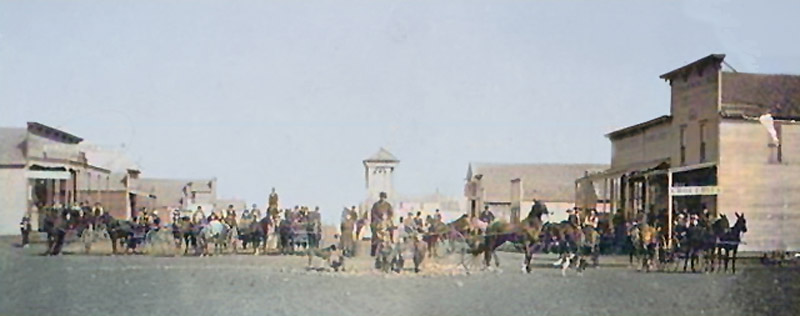
Early-day Sun City, Kansas.

Kansas Tornado
On April 21, 1883, between 12:00 a.m. and 1:00 a.m., a tornado struck Sun City with terrific force, unroofing and badly damaging five or six dwelling houses and two store buildings.
The majority of people were asleep and didn’t hear it until roused by the crashing of broken timbers, unroofed houses, heavy, sharp strokes of thunder rolling ominously and debris flying through the air with lightning rapidity, all telling in an instant the terrible destruction that must follow in the wake of that seething, howling cloud.
Frank Saunders was the heaviest loser. His store building was a wreck, and his goods were found scattered for half a mile. The ell part of the Sun City Hotel was gone, and the main part badly racked. Frank and family were sleeping upstairs in the main part and escaped unhurt. C.H. Douglas’ store room was half unroofed and his goods considerably damaged. The front of the livery stable was blown off. Lizzie Fishburn’s house was demolished down to a height of seven feet, but no one was hurt. Captain Ayers said he had been struck by both lightning and a cyclone in that house, and was still unharmed. The Captain’s books, papers, and soft raiment were among the things lost, but he consoles himself with the thought that some poor granger can enjoy a clean shirt and respectable literature.
The storm came and passed in a minute, and the destruction was gone. The storm track was narrow, from 40 to 80 rods. Where it passed through the timber, the trees were stripped of bark, limbs were twisted off, and large trees were uprooted.
In the end, the tornado destroyed five homes, causing deaths in one of them. It also unroofed a few stores and half a dozen homes, injuring five people. There were three deaths.
In 1885, Sun City’s businesses included two hotels, three livery barns, two dry goods stores, three grocery stores, a bank, a hardware store, and a shoe shop.
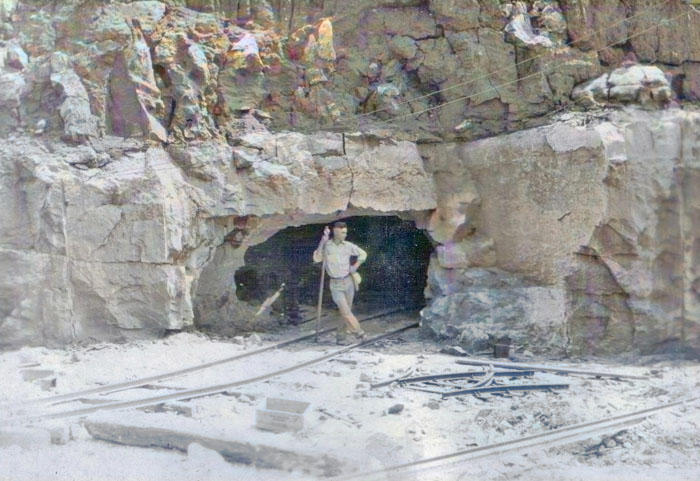
Gypsum Mine near Sun City, Kansas.
During construction of the Atchison, Topeka & Santa Fe Railroad in 1887, gypsum deposits were found along the Medicine Lodge River. William and Thomas Best were living in England when they read the news. They soon came to Kansas and opened a plaster company in Sun City in 1891. They initially quarried gypsum on the surface in the hills South of the Medicine Lodge River near Sun City. The gypsum gained a reputation for producing superior plaster and concrete. Over the years, hundreds of workers were employed in the industry.
The Best brothers also began manufacturing Keene’s cement nearby in Medicine Lodge in 1889.
On May 15, 1894, the town and post office name was changed from Sun City to Sun.
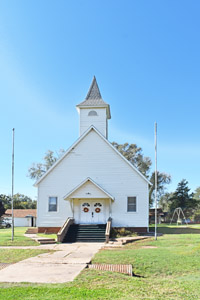
Baptist Church in Sun City, Kansas by Kathy Alexander.
Reverend Johnson M. Adams was an ordained minister of the Baptist Church and delivered the first sermon ever preached in this part of the country to the Sun City congregation, when most of the population consisted of cowboys. Afterward, “Grandfather” Adams stood for religious freedom, temperance, and society, and lived consistently by the precepts he taught. The church still stands today at 115 Washington Avenue. The church continues to serve a congregation today.
The Denver, Kansas, & Gulf Railroad came to Sun City in 1906, but plans to continue to Dodge City were set aside.
On May 27, 1909, the town’s name was changed back to Sun City.
In 1910, Sun City was still on the Atchison, Topeka & Santa Fe Railroad, with express and telegraph offices, a money order post office, and a population of 150.
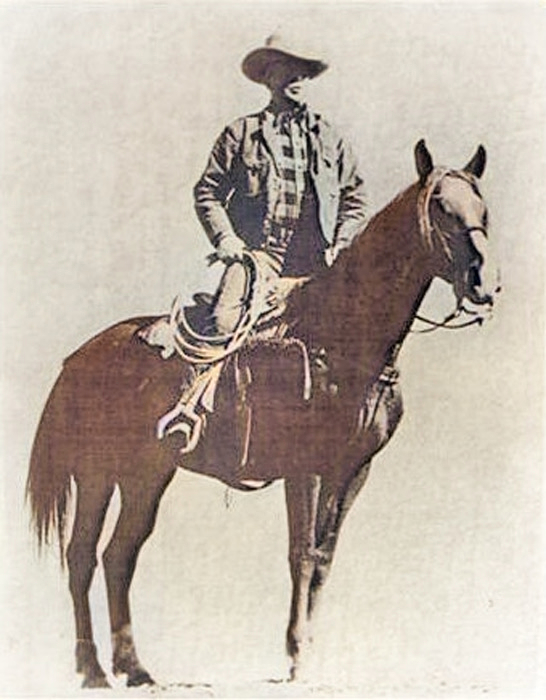
Marion Francis McLain.
In 1922, Mac McLain established the McLain Rodeo Roundup. It was the world’s largest rodeo, bringing cowboys associated with the Cowboys Turtle Association. The rodeo included a carnival, Indians, dances, and more, rivaling Buffalo Bill’s Show. The rodeo ran through 1938.
Sun City’s population peaked at 404 in 1930.
As quarries cut deeper into the hills and the overburden grew too heavy, the plaster company shifted operations to underground mining around 1930–1931. Underground work utilized chainsaw undercutting, column-mounted drills, and electronic dynamite blasting, transporting raw gypsum via aerial tramways and narrow-gauge locomotives to local crushers.
The plaster company was sold to the National Gypsum Company in 1938, and production continues today, providing quality building materials used in wallboard and plaster. It is located South of Sun City and hauls material to the Gold Bond Plant in Medicine Lodge, where wallboard is made and shipped nationwide.
Sun City historically operated its own local school (District Number 51) and high school. However, the schools eventually closed, requiring students to attend nearby schools in Medicine Lodge as rural populations declined after the Dust Bowl and mid-century school reorganizations.
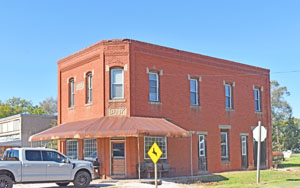
Old bank building in Sun City, Kansas, by Kathy Alexander.
Sun City High School in Barber County, Kansas, closed in 1966, ending a run of graduating classes that began in 1925. The original school building was ultimately demolished. The only surviving major piece of the school complex is the Sun City Gymnasium, built in 1951. It featured yellow pine walls and seating for up to 800 people, and it continued to serve the local area as a community center and sports facility.
Today, students are served by the USD 254, local school district in Medicine Lodge.
Sun City is in the Gypsum Hills, 20 miles northwest of Medicine Lodge, the county seat.
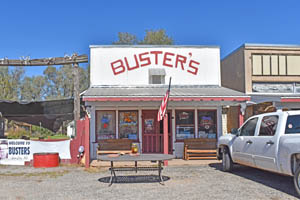
Buster’s Bar in Sun City, Kansas by Kathy Alexander.
©Kathy Alexander/Legends of Kansas, updated November 2026.
Sources:
BarberCountyGenWeb
Blackmar, Frank W.; Kansas: A Cyclopedia of State History, Vol I; Standard Publishing Company, Chicago, IL 1912.
Cutler, William G.; History of Kansas; A. T. Andreas, Chicago, IL, 1883.
Fort Hays State University
Kansas Historical Society
Travel Kansas
Wikipedia