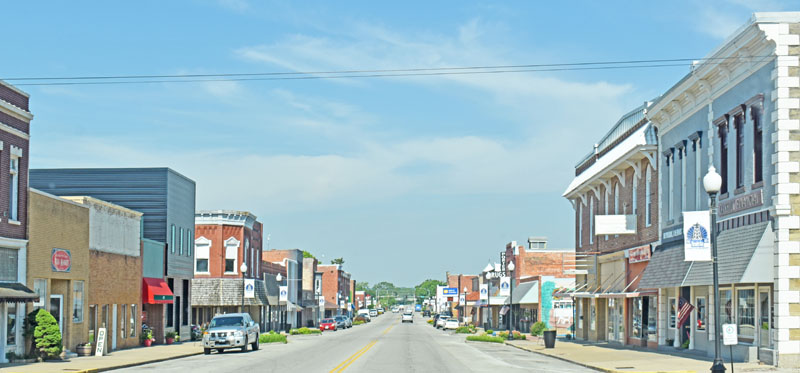
Business District in Neodesha, Kansas by Kathy Alexander.
Neodesha, Kansas, is a town near the confluence of the Verdigris and Fall Rivers in Wilson County. As of the 2020 census, Neodesha had a population of 2,275 and covered 1.39 square miles, of which 1.35 square miles is land and 0.04 square miles is water.
Numerous Indian villages were nearby, and the Osage Indians named it Ni-o-sho-de, which means “meeting of waters.”
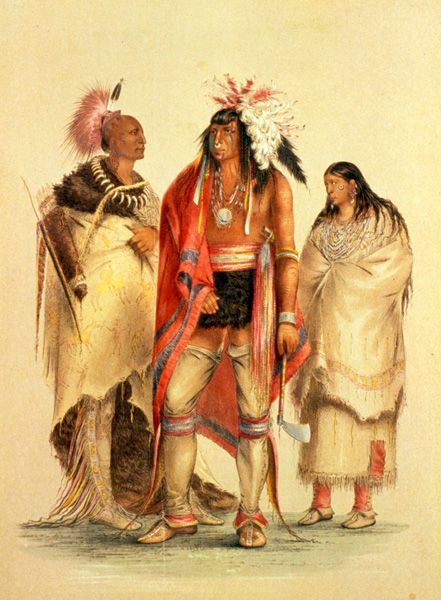
Osage indians by George Catlin.
In 1886, while the Indians still held the land and the whites had no rights in the premises, E.K. Parris and A. Tucker built a cabin on Fall River, some distance west of the future town site, and sold goods to the Indians.
In October 1867, A. McCartney and Alexander K. Phelon came from Neosho Falls and established a trading post among the Osage Indians, northwest of the present town near the Little Bear Mound. The Indians allowed them to establish a trading post on the Osage Diminished Reserve because the nearest trading post was more than 30 miles away.
In 1868, R.S. Futhey and John B. Keyes came to the trading post, and, deciding it would be an ideal location for a town, they bought the site for $500. Joining with A. McCartney and A.K. Phelon, a town company, was formed, and a townsite was surveyed in July. They set up a shingle and sawmill in November of the same year, and later began grinding corn. On December 24, the frame of the first building was raised, and, upon its completion, McCartney and Phelon moved the trading post’s stock into it.
The town company gave lots to all who would build, and before long, there were 200 buildings and 1,000 residents.
The first school was held in 1870, with James A. McHenry as the teacher. It was held in the old schoolhouse on Main Street.
The post office was established on June 13, 1870, with Alexander K. Phelon as postmaster. The next winter, the first school was taught by J.A. McHenry.
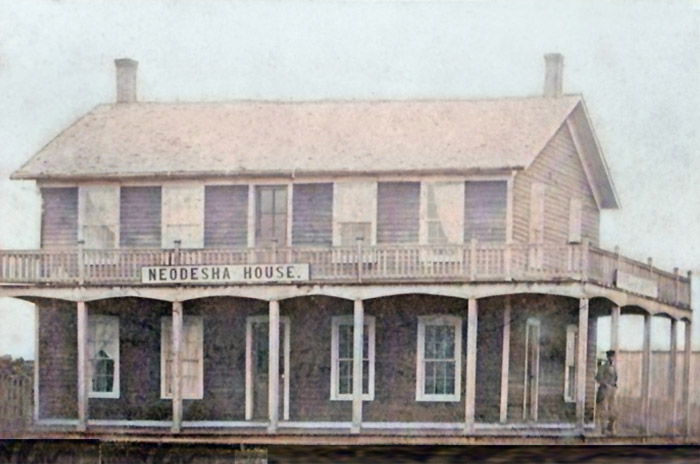
Neodesha House Hotel, 1871.
The Neodesha House was built in 1870 by B. Frank Renn on Main and Fourth Street. It opened on January 1, 1871, as the Neodesha House managed by George Bulkley. The hotel was a stage stop in the 1870s and was the town’s social center. Later, the name was changed to the Neodesha Commercial House.
After the Drum Creek Treaty was signed by the Osage tribe in September 1870, and they moved to Indian Territory (Oklahoma), it opened the way for settlers to move into the area.
The Methodist Episcopal Church was organized in 1870. The society soon had 80 members. A Sabbath school was established in 1871, and a brick church was erected in 1872 for $3,500.
The Neodesha Citizen was introduced to the public on November 18, 1870, by John S. Gilmore, who had previously published the same paper at Guilford. It was a seven-column Republican weekly, and initially did a prosperous business. Later, the support was inadequate to maintain the publisher’s goals, and it was discontinued on November 20, 1872.
On the day before Christmas, 1870, the first issue of the Neodesha Enterprise, a Democratic weekly, appeared, published by Berry & Campbell. Nine weeks later, the office was closed by its creditors. The newspaper’s material was spirited away one dark night by the holders of a second mortgage, and a Fredonia man who held a first mortgage was left to meditate on the well-known fact that it is easy to put money into a newspaper office, but its extraction is a far more difficult task.
In the winter of 1870-71, a stage line with four-horse Concord coaches began running from Neodesha to Thayer, the terminus of the Leavenworth, Lawrence & Galveston Railroad. In March, 1871, the town was incorporated as a city of the third class, with the first officers as follows: Mayor, Alexander K. Phelon; police judge, E.D. Huntley; councilmen, T. Blakesley, John S. Gilmore, W.A. Hampton, S.L. McQuiston, and C.W. Derry.
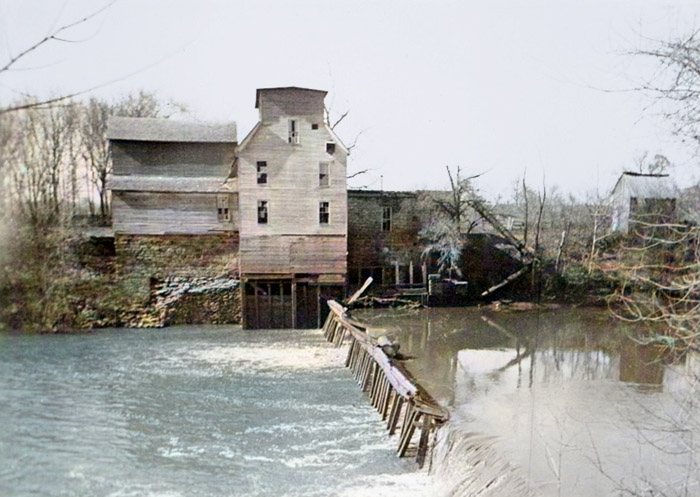
Mill on the Fall River in Neodesha, Kansas.
Neodesha was incorporated on March 2, 1871. On April 3, a city election was held, resulting in 167 votes and the return of a full set of officials as follows: A.K. Phelon, Mayor; T. Blakeslee, John S. Gilmore, W.A. Hampton, S.L. McCuiston, C.W. Derry, Councilmen; E.D. Huntley, Police Judge. J.K. DeMoss was made City Clerk. The first ordinance on the books regulated the sale of intoxicants.
The original plat was filed with the U.S. Land Office in July 1871.
That year, the Presbyterian Church was organized with 12 members. Its pastor was Reverend S.D. Lowhea. Early services were held in the schoolhouse and later in the city hall.
That year, a flour mill was built, and a bank was started. The bank was robbed after about three months and discontinued business. That fall, the townsite was entered at the land office. On December 15, a United States Land Office was located at this point.
Neodesha Township voted on February 10, 1872, by a ballot of 356 to 57, to give $60,000 of bonds to the Missouri & Kansas Southern Railway. This was accompanied by the provision that the road should be completed within one year and that it should be the first railway to enter Neodesha from the east. However, the road was never built.
The Neodesha Bank was organized in that year, and a city hall was built for $12,000. The brick schoolhouse in the northwest part of town was built and funded with $15,000 in bonds issued by the district to secure the building. It had four rooms. A bridge worth $14,000 were also built with bonds.
A Congregational Church was built in 1872 at a cost of about $600, and the society flourished for a time. Later, it gradually fell away, and with no pastor or services, the church building was used as a primary school.
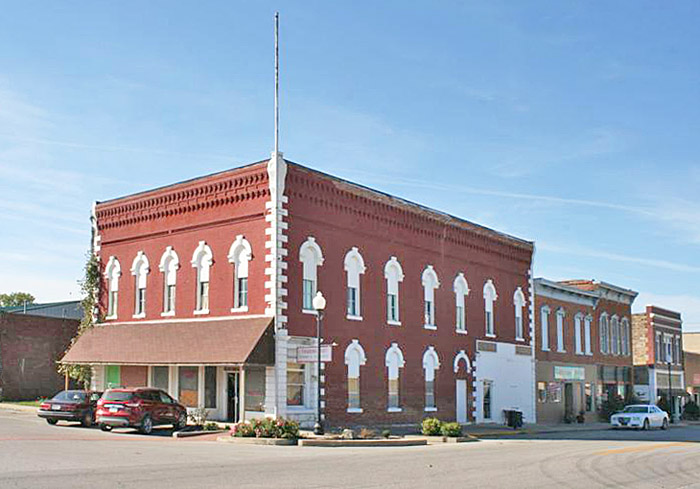
City Hall Building in Neodesha, Kansas.
The Neodesha City Hall Building was built at 102 S. 4th Street in 1872. The two-story, stone-and-brick, Italianate-style commercial building measured approximately 40 feet by 70 feet. The building was paid for with $12,000 in city hall bonds. When completed, the first story housed the Neodesha Savings Bank and a saloon. The city offices were upstairs, an arrangement that continued through the early 1910s.
The Wilson County Free Press was founded on January 9, 1873, by G. P. Smith, who used the material upon which the Humboldt Southarest had formerly been printed. The paper was a seven-column Independent weekly. In December 1874, it passed into the hands of G.D. Ingersoll, who made it Republican and reduced the size of one column.
The Hobart Water Mill, located on Fall River, one and one-quarter miles west of the town, was built in 1874 at a cost of $5,000. Power was furnished by a turbine water wheel which operated three runs of buhr-stones. This mill was built by Sprinkle & Co. and passed to Phelon Bros, B.F. Hobart, and finally G.A. Adams, later it.
Ownership of the Wilson County Free Press changed again in December 1876, and the paper became Independent in the hands of F.H. McCarter. A little later, it passed to Chapman Bros., who made it Democratic.
The Christian Church of Neodesha was organized in 1877 by Reverend C.A. Hedrick of Missouri. The church was placed under the care of Reverend Mr. Pucket, who filled its pulpit for a considerable time. At its organization, the society numbered 50.
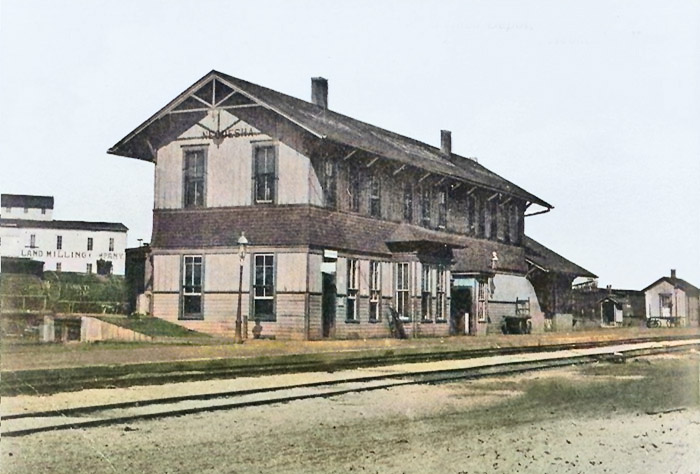
St. Louis & San Francisco Railway Depot in Neodesha, Kansas.
When the St. Louis and San Francisco Railroad came through in 1879, the company located its division headquarters here, which was a stroke of good fortune for the small town. In May 1879, the Wilson County Free Press was sold to George A. McCarter, published as a Republican sheet
In 1880, a division was established, and a roundhouse and repair shop were built. That year, the town’s population was 924.
The Neodesha Gazette, a seven-column folio with Republican leanings, was established on April 28, 1881. Its sponsors were John H. and Frank W. Long. After a little more than a year’s publication, the Gazette was sold to C.E. McClintock and R.J. Monroe, who turned it into the Prohibitionist. This new venture in journalism was what its name implies, the organ of the Prohibition party. It received little support and, in October 1882, discontinued publication.
A Christian Church church building, measuring 32 by 50 feet, was constructed in 1881, at a cost of $2,500. A Sabbath school was organized the following year. The Baptists also had a church building, and the Catholics were organized.
By 1882, the brick school was crowded out and relocated to the unused Congregational Church. At that time, it seemed that its 225 students would not decrease, and a second permanent schoolhouse was needed. At that time, its teachers were J.A. Wardlow, W.P. Maxwell, Eva Speers, Belle Witham, and Maud Gray.
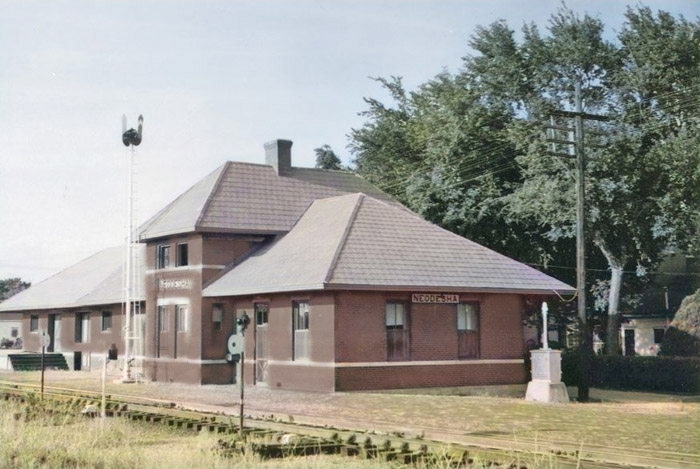
Missouri Pacific Railroad Depot in Neodesha, Kansas.
By 1882, the town’s population was 1,000 and was steadily growing.
The Missouri Pacific Railroad was built in 1886.
The Norman No 1. Oil Well was the first producing well in what became known as the Mid-Continent field. It was the first major oil discovery in the nation since the 1859 drilling in Titusville, Pennsylvania. Backed by several Neodesha businessmen, William Mills leased land from T.J. Norman to explore for oil. The drilling rig first struck oil on November 28, 1892, but the team had trouble getting the attention of eastern investors. John Guffey and James Galey of Pittsburg, Kansas, eventually became involved, and the first pumping occurred on October 4, 1893, yielding 371 barrels of oil.
Because eastern investors still had little interest in developing Kansas oil fields, Guffey and Galey sold out to the Forest Oil Company, a subsidiary of Standard Oil, which opened a refinery at Neodesha in 1897. It produced 500 barrels of crude oil per day and was the first to process crude from the Mid-Continent Field. The Norman No. 1 pumped until 1917, when it was abandoned. The Norman No. 1 Museum is near the original wellsite.
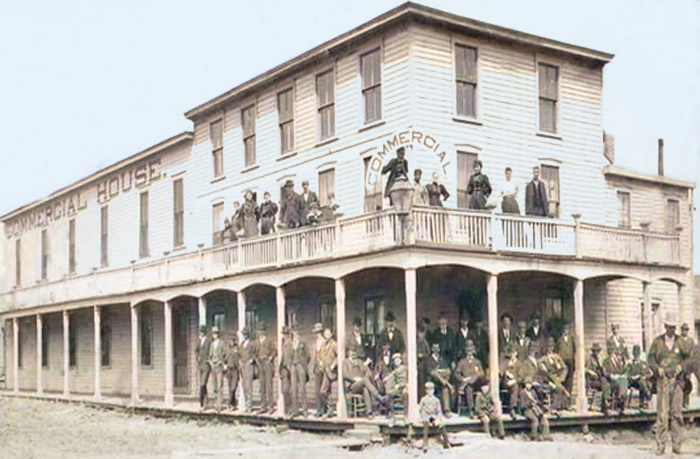
Neodesha Commercial House Hotel.
In 1896, the Neodesha Commercial House was under new management, with Mrs. Sam Weston as the manager. By that time, the original building had been elevated to three stories, and a 22-room wing added in 1894.
Two disastrous fires occurred in 1897, destroying a total of $46,000 worth of property.
The Lanyon Smelter was started in 1902.
The Indian Portland Cement Plant at Neodesha was incorporated in 1907.
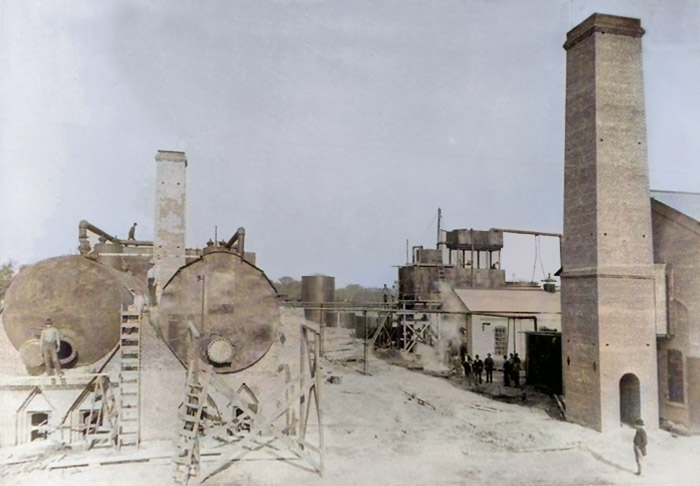
Oil company in Neodesha, Kansas.
In 1910, Neodesha was the second-largest town in Wilson County and the headquarters of the Kansas division of the St. Louis & San Francisco Railroad, which maintained a roundhouse and machine shops here. It was also served by the Missouri Pacific Railroad and had brick and tile factories, flour mills, an extensive Portland cement plant, an ice plant, and other manufactories. The city owned the gas plant, and natural gas was supplied to manufacturing at low cost. Located in the midst of the oil fields, it had a large oil refinery and tank field. There were also two newspapers, a national bank, telegraph and express offices, an international money order post office with four rural routes, and a population of 2,872.
Neodesha’s population peaked in 1920 at 3,943.
In 1943, German and Italian prisoners of World War II were brought to Kansas and other midwestern states as a means of solving the labor shortage caused by American men serving in the war effort. Large internment camps were established in Kansas: Camp Concordia, Camp Funston (at Fort Riley), Camp Phillips (at Salina, under Fort Riley). Fort Riley established 12 smaller branch camps, including Neodesha.
The once grand Frisco Roundhouse was down to two stalls by 1963. Eleven years later, the remaining two stalls burned down in 1974.
In February 2023, the old Neodesha City Hall building was demolished.
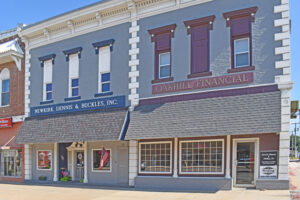
Business buildings in Neodesha, Kansas, by Kathy Alexander.
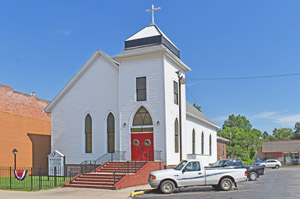
Church in Neodesha, Kansas, by Kathy Alexander.
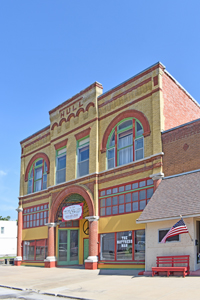
Hull building in Neodesha, Kansas, by Kathy Alexander.
Norman No. 1 Replica Well and Museum is a community museum in Neodesha, Kansas. The museum is open by appointment only. Outdoors is a 67-foot reconstruction of the oil derrick where oil first erupted in Neodesha in 1892. The well was the first commercially successful oil well west of the Mississippi River. This well operated for 26 years, while the oil industry grew across Kansas. The museum is located at 103 S 1st Street. It is open Thursday and Friday from 9:00 am to 4:00 pm, and on Saturday from 9:00 am to noon.
Located in the center of a rich agricultural district, Neodesha is located at the junction of U.S. Highways 75 and 400. It is 11 miles southeast of Fredonia, the county seat. It is only two hours to Wichita, Kansas; Tulsa, Oklahoma; Joplin, Missouri; and three hours to Kansas City, Missouri.
The community is served by the Neodesha USD 461 public school district.
©Kathy Alexander/Legends of Kansas, updated January 2026.
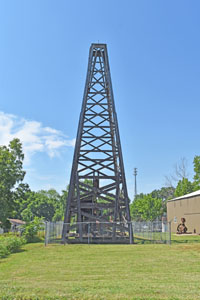
Neodesha, Kansas Oil Well by Kathy Alexander.
Also See:
Sources:
Blackmar, Frank W.; Kansas: A Cyclopedia of State History, Vol I; Standard Publishing Company, Chicago, IL 1912.
City of Neodesha
Cutler, William G.; History of Kansas; A.T. Andreas, Chicago, IL, 1883.
Wikipedia