
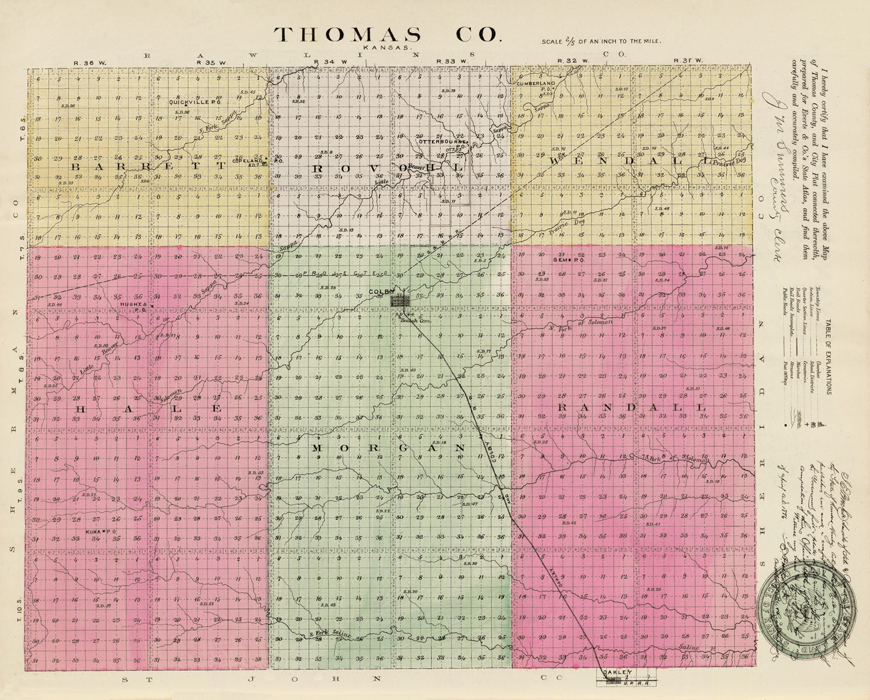
Thomas County, Kansas Map by L.H. Everts & Co., 1887.
Otterbourne, Kansas, was the first town in Thomas County to be laid out, platted, and to have the first store. However, it is gone today.
In April 1879, Miss Mary Hay, an experienced schoolteacher from Dubois, Pennsylvania, came west with her father, Lamar Hay, a niece, Ona, and a nephew, Isaac, ages four and six, who had been left in her care by the death of a younger sister. They unloaded their goods from the cars at Grinnell in Gove County. Then, loading them onto wagons, they made themselves as comfortable as possible and set out on a northwest journey of about 40 miles to South Sappa Creek.
When Mary saw the fish jumping and playing in the water at the ford where they crossed, she exclaimed that this was where they would stop. She homesteaded just west of the ford on the south fork of Sappa Creek. The area was hilly and rough, with deep draws cutting across the country from north to south. On the divide, drinking water was impossible to find. But here in the protected arm of a ravine was all they needed. Here, the grass was green for livestock, carp and catfish were plentiful in the clean, cold creek water, and groundwater was readily available with little digging.
As more people arrived, the South Fork community developed, following the creek downstream.
A blacksmith arrivede on Sappa Creek in 1880. The smithy, F.S. See, arrived with his wife, Mary Elizabeth Northrup See, six children, a set of tools, and a cash total of 35¢. He was a first-rate blacksmith, serving as the village smithy for residents of neighboring Cumberland and Otterbourne.
Seeing that a post office was needed, Mary Hay submitted an application to Washington, D.C., and two months later, on February 15, 1881, the post office opened. She named the community “Otterbourne,” becoming its first citizen and caretaker.
Here, settlers found at Otterbourne the security of an established postal service and a friendly postmistress. Twice a week, her sod house became a center of activity as families and bachelors gathered to meet the incoming mail. She let it be known that she preferred to be called “Auntie May.”
In about 1881, Mary Hay’s neighbor, William H. Archer, set up a small store in his home where he carried a stock that ran mostly to groceries and provisions. It was the first store in the county. He also carried some household items that would most likely be needed by the early settlers. An enterprising businessman, he hired drivers to haul supplies from Grinnell to Otterbourne to stock his shelves, at a labor cost of $2.00 per load, or about 15¢ per hundred weight.
At that time, the population of Thomas County was estimated at 161, and 46 people were known to be living in Otterbourne. Some of these included the families of W.H. Archer, F.S. See, C.D. Hubbard, E.T. Smith, and Henry Smith; the Hay-Rich group; the widow Lord and her children; and several unmarried men, including the Passell brothers, James and Samuel; the Barber brothers, John and Joe; the Knudson brothers, Henry and J.C.B.; Pat Turney; and a Mr. Underdown.
For a few years, the store did a good trade with folks who needed staple items. The Archers had a good, hand-dug well where neighbors came from miles around to draw water. Later on, the store had one of the first bored wells and a hand pump that was a delightful convenience for the settlers.
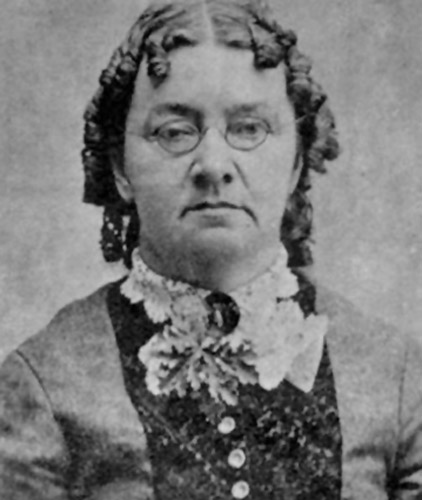
Miss Mary Hay.
Auntie May also treated illnesses and injuries and stocked some medicines and medical supplies, becoming a nurse, midwife, and physician for the community, even though she did not have a medical diploma.
Though she was not an ordained minister, she also established the first Sunday School in Thomas County, receiving materials from the Drexel family of Philadelphia, Pennsylvania. She acquired a license from Bishop Vail of Topeka, Kansas, to read sermons and officiate at funerals. She soon began providing worship services, holding the first service on Easter Sunday, 1882. Afterward, news of the weekly meeting spread, and before long, her church was full and overflowing.
She opened a school in her home in the fall of 1882, offering high school-level classes. Because some of her enrollees traveled long distances, she arranged to accommodate live-in students, calling the sod house academy the “Hay Boarding School.”
In the spring of 1883, Mary Hay was appointed deputy superintendent for Thomas County when the county was still attached to Sheridan County for judicial purposes. During the early part of her administration, she laid the groundwork for a public school system. At this time, only one school, District No. 1 at Colby, had been officially organized. In the first month of her administration, she oversaw the setting aside of land for the second school in the county, District No. 2, at Otterbourne. However, it was not possible to put the school into operation for some time.
In the meantime, she continued teaching at the school she held in her home. Her father, Lamar, died just shy of his 78th birthday and one year from proving up his claim, in March, 1884. That year, Mary had the post office moved to William Archer’s, where he assumed the postmaster’s duties.
The rapid settlement of the area in the fall of 1884 continued into 1885, culminating in the organization of the county that year.
The proliferation of other religious gatherings throughout the county led her to close her Episcopalian mission after four years. Afterward, a community Sunday School was then organized at the Archers’ sod house, providing nondenominational religious instruction. But Mary didn’t show up; she had ambitious plans.
In 1886, she proved up on her claim. She then built a new frame house on land she wished to buy through preemption and transferred the deed for the original claim to Isaac and Ona. A well was dug on the new property. In March 1887, Mary purchased the preempted land.
Watching the surveyors and noting the direction that the railroad tracks were taking, she felt sure that a branch line would cut across the South Fork of Sappa Creek on or near her land. All she had to do was establish a town on the route, and her fortune would be made. On September 7, 1887, she recorded a plat of her town at the Register of Deeds in Colby, surveyed by S.P. Chambers.
Her town comprised 42 blocks. In an age when the average little towns had narrow 20-foot lots, each of her blocks contained generous 27-foot by 154-foot lots.
She also designed a town square, with her recently dug 44-foot well serving at the center. She also built a town hall and began selling town lots at $10 apiece.
Auntie May sold 120 of the 840 lots she had available. The editor of the Thomas County Cat in Colby printed friendly references to the potential of Otterbourne in the early spring of 1888. However, the notices ceased after the railroad bypassed Otterbourne.
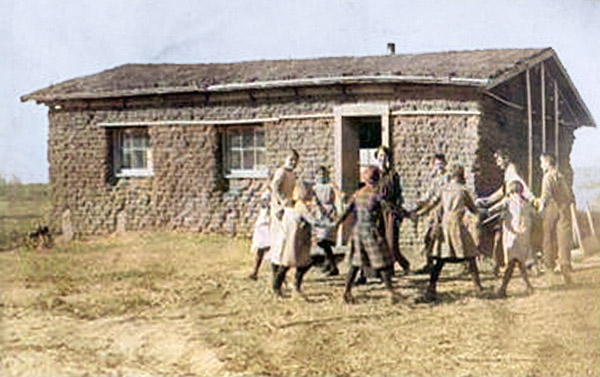
Sod schoolhouse, Otterbourne, Kansas.
The next summer, with her niece, Ona, getting married, Auntie May found herself in need of money. She sold some of the land to her nephew, Isaac, and took out mortgages on other parcels.
As she was struggling, she began to suffer from Parkinson’s Disease. She was then invited by her younger sister, Ellen Brady, to return to Dubois, Pennsylvania, and let the family look after her. By 1891, she had returned east and was living with the Brady family. In gratitude, she deeded the land to them, piece by piece. However, throughout the 1890s, Auntie May had no way to keep up her mortgage payments. At a sheriff’s sale held on the front steps of the courthouse on Saturday, February 25, 1889, her remaining land was auctioned to William Barber for $325.
Otterbourne’s post office closed on October 15, 1897.
Auntie May Hay died on December 2, 1907.
In August 1916, after passing through several owners, the land was put up for sale due to unpaid taxes. Ray Garvey bought all of the town of Otterbourne except for a 25-foot splinter in the center. This lot may have been the one where the town hall still stood.
If the railroads had gone that way, Otterbourne probably would still be a town in Thomas County. Despite Miss Hay’s best intentions, all that remains of the town today is memories.
©Kathy Alexander/Legends of America, updated January 2026.
Also See:
Sources:
Fort Hays State University
Prairie Museum, Colby, KS
Wingo, Wayne C.; A History of Thomas County, Kansas, 1885-1964, Master’s Thesis; Fort Hays Kansas State College, 1964