
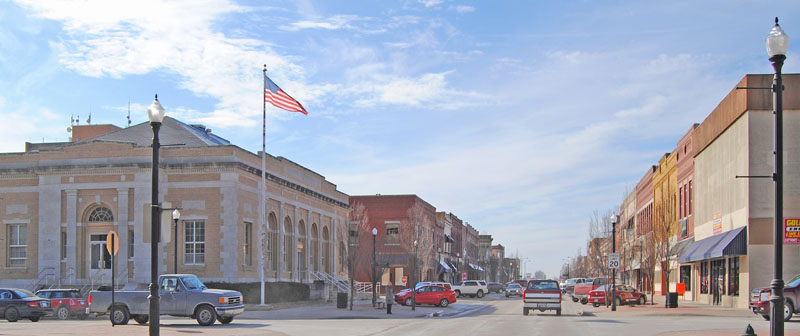
Parsons, Kansas Main Street.
Parsons, Kansas, is a city in north-central Labette County, three miles from the Labette-Neosho County line. As of the 2020 census, the city’s population was 9,600, and its total area was 10.70 square miles, of which 10.61 square miles was land and 0.09 square miles was water. It is the most populous city of Labette County, and the second-most populous city in the southeastern region of Kansas.
Parsons was initially named Mendota when a post office was established on September 25, 1869.
The townsite was chosen because it was on a flat ridge between Labette Creek and Little Labette Creek, offering an ideal location for the junction of the two branches of the railroad being built from Junction City, Kansas, and Sedalia, Missouri.
Track laying in that division reached the Parsons townsite on May 20, 1870, and was advanced at the rate of one mile per day. Railroad gentlemen of high official position determined upon the building of a town, and in the fall of that year, L.F. Olney, of Parkersville, Morris County, Kansas, the engineer who had been appointed to survey and plat the town, arrived upon the ground. A town company had already been formed, consisting of the following gentlemen: R.S. Stevens, President; O.B. Gunn, H.D. Minck, A.D. Jaynes, J.R. Barrett, and N.S. Goss.
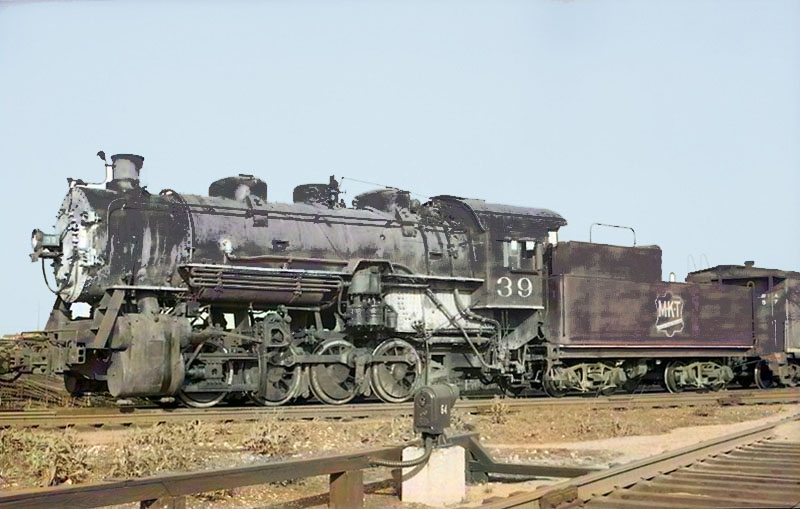
Missouri, Kansas & Texas Railway.
An agent was appointed to purchase the claims in the immediate vicinity of the townsite, which consisted of 2,560 acres, and was owned at the time of purchase by the following people: George W. Briggs, Abraham Cary, John Davis, H.L. Partridge, Henry Baker, Anson Kellogg, Angelina Baker, Joseph R. Simpson, Ed R. Rall, H. Pearson, Abraham Fultz, Samuel Eaves, John Kendall, R.F. Caldwell, W.K. Hayes, Aaron Midkiff, and George Wilson, most of whom owned a quarter section. The town was founded in 1870.
The creeks were soon dammed to provide a water source. The railroad commenced construction of a massive rail yard, foundry, and locomotive shop at Parsons.
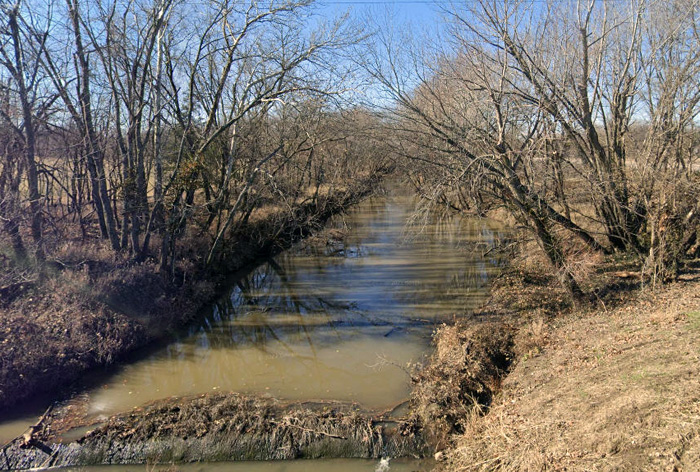
Labette Creek in Labette County, Kansas.
On December 9, 1870, the town’s name was changed from Mendota to Parsons. It was named after Levi Parsons, president of the Missouri, Kansas & Texas Railway.
As soon as it became known that a town was to be located here, people flocked in from all directions. They arrived in wagons, slept in tents, and hastily built wooden houses. The lots were offered for sale in March 1871, when prospects were so favorable that Abraham Carey purchased the first lot for $500. The lots were of two classes—business lots and residence lots, the former measuring 25 by 150 feet—and the prices at which they were sold ranged from $25 to $500. The company refused to sell lots to speculators. At this time, the town had a population of several hundred.
After a few small houses had been built, the town of Ladore, five miles to the northwest in Neosho County, which at the time contained about 1,000 inhabitants, was relocated entirely to Parsons. The towns of Montana, also in Neosho County, and Labette, contributed a portion of the population.
Parsons’s growth was remarkable from the outset, and on April 25, 1871, the town was incorporated as a third-class city by the railroad. Willard Davis was the first mayor, and the first council consisted of J.I. Plato, Abraham Carey, W.W. Dana, J.W. Rhodus, and Charles Watson.
The people of the city early availed themselves of every means and convenience for the education of the rising generation. No sooner had a sufficient number of children of school age been gathered into town than a school was furnished for them to attend. The earliest effort in this direction was made in 1871. A schoolhouse, a frame structure, was erected in which E.H. Taylor taught the first school.
The Sun newspaper was established in June 1871, through the enterprise of N.W. Reynolds and L.J. Perry. In subsequent years, it was subject to almost annual changes in proprietorship.
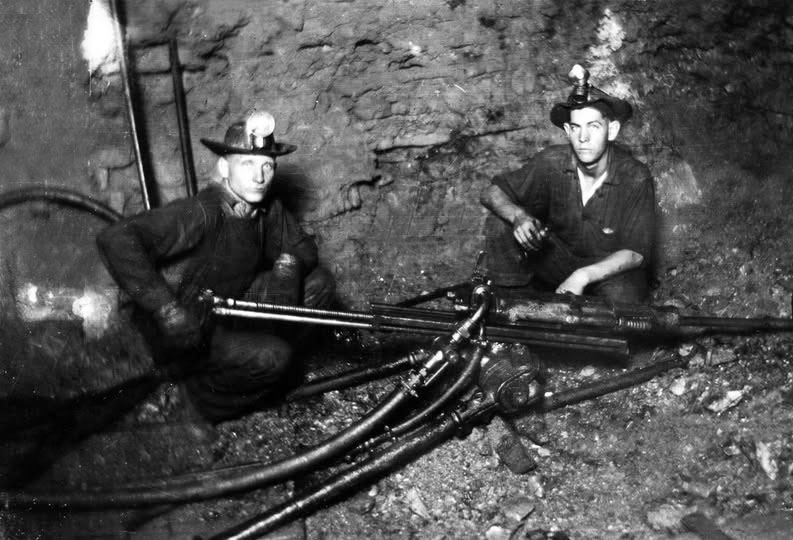
Osage Coal & Mining Company miners.
That year, the first sermon was preached by Presbyterian Reverend H.H. Cambern in a saloon, with a whisky barrel used as a desk or pulpit. Henry F. Baker was the first hotel keeper, and Jacob McLoughlin put up the first building suitable for a hotel. Sipple Bros. & E.K. Currant opened the first grocery store. Dr. T.L. Warren was the first physician. A library association was organized in 1871. The Osage Coal and Mining Company was organized in May 1871 by R.S. Stevens and several Eastern Parties. The company was formed for mining and trading coal and has a capital stock of $500,000.
The Banking House of Angell Mathewson was started the same year and continued until it was succeeded in 1872 by the First National Bank.
The First National Bank of Parsons was established and chartered on March 29, 1872, by a banking company of which A.D. Jaynes was president, and Angell Matthewson, cashier.
Settlers from nearby towns uprooted and moved to Parsons, and new settlers arrived on every incoming train. Parsons soon became a major railroad hub, serving the Missouri, Kansas & Texas Railway, the Parsons and Pacific Railroad, the Kansas City and Pacific Railroad, and the Memphis, Kansas & Colorado Railroad. For many years, Parsons was the third-largest railroad facility west of the Mississippi River, with only Kansas City, Missouri, and Los Angeles, California, larger.
The influx of settlers and the town’s rapid population growth rendered the school building inadequate by 1872, necessitating the construction of a new building. Accordingly, a large two-story brick building containing four rooms was erected at a cost of $15,000 in the eastern part of the city.
The Methodist Episcopal Church was organized in April 1872. A small frame church house was built in which services were conducted. The Catholic Church and the Baptist Church were established in the same year. For some time, the Baptists conducted worship in other churches and halls.
The principal manufacturing company was the Missouri, Kansas & Texas Railroad Company, which was located and built here in 1872. Of these, there was a semicircular roundhouse containing stalls for 14 engines and a machine shop measuring 100 by 300 feet, with an engine house measuring 40 by 50 feet. These buildings were massive stone structures, costing more than a quarter of a million dollars, and contained machinery valued at $60,000.
Parsons was designated a second-class city on February 25, 1873. That year, the railroad shops were located here. The Congregational Church was organized on July 12, 1873, and soon, a one-story brick structure was erected under the charge of Reverend Hartley. In the same year, the Christian Church was organized under the leadership of Reverend Asa Curl. This congregation initially held its meetings in other churches.
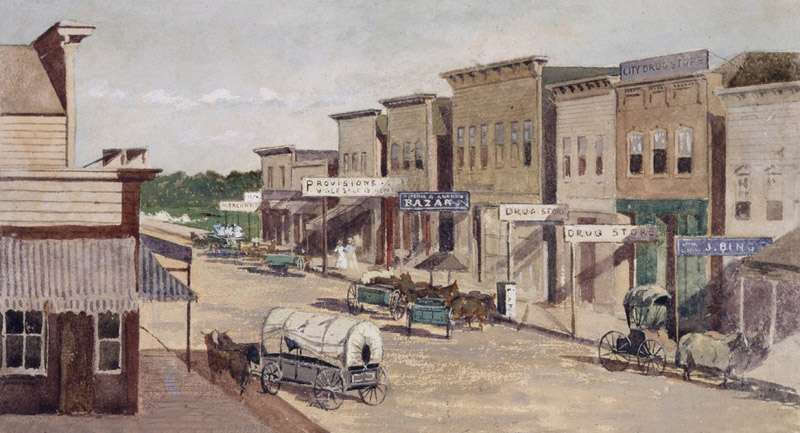
Broadway Avenue in Parsons, Kansas in 1873.
St. John’s Memorial Protestant Episcopal Church was also organized by Angell Matthewson. In 1874, the congregation of St. John’s Memorial Protestant Episcopal Church built a one-story brick building.
The Eclipse newspaper was started in April 1874 by J.B. Lamb as a weekly paper.
Parsons Commercial Bank was established in May 1874 as the Parsons Savings Bank by a stock company comprising approximately 15 members, and was duly incorporated. In 1878, it was changed from a savings bank to its present situation. A. Wilson was the first president, and Joshua Hill was the cashier. The institution conducts business with a capital of $50,000 and a reserve of $2,000. The deposits amount to $100,000. At present, J. Hill is president; A. Wilson, vice president; and G.W. Hawk, cashier and chief manager of the concern.
That year, the cramped condition of the schools necessitated additional space, and another two-story brick building was erected, costing the same as the former; it was very similar in appearance and size and stood in the western part of the city.
A one-story frame Presbyterian Church building was erected in 1875.
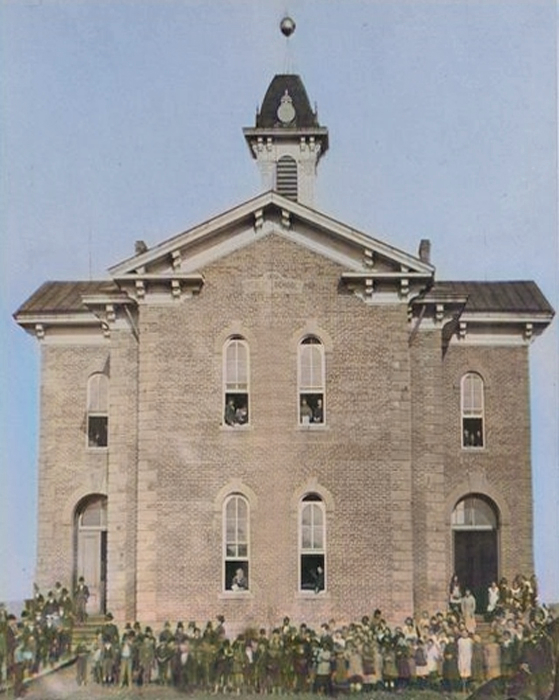
Parsons Grammar School, 1878.
The United Brethren became regularly organized as a church body in February 1875. They first held meetings in other churches until the Methodists built their new one, after which these Brethren procured the old frame building.
The African Methodist Episcopal Church was organized in November 1876.
The business streets were paved in 1878. That year, the Sun newspaper was purchased by H.H. Lusk, who published it as a weekly news journal. It was a six-column folio, Republican in politics, with a circulation of 1,400 copies.
The Parsons Foundry and Machine Shops were established in 1879 by Robert Crichton and engaged in the manufacture of a wide range of machinery and in performing a wide range of jobs and repairs.
The National Flour Mill and Elevator was brought to Parsons from Osage Mission (St. Paul) by H.H. Brown and H.D. Mirick in 1879 and was fitted up by Angell Matthewson. It was a steam mill with five runs of buhrs and a capacity of 200 bushels of wheat per day. The building was a three-story frame structure to which a large frame elevator was attached.
That year, the Baptists built a small one-story brick church, and the Christian Church built a one-story frame building.
In 1880, necessity compelled the erection of another school building. Located in the northern part of the city, it was a tastefully constructed two-story brick structure containing five rooms: three school rooms and two recitation rooms. Although perhaps the most significant and finest school building in the city, it cost only about $12,000 or less than $3,000 than either of the others.
The Stone Flouring Mill and Elevator was built in 1880 by Mr. Hoke. The large three-story stone structure was operated by steam power and contained three runs of buhrs. That year, a military company, known as the Parsons Light Guard, was organized.
That year, a spacious brick building was erected for the Methodist Episcopal congregation. The Sun began daily publication in September 1880. It is a five-column folio and had a circulation of 1,200 copies. It is a morning paper, and the only one receiving Associated Press dispatches.
The City Bank of Angell Matthewson & Co. was established on October 1, 1880, as a private institution by Angell Matthewson, Merrick Noyes, and F.H. Snyder, who was the cashier. It was a large brick building.
At about the same time, through the enterprise of E.H. Edwards, the city was supplied with an Opera Hall. It was a large two-story brick building, the upper floor fitted up and furnished as a hall, and the lower floor divided into storage rooms.
By the early 1880s, Parsons was a fine, prosperous city of nearly 7,000 people, regularly laid out with wide streets and numerous substantial brick stores, banks, churches, manufactories, and three railroads. By that time, the Eclipse newspaper had a subscription list of 1,000, and it was an eight-column folio. By then, the Osage Coal and Mining Company was operating mines in Oklahoma, Missouri, and Kansas, producing 50-60 carloads per day.
A park was laid out and improvements begun in 1881.
The Eclipse newspaper began daily publication in April 1881, at which time A.C. Lamb, the proprietor’s son, also became a partner in the concern. The Daily’s circulation was 350 copies.
During the fall and winter of 1881, the Catholic Church established a school for its children, which also admitted Protestant children. Four teachers, or sisters, were employed, and Father Roos managed the institution. A neat frame building was erected.
The African Methodist Episcopal Church erected a plain one-story frame church in 1882.
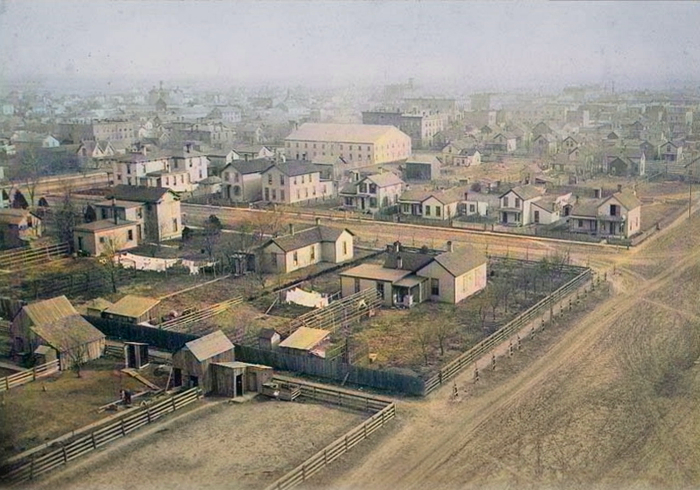
Parsons, Kansas, in 1885.
The firm of Hoke Brothers was formed in 1882 and has a capital stock of $30,000. Their large plant is located in the northern part of the city of Parsons, and covered about two acres of ground, employing from 10 to 15 men. They comprised a flour mill, a feed mill, a warehouse, and a grain elevator. Later, a new office building was added. The plant was operated by steam, with power supplied by a 60-horsepower engine and boiler. Soft-wheat flour in several grades is manufactured, the finest being Blue Ribbon, White Loaf, and Champion, and a complete line of feedstuffs is also produced. The business has expanded to the point that the local grain supply was insufficient to meet the mills’ current capacity, proportionately increasing, and a significant amount of grain is purchased from outside the region.
The Foster Automatic Windmill Manufactory was started in June 1882 by John Keys and William Alexander. The shop is operated to make windmills, as ordered, and to perform all sorts of wagon and carriage work and blacksmithing. The building is a one-story brick structure measuring 40 by 60 feet.
The Telephone Exchange was established in Parsons in July 1882 by the Merchants’ Telephone and Telegraph Company, located in Kansas City, Missouri, with the Parsons business under the management of J.C. Stimmell. There was also a line connecting to the city of Oswego. That year, the waterworks and gas mains were all added to the town’s improvements.
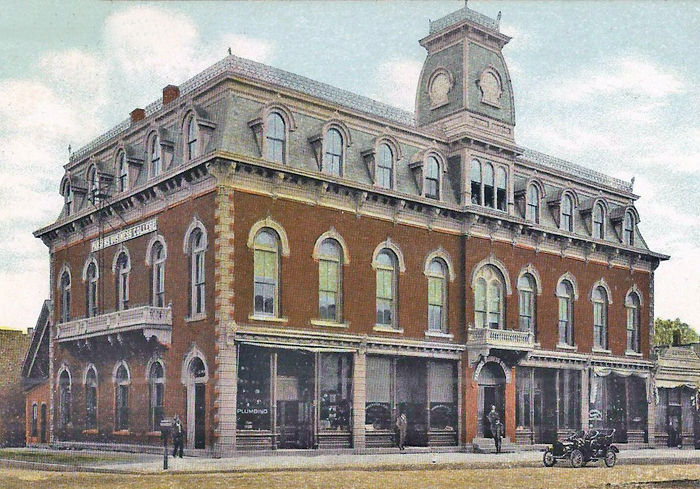
Parsons Business College.
At about the same time, a sash and door factory was built by D.P. Deprey and G.L. Ellis. The building was a large two-story brick structure; the lower story was being fitted with a complete line of machinery for the manufacture of a wide range of carpenters’ house-furnishing, finishing, and ornamental goods.
A new foundry was erected that year, replacing the old frame one. It is a substantial brick building, measuring 60 by 166 feet, and costing approximately $10,000. The blacksmith shop is a frame building, 50 by 130 feet. In all the departments of these shops, an average of 210 men are employed year-round, to whom $180,000 in annual wages is paid. In addition, the Bridge Department, which maintains more than 800 miles of road and employs approximately 30 staff members, is located at this site.
The Leader newspaper was established by G.F. Kimball as a Sunday-morning paper in October 1882; the first issue was published on Sunday, October 29.
The city’s growth was such that, by 1883, it had a population of 6,500 and more than 100 business establishments. The City’s prosperity helped it to weather economic trends that damaged other towns in the area. A number of large homes of the grandest design and most elegant detail were constructed, many of which survive today.
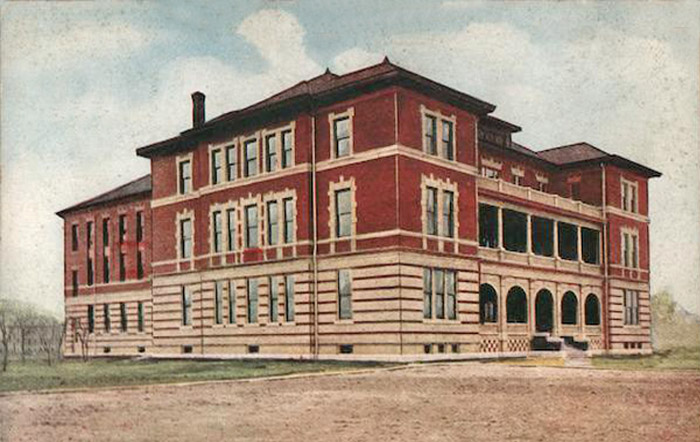
Parsons State Hospital For Epileptics.
The sewer system was installed in 1885. Electric lights were added in 1887.
Parsons Business College was established in 1892
In the early 1900s, Parsons operated its own streetcar system, and also had an interurban electric railroad connecting it to the nearby cities of Cherryvale, Independence, Coffeyville, Kansas, and Nowata, Oklahoma.
The Kansas State Hospital for Epileptics was established in 1903.
The first library began as a subscription library in 1904 and was located in the city hall.
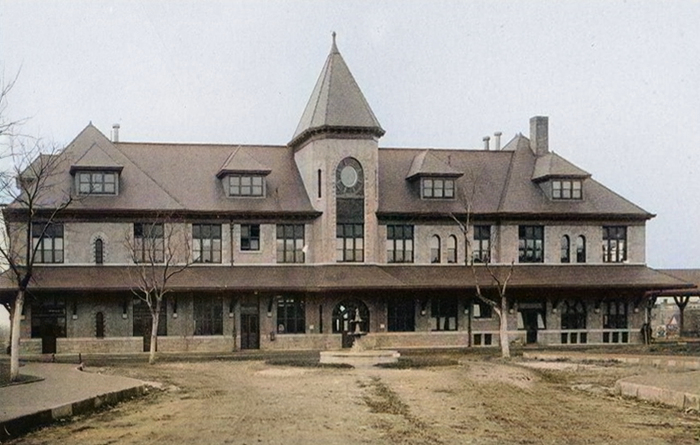
Missouri, Kansas & Texas Railway depot in Parsons, Kansas, 1900.
Early in 1905, the Kansas Natural Gas Company began buying property and soon owned all leases formerly held by the state’s major gas companies. The Kansas Natural Gas Company laid a pipeline to Kansas City, and St. Joseph , Missouri, as well as to Atchison, Topeka, Leavenworth, and Lawrence, Kansas. Another pipeline belonging to the same company carried gas to Parsons, Oswego, Columbus, and Pittsburg, and another went westward to Wichita and intermediate towns. In 1907, Kansas had more than 125 towns and cities using natural gas. The company’s main office was in Independence, Kansas.
A Carnegie Library was opened on May 18, 1909.
In 1910, Parsons was at the junction of two lines of the Missouri, Kansas & Texas Railway and the St. Louis and San Francisco Railroads and remained the largest city in Labette County and one of the most important in southeastern Kansas. The progressive city, had several miles of paved streets, a fine water system, good fire and police departments, modern hotel accommodations, electricity, natural gas for lighting; heating and commercial purposes, four banks, two daily and weekly newspapers, two weeklies, feed and flour mills, ice and cold storage plants, a foundry, corset factory, creamery, planing mills, cider mills, and establishments for the manufacture of cigars, mattresses, cornices, skirts, brooms, etc. The offices and repair shops of the Missouri, Kansas & Texas Railway company were located here, as was the state hospital for epileptics. Coal, building stone, natural gas, and oil were found in the vicinity. At that time, it had telegraph and express offices, an international money order post office, with eight rural routes, and a population of 12,463.
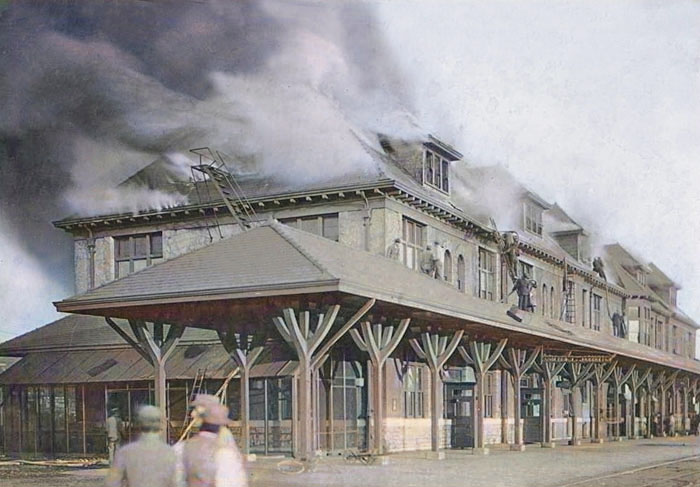
Depot burning in Parsons, Kansas, in 1912.
The Missouri, Kansas &Texas Railroad depot burned to the ground in March of 1912.
A new three-story Missouri-Kansas-Texas Railroad depot was built and opened on January 8, 1914. For many years, the facility provided rail service to the community.
Parsons’ population peaked in 1920 at 16,028.
Parsons Junior College was established in the fall of 1923. It was initially financed and operated as part of Parsons Public Schools, serving as a two-year extension of the Senior High School. Until 1935, the college operated as a two-year institution and served as a stepping stone for students seeking to continue their education at a four-year university.
In 1935, Parsons’s schools were reorganized. Under this new system, the Junior College was a four-year institution that instructed students in grades eleven, twelve, thirteen, and fourteen.
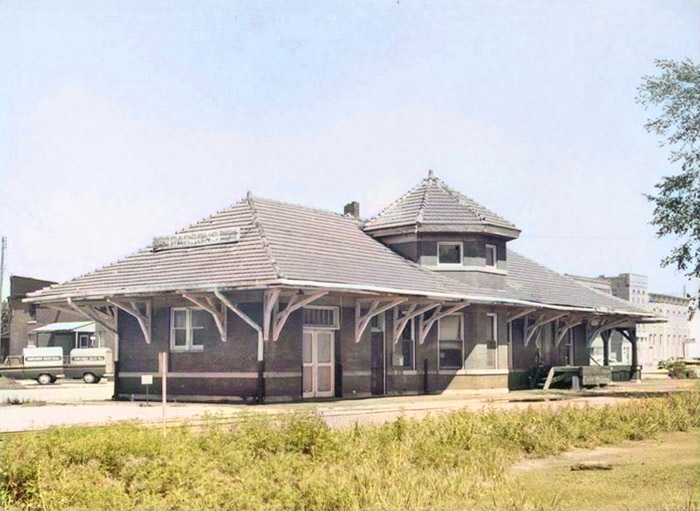
St. Louis-San Francisco Railway depot in Parsons, Kansas, by H. Killam, 1963.
In 1942, during World War II, the Kansas Ordnance Plant was established southeast of Parsons. It consisted of 21 separate facilities across 13,727 acres. The installation was used as a munitions-loading, assembly, and packing facility. Later, it was operated as the Kansas Army Ammunition Plant.
In 1957, the Kansas State Hospital for Epileptics was renamed Parsons State Hospital and Training Center. At that time, it began providing programs for individuals with developmental disabilities. The Hospital occupies 43 buildings on 163 acres. The hospital also includes residential services, the University Center on Developmental Disabilities, the Parsons Research Center for the University of Kansas, and the Special Purpose School of the Southeast Regional Education Service Center. The Southeast Kansas Agricultural Research Center of Kansas State University is also located on the grounds, as is the Alzheimer’s Association, Heart of America Chapter, Southeast Kansas Regional Office.
When the need for physicians and medical facilities became apparent in the late 1960s, Parsons began a construction and recruitment program that led to the most comprehensive medical services in the surrounding area.
In 1967, Parsons Junior College was renamed Labette Community Junior College.
In the 1970s, a massive urban renewal program was undertaken to benefit the municipal facilities and the business district.
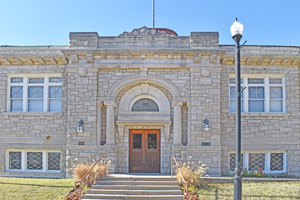
The former Carnegie Library in Parsons, Kansas, is now a Performing Arts Center. Photo by Kathy Alexander.
In February 1972, the Missouri, Kansas & Texas Railway depot was razed.’A new library opened on April 18, 1977, and the former Carnegie Library was subsequently renovated to serve as a visual and performing arts center.
In 1980, Labette Community Junior College was renamed Labette Community College. The main campus is in Parsons, with satellite campuses in Cherokee, Oswego, and Pittsburg.
The Kansas Army Ammunition Plant was downsized in the 1980s. The plant is currently owned and operated by Day and Zimmerman, Inc., and primarily produces mortar ammunition.
The sale of the Missouri, Kansas & Texas Railway to the Union Pacific Railroad in 1988 ultimately led to the loss of many railroad jobs and to the severing of a significant part of Parsons’ city history, which dated back to its 1871 incorporation. In return, the city received $1 million to support its recovery. The funds are held in a city government fund, which uses the accrued interest for economic development projects. The only reminder of the Katy Railroad is now found in the local historical society’s museum, the annual Katy Days Festival, and, of course, the tracks, over which trains now speed through Parsons.
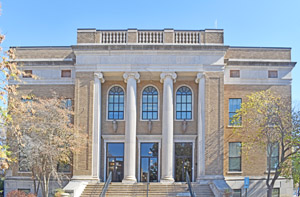
Municipal Building in Parsons, Kansas by Kathy Alexander.
On April 19, 2000, an F3 tornado cut a devastating path of destruction through the center of Parsons. About 700 homes were damaged, and about 100 were destroyed. About 60 businesses were damaged, and 11 were destroyed.
On June 5, 2006, the National Trust for Historic Preservation named Parsons a winner of the 2006 Great American Main Street Award for its successful efforts to revitalize its downtown through historic preservation. The award was presented during the 2006 National Main Streets Conference in New Orleans, Louisiana. Parsons was one of only five cities receiving the 2006 award.
Parsons is home to Labette County Medical Center, Labette Community College, and the Parsons State Hospital & Training Center. It is also home to Dwayne’s Photo, which became the last processor of K-14 Kodachrome film in the world and was the location of the final frame taken on the final roll of Kodachrome film produced.
The city is at the junction of U.S. Route 59 and U.S. Route 400. Along US-59, Erie, the Neosho county seat, is 17 miles to the north, and Oswego, the Labette County seat, is 20 miles south and east. Big Hill Lake is several miles to the west of the city, and Lake Parsons is situated northwest of the city.
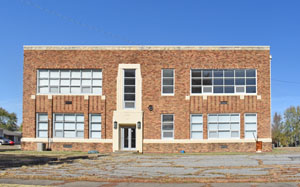
Parsons, Kansas Commercial Building.
©Kathy Alexander/Legends of Kansas, January 2026.
Also See:
Sources:
Blackmar, Frank W.; Kansas: A Cyclopedia of State History, Vol I; Standard Publishing Company, Chicago, IL 1912.
Case, Nelson; History of Labette County, Kansas, Biographical Publishing Co., Chicago, Ill. 1901.
City of Parsons, Kansas
Wikipedia