
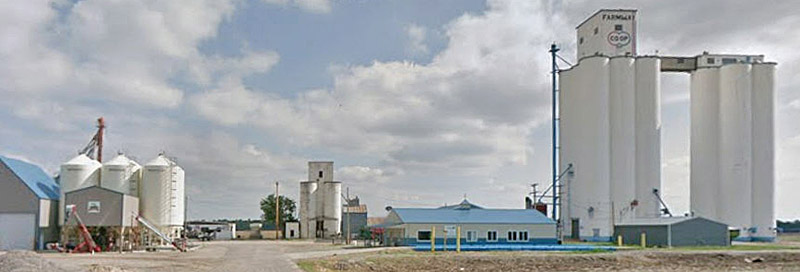
Solomon Rapids, Kansas, courtesy of Google Maps.
Solomon Rapids is an unincorporated community in Turkey Creek Township of Mitchell County, Kansas. It is also an “extinct” town as it no longer has a post office.
One of the first settlers in the Solomon Rapids area was R.C. Clark, a prominent attorney.
The Kanza tribe lived along the Solomon River, and when the settlers began encroaching on their land, the Kanza attacked. In the spring of 1870, a stockade was established by a party including C.J. Brown, G.W. Anderson, R.C. Clark, and John S. Smith on the North side of the river about ¾ of a mile West of present-day Solomon Rapids. Its purpose was to provide a place for the settlers to go in case of an attack by Indians.
Settlers were drawn to this area for the great farming opportunity and the stockade.
Early settlers built a grist mill at this point beside the river, and Yates Douglass opened the first general store.
A post office was established on August 9, 1870. It was named for the river rapids on the Solomon River a half mile south of the townsite.
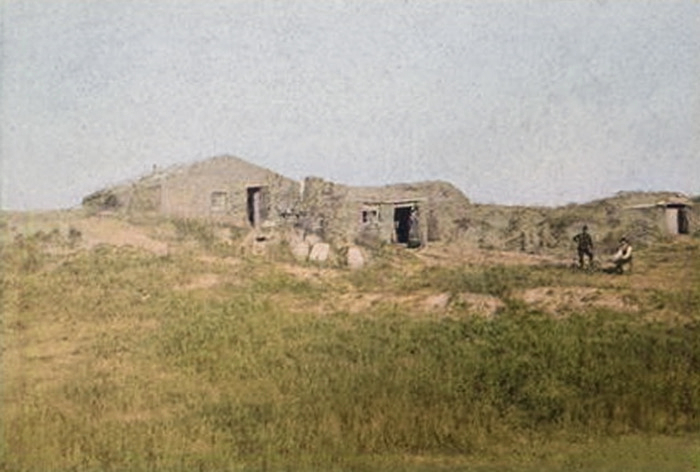
Sod dugouts in Solomon Rapids.
When the county was deciding where to put the county seat, Aaron Bell, who founded Beloit and a better-producing mill site, made people realize the potential for his area as county seat rather than Solomon Rapids. Business interests also seemed to favor Beloit. Solomon Rapids put up a good fight because it had a larger population, but it could not sway the other parties in the rest of the county.
That fall, the governor of Kansas appointed Don Peaslee of Solomon Rapids as Special County Clerk to oversee the first election to organize Mitchell County. In that election, Don Peaslee was elected the first Mitchell County Attorney, and Beloit was selected the permanent county seat by a vote of 143, only 43 for Solomon Rapids.
The loss of the county seat election led to Solomon Rapids’ decline. In the meantime, Beloit became more attractive to businesses and settlers.
School District #11 was formed in October 1872, with Miss Mary Green as one of the first teachers.
O.B. Douglass was a farmer and a water-powered mill owner. In the early years, other businesses included a hotel, doctor, dentist, three general stores, and a grain elevator.
A United Presbyterian Church was established East of the village on the North side of the Solomon River on May 17, 1873, with 13 charter members.
By the early 1880s other community leaders included W.C. Cochran, a Civil War veteran who served as Justice of the Peace and Trustee of Solomon Rapids Township; Yates Douglass, farmer and mercantile store proprietor; O.B. Douglass, a farmer and miller who erected a water-powered flour mill on the Solomon River that stood four stories high and measured 40 feet by 60-feet; Don A. Peaslee, who served as county attorney for two years; and English-born John W. Wood, were said to have raised the first barley crop in Mitchell County and marketed it at Junction City, 110 miles to the East.
By that time, the city had a store and a railroad depot
One of the first settlers of the township was R.C. Clark, an attorney of some prominence, and on the formation of the Fifteenth Judicial District, a candidate for Judge.
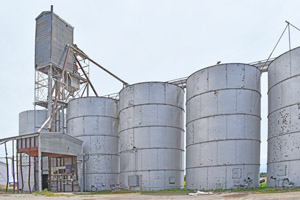
Silos in Solomon Rapids, Kansas by Kathy Alexander.
In 1893, C.J. Johnson, a Swedish immigrant, and D.H. “Jud” Thierolf formed a partnership and built a wooden grain elevator along the railroad tracks.
Between 1893 and 1909, one of the first concrete elevators in the region was built, along with a large two-story stone store and a lumber yard. The second story of the store was used for many community meetings.
Solomon Rapids was never platted or incorporated as a city.
In 1910, Solomon Rapids was a station on the Missouri Pacific Railroad. At that time, it had a money order post office, and its population was 50.
In June 1914, the concrete elevator, the store building, and coal sheds were rented to the Farmers Union, later called the Farmers Co-op.
In 1934, the Johnson heirs bought out the Thierolf heirs, and the company remained with the Johnson family until it was sold to Ron Tice.
Solomon Rapids had many businesses over the years: the first cement grain elevator in north-central Kansas, general store, post office, blacksmith, dance hall, hotel, grist mill, saw mill, dentist/doctor office, grocery store, lumberyard, coal yard, depot, two churches, and a school. Most of these enterprises had closed by 1940.
By 1950, the population of the village and area around was in decline, and on December 31, 1953, the Solomon Rapids Post Office was discontinued.

An old house in Solomon Rapids, Kansas by Kathy Alexander.
The Co-op built a large concrete elevator in 1950 and built an annex in 1954.
In 1968, the original grain elevator built by Charles Johnson and Mr. Thierolf in 1892 was destroyed by fire.
In March 1969, the wooden elevator caught fire and burned. A steel feed mill was then erected in its place.
Today, the community is served by the Beloit USD 273 public school district.
The Kyle Railroad still runs through the community.
Solomon Rapids is five miles West of Beloit, the county seat.
©Kathy Alexander/Legends of Kansas, updated 2026.
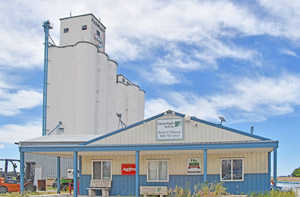
Seed company in Solomon Rapids, Kansas by Kathy Alexander.
Also See:
Extinct Towns in Mitchell County
Sources:
State History, Vol I; Standard Publishing Company, Chicago, IL 1912.
Cutler, William G.; History of Kansas; A. T.
Mitchell County, Kansas
Thiessen, Laura; Lost Kansas Communities, Kansas State University Chapman Center for Rural Studies, May 2, 2012
Wikipedia