
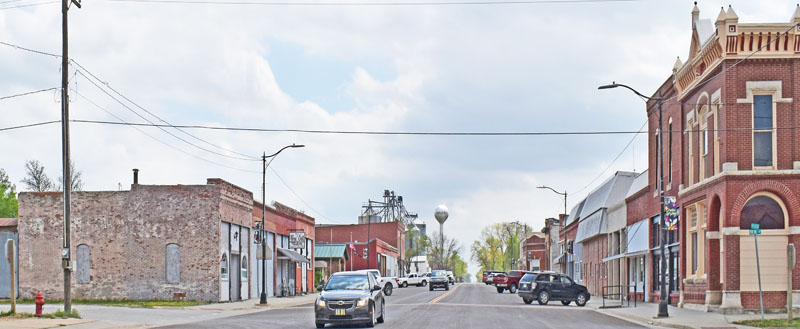
Waverly, Kansas Main Street by Kathy Alexander.
Waverly, Kansas, is a small town in Rock Creek Township in the northeast corner of Coffey County. As of the 2020 census, its population was 574, and its total area was 0.73 square miles, of which 0.72 square miles was land and 0.01 square miles was water.
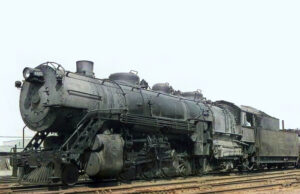
Burlington Locomotive.
In 1877, the Ottawa & Burlington Railroad was started by W.H. Schofield. It was completed the following year, and the town of Waverly was founded. It was platted that year by Isaac Pierson, the land’s original owner and one of the first settlers in the area. It was named for his hometown, Waverly, Indiana.
The first store was opened in a story-and-a-half building, erected in 1878 by A.N. Sylvester. The post office was established on June 10, 1878, with Sylvester serving as the first postmaster. Some of the town’s first houses were built that year, including one by H.P. Donnell, built on Pierson Street. Other small houses for residences for railroad men were also erected. That year, J.A. Nash, from Pennsylvania, moved to Kansas and located in Rock Creek Township, in Coffey County, where he first engaged in farming. He then moved to Waverly and entered the restaurant business.
In the spring of 1879, Thomas Donnell, an attorney-at-law and real estate agent, erected a frame building for a dry goods store. Several dwelling houses were also erected that year.
A town company was chartered in 1880 by W.H. Schofield, Orson Kent, James Houston, Isaac Pierson, J.W. Hammond, and Thomas Donnell. The officers were\: James Houston, president; Isaac Pierson, vice-president; Thomas Donnell, secretary; Orson Kent, treasurer.
James Lindsey and his family were among the first settlers of Waverly in 1880. Originally from New York, he first engaged in farming, then worked in the hardware business, before engaging in the real estate business and land agency. The same year, John F. Stark, a building contractor born in Charlestown, West Virginia, moved his family to Waverly. Dr. Charles Van Orman and his family came from Illinois to Waverly in 1881. A Civil War veteran, he studied medicine at the Ohio Medical College and the American Medical College of St. Louis, and he established his practice.
That year, J.W. Hammond built a house for a general merchandise store, and Campbell & McSherry built a frame building for a hardware store. Z.H. Brock built a story and a half building, the first story of which was occupied by Mrs. I.E. Murray for a millinery store, and the second story by Mr. Brock for his residence. Peter Weikert also built a story-and-a-half frame building, the first story of which was occupied by Weikert & Butler for a billiard hall, and the second story by the same parties for a photograph gallery. Some dwelling houses were also erected that year. The Waverly Presbyterian Church was organized on May 1, 1880, with a membership of eleven. The first pastor was Reverend W.M. Pocock. John L. Senior, a banker, came to Waverly from New York in July 1880 and first engaged in the practice of law. Later, he became a member of the banking firm of Fisher & Senior.
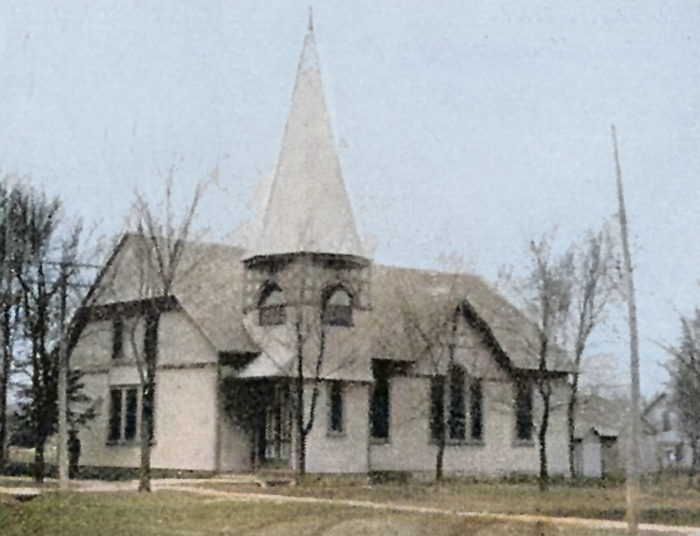
Presbyterian Church in Waverly, Kansas.
In 1881, the Congregational Church members erected a church building for $1,200. However, the church subsequently disbanded and sold its property to the school district for a schoolhouse. Alexander Hutchison, a merchant born in West Virginia, moved with his family for several years before relocating to Waverly in 1881, where he operated a grocery business and farmed. C.A. Phillips, a druggist born in New York, moved around a couple of times before coming to Waverly in 1881. H.A. Sunday, originally from Ohio, came to Kansas in May 1881, settled in Waverly, and engaged in merchandising.
Waverly had its first fire in January 1882, which destroyed half of the houses and businesses. The fire started in Campbell & McShery’s hardware store after a dog allegedly overturned a lamp. J.J. Campbell lived above the store. He and his baby escaped just before the powder in the store exploded.
The Presbyterians erected a church in that year for $1,800. The Methodist and New Light Churches were also organized, but had no buildings.
C.B. Forsythe, a wagon maker originally from Pennsylvania, brought his family to Waverly in the spring of 1882. The same year, Joseph H. Kemp, originally from Montgomery County, Ohio, settled in and engaged in the drug business. In June, 1882, a bank was established at Waverly by R.R. Fisher and John L. Senior. The same year, a 48-by-48-foot hotel was erected by H.A. Sunday. J.W. Bixler, originally from Illinois, moved to Waverly at about the same time and engaged in the mercantile business.
By that time, the town had two lumber yards, two drug stores, two hardware stores, five general merchandise stores, two millinery stores, a livery stable, a restaurant, a notion and stationery store, a furniture store, a tinware and stove store, a confectionery store, a flour and feed store, a blacksmith shop, a wagon shop, two carpenters, two lawyers, two doctors, two preachers, two school teachers, two real estate offices and three live stock shippers. Coal and flagging stone were found on the townsite. Alexander Hutchison sold out his business in October 1882 and built the large Waverly Hotel. That year, Walter M. Tuttle, originally from New York, came to Waverly with his wife and child in February 1882 and opened a blacksmith shop.
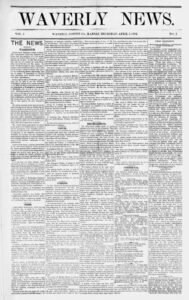
Waverly News, in Waverly, Kansas.
Waverly’s first newspaper, the Waverly News, was started by L.E. Smith on March 29, 1883.
Waverly was incorporated on July 5, 1886, and the first city election was held on July 16, 1886. J.L. Senior was elected as the first mayor of Waverly.
The Waverly News was later taken over by Dan Swearingen of Burlington, Kansas, who began the Gazette in the late 1880s due to the Waverly News’s lack of patronage.
Waverly’s only bank robbery occurred on January 27, 1892. Approximately $600.00 was taken by Lewis and VanOrman. Before the robbers were caught near Lebo, Kansas, they shot A.R. Ingleman in the first alley west of Pierson Street. Lewis was taken to the penitentiary while VanOrman escaped from jail.
Waverly High School graduated its first class in 1892.
Originally a Sunday school class, the Day Star Daughters established the first free public library in Waverly in 1895, encouraged by their teacher, M.L. Hays.
Waverly’s first water tower was built in 1903.
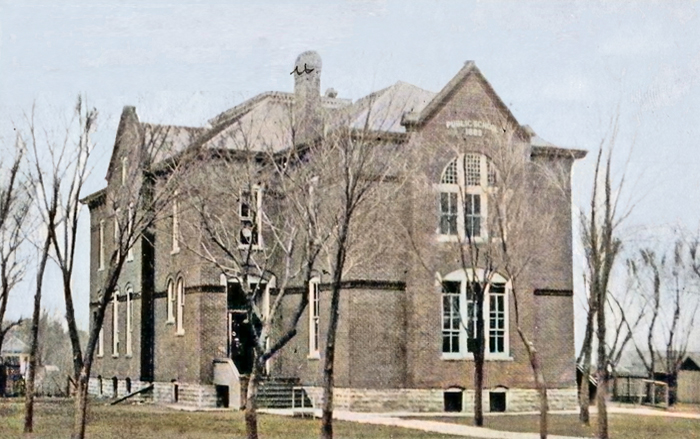
Waverly, Kansas High School, 1913.
A tornado did some damage to the Waverly area in 1905. The Waverly Volunteer Fire Department was organized that year, with J.F. Grennan as the first fire chief.
Ron Senior closed the Waverly skating rink in 1909.
In 1910, Waverly was the second-largest and most important town in Coffey County. At that time, it was at the junction of the Atchison, Topeka & Santa Fe and the Missouri Pacific Railroads, was an excellent trading point, and was the most important shipping point between Burlington and Ottawa. It was a modern town in every respect, having waterworks, electric lights, a public library, banks, and a newspaper. It was an incorporated city of the third class; its schools are among the best, and the churches are ample and substantial. There were also telegraph and express offices, an international money order post office, three rural routes, and the population peaked that year at 751.
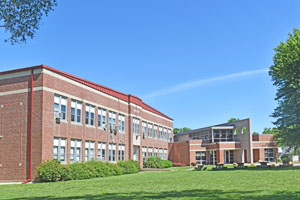
Jr-Sr High School in Waverly, Kansas by Kathy Alexander.
On November 14, 1913, the new Gem Theatre opened in Waverly.
On March 3, 1930, the first talking motion picture was shown at Waverly’s Bailey Theatre.
By 1936, a new high school was built behind the old one.
Then, in 1957, a new grade school was built two blocks west of the high school to accommodate students from the country schools.
After the water tower was found to be providing inadequate services for the town’s water supply, citizens voted to replace it in 1963.
In 1965, the old water tower fell on the Santa Fe Depot, crushing it. The water tower that is standing today was built in 1965.
Waverly unified as a school district with Lebo in 1966. USD #243 Lebo-Waverly district’s office is located on Waverly’s Pierson Street.
One of the town’s annual traditions is the Ohio Days celebration. It got its start in, when the citizens of Waverly decided to host a reunion for Ohio settlers who had made Waverly their home. It was a picnic held at James Grove, 1.5 miles east of Waverly. This heritage is still celebrated annually at the multi-day Ohio Days Festival, usually held every second weekend in July. The festival includes a downtown parade, a dance in the city park, a free breakfast, a church service, and a carnival with games and contests.
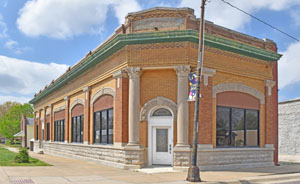
Business building in Waverly, Kansas by Kathy Alexander.
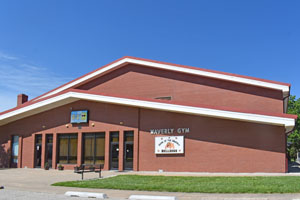
Waverly, Kansas Gymnasium, by Kathy Alexander.
Today, the community is served by Lebo–Waverly USD 243 public school district.
Waverly is located between Ottawa and Emporia, Kansas, on Interstate 35. It is about 18 miles northeast of Burlington, the county seat.
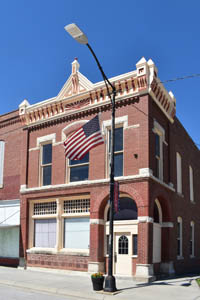
Business building in Waverly, Kansas by Kathy Alexander.
©Kathy Alexander/Legends of Kansas, updated February 2026.
Also See:
Sources:
Blackmar, Frank W.; Kansas: A Cyclopedia of State History, Vol I; Standard Publishing Company, Chicago, IL 1912.
Cutler, William G; History of Kansas; A. T. Andreas, Chicago, IL, 1883.
Coffey County, Kansas
Welcome to Waverly
Wikipedia