
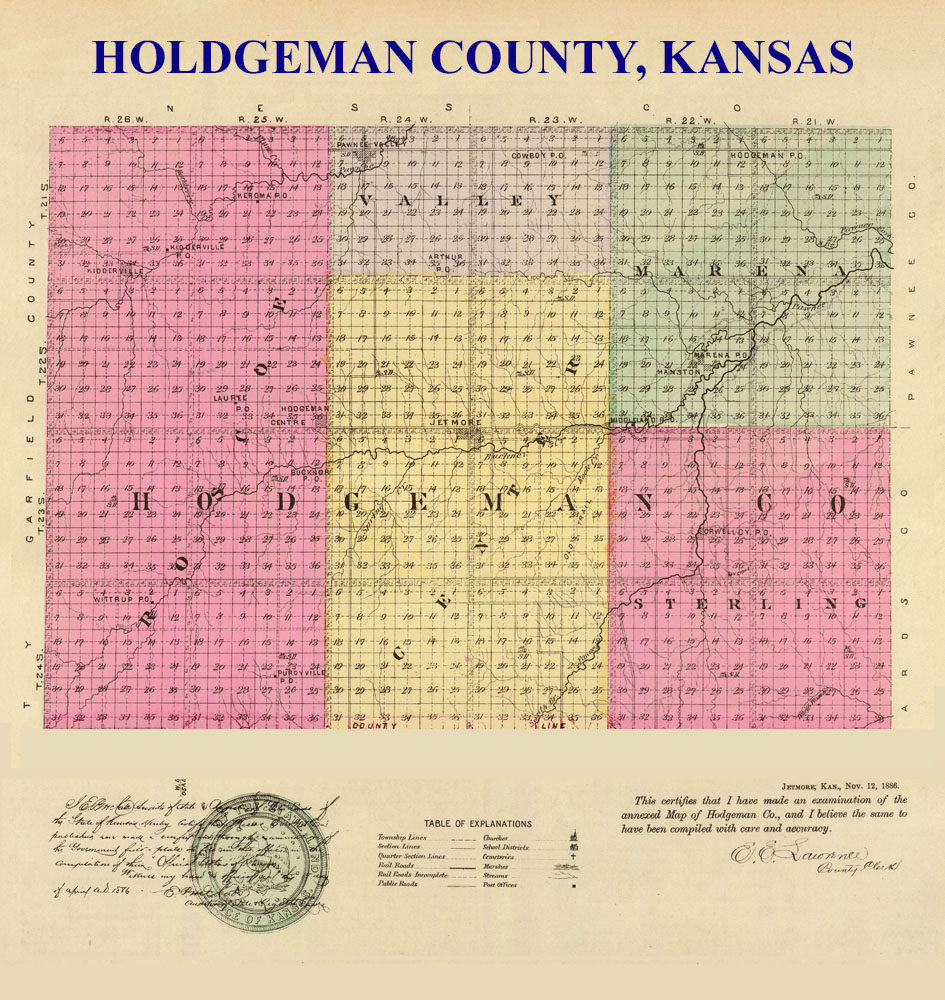
Hodgeman County Map by L.H. Everts & Co., 1887.
Beersheba, Kansas, in Hodgeman County, was the first of seven Jewish agricultural colonies founded in Kansas in the late 19th Century.
In the late summer of 1882, about 60 Jewish immigrants arrived from Russia, supported by the Hebrew Union Agricultural Society, and settled along Pawnee Creek to establish Beersheba. Named for the ancient city of Beersheba, the colony stretched over several sections of land, with each family homesteading 150 acres. They built dugouts and sod houses, along with a synagogue and a school. They dug wells and plowed and planted the native prairie. Cow chips were used for fuel. Within the first few months, a wedding took place, a baby was born, and the first death occurred.
The Beersheba settlers built sod houses, a sod synagogue, and a schoolhouse where children studied during the day and adults at night. Colonists sought books and furniture to supply the school and an American female to teach. By spring 1883, they had more than 200 acres in production, mostly sorghum. Beersheba’s initial success inspired other colonization efforts.
However, the new arrivals found farming difficult because water supplies were unreliable. Like other groups of settlers in the region, they were unprepared for the prairie climate. During their first year, the area suffered a drought. In response, some of the men who might have helped the agricultural colony had little choice but to seek jobs with the railroad in Cimarron, Kansas.
In the end, farming proved unprofitable, and severe winters brought hardships. To supplement their meager incomes, colonists sold their equipment and livestock, took jobs with the railroad, mortgaged their land, and established businesses in nearby Ravanna and Eminence.
By 1886, the community failed partly because the Cincinnati company reclaimed its implements and livestock. By 1890, all of the colonists had abandoned Beersheba.
Other Jewish colonies included Gilead in Comanche County, Hebron in Barber County, Lasker in Clark and Ford Counties, Leeser in Finney County, Montefiore in Pratt County, and Touro in Kearny County. While some Jewish colonies, especially Gilead and Hebron, succeeded, the other settlements were abandoned by the 1890s.
At that time, Ravanna and Eminence were in the middle of a bitter battle for the county seat. After it was determined in 1892 that nearby Garfield County (present-day Hodgeman County) had been illegally organized, those towns were also abandoned, and former Beersheba colonists moved to places like Dodge City, Kansas City, and Wichita. Today, while remnants of the twin towns remain where Garfield County once was, Beersheba has vanished.
©Kathy Alexander/Legends of Kansas, updated September 2026.
Also See:
Sources: