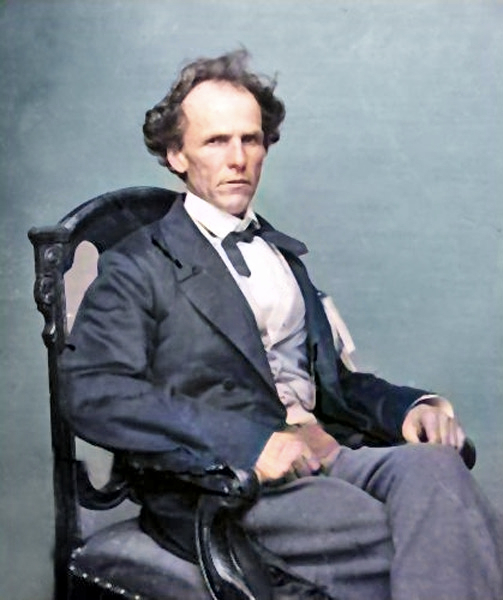
Abolitionist James Lane.
The Lane Trail in Kansas was laid out by abolitionist James Lane in 1856, so Free State immigrants coming to the Kansas Territory could avoid pro-slavery settlements along the Missouri River. Used by the Underground Railroad to assist runaway slaves, this was part of a network of trails with safe houses where they could stay and receive food and shelter. It reached its height of operation after the passage of the Fugitive Slave Act of 1850, making it a federal crime to aid escaping slaves. The trail’s isolation made it an ideal route for the Underground, and the presence of free-state settlers along it guaranteed their safety.
Marked with rock piles that became known as Lane’s chimneys, the trail began in Topeka and continued North through Jackson and Brown Counties (along today’s U.S. Highway 75), ending at the Kansas-Nebraska border. By 1856, its use as an immigrant trail had declined, but its runaway-slave traffic had increased. Because of the secretive nature of the Underground Railroad, it is unclear how many slaves used this route through northeast Kansas.
After the Sacking of Lawrence on May 21, 1856, and the arrest and imprisonment of Free-State leaders, the Free-State cause was in danger of collapse. A national effort to organize aid for Kansas in the North was launched. Kansas Committees were formed in 13 states, as well as a national coordinating group based in Chicago, Illinois. Eli Thayer and other members of the New England Emigrant Aid Society were officers of the national committee.
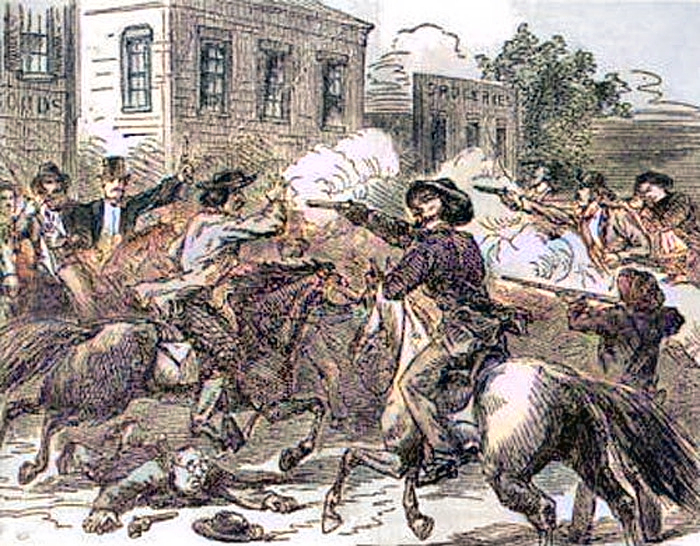
Sacking of Lawrence, Kansas.
James Lane, who was in Washington, D.C., during the Sacking of Lawrence, and other Free-State leaders who were not arrested, spoke at rallies in Chicago, Illinois, Detroit, Michigan, and other cities in the North. Lane’s performance in Chicago, before thousands of sympathizers, inspired contributions and enrollment in the cause. A vanguard group of 78 Free-State emigrants who signed up at the Chicago rally to go to the territory were turned back on June 20 by pro-slavery forces when they reached the border by steamboat via the Missouri River.
This was the beginning of the blockade that forced Free-State emigrants to take an overland route across Iowa, through the Southeast corner of Nebraska, to the northern Kansas border. Starting in early July, James Lane led an initial company of some 200 men across Iowa to Nebraska City, arriving there at the end of July. This is where the ‘trailblazing’ took place and where the terms “Lane’s Expedition”, Lane’s Party”, “Lane’s Army” and “Lane’s Trail” came into use in the press and popular usage. The trail had not been laid out from the Nebraska-Kansas border to Topeka until Dr. J.P. Root and A.A. Jameson, a committee of two sent by the Kansas Central Committee, accomplished the task in the first few weeks of July.
Meanwhile, more emigrant parties from Wisconsin, Illinois, Ohio, and elsewhere, totaling some 400 men, women, and children, followed the route across Iowa, ending up at Tabor, Iowa. Although bona fide settlers, they too were called “Lane’s Army”.
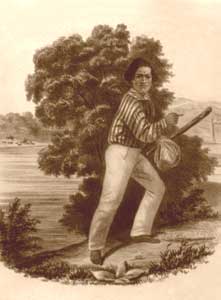
Fugitive Slave
The Smiths and Fullers were two of the armed stations established in 1856 by James Lane. His purpose was to protect Free-State settlers when pro-slavery mobs blockaded the Missouri River ports of entry into Kansas. Lane called for a free state army to assemble in Iowa, cross the Missouri River into Nebraska, and enter Kansas near the mouth of Pony Creek in Brown County.
One group of 300 armed men under James Redpath and an additional 30 men led by Preston B. Plumb responded to the challenge. They met and established a settlement which they named Plymouth.
Fugitives chose from several different routes through Kansas. Many escaping from Missouri made their first stop in Quindaro, in Wyandotte County. This town became an Underground Railroad station around 1857 and remained one until the start of the Civil War. The next stop on the route was often the free-state town of Lawrence. Slaves then made their way to Topeka and turned North. The last leg of the route through Kansas, and the best known, was the Lane Trail.
That year, a group of over a dozen families, connected by blood and marriage, settled at the head of Pony Creek and named their town Albany in honor of the capital of their native New York. Albany was located two miles North of present-day Sabetha, on the eastern edge of Nemaha County.
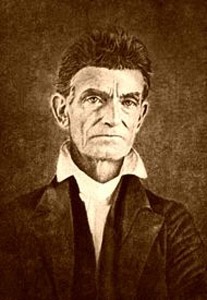
John Brown.
Near here, the towns of Plymouth, three miles South of the Nebraska line, and Lexington, a few miles farther South, were settled. The settlers built log cabins surrounded by earthen-walled forts for protection. A station was established in Lexington, with E.P. Harris identified as the proprietor. Armed with rifles and bolstered by a small cannon at Plymouth, the settlers established an antislavery presence that helped bring “Bleeding Kansas” into the Union as a free state. Today, Plymouth and Lexington exist only in memory.
On at least one occasion, the Lane Trail was used by famous abolitionist John Brown. He arrived at the home of Charles Smith, a haven known to a select few as a stop on the Underground Railroad, very late on a cold January night in 1859. Accompanying him were nearly 30 people — among them were formerly enslaved people who were liberated on a raid into Missouri just a few weeks earlier. Charles provided John Brown and his party with food and shelter that night. This station was only a one-room cabin with few places to sleep, including the bare floor. Brown was offered this chair for the night.
The captain dozed in one of our two chairs by the stove, where he kept a slow fire going.
— Charles Smith
The following morning, the party continued on its way North, probably passing into Nebraska and then Iowa.
After John Brown raided Harper’s Ferry, he was tried before a Virginia court, convicted of treason, and sentenced to be hanged. His execution took place on December 2, 1859
The demand for an Underground Railroad route in Kansas diminished after Kansas was admitted to the Union as a free state in 1861.
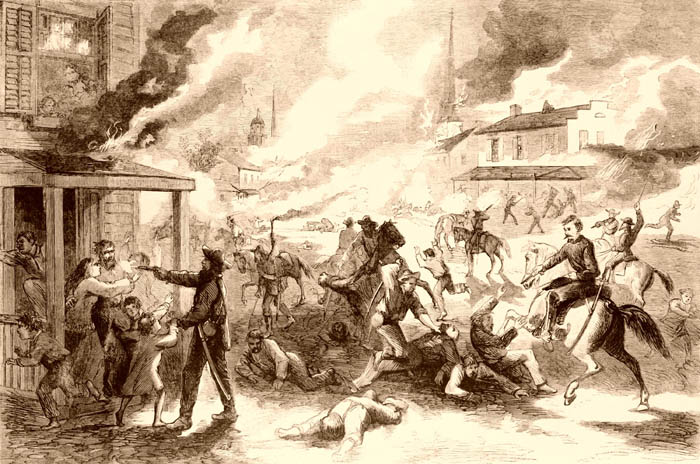
Destruction of Lawrence, Harper’s Weekly, September 5, 1863.
E.P. Harris abandoned his claim and the Lexington Station in 1863, during the Quantrill Massacre in Lawrence. At this point, the trail passed due South, paralleling the West boundary of Brown County to Smith’s Station and then to Fullers. A settlement was established in Calhoun County, at present-day Holton, which later became the county seat of Jackson County. The southern terminus of the trail was Rochester, a hamlet on the Fort Leavenworth-Fort Riley Military Road, North of Topeka.
After the Civil War, some efforts were made to resettle freed slaves in Kansas. The Freedmen’s Bureau played a significant role in this initiative, but the “Exodusters” had little impact on the state. Understandably, many ex-slaves were hesitant to abandon their Southern roots for the promise of 40 acres of unimproved land in a challenging climate and with limited access to financial resources. However, Nicodemus, located in Graham County, Kansas, stands out as a notable exception. This colony achieved a degree of success through hard work and cooperative efforts. In many ways, Nicodemus embodies the ideals that the Free State movement in Kansas aimed to promote.
James Lane became one of the first U.S. Senators from Kansas but died by suicide in 1866.
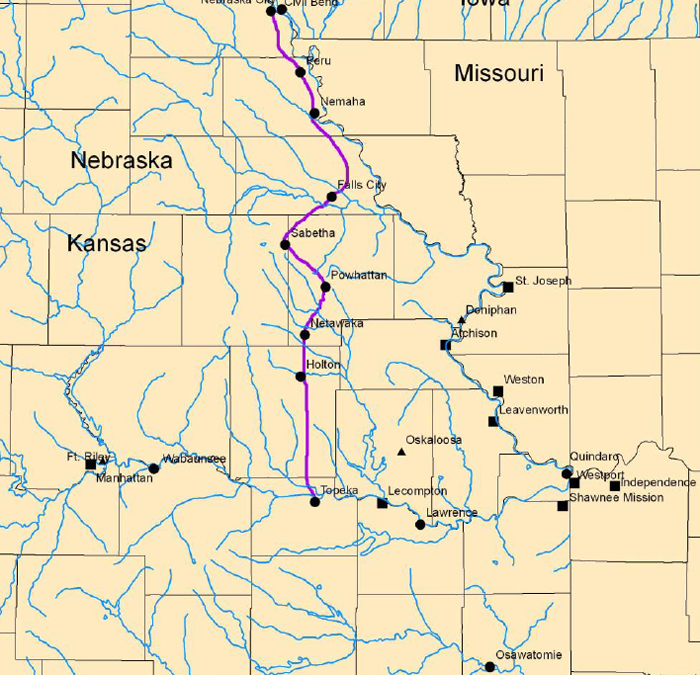
Lane Trail Map.
© Kathy Alexander/Legends of Kansas, updated August 2026.
Also See:
James H. Lane – Grim Leader in the Free-State Fight
Sources:
Historical Marker Database
Kansapedia
Kansas Heritage
Mount Mitchell Prairie