
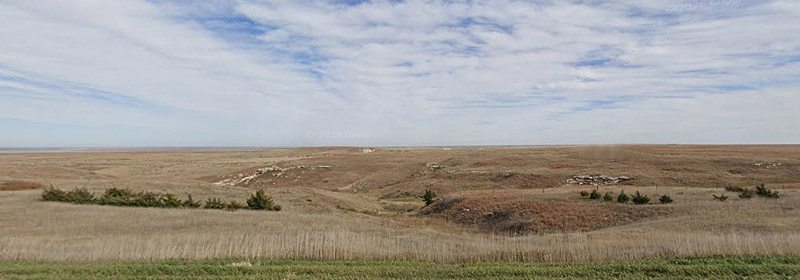
Lane County landscape, courtesy of Google Maps.
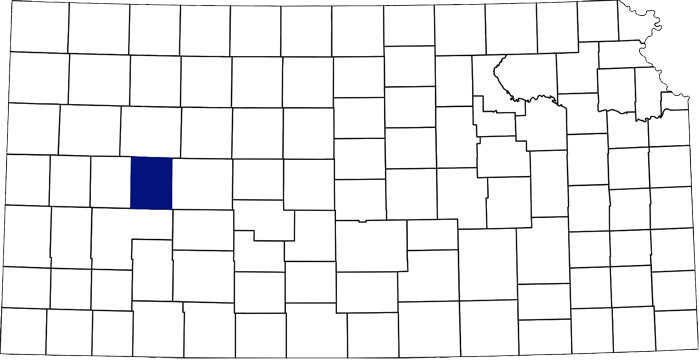
Lane County, Kansas, location.
Towns & Places:
Dighton
Healy
Lane County, Kansas, is located in the western part of the state. Dighton is the county seat and the county’s only incorporated city. As of the 2020 census, the county population was 1,574, making it the third-least populous county in Kansas. The county covers 718 square miles, which includes 717 square miles of land and 0.2 square miles of water.
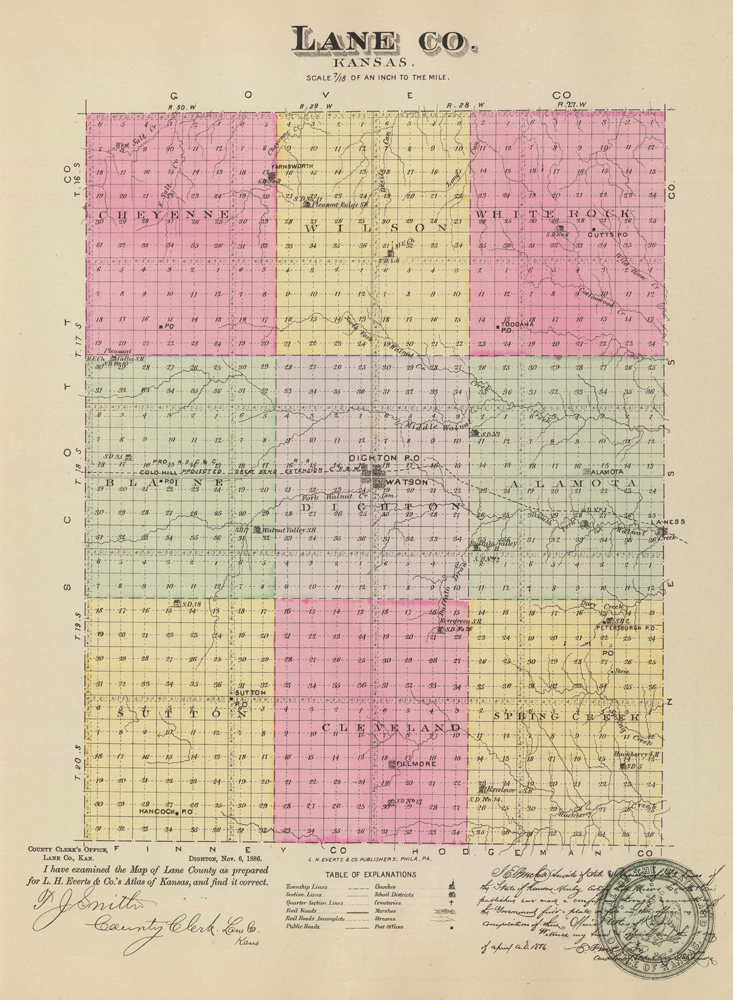
Lane County, Kansas Map, L.H. Everts & Co., 1887.
The first inhabitants of Lane County were buffalo and the Indians. The land was a great grazing ground for the buffalo, and the Indians used its meat for food and its hide for clothing and shelter. Later, when cash was scarce, white settlers used buffalo bones for cash.
In 1872, the Jordan Massacre took place when Richard Jordan and men with him were killed by Indians while traveling through the area. His wife was captured, and despite efforts to look for her, she was never found.
The Legislature created it in 1873 and named it forJames H. Lane, a leader of the Jayhawker abolitionist movement and one of Kansas’s first U.S. senators.
Lane County is the fourth East from Colorado, and the fourth North from Oklahoma. It is bounded on the North by Gove County; on the East by Ness County; on the South by Finney County, and on the West by Scott County.
The county’s general surface is rolling prairie. Bottom lands initially averaged one-half mile in width and comprised about 8% of the area. A few small streams, flowing North and East, have their sources within the county. Little native timber existed, and some artificial plantings were present. White limestone was found in the bluffs, and gypsum was plentiful.
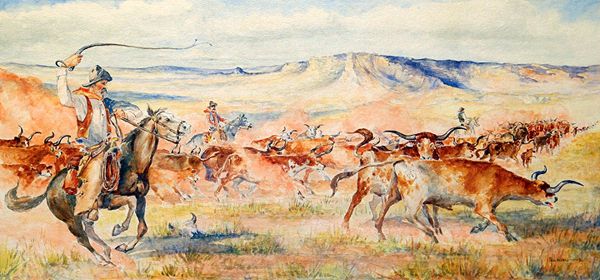
Cattle Trail.
The Great Western Cattle Trail, blazed in 1874, was a significant event in Lane County’s history. Large herds of Texas Longhorns were driven through the county every season. Wild Horse Johnson of Alamota was noted for bringing horses into Lane County from the West. He brought horses in, partially broken, and sold them to settlers and cowboys. Breaking and training these wild horses provided both amusement and entertainment. Cowboys riding wild broncos, roping calves, bull-dogging steers, and riding steers gave both settlers and cowboys enjoyment.
The first settlements were made in 1877 in or near Alamota, where the first post office was established that year. A pioneer character known as “Wild Horse” Johnson was the first postmaster.
The City of Dighton was founded, and the post office was established on March 26, 1879. That year, the first school opened there.
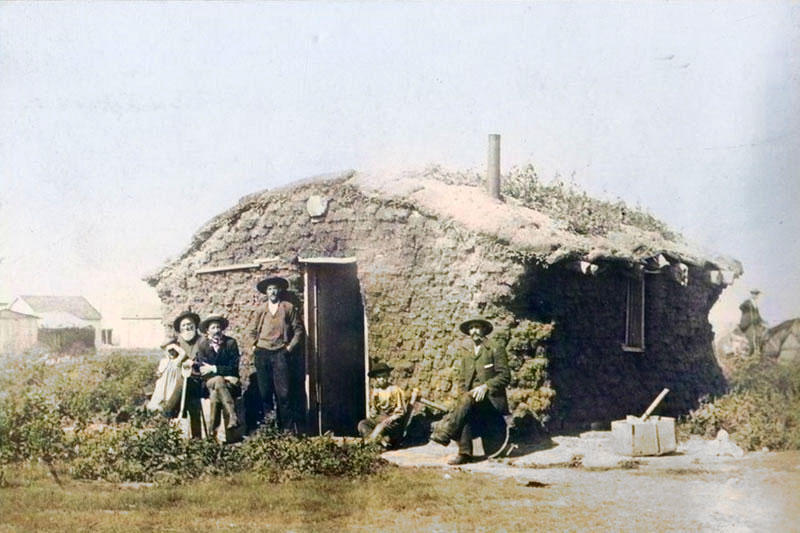
A sod house in Dighton, Kansas.
The first boundary change occurred in 1879, when the county was enlarged by Township 15.
Robert Mitchell established the newspaper Dighton Progress in February 1880.
The first United States census was taken in 1880 and showed a population of 619. At that time, Lane was attached to Ness County for political purposes. Several towns were founded around this time, including Waterloo, founded by R.W. Hey; Gould City, or California, at the county’s geographical center, where the first newspaper was established one month before the Dighton Progress; and Watson.
In 1881, Lane County was diminished on the North by one tier of townships and increased on the South by a strip taken from Buffalo County. In 1883, townships 21 of ranges 27 to 30 were detached; the first two were given to Hodgeman County, and the last two were attached to Finney County.
In 1882, Lane Township had deeded only three sections of land, 1,198 head of cattle, and 2,304 sheep. The real estate and personal property were worth $45,000. Five years later, they had deeded 180 sections of land; the livestock numbered 6,326, half of which were cattle.
In February, 1886, in response to a petition from the residents of Lane County for organization, Governor John Martin appointed G.T. Sutton census taker. His report, made on June 3, showed 2,726 inhabitants, of whom 924 were householders, and $739,843 worth of taxable property, exclusive of railroad property, of which $462,955 was real estate. Dighton was the choice of the majority of the voters for temporary county seat. The governor’s proclamation, made the same day this report was returned, declared Dighton the temporary county seat and appointed the following officers: county clerk, T.J. Smith; county commissioners, Joshua Wheatcraft, J.J. Shaffer, and G.H. Steeley.
The county is divided into nine townships: Alamota, Blaine, Cheyenne, Cleveland, Dighton, Spring Creek, Sutton, White Rock, and Wilson.
Dighton became Lane County’s county seat in 1886, and the first courthouse was erected.
On January 4, 1887, Dighton became an incorporated city named after surveyor Dick Dighton.
During the 1880s, a building boom occurred, driven primarily by speculators from Wichita who loaned money to homesteaders or bought land themselves to support farming growth in the area. More than one quarter section was required for adequate farming, and the economy did not progress until settlers could prove, acquire, and pay for additional acreage.
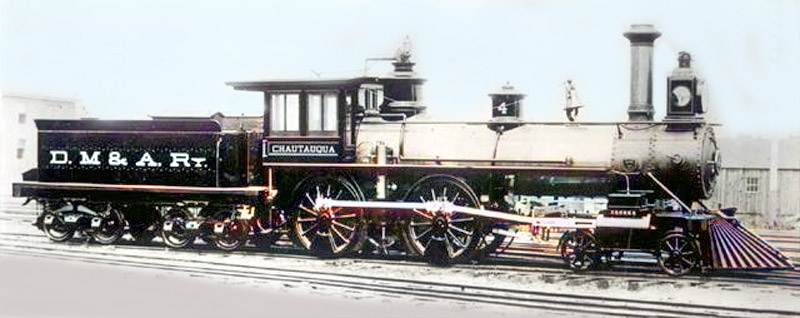
Denver, Memphis & Atlantic Railway
The Denver, Memphis and Atlantic Railroad Company built the first railroad to enter Lane County, Kansas, in early 1887.
After the railroad was built, Dighton reached a population of 2,000, according to the newspapers.
The hard times of 1892-93, which caused great suffering in western Kansas, were especially disastrous for Lane County people. In the Winter of 1893, many farmers, unable to buy coal for fuel, asked Governor Lewelling to supply them from the state mines at Leavenworth. The law did not allow this, but private contributions helped. Ten years later, the whole section had practically recovered from these hardships, land prices in Lane County had gone up, and permanent prosperity had been established.
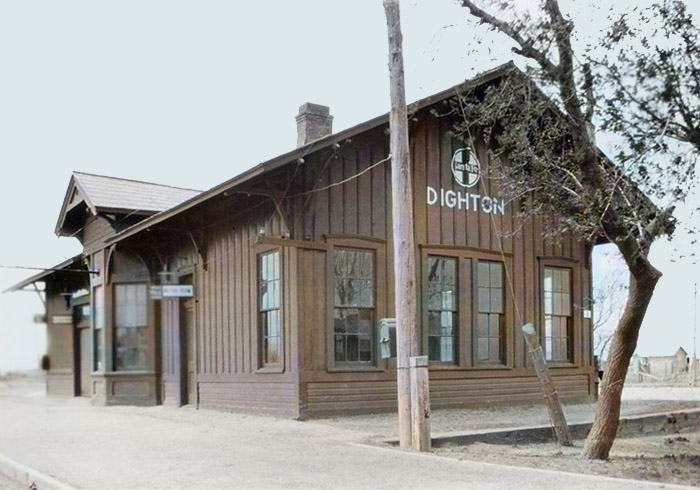
Atchison, Topeka & Santa Fe Railroad depot in Dighton, Kansas.
In 1910, post offices existed in Alamota, Amy, Dighton, Division, Farnsworth, Healy, Lobdell, Pendennis, and Shields. A branch of the Atchison, Topeka & Santa Fe Railroad crossed near the center, almost directly West through Dighton. The Missouri Pacific Railroad entered in the northeast and crossed Southwest into Scott County. The county had 45 organized school districts and one county high school.
The total value of farm products at that time was $691,847, of which $593,327 came from field crops. Wheat was the most valuable crop, amounting to more than $200,000. Sorghum for forage and grain brought $110,000. Corn, oats, barley, and hay were other important crops. There were 13,520 head of livestock. The assessed property value was $6,546,431. The population was 2,603, up nearly 900 from 1900.
Lane County’s population peaked at 3,372 in 1930.
Lane County Courthouse in Dighton, Kansas, by Kathy Alexander.
A new courthouse was erected between 1930 and 1931. Located at 144 South Lane Street and Pearl Street, the four-story, buff-colored brick-and-concrete structure was designed in the Art Deco style by Mann & Company of Hutchinson, Kansas. H.W. Underhill built it. The West-facing building is located on landscaped grounds in the center of Dighton. The building has projecting wings on the Southwest and Northwest. The main entrance on the West side is framed by white stone at the roofline and has three long windows above the entrance. Inside, the County District Court courtroom is on the East side of the third story. The building houses the County District Court of the 24th Judicial District, which includes Edwards County, Hodgeman County, Ness County, Pawnee County, and Rush County.
Southwest Kansas was hit hard by the Dust Bowl and its dust storms, and Lane County was no exception.
The discovery of oil in the 1950s and the continued development of the oil industry have been primary economic factors in the county.
Today, the Colorado Pacific Railroad operates grain transportation and feeder facilities in Dighton, Kansas.
Dighton USD 482 serves the community; it is a public unified school district headquartered in Dighton, Kansas. The district includes Dighton, Alamota, Amy, Pendennis, Shields, and nearby rural areas.
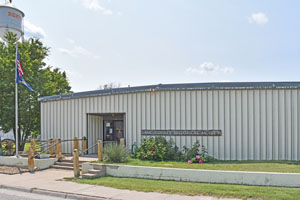
Lane County Museum, in Dighton, Kansas, by Kathy Alexander.
©Kathy Alexander/Legends of Kansas, updated September 2026.
Also See:
Sources:
American Courthouses
Blackmar, Frank W.; Kansas: A Cyclopedia of State History, Vol. I; Standard Publishing Company, Chicago, IL, 1912.
Kansapedia
Kansas Post Office History
Lane County History
Wikipedia