
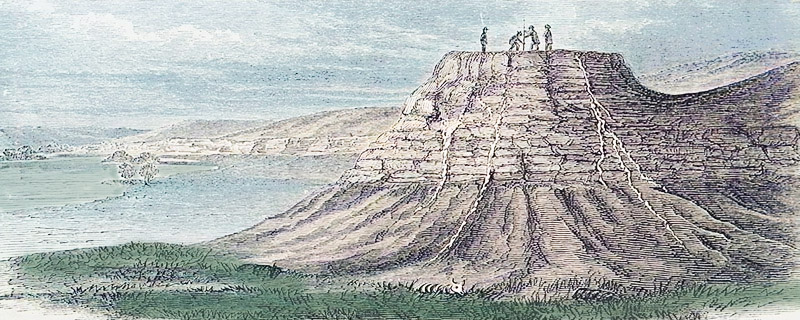
Waconda Spring, Kansas, by William E. Webb, 1873.
Waconda Spring, or Great Spirit Spring, was a natural artesian spring located in Mitchell County, Kansas, near the communities of Glen Elder and Cawker City. It was in Cawker Township in the northwest corner of Mitchell County and was named after the chief god of the Kanza Indians.
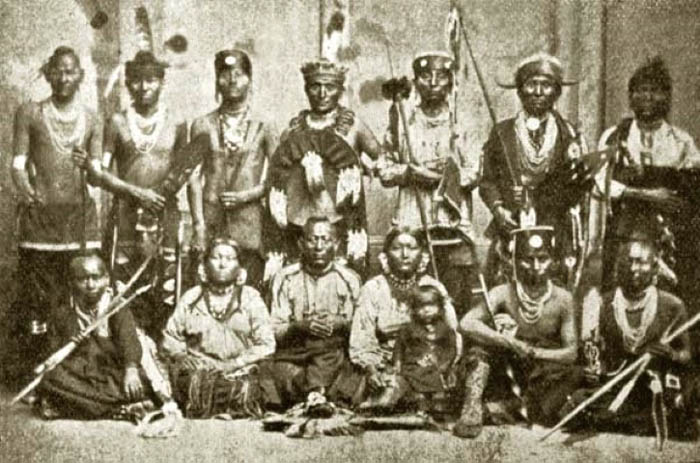
Kanza Indians.
This sacred site for Native American Tribes of the Great Plains was, for a time, a health spa for American settlers.
The name “Waconda” is from the Kanza Indian tribe language and translates as “spirit water” or “Great Spirit Spring.” It was located in territory controlled by the Pawnee Indians, who knew it by the names “Pahowa” and “Kitzawitzuk”, the latter translated as “water on a bank”.
Many Indian tribes visited the site, including the Pawnee, Wichita, Kanza, Kiowa, Sioux, Arapaho, Comanche, Miami, Crow, and others. The Cheyenne and the Arapaho were the last tribes to roam the plains around the Springs and the Solomon River Valley. In this neutral area, all Indian tribes would come to worship the “Great Spirit” on their annual migration with the buffalo herds. They honored the spring, casting articles of value into it as offerings. George Bird Grinnell, an American anthropologist, historian, naturalist, and writer, described the Pawnee offerings as including blankets and robes, blue beads, eagle feathers, and moccasins.
The Indians believed the water to have healing powers. They also believed that the springs contained the spirits of animals, and they visited the site to gain knowledge from these spiritual beings.
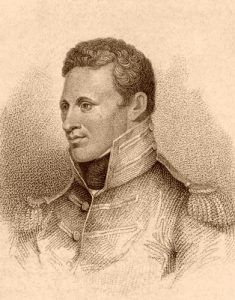
Captain Zebulon Pike.
General Zebulon Pike made the first recorded visit to the site in 1806. During his visit with the Pawnee Indians to conclude a treaty, he learned of what the Indians called the “Great Spirit Spring,” a place where, for generations, Indians had gathered in respect of a Great Spirit. Pike altered his route and visited Waconda Springs on his way to Colorado, where he discovered Pike’s Peak.
During his visit, he learned of what the Indians called the “Great Spirit Spring,” a place where, for generations, Indians had gathered in respect of a Great Spirit. Pike altered his route and visited Waconda Springs on his way to Colorado, where he discovered Pike’s Peak.
In the Pawnee traditional religion, the supreme being Tirawa allotted supernatural powers to certain animals. These animals, called the nahurac, act as Tirawa’s servants and messengers, and intercede for the Pawnee with Tirawa.
A legend tells of the beautiful Waconda who came upon an injured warrior. After a short conversation, they realized they were from enemy tribes, but that did not stop Waconda from nursing him back to health. The warrior’s name was Takota, the son of the opposing chief. Eventually, he regained his strength and went to Waconda’s father to ask for her hand in marriage. This led to harsh words, and the forbidden relationship led to a battle, during which Takota was fatally shot and fell into the springs. Heartbroken, Waconda followed her lover into the waters and never resurfaced.
Waconda Spring was situated on the bank of the Solomon River, below its North and South Forks. Water from the spring had deposited a large mound of travertine around it. Its pool basin was set in a 300-foot-wide mound rising 40 feet above the surrounding Solomon River Valley. The spring’s pool was 50 feet in diameter and 15 feet deep, though a myth claimed the pool was bottomless.
A geoglyph, produced by the intaglio technique of removing surface sod to form a figure, lies on a hillside about two miles Southwest of Waconda Spring. The figure represents an unidentified animal, possibly a beaver. It is thought to be several hundred years old; soil analysis indicates it was renewed at least once after its initial excavation, suggesting it was used over an extended period.
Settlement in the area did not take place until after Kansas became a state in 1861. The first settler in the region was a man named Pfeiffer, who took out a claim on the property in 1870. Kansas Senator Samuel C. Pomeroy toured the region that year and marveled at what he saw, stating:
“At first I declared it the Crater of an Ancient Volcano. The Water occupying its hollow center is fathomless, and about 200 feet in diameter in a perfect circle! It is always brimming full and running over on all sides… The hills about it were as sacred to the Indians as those about Jerusalem.”
Pomeroy recognized the site’s commercial potential and predicted that a health resort would soon be built in the region.
In 1866, surveyor David E. Ballard described it:
“The Spring itself is a natural curiosity, it being located on the summit of a cone-shaped limestone rock. The rock is circular, about 200 feet in diameter at the base and about 30 feet high; upon the summit of this rests the spring, the basin being circular and about 30 feet in diameter. Its outlet is a trough apparently formed by the water’s action on the rock. The water in the spring is about 20 feet deep and exceedingly strong with salt.”
The water contained calcium, magnesium, iron, silica, sodium chloride, sulfate, and bicarbonate. Geologists thought the mound formed from mineral deposits forced up by artesian pressure in the water.
The last great pilgrimage of the Indians to the “Great Spirit Springs” was in the early 1870s.
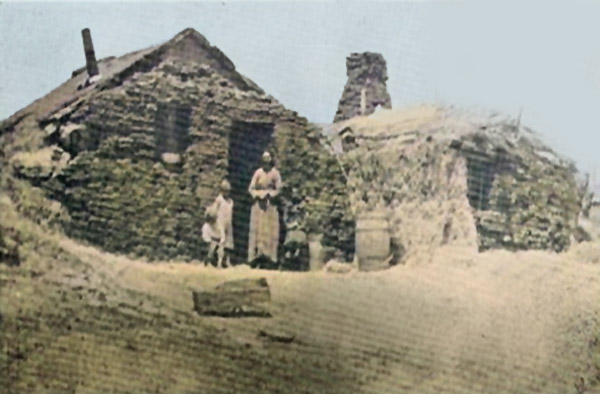
Sod house at Waconda Spring, Kansas.
The first permanent habitation at the Springs was a sod house built in 1870 by a man named Pfeifer, who took out the first claim on the property. A few years later, a man named Burnham established a bottling works on the site and began selling and distributing Waconda Flier, a mineral water he marketed as a health tonic.
Waconda Flier sales piqued the interest of an eastern investor named McWilliams, who in 1884 invested in the site and began constructing a stone sanitarium. He then fenced it off and privatized it. The building was completed ten years later, under the management of G.W. Cooper, and became a hotel and health spa. During this time, Waconda Flier’s distribution extended to all parts of the country.
In 1904, Waconda Flier won a medal for its superior medicinal qualities at the St. Louis World’s Fair.
In 1906, Dr. G.P. Abrahams, who had operated a bathhouse at Mankato, Kansas, purchased the property from McWilliams. Abrahams was well acquainted with the extraordinary qualities and advantages of the Great Spirit Spring, and moved his family to the Spring in November of the same year.
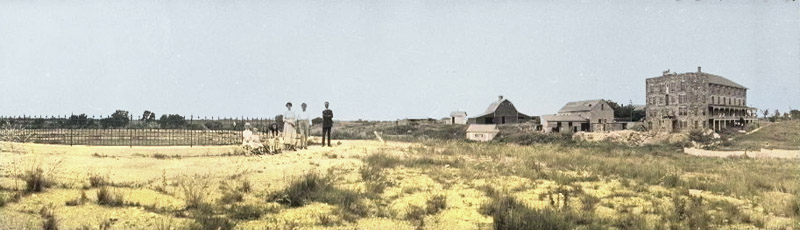
Waconda Spring, Kansas, 1921.
A post office was established on April 23, 1908.
In 1910, Waconda Spring was on the Missouri Pacific Railroad, at the junction of the two forks of the Solomon River, 20 miles West of Beloit, the county seat, and about two miles West of Cawker City, from which place it received mail. The population in 1910 was 32.
G.P. Abrahams continued operating the health spa and bottling plant until he died in 1924. The property then passed to Carl Bingesser, who had married Abrahams’ daughter Anna in 1907. The spa then passed to Carlos Bingesser, the third generation of the Abrahams-Bingesser family to own and operate it. Under both the Abrahams and Bingesser families, the hotel resort was improved and maintained a solid reputation as a health spa and place of healing.
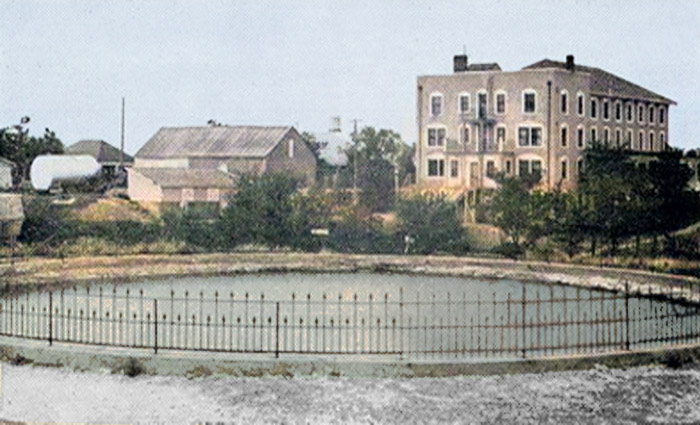
Waconda Spring in Mitchell County, Kansas.
Over the years, the facilities offered physical and hydrotherapy, electric therapy, and dietary regimens. Water from the Spring was piped into every bathtub in the 60-room sanitarium. They used it in a program of internal and external body cleansing. Dr. Carlos used the slogan “It will clean your works until your works work.” The scenic beauty, historical connections, and health interest attracted hundreds of people to the Springs annually.
Meanwhile, the Bureau of Reclamation and the Army Corps of Engineers announced plans for a large earthen dam on the Solomon River near the town of Glen Elder in 1944. The plan called for flooding Waconda Spring. The Bingesser family fought the proposed dam, even hiring a hydrologist who verified the site’s uniqueness. Dam supporters dismissed the findings and called the springs a “mud hole.”
Dr. Bingesser and others fought the Bureau of Reclamation and the Army Corps of Engineers to stop the project.
However, in 1951, heavy rainfall in Kansas caused massive flooding in Topeka, Lawrence, Kansas City, and other Kansas towns. This led to renewed calls for dams and other flood control projects, including the Glen Elder Dam. A hydrologist was brought in to inspect Waconda Spring and concluded it was unique and possibly the only spring like it in the world. However, commercial advocates for the dam dismissed the hydrologist and claimed Waconda Spring was nothing more than a “mud hole.”
On July 15, 1955, the post office was discontinued. Most of the buildings were later moved to Cawker City.
Construction of the dam began in 1964, and that year, the spa closed.
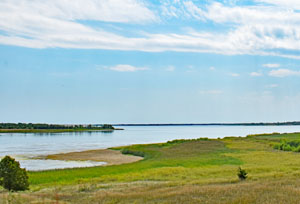
Waconda Lake at Glen Elder, Kansas.
The dam was completed in December 1968. Engineers bulldozed the hotel and health spa, then dumped the debris into the Waconda Spring pool. Before long, the mineral spring disappeared beneath the waters of Waconda Reservoir.
Water from the Solomon River began filling up the valley, and by 1970 it was full.
Today, the Waconda Springs Replica at Glen Elder State Park pays tribute to a former spring. A short hike takes visitors to the top of the scenic bluff. It is located just West of the historic Hopewell Church. Educational signage provides information on Native American History and time periods, explorers, the Waconda Springs Health Resort, and the building of the Glen Elder Dam. Waconda Visitor and Education Center, a small museum, is also in the State Park.
©Kathy Alexander/Legends of Kansas, updated September 2026.
Also See:
Extinct Towns of Mitchell County
Sources:
Blackmar, Frank W.; Kansas: A Cyclopedia of State History, Vol I; Standard Publishing Company, Chicago, IL 1912.
Directory of Mitchell County, Kansas, The Western Call, Beloit, Kansas, 1899.
Glenelder Kansas
Historic Marker Database
Humanities Kansas
Waconda Cultural Association
Wikipedia