
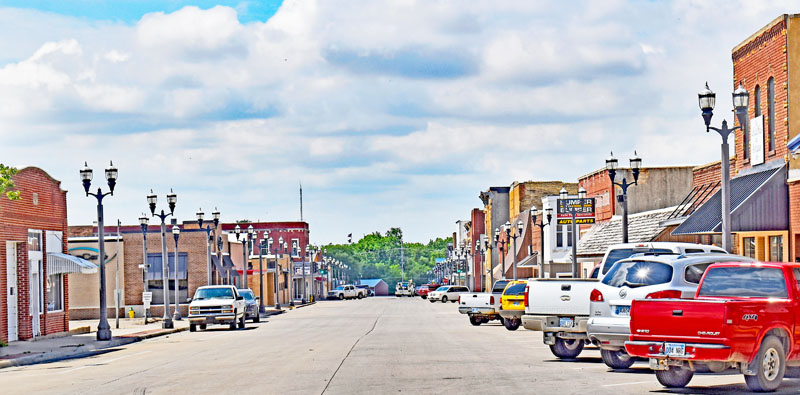
Beloit, Kansas, business district by Kathy Alexander.
Beloit, Kansas, is a city and the county seat of Mitchell County. As of the 2020 census, its population was 3,404, and it had a total area of 4.05 square miles, of which 4.02 square miles is land and 0.03 square miles is water. It is located northeast of the county’s center on the Solomon River.
The community was first called Willow Springs, after the fresh water springs surrounded by willows on the North bank of the Solomon River. The springs served those located here, as well as hunters, emigrants, and freighters passing through, until the mid-1870s.
The townsite was first settled by Aaron A. Bell, who came from Williamson County, Illinois, by an ox-drawn covered wagon, arriving in April 1866. He put up the first home on the townsite, a log cabin. He soon began to improve the water power.
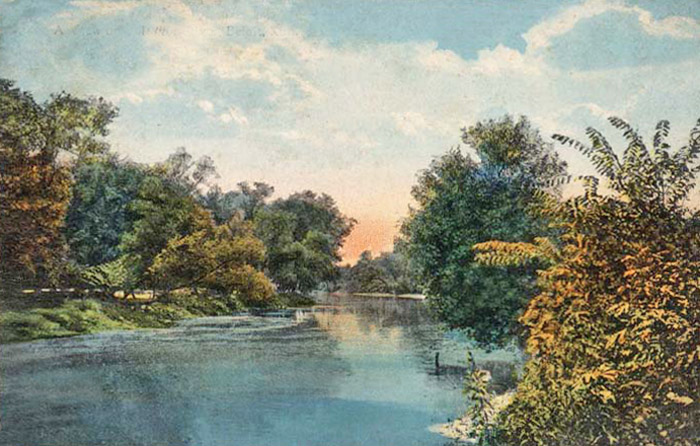
Solomon River in Beloit, Kansas.
In 1869, Tim Hersey purchased part of Bell’s land. Bell retained the plot West of a north-south draw which probably closely paralleled Bell Street, and Hersey took the land East of the draw. Hersey began cutting timber to dam the river and build a mill in the fall of that year. It became the largest and most complete flouring mill in this part of the state.
Tim Hersey renamed the town Beloit after his hometown, Beloit, Wisconsin.
A post office was established on May 16, 1870, with Aaron A. Bell as the postmaster.
L.D. Williams, who had served during the Civil War in Company F, 37th Illinois Infantry, arrived in Beloit in the fall of 1870 and built the city’s first business structure. In this two-story native limestone building, he opened a merchandise business in partnership with James Finnegan.
F. Charlesworth, born in England, came to Kansas in March, 1857, and took an active part in favor of a Free State effort. He moved his family to Beloit in the fall of 1870. He served one term as City Councilman, and one term as County Commissioner. A dealer in agricultural implements, he was elected to the Legislature in 1880, and again in 1882.
After Mitchell County’s organization was effected in 1870, Beloit was selected as county seat. A courthouse building was needed at once, and T.F. Hersey built one in 1871 and presented it to the county. The building cost about $4,000, and was amply sufficient for the county at that time. The county built a jail shortly after, at an expense of $800.
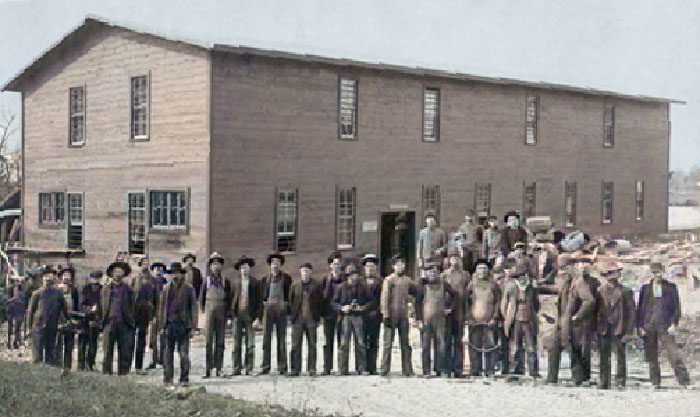
Sawmill in Beloit, Kansas.
Despite heavy floods, Tim Hersey put a sawmill in operation in September 1870. He built a grist mill in 1871.
The first school was built in 1871. Reverend O.N. Fletcher was secured as a teacher that year, his salary raised by subscription. It was the first school in the county. Fletcher also held religious meetings in the neighborhood, and was instrumental in organizing the Baptist Church in this city.
The first newspaper in Mitchell County was the Mirror, with its first issue published on April 5, 1871, by A.B. Cornell. After a few months of earnest hard work, the Mirror was suspended, and Cornell removed to Russell County.
The first church congregation organized in Beloit was by the Baptists in the summer of 1871, with the Reverend George Balcom as minister. On one occasion, Reverend Balcom strode into one of the saloons on Mill Street, took the violin from the hands of the establishment’s musician, walked behind the bar, and held the audience’s attention for an hour by singing, playing, and preaching.
F.W. Barrett, a liveryman, was born in Westminster, Vermont, and moved to Beloit in 1871, where he engaged in the sewing machine business and loaned money. He also ran a feed, breeding, and exchange stable. A few years later, he married and had a family.
Tim Hersey’s family followed him to Beloit in 1872. That year, Alver Cooper surveyed Beloit, and the plat was filed with the Register of Deeds on March 26, 1872.
Henry Case, a merchandiser born in New York, came to Beloit with his family on April 16, 1872, and engaged in general merchandising. He built a building and did a good business.
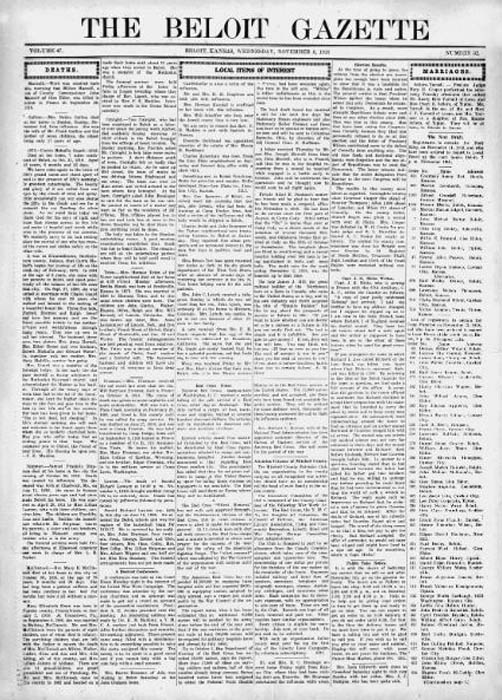
Gazette Newspaper in Beloit, Kansas.
About a year after the birth of the Mirror, J.J. Johnson and A.B. Chaffee commenced the publication of the Gazette, the first issue appearing on April 11, 1872. On June 25, Johnson became the sole proprietor. He continued the publication of the Gazette alone until September 3, 1874, when his brother, W.H. Johnson, purchased a half interest in the business, and remained with it until the following April, when J. J. Johnson resumed complete proprietorship.
The town grew very rapidly, and in July 1872, it was incorporated as a city of the third class.
The Presbyterian Church was organized March 17, 1872, by Reverend Charles Higgins, pastor.
Tim Hersey was chosen Beloit’s first Mayor at the initial election and served from August, 1872 to May, 1873. At the first Council Meeting on August 21, 1872, Lew J. Best was appointed City Clerk, and the duly-elected Councilmen were qualified for office. Beloit’s first Councilmen were W.C. Ingram, M.R. Mudge, H.H. Lyon, Joseph Baughman and Joseph R. Vaughn.
Beloit’s first regularly appointed teacher was W.A. Reeder, later a congressman, who taught in the fall and winter of 1872-1873.
The city’s first school district, the second one organized in the county, voted $5,000 in bonds in 1872 for a building. Work started on schedule, and the first story was completed in 1873.
That year, an iron bridge was built across the Solomon River for $10,000.
In 1873, F.H. Hart came to this city and erected a stone building on Main Street, where he started a banking business. This business increased every year, and he has twice added to the size of his building. Mr. Hart also bought an interest in the town company, and did much toward improving and building up the town. On East Main Street he built one of the most elegant private residences in the western part of the State.
The Methodists organized the next church. The church building is of stone, was erected in 1874, valued at $2,000.
J.F. Cooper, a druggist, born in Illinois, moved his family to Beloit, settling on a ranch and dealing with cattle. He established a drug store in 1874; was elected County Treasurer of Mitchell County in 1876, and re-elected in 1878.
During the first week of December in 1874, G.W. McBride, of Iowa, arrived in Beloit with new material, and began the publication of the Beloit Index. It survived for only three months due to the grasshopper plague, when its editor returned to his native State.
In 1875, the Baptists built a handsome church on the corner of Campbell Avenue and Second Street, for $4,000.
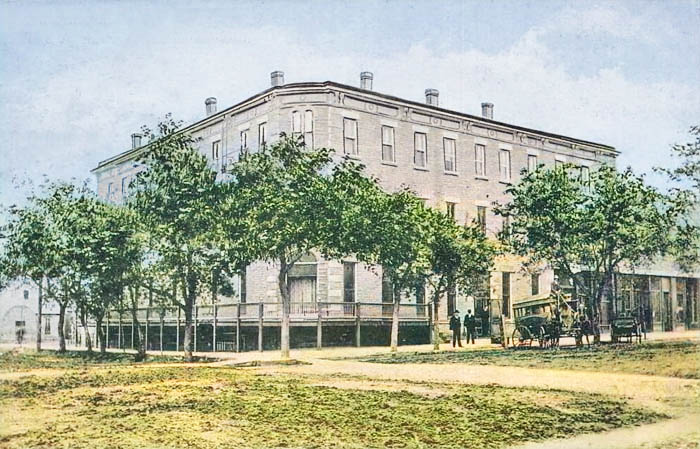
Avenue House in Beloit, Kansas.
Beloit had two large three-story hotels. The Avenue House was built in 1875 by Frank McGrath and H. Bramwell on the corner of Main Street and Hersey Avenue. It was a stone building three stories above a well-finished basement, and the roomiest house in the county. The Reeder House, made of wood, was on the corner of Hersey Avenue and Court Street. It was built by W.A. Reeder and managed by him. Both houses are very popular and are a credit to the town and county. Several smaller hotels were also kept busy.
On February 11, 1876, J.J. Johnson sold the Gazette to an early settler of Solomon Rapids Township, G.W. Anderson, who in turn sold it to Brewster Cameron. Anderson removed to Lincoln County.
G.T. Finnell, a hardware merchant, born in Virginia, came to Beloit with his family in the fall of 1876, and erected a building for the hardware business, measuring 25 by 102 feet,
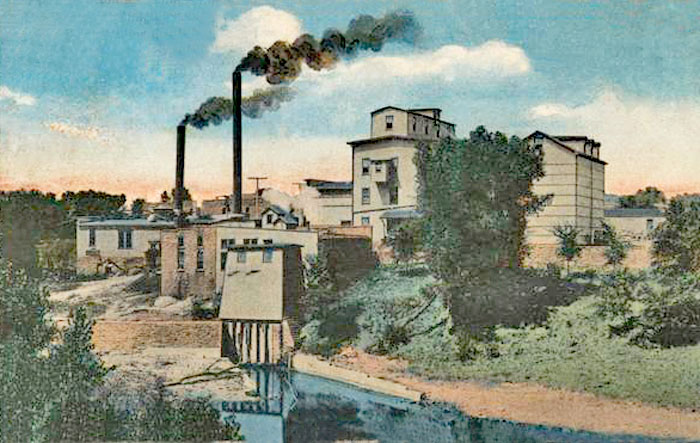
Beloit, Kansas Milling Company.
The Catholic Church, known as St. John’s Congregation of Beloit, was organized by Reverend Henry Temphans in 1876. In 1878, their church, which is the largest in the county, was completed. The church property was valued at $5,000.
James M. Brown, from Pennsylvania, who had been engaged in farming and the mercantile business, came to Beloit with his family in 1877, where he was engaged in farming and the hotel business.
The Beloit Record, a real estate monthly, was issued on February 15, 1877. In August of the same year, it was made a weekly and shortly passed into the hands of the junior partner, Mark J. Kelley, who bought the interest of G. Webb Bertram. Kelley conducted the paper for a few months, and then sold it to W.H. Caldwell, who changed the name to the Courier.
Derby & Puffenburger built a stone building in 1878 for foundry purposes, and until 1882 were engaged in the manufacture of every variety of castings, many of the handsome iron fronts in the Western towns bearing their mark. In March, 1882, they sold the business to S.H. Smith, who soon employed several hands and continued the business.
Marble Works was conducted by R.F. Wilcox, a practical marble-cutter, who employed several hands in the shop, and men and teams constantly on the road. The value of the manufactured goods which left his factory during the past year reaches well up into the thousands. The business was established in 1878, and grew steadily.
S.H. Callender, an attorney born in Wisconsin, came to Beloit in 1878. He was elected City Attorney in the spring of 1880.
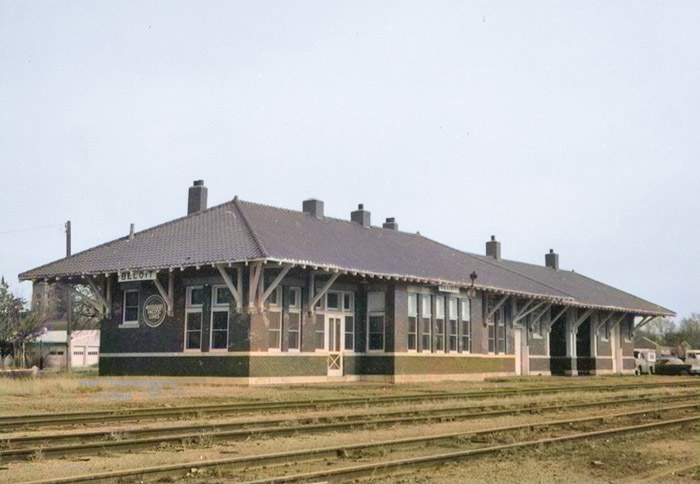
Missouri Pacific Railroad depot in Beloit, Kansas.
Dr. Edmund D. Converse, a physician born in Princeton, Illinois, came to Beloit in March 1880 and established a practice. He soon became the county physician, as well as a physician and surgeon for the Missouri Pacific Railroad Company.
J.S. Goodwin, an attorney initially from Indiana, came to Beloit on September 27, 1878, and began the practice of law. He was married in October 1880 and was elected judge pro tem of the District Court of Mitchell County in the fall of 1882.
On October 1, 1878, the Western Democrat was started by J.B. Chapman, who had just arrived from Tama City, Iowa. He made the Democrat a success, and on October 14, 1881, sold it to F.W. Hiddleson, who changed its name and politics. It was then called the Western Nationalist, and advocated the principles of the Greenback Party.
A Presbyterian Church building committee was appointed to build the church on Main Street. It was one of the most elegant houses of worship in the county, valued at about $5,000. It was dedicated December 1, 1878.
The first railroads, from Atchison and Solomon, reached Beloit between 1878 and 1879.
On March 10, 1879, Governor John P. St. John proclaimed Beloit a city of the second class.
S.G. Barton, a land and loan agent, was born in New York and moved to Beloit in March of 1879. The next year he married Miss Kate E. Bonren; they had one child.
Dr. Willis C. Glidden, a Homeopathic physician and surgeon, from New York, came to Beloit in 1879 and began the practice of his profession.
M.S. Atwood, originally from New York, moved his family to Beloit in November, 1878. On May 1, 1879, he established himself in the banking business, opposite the courthouse on Court Street.
Charles N. Fowler, a member of the law firm of Holt & Fowler, was born in Illinois, arrived in Beloit in January, 1879, and established his practice. He was married in 1879 and had a child.
The Library and Historical Association was chartered on September 4, 1879, with 20 members, who subscribed $25 each. Among the donations was a fund of about $50. Dexter L. Ruggles was the first librarian. It contained about 800 volumes, valued at $1,000, and was located on the corner of Main and Mill Streets.
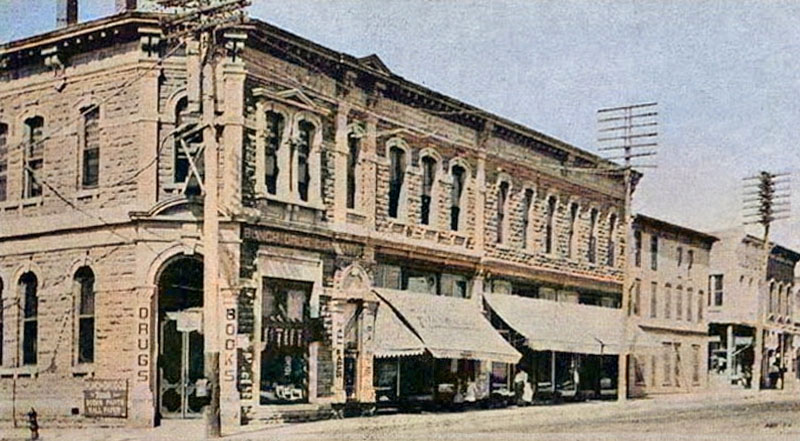
Main and Mill Street buildings in Beloit, Kansas.
In 1880, the Bank of Beloit built an elegant two-story bank building on the corner of Mill and Main Streets. A.N. Schuster was president; H.T. Walker, vice-president; and J.W. Walker, cashier. It had a capital of $50,000. They also had branch banks in adjoining counties.
The city’s first water “system”, consisting of a windmill and a storage tank, was installed in 1881 for $136.
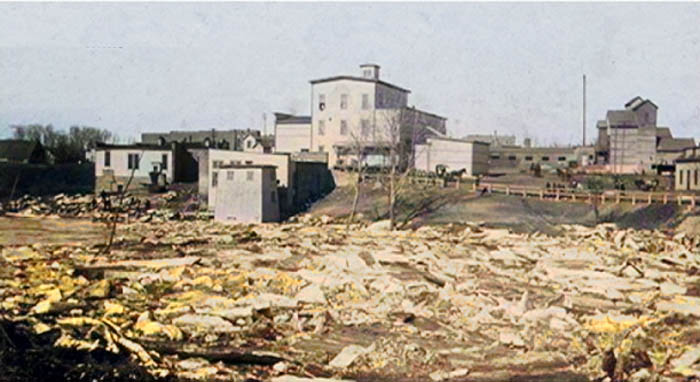
Electric plant in Beloit, Kansas.
By the early 1880s, the Beloit flour mill was owned by Vreeland & Sheldon, and valued at $25,000. The mill was a four-storied frame building. The engine house was 60 feet North of the mill and contained an engine of 80 horse-power, which united with the water power on the south side and operated two roller mills and seven runs of stone. The flour manufactured had a good reputation and found ready sale all over the State.
S.H. Fullerton, a lumber merchant born in Ireland, came to Beloit in the 1880s and engaged in the lumber business. He soon had an interest in 17 different lumber yards in Kansas, holding the position of general manager. The firm was named the Chicago Lumbering Company.
By 1883, Williams had erected about 10 buildings in Beloit.
Bonds totaling $26,000 were issued in 1886 to pay for a steam-driven electric power generating plant and a stone water tower for a municipal light and water system.
The Kansas Industrial School for Girls was established on February 1, 1888, in Beloit, by the Women’s Christian Temperance Union. The State of Kansas took over the operations in 1889. The school housed young women and girls labeled “incorrigible” or “delinquent” for minor issues like truancy, running away, or petty theft.
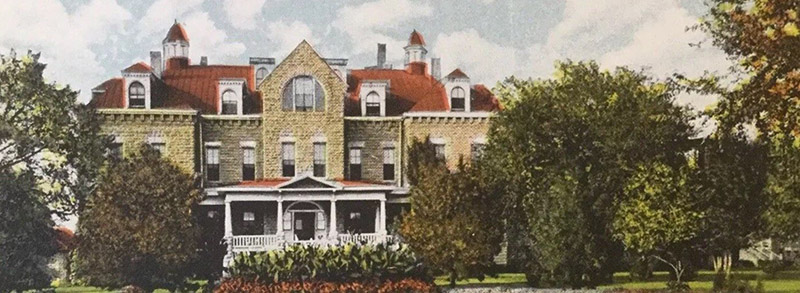
Kansas State Industrial School For Girls in Beloit, Kansas – Main Building
The first steps toward providing Beloit with a city building were taken at the June 15, 1897 meeting of the Mayor and Council. A committee was appointed on July 6, 1897. A one-story structure measuring 50 by 86 feet was decided on. However, the dimensions were later changed to 50 by 40 feet. The building was a two-story native limestone structure that cost about $3,000. It was completed in 1898. It is believed that excessive fines, assessed frequently against the city’s many saloons, raised the needed money.
By 1898, the population was around 2,500. At that time, Beloit was at the junction of the Union Pacific Railroad and the Missouri Pacific Railroad.
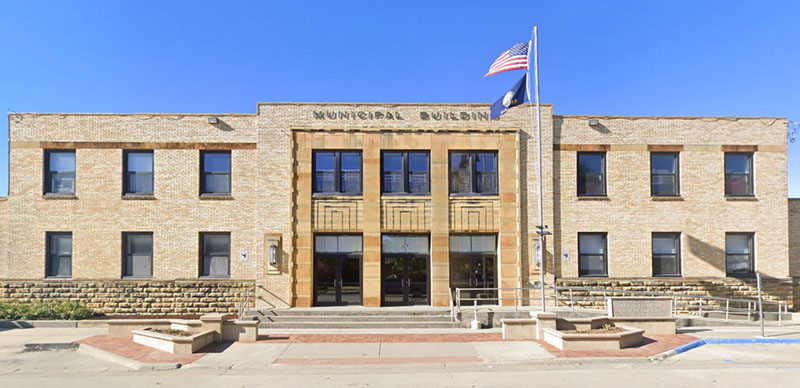
Beloit, Kansas City Hall, courtesy of Google Maps.
When Monsignor Michael Heitz was appointed pastor of St. John’s Catholic Church in 1898, he found a small stone church with bulging walls held together by a steel rod. Within a year after his arrival, he announced plans for a new church to serve the needs of the congregation and to prepare for future growth. Joseph Marshall, a Topeka, Kansas, architect, was hired to bring Monsignor Heitz’s dream of a church, modeled after the Romanesque Church of St. Richard in his native France, to reality.
After being appointed pastor of St. John’s Catholic Church in 1898, he discovered a small stone church with bulging walls held together by a steel rod. Within a year of his arrival, he announced plans to build a new church to serve the congregation better and accommodate future growth. He hired Joseph Marshall, an architect from Topeka, Kansas, to help turn Monsignor Heitz’s vision into reality. The new church was to be modeled after the Romanesque Church of St. Richard in Monsignor Heitz’s native France.
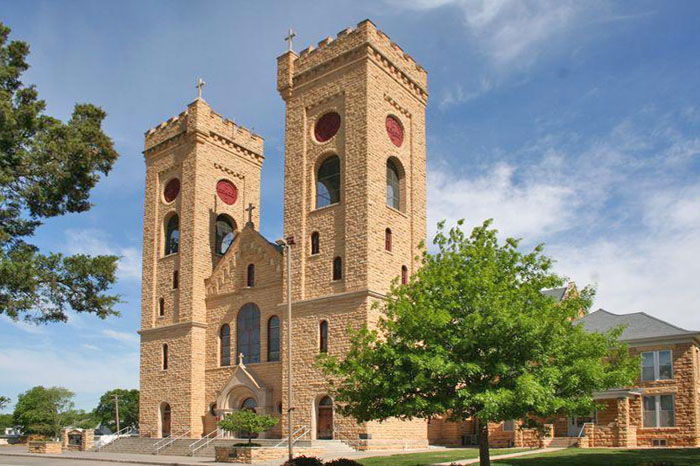
St. John The Baptist Catholic Church in Beloit, Kansas.
Architect Joseph Marshall designed the church. All segments of the parish were enlisted for participation in the mammoth construction project, which extended over a period of four years. Work began on the foundation, built around the old church, in early October 1900, with Bishop John F. Cunningham of Concordia blessing the site and laying the cornerstone on June 4, 1901.
Completed in 1904, the church was built around the old church in the form of a Latin cross. It was, at the time, the largest church West of the Mississippi River. In 1975, the church was placed on the National Register of Historic Places. St. John’s Catholic Church is located at 701 E Court in Beloit, Kansas.
In the meantime, the second and present courthouse was constructed from 1901 to 1902 for $38,310. The Richardsonian Romanesque building was designed by J.C. Holland and Company of Topeka, Kansas, and built by Cuthbert & Sargent of Topeka. This building continues to be utilized today. It was listed on the National Register of Historic Places in 1977.
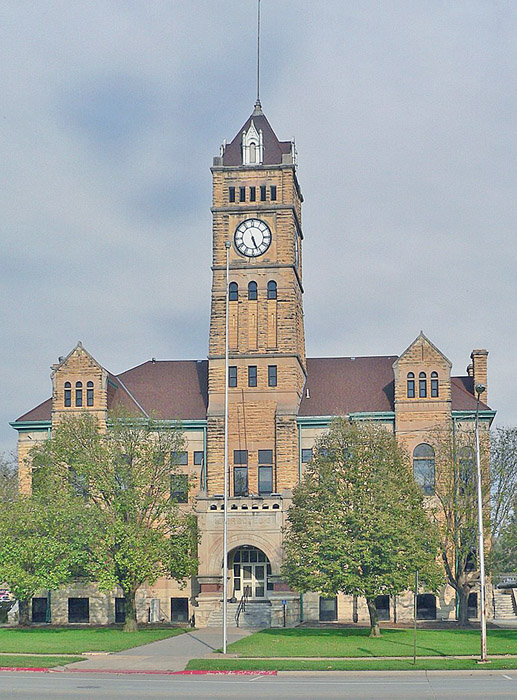
Mitchell County Courthouse in Beloit, Kansas, courtesy Wikipedia.
In 1910, Beloit was the largest town in Mitchell County and was at the junction of the Union Pacific and the Missouri Pacific Railroad. At that time, it had an electric light plant, water works, a public library, an opera house, two daily and three weekly newspapers, three banks, and all lines of business activity. The state industrial school for girls was located here. The city was also supplied with telegraph and express offices, an international money order post office with 8 rural routes, and a population of 3,082.
Lula Coyner ran the Kansas State Industrial School for Girls in the 1930s. Known to be cruel, Coyner sent girls 175 miles away for forced sterilizations. She also recommended girls with “serious physical or family handicaps,” including venereal diseases, insanity, epilepsy, and illegitimacy, for the procedure. After she was replaced, conditions improved. Staff from the Menninger Clinic in Topeka, who trained at the school, helped residents receive therapy to help them cope with trauma.
Beloit’s population peaked in 1980 at 4,367.
In August 2009, the Kansas Industrial School for Girls closed after 121 years of operation. The final remaining residents were transferred to a facility in Topeka, closing the historic campus. In 2010, property ownership transferred back to the city of Beloit.
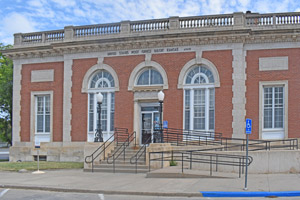
Today, the community is served by the Beloit USD 273 public school district, which has two of its three schools: Beloit Elementary School and Beloit Junior/Senior High School.
Beloit is also home to St. John’s Catholic Grade School and St. John’s Catholic High School.
It also boasts North Central Kansas Technical College, which served as the Kansas Industrial School for Girls until 2009.
Visitors can learn more about Beloit and Mitchell County at the Mitchell County Museum at 1915 N. Independence Avenue in Beloit. Another interesting stop is the historic Honey Creek School, which was established in 1874, southeast of Glen Elder. In about 1942, the original schoolhouse burned to the ground and was rebuilt, and school was held in it until 1960. Later, three men from Beloit purchased it and moved it to its location on Highway 24. It was painted red and is surrounded by rock posts. In 1964, the school was given to the City of Beloit and was opened by the Mitchell County Historical Society. It is located at Roadside Park at the junction of Highway 9 and 24
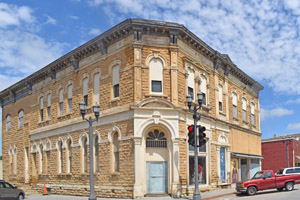
Beloit, Kansas business building by Kathy Alexander.
Nearby Waconda Lake and Glen Elder State Park offer additional sporting and recreational activities.
©Kathy Alexander/Legends of Kansas, updated July 2026.
Also See:
Kansas Industrial School for Girls
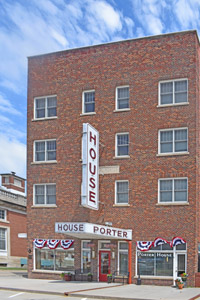
The Porter House in Beloit, Kansas by Kathy Alexander.
Sources:
Blackmar, Frank W.; Kansas: A Cyclopedia of State History, Vol I; Standard Publishing Company, Chicago, IL 1912.
Cutler, William G.; History of Kansas; A.T. Andreas, Chicago, IL, 1883.
Beloit, Kansas
Kansas Historical Society
Mitchell County, Kansas
St. John’s Church
Wikipedia