

Chanute, Kansas Business District by Kathy Alexander.
Chanute, Kansas, on the Neosho River in Tioga Township, in northwest Neosho County, was founded on January 1, 1873, and named after railroad engineer and aviation pioneer Octave Chanute. As of the 2020 census, its population was 8,722.
Settlers had begun populating the area as early as 1856. Located in the Neosho Valley, renowned for its fertility and beauty, it was approximately one-half mile from the river.
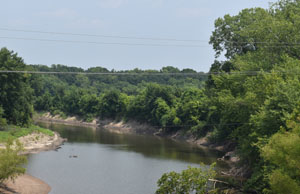
Neosho River in Neosho County, Kansas by Kathy Alexander.
The land upon which Chanute was located was entered under the Joint Resolution of Congress of April 10, 1869, by G.R. Malcom.
In 1870, when the Leavenworth, Lawrence & Galveston Railroad crossed the Missouri, Kansas & Texas Railway line within the limits of Neosho County. On April 28, 1870, G.R. Malcom received a patent for the property comprising 160 acres. After the land was patented to Malcom, it was sold, in tracts, to T.C. Jones, S.W. Foster, J.A. Wells, J.D. Carpenter, W. Fisher, J. McCullough, C.H. Pratt, and others for a townsite. New Chicago was laid out in May, and the plat was filed on June 11, 1870. The New Chicago post office opened on July 1, 1870, with Mr. Moore as post master.
At about the same time, the town of Alliance was laid out by John Cooper, adjacent to New Chicago on the west, and Chicago Junction, adjacent to New Chicago on the north, was established by K.P. Stone. In these places, a slight improvement was made. Wendell & Holmes built a hotel in Chicago Junction, which they later relocated to New Chicago. In Tioga, however, New Chicago found her most potent rival. The site of Tioga covered 80 acres. These two opposing towns adjoined one another, on either side of the Leavenworth, Lawrence & Galveston Railroad.
The first meeting of the Board of Trustees for New Chicago was held on April 5, 1870, and T.C. Jones was made chairman. New Chicago was organized as a village in early summer 1870.
For a time, these settlements made very slow progress. Although the trains were running, there was no station at this location. Consequently, goods and supplies had to be brought from Humboldt by team, a distance of ten miles. The railroad company was persuaded to install a switch and designate this as a station. They did so at the Junction in the latter part of June 1870, and in September of that year, they erected a depot building. This materially enhanced the town’s progress. It was organized as a village under a board of trustees, who held their first meeting on July 5, 1870, and T.C. Jones was chosen chairman.
The New Chicago Transcript was established on September 23, 1870, by George C. Crowther.
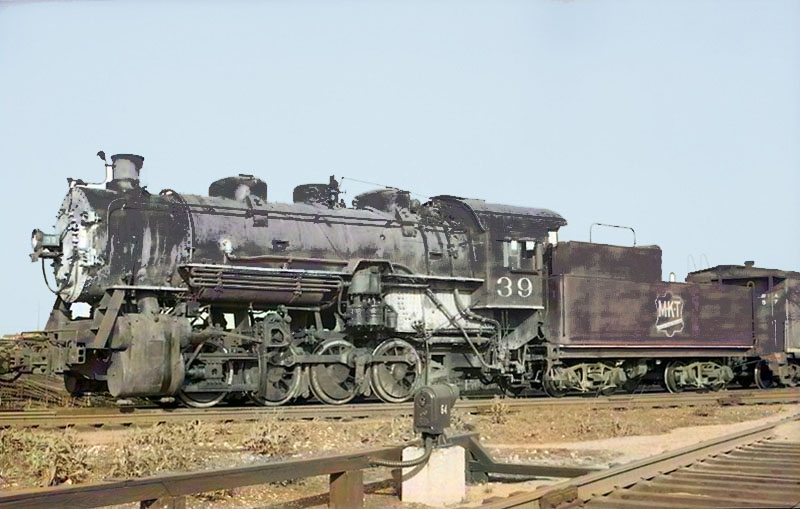
Missouri, Kansas & Texas Railway.
The Neosho division of the Missouri, Kansas & Texas Railway was built in December 1870. This road crossed the Kansas City, Lawrence & Southern Kansas Railroad at a point a short distance north of New Chicago, passing on the east side of the town. The Leavenworth, Lawrence & Galveston Railroad favored the town of Tioga, while the Missouri, Kansas & Texas Railway Company assisted New Chicago. The growth of both New Chicago and Tioga was extremely rapid.
The first school was held in New Chicago in the winter of 1870, in a rented, converted building.
However, the rapid growth in the school population soon necessitated additional school facilities. In early 1871, steps were taken toward the erection of a school building. For this purpose, an act of the Legislature was secured, authorizing District #2 to issue its bonds, provided that a majority of the district’s legal voters expressed approval at an election held for this purpose. When the election favored the issuance of the bonds, a committee of three men was appointed to select and purchase land for the building. This committee was comprised of M.T. Jones, T.F. Morgan, and G.C. Crowther.
In New Chicago, a questionable practice emerged: individuals empowered by the Legislature sought to advance New Chicago’s interests while undermining Tioga by selecting a location for a new building that was least convenient for Tioga. When the residents of Tioga became aware of this maneuver and its potential consequences, they objected to the issuance of bonds, arguing that the act authorizing them was unconstitutional.
Almost immediately, they sought an injunction to enjoin the bond issuance; however, before the officer could serve the writ, the bonds had already been issued and delivered to D.G. Himrod. To avoid the writ’s service, Himrod discreetly left town with the bonds, selling them to unsuspecting buyers, thus placing them beyond the reach of the restraining order.
The case was heard in the District Court, which referred it to the Supreme Court, where it was ultimately decided that the bonds were valid.
The school building was erected in 1871. It was a handsome, two-story brick structure containing four large school rooms, built for $15,000.
On March 17, 1871, New Chicago was incorporated as a third-class city, and on April 3, 1871, C.A. Dunakin was elected mayor.
The Tioga Herald was begun in May 1871 by S.D. Rich, who managed the paper in the interests of the Tioga Town Company, to whom it belonged. After a brief tenure, Rich was succeeded in the editorial chair by Mr. Haines.
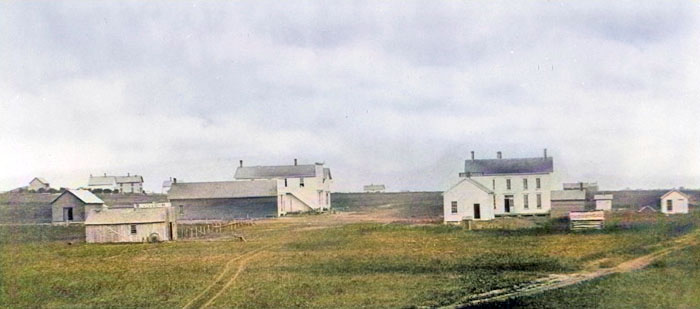
Tioga, Kansas.
The Methodist Episcopal Church was established on June 28, 1871, by Reverend G.W. Pye. The first services were held in Larkin’s Hall. A one-story frame church building was erected that year, measuring 40 by 60 feet, and was dedicated on December 30, 1871. A Sunday school was organized soon after the congregation was formed, and M.S. Furnham was chosen superintendent. The present membership of the Sunday school is about 175. It had a small library.
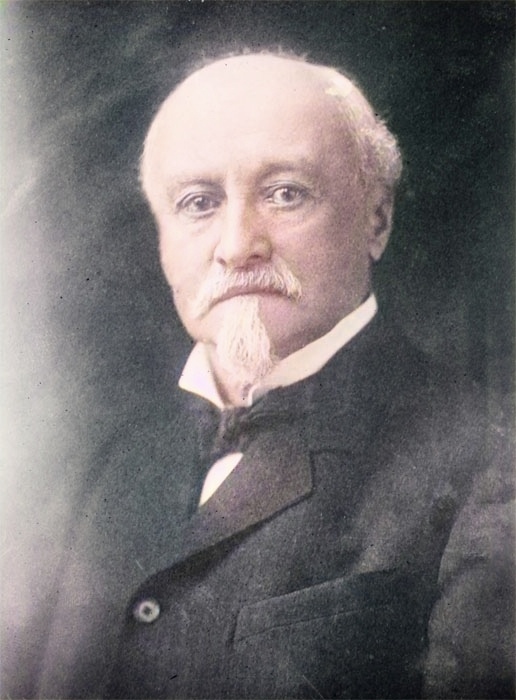
Octave Chanute.
On April 30, 1872, the New Chicago Transcript was moved to Osage Mission (St. Paul). In October 1872, the Tioga Herald was suspended.
A.L. Rivers established the New Chicago Times on October 19, 1872. With the change of the town’s name, the paper’s name was also changed, and on January 11, 1873, it appeared as the Chanute Times. When it first started, it was a seven-column folio, and on April 15, 1880, it was enlarged to an eight-column folio. It is a Republican publication with a circulation of 650 copies.
The early residents of the towns of Tioga, Chicago Junction, Alliance, and New Chicago sought an innovative solution to an escalating dispute over which town would host the Leavenworth, Lawrence & Galveston Railroad’s new land office. The towns were unable to resolve their differences until Octave Chanute arrived. Octave was the Chief Engineer and General Superintendent of the Leavenworth, Lawrence & Galveston Railroad. In 1872, he proposed that the towns merge to end the disputes. On January 1, 1873, the towns merged and became Chanute. At that time, the town was incorporated as a third-class city with a population of 800. After the consolidation of the towns, all the business houses established in Tioga were relocated to Chanute. The post office’s name changed from New Chicago to Chanute on April 29, 1873, with Mr. T. Jones as postmaster.
The Chanute Flouring Mills were built on July 22, 1873, by J.B. Beatty. They afterward fell into the hands of A. Aikens & Son, who continued to operate them briefly.
The “hard times” of 1873 and 1874 slowed the town’s growth, and for several years its population decreased.
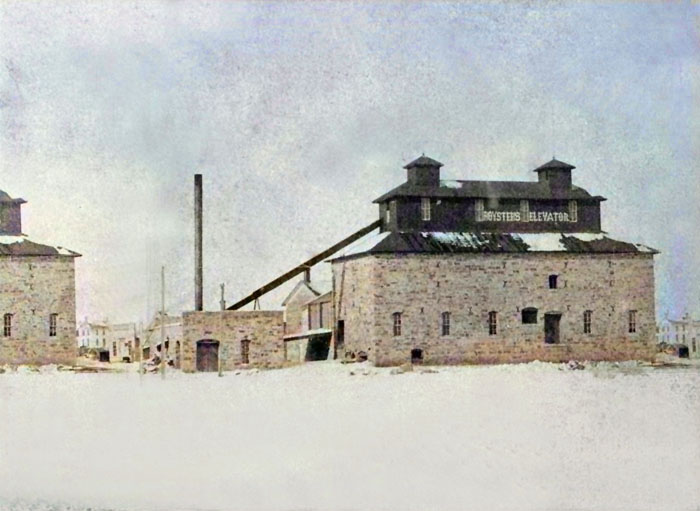
Royster’s Elevator and Mill, in about 1880.
In 1878, however, it began to improve and experienced continuous, substantial growth. The city now has a population of 1,500 and has many large and handsome buildings. The principal of these are the Public School building, the Presbyterian and Methodist churches, Bailey & Co.’s Bank block, the Kramer & Payne block, Hysinger & Rosenthal’s block, C.T. Ewing’s block, including the Lindell Hotel, a large two-story store; and the Chanute Banking House, a two-story brick; Jeffrie’s block, the Cross block, Winfield & Allen’s block, Royster’s Stone Elevator, the Chanute Mills, a three-story stone structure, and the handsome brick residence of M. Bailey, of the banking firm of Bailey & Co.
The Chanute Democrat was established in February 1879 by Bowen & Hite. After running the paper for about four months, Hite sold out to Bowen.
After several ownership changes, the Chanute Flouring Mills were purchased by Harter & Stump in 1879. The mill building was a massive stone structure, 40 by 50 feet in dimensions and four stories high, including the basement. There were four runs of stone, each capable of grinding 100 barrels of flour and 16,000 pounds of meal per day. The power was a 110-horsepower engine. The engine house was a one-story building, 36 feet long by 28 feet wide, constructed of stone. The mill’s machinery was in fine working condition, and its operation sustained an active and prosperous business.
The City Mills and Elevator were started in 1879 by Williams & Alcock. After running for about two years, Williams sold out his interest in the concern to his partner, W.B. Alcock & Sons. It contains three runs of stone, two for wheat and one for corn, from which fifty barrels of flour and 100 barrels of corn meal per day may be turned out. The mill building was a 30-by-40-foot frame structure, three stories and a half high, including the basement. A corn sheller was installed during the mill’s construction and had a shelling capacity of 2,000 bushels per day. The power is a 40-horsepower engine. An additional buhr and a purifier were installed in the mill machinery. A lively and profitable business is sustained in connection with the establishment’s operation, a great demand being made upon the goods manufactured, for which a market is found mainly in Kansas and Texas.
In 1879, the Atchison, Topeka & Santa Fe Railroad acquired control of the Leavenworth, Lawrence, & Galveston Railroad Company and renamed it the Kansas City, Lawrence & Southern Kansas Railroad. This subsidiary company was soon renamed the Southern Kansas Railway Company, which by 1900 had become known as the Atchison, Topeka and Santa Fe Railway Company, Southern Kansas Division.
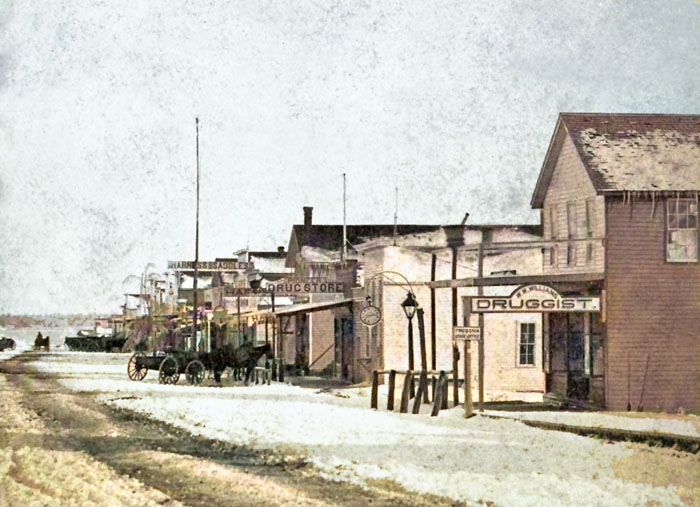
Chanute, Kansas, Street Scene in about 1885.
By 1882, the school’s enrollment was 274, comprising five departments: the high school, grammar school, intermediate, second intermediate, and primary. These were under the supervision of a corps of five efficient teachers.
In May 1882, J.R. Detwiler purchased the Chanute Democrat, which was renamed the Chanute Chronicle. At the time of purchase, the circulation was 432 copies, which quickly grew to 840. The sheet was an eight-column folio, Republican in politics.
The Christian Church was organized on August 8, 1882, by Reverend Kirk Baxter, with 13 members. The organization took place in the Presbyterian Church, where meetings were held. T.T. Harding was appointed as an elder to oversee church affairs.
At that time, Chanute had four drug stores, seven dry goods stores, eight groceries, three lumber yards, four grain elevators, two bands, five hotels, four restaurants, two harness shops, four hardware stores, two jewelry stores, three millinery stores, three meat markets, a blacksmith, wagon, and carpenter shops. The city was surrounded by fertile farmland, which, with the addition of two lines of railroad and its removal to considerable distances from other vital towns, afforded it the advantage of extensive country trade, promising increased size and prosperity.
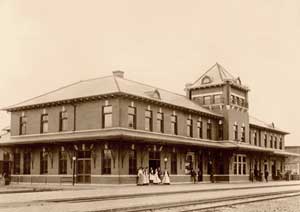
Atchison, Topeka & Santa Fe Railroad Depot and Harvey House Restaurant.
In 1883, the Atchison, Topeka & Santa Fe Railroad extended its line from Chanute to Pittsburg, thus connecting the town with cheap fuel. Afterward, the business and population grew. The discovery of oil and gas experienced a particular boom.
In 1886, the Atchison, Topeka & Santa Fe Railroad relocated the division headquarters of the Southern Kansas Railway Company from Ottawa to Chanute. On November 4 of that year, a company representative met with city officials and announced the company’s intention to build a roundhouse in Chanute capable of handling 18 locomotives, machine shops, a switching yard with 16 lines, and other improvements, contingent on certain concessions. The railroad company sought to purchase 60 acres of land along its line south of Main Street and to close all streets and alleys crossing that land. They also requested $1,500 for the removal of the stone-and-wood structure that housed W.W. Royster’s grain elevator and permission to construct a depot on the site. Chanute quickly granted the concession requests and thus began its “railroad town” era, which lasted into the 1960s.
During the late 1880s, the Atchison, Topeka & Santa Fe Railroad established a subsidiary, which significantly affected the development pattern and growth of Chanute.
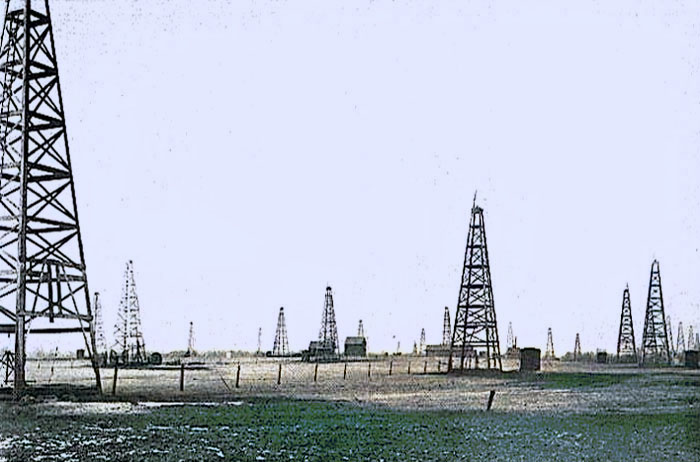
Oil derricks near Chanute, Kansas.
In 1897, the Standard Oil Company built a pipeline from Benedict, 17 miles away, at a cost of $37,000; the city of Chanute later purchased it for $65,000. From this line, the city derived considerable revenue.
The availability of railroad service and the discovery of natural gas and oil in the area led to an economic boom at the turn of the century, resulting in numerous industries and businesses locating in Chanute. This increase in trade directly influenced the Atchison, Topeka & Santa Fe Railroad’s decision to build a new depot. The contractor was F.S. Williams, supervised by W.R. Carter of Lawrence, Kansas, for the construction. Construction of the Richardsonian-Romanesque style depot began in August 1902 and was completed by August 1903. This depot not only served as the division headquarters, but also because Chanute is midway between Tulsa, Oklahoma, and Missouri, where passenger trains stopped.

Chanute, Kansas Electric Plant.
The building included a passenger depot, a Harvey House restaurant, a Wells Fargo Express office, and a reading room and served ten passenger trains daily. The first passenger trains stopped on September 21, 1903.
In 1903, the City of Chanute established the electric utility and, in subsequent years, the gas, water, wastewater, and refuse utilities. Ash Grove Cement Company, the sixth-largest cement manufacturer in North America, commenced cement production in 1908 in Chanute. In September 2011, Spirit AeroSystems announced the expansion of an assembly facility, which will grow to 150 employees in five years and boost the local economy.
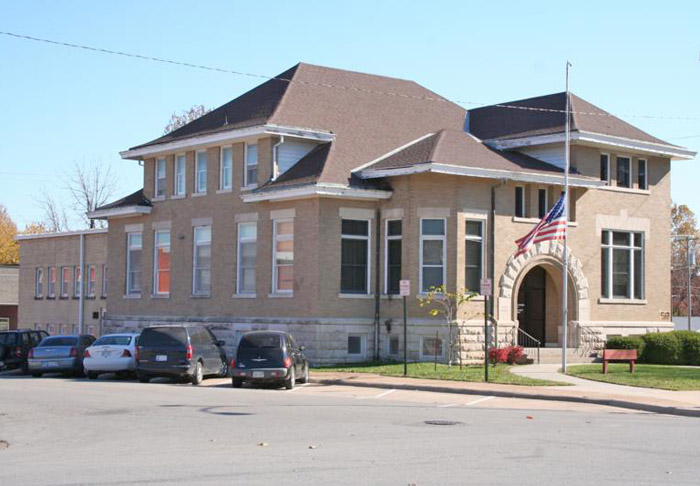
Old Carnegie Library in Chanute, Kansas, by the Kansas Historic Resources Inventory.
Chanute Public (Carnegie) Library, at 102 S Lincoln Avenue, was built in 1905. The two-and-a-half-story, brick Prairie-style appearing building stands on a corner lot one block south of Chanute’s central business district. It was designed by A. T. Simmons and built by C.H. Mills. The building measures approximately 50 feet in width from north to south and 80 feet in width from east to west. The two-story, yellow brick building sits on a rusticated limestone block raised foundation. The rectangular structure with a two-story, yellow brick addition built in about 1938, projects from its rear. A wide, Romanesque-arched doorway with rusticated voussoirs stands at the center of the facade. The imposts bear the inscriptions “Public Library” and “Carnegie 1905”. The interior of the library retains its relatively open original first- and second-floor plans. Today, the building is utilized by the City of Chanute as its municipal judicial center. It was listed on the Register of Historic Kansas Places in February 1987.
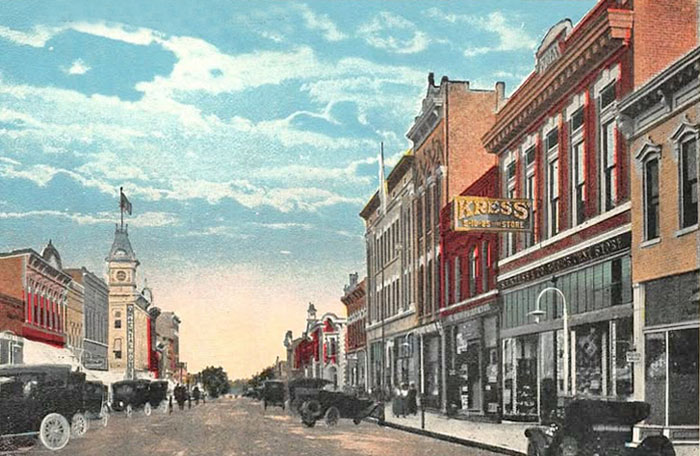
East Main Street in Chanute, Kansas.
In 1910, Chanute was the largest town in Neosho County and one of the most important in southeastern Kansas. It was located at the junction of the Atchison, Topeka & Santa Fe and the Missouri, Kansas & Texas Railroads and served as a gas, oil, and manufacturing center, with the largest oil and gas wells in the state in the immediate vicinity. Some of the industries were car repair shops, of which the monthly payroll exceeded $40,000, brick and tile works, cement plants, zinc smelters, glass factories, flour mills, an oil refinery, planing mill, gas engine works, boiler works, egg case factory, machine shops, broom factories, torpedo manufactory, an ice plant, drilling tool factory and lime plant. Chanute also had an electric light plant, city waterworks, good fire and police departments, an opera house, four banks, four newspapers, fine church buildings, and excellent schools. Several oil and gas companies are headquartered there. It also had express and telegraph offices, an international money order post office, with six rural routes, and a population of 9,272.
The Missouri, Kansas & Texas Railroad Depot was established in 1911.
In 1917, the Atchison, Topeka & Santa Fe Railroad depot doubled in size, adding a large dining room to the Harvey House Restaurant to accommodate the increasing number of passengers traveling by train.
The 1920s brought significant changes to Chanute. Memorial Hall, a large civic structure housing governmental offices and a 2,000-seat auditorium, was constructed.
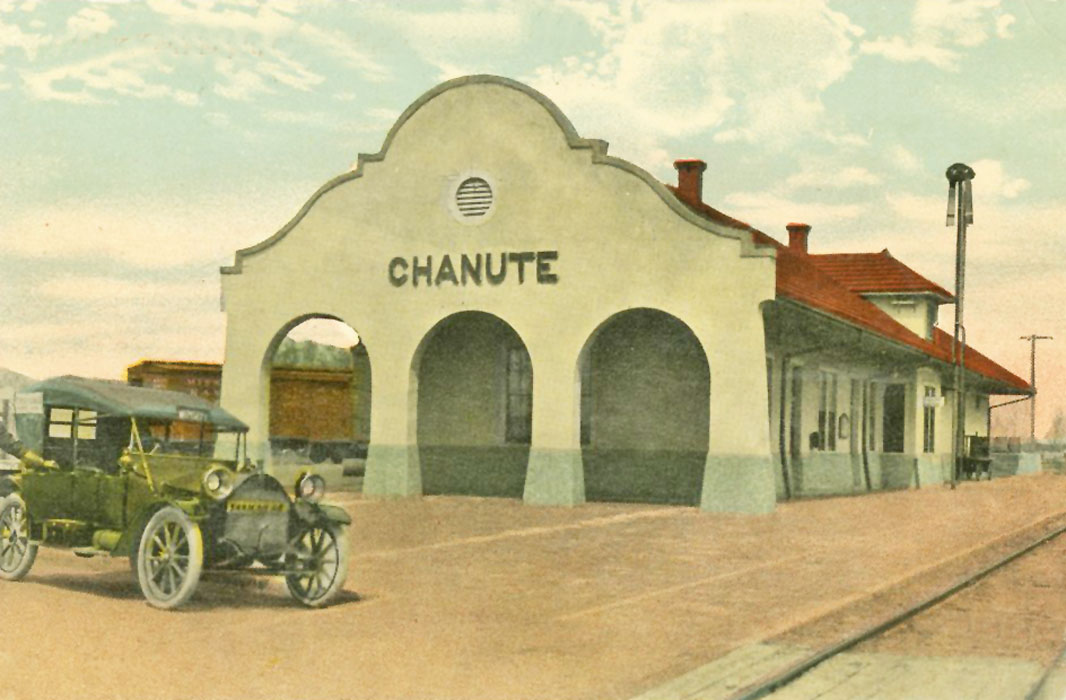
Missouri, Kansas & Texas Railroad Depot in Chanute, Kansas.
In 1928, three Chanute citizens, brothers Milo T. and Hugh T. Jones and their cousin Neil S. Jones (all sons of two town founders), developed a new and promising proposal for a hotel. This proposal called for a total investment of $218,000, with $183,000 from principal investors and the remaining $35,000 to be raised by Chanute citizens. A major fundraising campaign was launched, with substantial local press support that promoted the virtues of such a hotel and emphasized that other towns had adopted a similar approach and achieved success. The citizens responded, and by March 1928, the necessary funds had been raised; after the existing one-story brick buildings were removed, construction of the new hotel was ready to begin.
The Tioga Inn at 12 E. Main Street was designed and built by John W. Pratt, a Chanute, a civil engineer and contractor, in 1929. John Sweet, president of Sweet Hotels, Inc., a chain of hotels in Missouri and Kansas, was contracted to operate the hotel upon its completion. Known and respected for his efficient management and natural hospitality, he played an essential role in the overall quality and atmosphere of Chanute’s hotel, including the selection and procurement of furniture and equipment. Sweet ultimately chose the name “Tioga Inn,” one of the suggestions from several participants in an earlier public contest to name the hotel, sponsored by the Chanute Tribune. The word “Tioga” was significant within the community and an appropriate name for an essential new hotel. In Iroquois, the word means “at the forks” or “open way.” More significant is that “Tioga” was the name of one of four original platted villages, which eventually merged to form the city of Chanute.
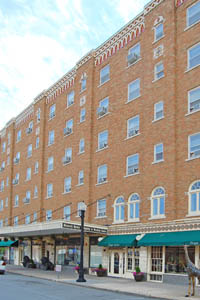
Tioga Inn in Chanute, Kansas by Kathy Alexander.
Located in the middle of downtown, the Tioga Inn officially opened on September 19, 1929, attracting considerable attention and stimulating local commerce. Its location near the railroad depot encouraged visitors to stay in Chanute, benefiting both the hotel and the community. The hotel offered exterior-facing guest rooms equipped with transoms and air vents, as well as lavatories. Two-thirds of the rooms included a bathtub or shower. The sixth floor housed eight private suites, each with a living room, bedroom, hallway, and bath. Guests dined in an elegant room adjacent to the lobby.
Retail and service facilities, accessible from the street or an interior arcade, included a drugstore, barbershop, beauty shop, jewelry store, tailor shop, and a cigar, book, and newsstand. A large second-floor room was available for banquets and social functions, complete with retiring rooms.
The six-story, L-shaped, 100-room hotel that dominates the Chanute skyline was listed on the National Register of Historic Places in February 1990. Over the years, it has also been known as The Tioga Hotel, The Tioga, and The Jones’ Building. Today, it is known as the Tioga Extended Stay Hotel, where guests find comfort in its thoughtful amenities, from barbecue grills with outdoor furniture to the cozy lobby fireplace.
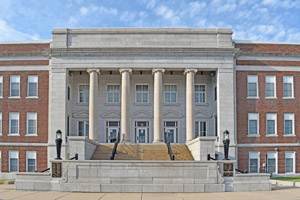
Chanute, Kansas City Hall by Kathy Alexander.
In 1929, an airport was built to attract new factories to the area, and central utility systems were expanded and improved.
Chanute’s population peaked at 10,849 in 1960.
On April 30, 1971, a passenger train stopped at the depot for what may have been the last time.
The Missouri, Kansas & Texas Railroad Depot was destroyed by fire in 1974.
The depot was vacated in mid-December 1983 and is presently owned by the City of Chanute. This structure, one of the most substantial depots in eastern Kansas and now one of the last remaining, is a physical link to an era when railroad passenger and freight services were essential to a community’s life and well-being.
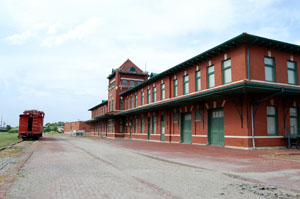
Old depot in Chanute, Kansas by Kathy Alexander.
In 1987, the Chanute Depot was placed on the Kansas Register of Historic Places. After soliciting private donations in 1991, the Depot was restored and now houses the Martin and Osa Johnson Safari Museum at the south end and the Chanute Public Library at the north. The area adjacent to the depot has been developed into a plaza area featuring a gazebo, hiking/biking path, and a small collection of rail stock. It is located at 111 N. Lincoln Avenue.
Today, Chanute is the home of Neosho County Community College. It is also home to two private schools: Saint Patrick Catholic School provides schooling for students from pre-school (ages three to four) through the sixth grade, and the Chanute Christian Academy provides schooling for students from kindergarten through the twelfth grade.
Visitors to Chanute often enjoy the attractions such as the Martin and Osa Johnson Safari Museum and the Chanute Art Gallery. The town’s historical significance is evident in places such as the Downtown & Historic Homes, the Chanute Historical Museum, and the Historic Santa Fe Depot.
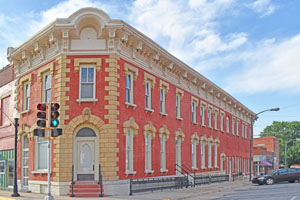
A business building in Chanute, Kansas, by Kathy Alexander.
Chanute is 14 miles northwest of Erie, the county seat, and ten miles south of Humboldt.
©Kathy Alexander/Legends of Kansas, updated December 2025.
Also See:
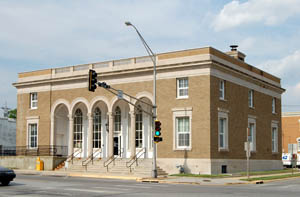
Post Office in Chanute, Kansas by Kathy Alexander.
Sources:
Blackmar, Frank W.; Kansas: A Cyclopedia of State History, Vol I; Standard Publishing Company, Chicago, IL 1912.
Cutler, William G.; History of Kansas; A. T. Andreas, Chicago, IL, 1883.
Kansas Register of Historic Places – ATSF Depot
National Register of Historic Places – Tioga Inn
Wikipedia